Little Women - Sisterhood, Work, and Growing Up Without Losing Yourself
A detailed guide to Alcott's domestic classic about the March sisters, moral ambition, creative work, grief, love, and the cost of becoming a woman.
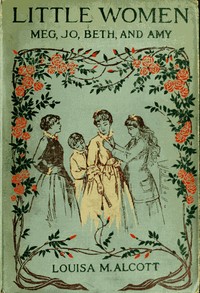
Sua's Quick Take
Little Women looks gentle from a distance, but up close it is one of the sharpest novels about ordinary pressure: money, temper, ambition, duty, illness, art, marriage, and the fear that becoming "good" might mean becoming smaller.
What makes the book last is not that the March sisters are perfect. They are not. Jo is angry, Amy is vain, Meg wants comfort, Beth is almost too self-effacing, and Marmee has to teach self-command because she is still practicing it herself. Alcott's domestic world matters because its small rooms keep producing large moral tests.
What the Book Is Really About
Louisa May Alcott's Little Women; Or, Meg, Jo, Beth, and Amy follows the four March sisters in Civil War-era Massachusetts as they move from girlhood into adult life. Their father is away serving as a Union chaplain, the family has lost much of its former comfort, and their mother, Marmee, raises them through work, faith, humor, and practical love.
The plot is domestic, but the stakes are not small. Each sister has a private hunger. Meg wants beauty, ease, and social respect. Jo wants freedom, writing, and a life large enough for her energy. Beth wants home, music, and peace. Amy wants refinement, art, and a place in the wider world. The novel asks how those desires can grow without becoming selfish, and how moral education can shape a life without crushing individuality.
Alcott builds the book around a central tension: the March girls are urged to become "little women," but the novel is constantly testing what that phrase means. Does womanhood mean obedience, sacrifice, self-erasure, creative discipline, economic usefulness, emotional maturity, or all of these at once? The answer keeps changing because each sister grows differently.
Plot Summary
1. Christmas, poverty, and the first moral test
The novel opens with complaint. Christmas feels wrong because there will be no presents. That first line matters because Alcott begins not with saintly girls but with ordinary disappointment. The March family is poor compared with its former life, Mr. March is away in the Civil War, and the girls are old enough to know that sacrifice is noble but young enough to resent it.
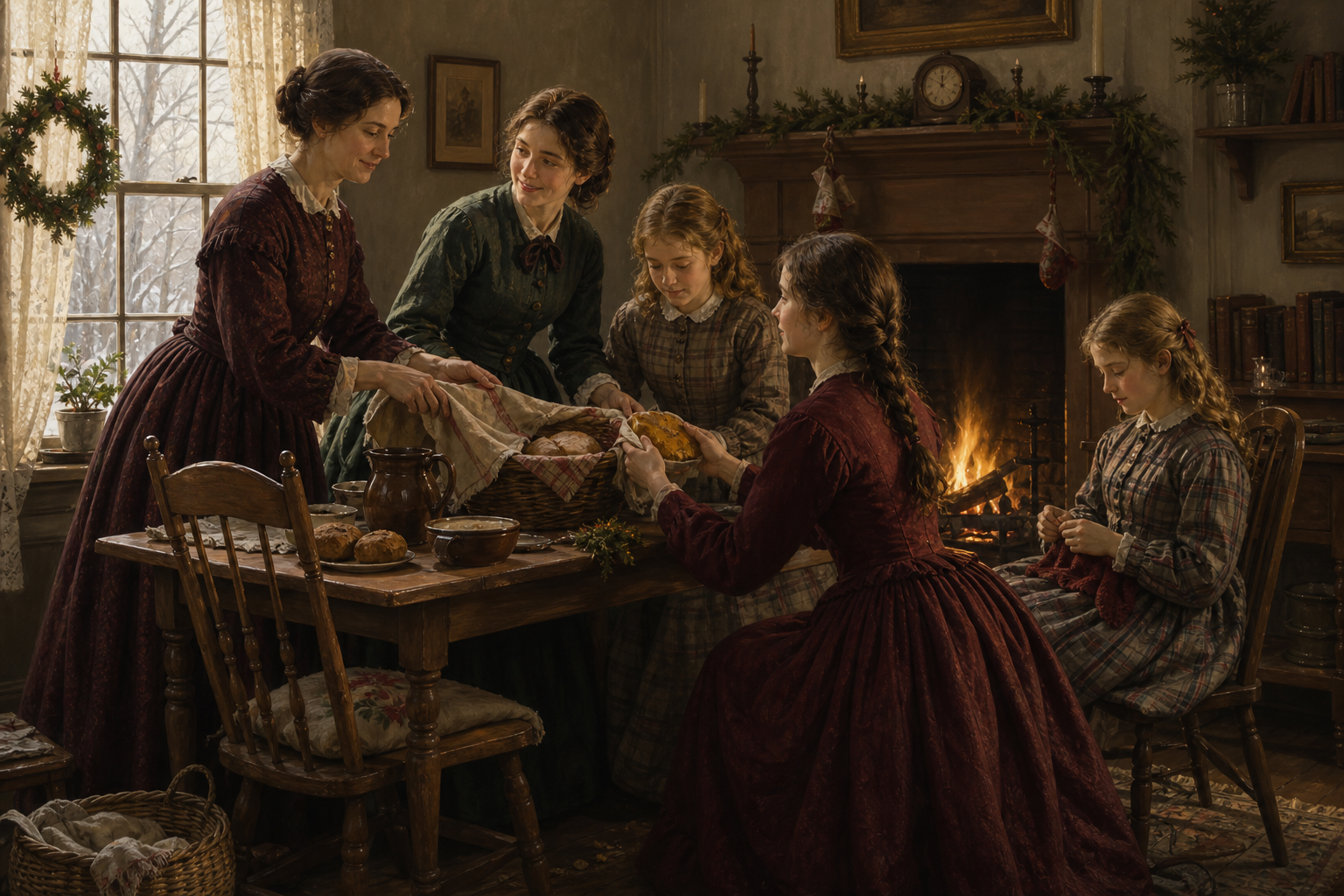
Marmee's rule for the holiday is simple: the family should not spend money on pleasure while soldiers and poor neighbors are suffering. The sisters grumble, but the chapter turns their disappointment into a test of imagination. They buy gifts for Marmee instead of themselves. Then, after waking to a modest Christmas breakfast, they give that breakfast away to the Hummel family, whose need is greater than their own.
This opening establishes the book's moral pattern. Alcott is not interested in goodness as a slogan. Goodness must interrupt appetite. The girls are not rewarded because they never wanted anything; they are rewarded because they wanted things and learned to choose something better. Their neighbor Mr. Laurence later sends a feast in response to their generosity, but the point is not that charity magically pays back. The point is that the March home teaches the sisters to see beyond the self.
The chapter also introduces The Pilgrim's Progress as the family's controlling metaphor. The girls imagine their lives as a pilgrimage in which each must carry a burden: Meg's vanity, Jo's temper, Beth's shyness, Amy's selfishness, and the family's collective worry about their father. The metaphor can feel old-fashioned, but it gives the novel a strong structure. Growing up is not one grand adventure. It is a series of ordinary burdens carried a little farther each day.
2. The sisters' daily burdens become character tests
After Christmas, Alcott turns to the sisters' routines. Meg works as a governess, Jo serves irritable Aunt March, Beth keeps house and practices music, and Amy goes to school. These duties are not background chores. They are the places where each girl meets her weakness.
Meg's labor among wealthier children sharpens her longing for pretty clothes and ease. She is not greedy in a melodramatic way; she simply feels the sting of comparison. Jo's job with Aunt March exposes her temper and impatience. Jo's energy wants action, books, boys' games, and adventure, but her circumstances put her in rooms where she must restrain herself. Beth's domestic labor reveals her gentleness, but it also shows how easily quiet service can become invisible. Amy's school life brings out her vanity and sensitivity to class judgment.
Laurie Laurence enters this world as both contrast and companion. He is wealthy, lonely, and restless. Jo first sees him as a boy trapped in a grand house, while he sees the March home as noisy, warm, and alive. Their friendship is one of the novel's great early pleasures because it gives Jo a peer who matches her speed. Laurie can climb, laugh, scheme, and read with her; he also introduces the March sisters to a wider social world.
The Laurence household expands the novel's moral geography. Mr. Laurence looks severe, but Beth's music opens him. Jo's bluntness brings Laurie into family life. The March sisters do not merely receive charity from richer neighbors; they humanize a lonely house. Alcott's best social vision is reciprocal: poverty needs help, wealth needs warmth, and both households become better through contact.
The chapters about work also resist a simple moral. The girls must learn patience, but the novel knows that some work is dull, unfair, and exhausting. Jo's frustration is real. Meg's longing is real. Amy's shame is real. Marmee's teaching matters because she does not deny those feelings. She teaches the girls to govern them.
3. Plays, parties, clubs, and the education of imagination
The March sisters do not grow only through moral lessons. They grow through play. They stage melodramas, publish the Pickwick Portfolio, form secret societies, write, act, draw, sew, read, and make a small world vivid through imagination. These scenes keep the novel from becoming a sermon. The girls' creativity is not decoration; it is how they test possible selves.
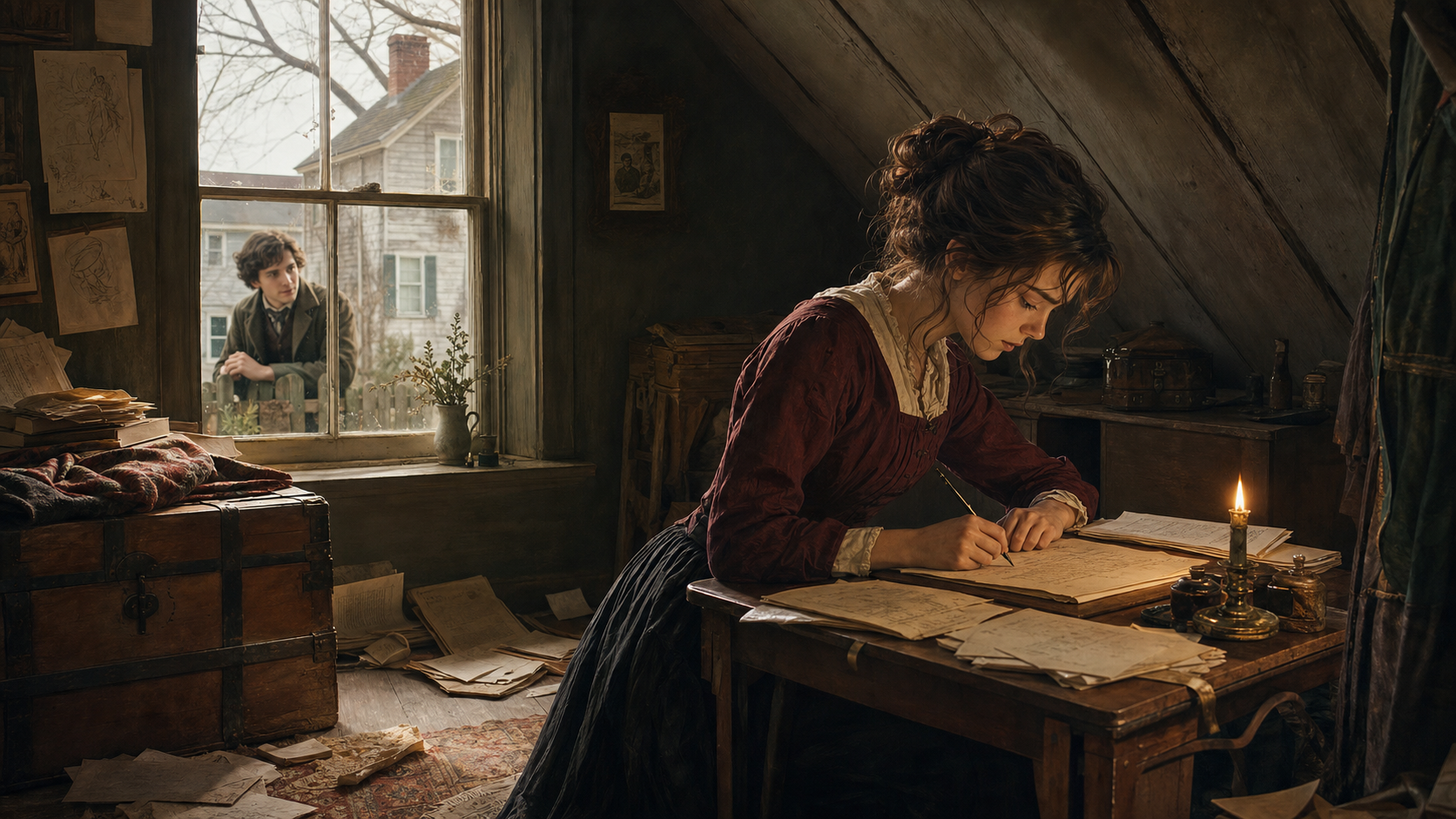
Jo is the center of this creative energy. She writes sensational plays and stories, invents roles, and wants language strong enough to hold her feelings. Her imagination is unruly, funny, ambitious, and sometimes careless. When Amy burns Jo's manuscript in revenge for being excluded, the loss is devastating because the book understands writing as part of Jo's identity. Jo's anger afterward leads to one of the novel's harshest early crises: she nearly lets Amy drown while skating because she is too angry to warn her.
That incident matters because Alcott refuses to romanticize Jo's temper. Jo's rage is connected to her vitality, but it is also dangerous. Marmee's response is crucial. She tells Jo that she, too, has struggled with anger for years. This confession changes the moral scale of the novel. Marmee is not an effortless angel; she is a woman who has learned discipline slowly. Jo is not asked to become less alive. She is asked to become responsible for the force of her own emotions.
Meg's visit to Annie Moffat's world provides another education. Dressed up and admired, Meg experiences the seduction of vanity and social performance. She is not ruined by it, but she sees how easily admiration can make a person act unlike herself. Alcott's critique of society is gentle but clear: wealth can create a stage on which girls are encouraged to become ornamental, competitive, and dependent on being seen.
Amy's humiliations work differently. She is vain, but she is also a child trying to master the codes that the world rewards. Her mistakes with limes, grammar, and social aspiration are comic, yet Alcott uses them to show how refinement can become both discipline and performance. Amy wants beauty, but the novel slowly pushes her toward responsibility for the kind of beauty she creates.
4. Letters, illness, and the family's first deep darkness
The plot darkens when Mr. March becomes seriously ill in Washington. Marmee leaves to nurse him, and the daughters must keep the household going. Jo sells her hair to help fund the trip, an act that reveals both sacrifice and pain. She tries to make light of it, but the loss hurts because her hair is one of the few beauties she owns. Alcott lets the sacrifice be noble without pretending it costs nothing.
While Marmee is away, Beth continues visiting the Hummel family and catches scarlet fever. Her illness changes the emotional center of the novel. Beth has often been the quietest sister, but in danger she becomes the measure of the family's love. Jo's devotion to Beth is fierce, physical, and sleepless. The sister who longs for adventure now faces the most intimate form of courage: staying beside a sickbed.
Amy is sent away to Aunt March's house for safety. At first the move seems like another social lesson, but it becomes an encounter with mortality. Amy writes a will, thinks about death, and begins to understand that refinement without goodness is hollow. This is one of the moments where Alcott's moral structure works through character rather than lecture. Amy's growth begins not when she stops loving beauty, but when she connects beauty to generosity and remembrance.
Beth survives the fever, but she is permanently weakened. Mr. March returns, and the family reunion is joyful, yet the book has changed. The early chapters treated burdens as habits to improve. Now burden includes bodily fragility, fear, and the knowledge that goodness does not exempt anyone from suffering.
The first half ends with Meg and John Brooke's engagement. Aunt March disapproves because John is poor, but Meg chooses affection over status. Jo resists the engagement because it changes the sisterhood. Her reaction is not simple selfishness; it is grief for the passing of childhood. The March home will not remain one protected circle forever.
5. Marriage, art, and the uneven shape of adulthood
The second part of Little Women, sometimes published as Good Wives, moves the sisters into young adulthood. Meg marries John Brooke and learns that domestic happiness requires more than romance. Money is tight, pride causes quarrels, twins arrive, and Meg discovers that marriage includes labor, compromise, and the discipline of not turning small irritations into permanent grievances.
These chapters are sometimes treated as conventional, but they are more practical than sentimental. Alcott shows Meg learning to manage a household without making domesticity look effortless. Meg's growth is not that she stops wanting pretty things. It is that she learns to place comfort, love, and vanity in a better order. Her marriage is not glamorous, but it is real because both partners must change.
Jo, meanwhile, tries to become a professional writer. She publishes sensational stories for money, and the experience is morally complicated. On one hand, Alcott respects paid labor. Jo wants economic independence and literary recognition, and the novel does not mock that desire. On the other hand, Professor Bhaer later challenges her to ask whether she is feeding readers' worst appetites. The question is not whether women should write. It is what kind of truth Jo will choose to write.
Jo's time in New York is one of the novel's most important departures. Away from home, she sees herself differently. She teaches, writes, observes, and meets Professor Bhaer, whose kindness and intellectual seriousness contrast with the flashy literary market around her. Their relationship grows through conversation, criticism, music, and mutual respect rather than instant romance.
Amy's adulthood unfolds abroad. She travels with Aunt Carrol, studies art, and enters European society. The trip could have made her more vain; instead, it clarifies her limits. She realizes that she may not be a great artist, but that she can still cultivate taste, judgment, and usefulness. Her refusal of Fred Vaughn is a turning point because she gives up the easy social triumph of a rich marriage that lacks love.
6. Jo and Laurie, Amy and Laurie, and the refusal of the expected plot
Laurie's proposal to Jo is one of the novel's most debated scenes because many readers expect them to marry. Alcott refuses that expectation. Jo loves Laurie deeply, but not in the way he wants. She knows that their similarity would not necessarily make a stable marriage. They are both intense, restless, and proud; as husband and wife, they might wound each other.
Jo's refusal is painful because Laurie is not a villain. He is generous, wounded, and sincere. But the scene is important for Alcott's larger argument: affection alone is not destiny, and a woman must be allowed to know the difference between love as kinship and love as marriage. Jo's "no" is one of the book's strongest acts of self-knowledge.
Laurie leaves in despair and meets Amy abroad after Beth's death. Their relationship develops out of rebuke, recognition, and shared grief. Amy sees that Laurie is wasting himself in romantic disappointment and challenges him to become worthy of his gifts. Laurie sees Amy's tenderness and strength more clearly than he did when she was younger. Their marriage can feel surprising only if Amy has been reduced to vanity. Read carefully, and the match rewards her growth: she has learned discipline, and Laurie needs precisely that steadiness.
This plot turn also shows Alcott's refusal to make Jo the prize at the center of every romance. Jo is the novel's most magnetic character, but she is not required to marry the boy who loves her first. Amy is not punished for wanting beauty and social polish; she matures into a woman capable of choosing love and usefulness over display. Laurie is not rewarded for persistence with Jo; he must redirect his life.
The emotional cost is still real. Jo becomes lonely. The old family circle has changed: Meg has her household, Amy is abroad, Laurie is gone, and Beth is fading. Jo's independence, once exhilarating, now meets the harder question of how to build an adult life that is free but not empty.
7. Beth's decline and Jo's education in grief
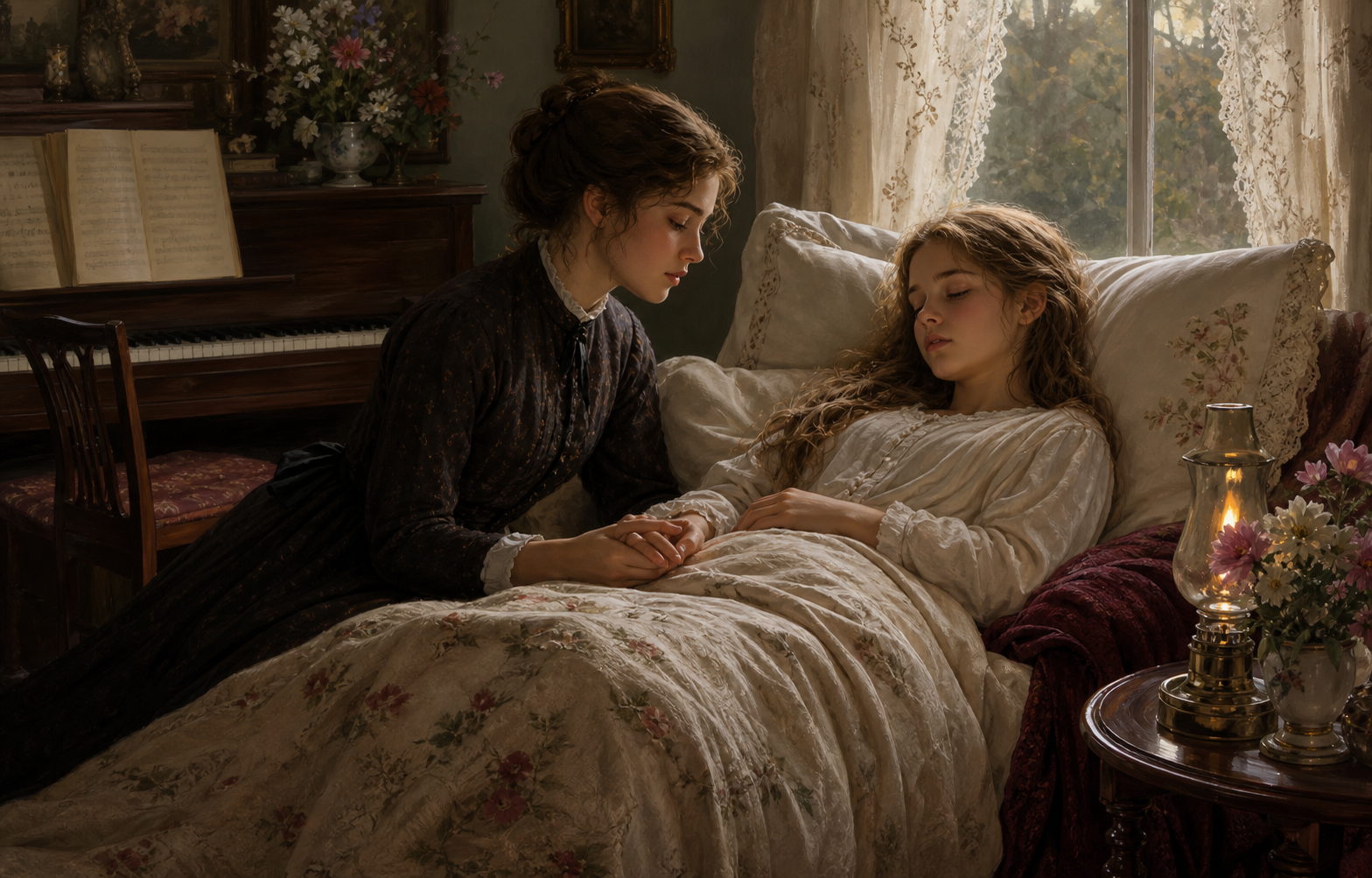
Beth's second illness is quieter than the first and more devastating. She knows she is dying before the family fully accepts it. Her conversations with Jo turn the novel inward. Beth is not ambitious in worldly terms, but her influence is profound because she teaches constancy, gentleness, and the value of unnoticed work.
The danger in reading Beth is to make her merely symbolic. She is certainly idealized, but Alcott gives her a particular emotional function: Beth is the person who makes home feel morally alive. When she weakens, the house itself seems to lose light. Jo's grief is therefore not only fear of losing a sister. It is fear that the center of her world will disappear.
Beth's death forces Jo into a different kind of maturity. Earlier, Jo wanted literary fame, physical freedom, and a boyish escape from the narrowness of women's lives. After Beth, she must learn how to live when action cannot fix loss. She tries to comfort her parents, write from the heart, and accept ordinary duties without surrendering her inner fire.
This grief changes Jo's writing. She begins to write stories with truth, humor, and pathos drawn from home. Alcott is clearly reflecting on her own art here. The novel suggests that Jo's real subject was never distant melodrama alone. It was the domestic world she had been trying to escape. Her ambition does not die; it is redirected into a form that can carry love and sorrow together.
8. The ending and what it leaves behindThis section contains spoilers.
Beth dies, and the family is permanently changed. Alcott does not turn the death into a quick lesson. Jo's loneliness after Beth's passing is heavy, resentful, and slow. She must learn how to live with absence rather than overcome it.
Professor Bhaer returns, and Jo realizes that the affection between them has become love. Their proposal happens under an umbrella in the rain, without glamour. That plainness is exactly the point. Jo's adult love is not the theatrical destiny she wrote in her early stories. It is companionship, intellectual respect, shared work, and emotional steadiness.
Amy and Laurie marry, Meg continues her domestic life, and Jo eventually opens Plumfield as a school with Bhaer. The ending gathers the surviving family around Marmee on her sixtieth birthday. They are not the same girls from the Christmas fire. They have suffered, married, worked, parented, buried Beth, and remade home in new forms.
The ending matters because it does not simply reward obedience. Each sister receives a life shaped by her own temperament. Meg gets domestic love, but with practical struggle. Amy gets beauty and status, but only after learning moral proportion. Jo gets marriage, but also school, work, and a wider form of motherhood. Beth does not get a future, and that loss prevents the ending from becoming neat.
Alcott's final vision is harvest, not escape. The girls do not leave ordinary life behind; they make ordinary life meaningful through labor, affection, art, and memory. That is why Little Women still works. It understands that growing up is not one choice between freedom and duty. It is the long work of building a self that can love without disappearing.
Major Characters
Jo March
Restless writer, sister, and moral center of conflict
Jo is energetic, blunt, imaginative, and angry at the limits placed on girls. She wants books, movement, work, money, and a life bigger than polite womanhood seems to allow. Her temper is part of her vitality, but Alcott also shows its danger.
Jo's growth is not a surrender of ambition. It is a transformation of ambition. She learns that writing can come from truth rather than performance, that love is not owed to the person who wants it most, and that domestic material can become serious art.
Meg March
Beauty, domestic aspiration, and practical marriage
Meg is the eldest sister, drawn to elegance and comfort because she remembers the family's better days. Her vanity is real, but so is her tenderness. She often serves as a bridge between girlhood play and adult responsibility.
Through her marriage to John Brooke, Meg learns that domestic happiness is made through patience, budgeting, apology, and mutual respect. Alcott uses Meg to make ordinary marriage neither fantasy nor failure, but work.
Beth March
Quiet service, music, and the moral life of home
Beth is shy, musical, and devoted to home. She rarely claims attention, which is why it is easy for readers to underestimate her. But within the March household, Beth is the emotional center who turns duty into tenderness.
Her illness and death expose both the beauty and danger of self-effacing goodness. Beth's life is brief, but her influence redirects Jo's writing, deepens Amy's grief, and marks the family permanently.
Amy March
Art, refinement, and disciplined self-fashioning
Amy begins as vain, status-conscious, and eager to sound refined. Alcott makes her comic, but not shallow. Amy's love of beauty becomes more serious as she learns discipline, social intelligence, and self-command.
Her marriage to Laurie is not merely a consolation plot. Amy challenges Laurie when he is wasting himself, refuses a loveless rich marriage, and chooses a life in which beauty must answer to character.
Marmee and Laurie
Moral guidance, chosen family, and emotional education
Marmee is loving but not effortlessly serene. Her admission that she still struggles with anger gives the novel's moral teaching credibility. She guides the girls through example, confession, and practical care.
Laurie enters as lonely wealth and becomes chosen family. His friendship with Jo, grief after rejection, and eventual marriage to Amy show how affection must mature beyond possession into generosity.
Best Quotes
"Christmas won't be Christmas without any presents," grumbled Jo, lying on the rug.
This opening works because Jo is not introduced as a moral example. She is disappointed, funny, and honest. The novel begins with appetite so that sacrifice can become a real choice, not a decorative virtue.
"We've got father and mother and each other," said Beth contentedly, from her corner.
Beth's line gives the March home its deepest value system. Poverty matters, absence hurts, and work is tiring, but the family still possesses relationship as its central wealth.
"I like good strong words, that mean something," replied Jo.
Jo's defense of strong language is also a defense of her nature. She wants words with force because she has feelings and ambitions that polite language cannot always hold.
"I don't pretend to be wise, but I am observing."
Amy's sentence marks how much she changes. She begins as a girl who wants to appear refined; she grows into a woman who watches, judges, and applies what she learns.
Major Themes
Sisterhood
Family Love as Moral Practice
The March sisters love one another, but they also envy, wound, correct, and outgrow one another. Alcott treats sisterhood as daily practice rather than automatic harmony.
Work
Domestic Labor and Creative Labor
The novel places housework, teaching, nursing, writing, music, and art inside the same moral economy. Work can be tedious or liberating depending on whether it is connected to love, purpose, and self-respect.
Gender
Becoming a Woman Without Vanishing
"Little women" can sound restrictive, and the book sometimes reflects nineteenth-century ideals. Yet it also keeps asking how girls can mature without losing wit, anger, imagination, and desire.
Grief
Loss as a Form of Education
Beth's decline turns the novel from improvement story into grief narrative. The sisters grow not because suffering is good, but because love forces them to respond to suffering with deeper truth.
Louisa May Alcott and the Civil War Home Front
Alcott published the first part of Little Women in 1868 and the second in 1869. The novel draws heavily on her own family life in Concord, Massachusetts, including her sisters, her father's reformist ideals, and her experience of financial pressure. Like Jo, Alcott wrote for money and understood authorship as labor, not only inspiration.
The Civil War setting matters even when battles stay offstage. Mr. March's absence, the family's sacrifice, Marmee's trip to Washington, and the Hummels' poverty place the March home inside a national crisis. The home is not sealed away from history; it is one of the places where history is endured.
The book also belongs to nineteenth-century debates about girls' education, women's work, marriage, and moral formation. Some of its assumptions are clearly of its time. Yet Alcott's energy keeps pushing against the edges of those assumptions, especially through Jo's hunger for authorship and Amy's disciplined self-fashioning.
Why It Still Matters
Little Women remains readable because it takes young people's inner lives seriously. The sisters' problems may look ordinary, but Alcott understands how large ordinary feelings can be: envy, shame, ambition, loneliness, anger, creative hunger, and the ache of watching a family change.
It also gives students a strong way to discuss gender and genre. The novel is domestic fiction, but domestic does not mean minor. Alcott turns kitchens, parlors, sickrooms, attics, letters, and schoolrooms into places where character is tested as intensely as in any battlefield plot.
For modern readers, Jo is often the entry point, but the book becomes richer when all four sisters are read as different answers to the same question: how can a girl build a life that is useful, loving, and genuinely her own?
FAQ: Summary, Ending, and Themes
What is Little Women about?
Little Women follows Meg, Jo, Beth, and Amy March as they grow up in Civil War-era Massachusetts. The novel combines family life, work, illness, friendship, art, romance, grief, and moral education into a coming-of-age story.
Why does Jo not marry Laurie?
Jo refuses Laurie because she loves him as family, not as a husband. Alcott also shows that similarity is not always compatibility: Jo and Laurie share energy and affection, but they might intensify each other's restlessness rather than steady one another.
Why is Beth's death important?
Beth's death changes the novel's scale. It turns the March sisters' moral education from childhood improvement into adult grief, and it pushes Jo toward writing that comes from truth, memory, and love.
Is Little Women feminist?
The answer is complicated. The novel reflects nineteenth-century domestic ideals, but it also argues for women's work, education, authorship, moral agency, and the right to choose different kinds of lives. Its power lies in that tension.
Read Next
- Pride and Prejudice for another classic about marriage, judgment, and women's social choices.
- The Great Gatsby for a sharper American dream tragedy about money, longing, and self-invention.
- Jane Eyre pairs well with Jo March's hunger for moral and creative independence.