Jane Eyre - Self-Respect, Desire, and the Cost of Freedom
A detailed guide to Charlotte Bronte's Gothic bildungsroman about a poor governess who refuses to trade her conscience for love, safety, or status.
Sua's Quick Take
Jane Eyre is a love story only if you read love as a test of the self. Jane wants affection, work, home, and spiritual belonging, but she keeps asking a harder question: what kind of love can a person accept without losing her own soul?
That is why the novel still feels alive. Charlotte Bronte gives Jane intense feeling without letting feeling become surrender. Highlighter went brrrr on every page where Jane chooses hunger, loneliness, or misunderstanding over a false version of safety.
What the Book Is Really About
Jane Eyre follows an orphaned girl from the cruelty of Gateshead, through the discipline and loss of Lowood School, into adult work as a governess at Thornfield Hall. There she meets Edward Rochester, a brilliant and wounded master whose house hides a secret that can destroy Jane's hope of marriage. The plot is Gothic, romantic, and suspenseful, but the deeper structure is moral: Jane is repeatedly offered belonging at the price of self-betrayal.
Bronte's first-person narration matters as much as the events. Jane does not sound like a passive heroine waiting for rescue. She argues, remembers, judges, forgives, resists, and revises her own desires. The novel becomes a record of how a socially powerless woman learns to speak with authority.
Plot Summary
1. Gateshead: a child learns that injustice has a room
Jane begins the novel as an orphan living at Gateshead Hall with her aunt, Mrs. Reed, and the Reed children. She is not treated as a daughter, cousin, or guest. She is treated as a dependent who should be grateful for neglect. John Reed bullies her, the servants repeat the household's judgment that she is troublesome, and Mrs. Reed treats Jane's anger as proof that Jane deserves more punishment.
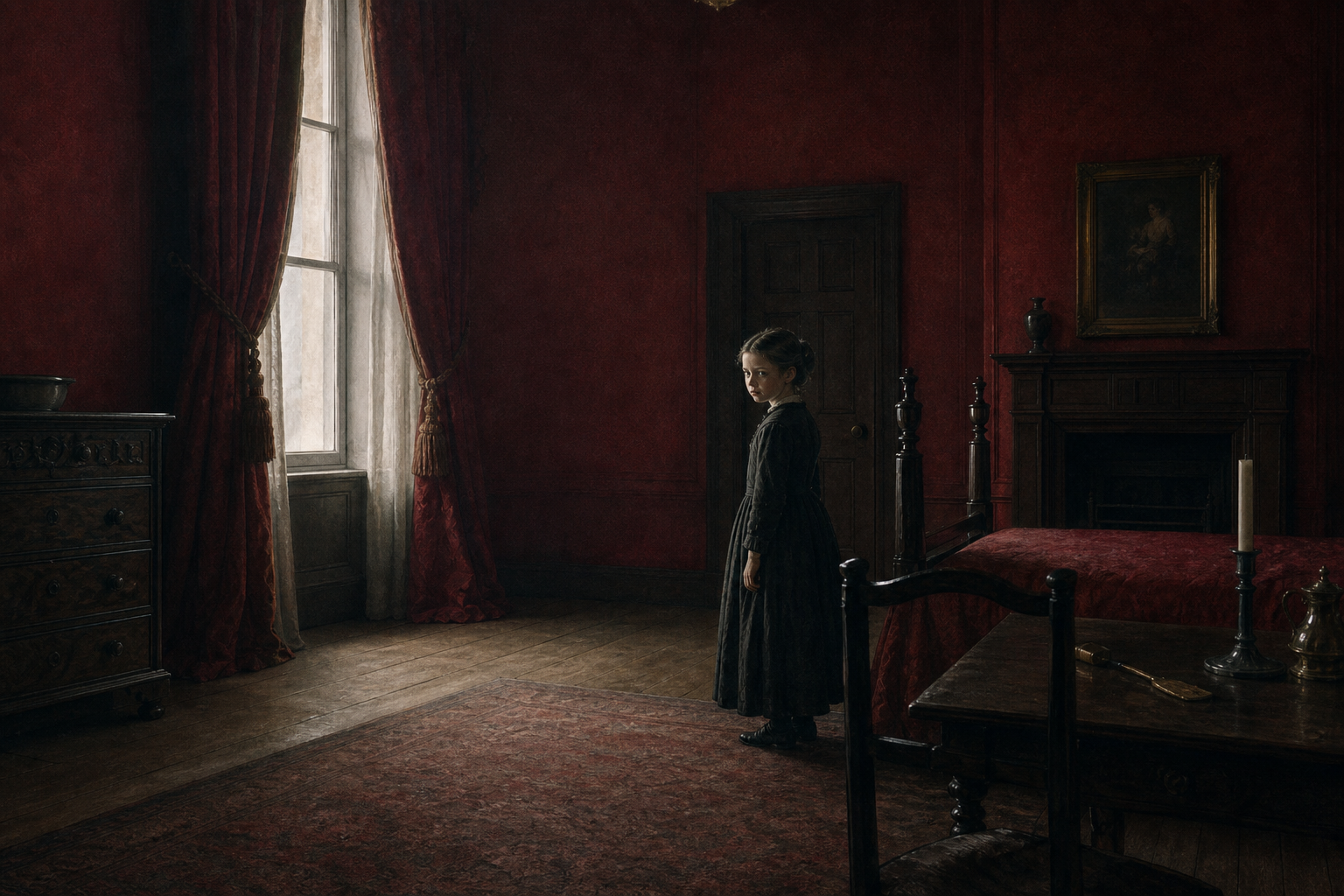
The famous red-room scene gives the early chapters their emotional shape. After Jane fights back against John Reed, she is locked in the room where her uncle died. The space is physically grand but psychologically terrifying: red drapery, cold furniture, mirrors, silence, and the idea of death press against a child who already feels excluded from ordinary human protection. Jane's terror is not only fear of a ghost. It is the shock of realizing that adults can call cruelty discipline and still expect the child to accept their version of reality.
When the apothecary Mr. Lloyd sees Jane after her collapse, he becomes the first adult to imagine a different future for her. Jane is sent away to Lowood School, but before leaving she speaks back to Mrs. Reed with a clarity that matters. She says she is not deceitful; she names the injustice she has endured. That outburst does not make Jane powerful in society, but it marks the beginning of her moral voice. She cannot control where she is sent, yet she can refuse the lie that she deserved Gateshead's cruelty.
2. Lowood: discipline, friendship, and the education of conscience
Lowood is supposed to rescue Jane, but it first exposes another kind of cruelty. Mr. Brocklehurst runs the school as a machine of religious humiliation. He preaches humility while his own family appears in comfort and display. The girls are underfed, cold, and watched. Jane's body learns deprivation; her mind learns to distinguish religion from self-righteousness.
Helen Burns changes Jane's emotional education. Helen endures punishment with spiritual patience that Jane finds both admirable and impossible. Where Jane wants justice now, Helen looks toward a heavenly justice beyond human cruelty. Bronte does not simply make Helen "right" and Jane "wrong." Instead, Helen gives Jane language for forgiveness and inward freedom, while Jane's passionate protest keeps the novel from blessing every form of suffering as holy.
Miss Temple is equally important. She models adult authority that is calm, educated, and fair. When Brocklehurst publicly shames Jane as a liar, Miss Temple listens, verifies Jane's story, and restores her reputation. That scene matters because Jane's self-respect is not built only by defiance. It is also built by being believed.
Typhus sweeps through Lowood, revealing the physical cost of institutional neglect. Helen dies, and Jane survives. After public criticism improves the school, Jane spends years there as student and teacher. She gains discipline, skill, and social usefulness. But once Miss Temple leaves, Jane recognizes that she has mistaken stability for life. She advertises for a position as governess, not because she rejects education, but because her inward life wants a wider field.
3. Thornfield: work, mystery, and the danger of being seen
Jane arrives at Thornfield Hall to teach Adele Varens, Rochester's young ward. At first, Thornfield seems like a step into independence. Jane earns wages, has a room, and is treated with relative respect by Mrs. Fairfax. Yet the house is full of Gothic pressure: strange laughter, locked spaces, unexplained movements at night, and the sense that domestic order rests on something hidden.
Rochester enters the story with physical abruptness. Jane meets him on the road after his horse falls; she helps him without knowing he is her employer. Their relationship begins not as polished courtship but as argument, observation, and recognition. Rochester tests Jane with questions; Jane answers without flattering him. He is fascinated because she does not perform the expected submissiveness of a poor governess. She is socially below him, but intellectually and morally she keeps meeting him face to face.
Their conversations are charged because both are lonely, both are proud, and both are used to concealment. Rochester has experience, wealth, and power, but he is not free. Jane has little money and little status, but she guards an inward freedom Rochester lacks. This reversal is one reason the romance works as more than wish fulfillment: Jane's poverty makes her vulnerable, but her conscience gives her leverage.
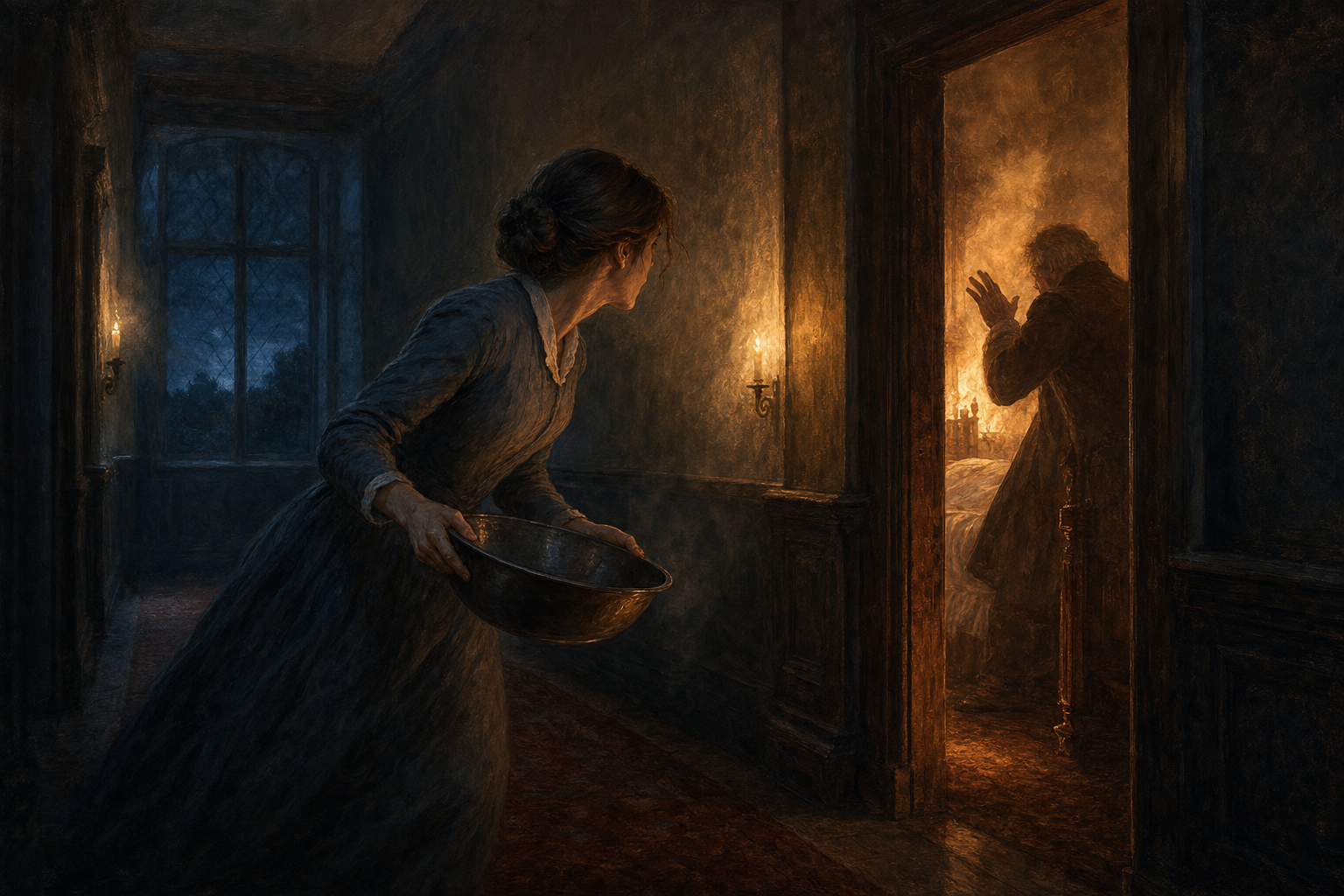
The mystery intensifies through fire, injury, and coded explanations. Jane saves Rochester from a burning bed after hearing strange laughter in the corridor. Rochester blames Grace Poole, a servant whose behavior seems suspicious, but the explanation is too neat. Later, a visitor named Richard Mason is attacked in the house. Jane is asked to help secretly, and Thornfield begins to feel less like a home than a structure built over a buried life.
4. Love, equality, and the interrupted wedding
Rochester tries to make Jane jealous through Blanche Ingram, a beautiful woman of his own class. The performance shows how deeply class shapes romance. Blanche treats governesses as socially invisible, and Rochester watches Jane's pain while pretending indifference. The plot device is uncomfortable because it reveals Rochester's manipulative streak. Bronte lets readers want the lovers together while also seeing that Rochester's power can become careless.
The proposal scene is one of the novel's emotional centers because Jane refuses to speak as a purchased dependent. She tells Rochester she is not an automaton and insists that her spirit addresses his spirit as an equal. This is the opposite of a Cinderella rescue. Jane wants love, but only if love recognizes her full personhood. Rochester proposes, and for a short time Thornfield becomes almost dreamlike: new clothes, new status, and the promise that Jane's life of exclusion is ending.
But the wedding collapses before it can be completed. Richard Mason and the lawyer Briggs interrupt the ceremony with proof that Rochester is already married to Bertha Mason, who lives hidden in Thornfield. The revelation reorders the whole novel. The laughter, fire, and attacks were not random Gothic decorations; they were symptoms of a concealed marriage and a woman imprisoned in the attic.
The interruption also forces readers to reinterpret Rochester's courtship. His proposal may be emotionally sincere, but it has been built on an information advantage Jane never possessed. The jewels, new clothes, and plans for travel now look less like romantic generosity and more like an attempt to hurry Jane into a role before she understands its cost. Bronte does not make Rochester a simple villain. His misery is real, and the novel gives him a history of entrapment, sexual disillusion, and shame. Still, sympathy for his suffering cannot become permission to use Jane as an escape route.
Rochester explains his past and begs Jane to stay with him outside the law. The temptation is real. Jane loves him. She knows his suffering. She also understands that becoming his mistress would destroy the self-respect she has spent the entire novel building. Her decision to leave Thornfield is not cold moralism. It is the most painful act of self-preservation in the book.
5. Whitcross and Moor House: hunger, kinship, and a different trap
Jane flees with almost nothing. The moorland chapters strip the romance plot down to survival. She is hungry, homeless, and near death. Bronte makes freedom bodily: Jane has saved her conscience, but she has no shelter, no money, and no social protection. The question becomes whether moral independence can survive material desperation.

Diana, Mary, and St. John Rivers rescue Jane at Moor House. For the first time, Jane experiences intellectual companionship with women who feel like equals. Diana and Mary are educated, affectionate, and capable of friendship without domination. The household offers a different form of belonging from Thornfield: quieter, plainer, and less erotically charged, but deeply important to Jane's sense of family.
The inheritance plot changes Jane's social position. She learns that her uncle has left her a fortune and that the Rivers siblings are her cousins. Jane's response reveals her character. Instead of hoarding the money as compensation for deprivation, she divides it equally among the four cousins. Wealth matters because it gives Jane material independence; sharing it matters because she understands independence as a condition for chosen relationship, not isolation.
St. John Rivers becomes the novel's second major test. He is disciplined, intelligent, religious, and ambitious for missionary work. Unlike Rochester, he does not tempt Jane through passion. He tempts her through duty. He wants Jane to marry him and go to India as his missionary wife because he sees she has endurance, language skill, and moral strength. But he does not love her as Jane needs to be loved. He wants to use her best qualities without meeting her emotional self.
The St. John plot is crucial because it prevents the novel from making "morality" simple. Jane has already rejected unlawful passion with Rochester. Now she must reject loveless righteousness with St. John. Both men try, in different ways, to absorb her into their own designs. Jane's freedom requires saying no to sin and no to sanctified self-erasure.
Ending Explained: Thornfield burns, Ferndean answersThis section contains major ending spoilers.
At the height of St. John's pressure, Jane hears Rochester's voice calling her name across a mysterious distance. The moment is Gothic, spiritual, and psychologically exact: the voice returns Jane to the question her whole life has prepared her to answer. She leaves Moor House and goes back to Thornfield.
Thornfield is destroyed. Bertha set the house on fire and died after jumping from the roof. Rochester tried to save everyone, including Bertha, and was injured: he has lost a hand and his sight. The ending is often debated because Bertha's death removes the legal obstacle to Jane and Rochester's marriage, and modern readers rightly notice how the novel uses Bertha as both suffering person and Gothic symbol. The strongest reading does not ignore that discomfort. It sees the ending as Bronte's attempt to make Rochester lose the mastery that made his earlier love dangerous.
Jane finds Rochester at Ferndean, a smaller, darker, more isolated house. The setting matters. She does not return to the glittering power of Thornfield; she returns to a humbled man who can no longer dress her up, command the house, or control the terms of the relationship. Jane now has money, family, and the ability to choose. Rochester has need, remorse, and love without the same social dominance.
The reunion is therefore not a return to the old romance but a revision of it. At Thornfield, Jane was a dependent employee in a house whose master controlled nearly every visible fact. At Ferndean, she arrives as an heiress who has chosen what to do with her inheritance, shared it with kin, and learned that she can survive without Rochester. The marriage becomes possible only after Jane has proved that love is not her last refuge and Rochester has lost the domestic empire that made his desire dangerous. The novel's conclusion is conservative in form, because it ends in marriage, but radical in emotional grammar: Jane enters that marriage as the narrator, chooser, and moral center.
"Reader, I married him" is famous because Jane makes herself the grammatical subject. She does not say he married her, or that fate rewarded her, or that society restored her. The line announces chosen marriage after a long education in self-respect. The ending is not pure equality by modern standards, but within the novel's moral design it gives Jane something she has insisted on from the beginning: love that does not require her to become less than herself.
Major Characters
Jane Eyre
Narrator, orphan, governess, and moral center
Jane is passionate, observant, wounded, and fiercely self-respecting. Her growth is not a move from anger to obedience; it is a move from helpless anger to disciplined moral speech.
She wants love intensely, which makes her refusals meaningful. Gateshead, Lowood, Thornfield, Moor House, and Ferndean each test whether she will trade conscience for belonging.
Edward Rochester
Beloved, master, and flawed equal-in-the-making
Rochester is intelligent, sardonic, lonely, and emotionally forceful. He sees Jane's mind before society does, but he also uses secrecy and power to arrange the world around his desire.
His arc depends on loss. Only after Thornfield burns and his dominance is broken can his love meet Jane without asking her to live inside a lie.
Bertha Mason
Hidden wife and Gothic exposure of repression
Bertha is Rochester's first wife, confined in Thornfield's attic. The novel treats her through troubling Gothic and colonial language, so modern readers need to read her both as a plot figure and as a sign of what the house represses.
Her presence exposes the cost of Rochester's secrecy. Thornfield's romance cannot become morally whole while another woman is locked away inside it.
Helen Burns and Miss Temple
Spiritual patience and just authority
Helen teaches Jane a form of inward freedom rooted in forgiveness and faith. Miss Temple shows Jane what humane authority looks like: listening, fairness, education, and steady care.
Together, they keep Jane's resistance from becoming mere bitterness. They help her turn pain into judgment, language, and self-command.
St. John Rivers
Duty without tenderness
St. John is not a villain in the simple sense. He is brave, disciplined, and sincerely religious. But his virtue is hard, instrumental, and emotionally cold.
His proposal tests Jane as seriously as Rochester's temptation does. He offers purpose without love, and Jane recognizes that spiritual language can still become domination.
Best Quotes
Conventionality is not morality. Self-righteousness is not religion.
This preface line gives the novel a key distinction. Bronte is not rejecting morality or faith; she is rejecting the social habit of confusing outward respectability with goodness.
I must keep in good health, and not die.
Young Jane's answer to Brocklehurst sounds blunt, almost comic, but it cuts through religious intimidation. She answers a death-haunted question with the simplest claim of survival.
Do you think, because I am poor, obscure, plain, and little, I am soulless and heartless?
Jane's protest to Rochester is one of the novel's clearest statements of spiritual equality. The sentence names the social categories used to diminish her, then rejects the assumption that they define her inward worth.
I am no bird; and no net ensnares me; I am a free human being with an independent will.
The bird image matters because Rochester has just described her as a frantic bird. Jane takes the metaphor and breaks it. She refuses to be decorative, trapped, or owned.
I care for myself. The more solitary, the more friendless, the more unsustained I am, the more I will respect myself.
This is the ethical center of Jane's flight from Thornfield. She does not choose loneliness because it is easy. She chooses self-respect because accepting love without law and truth would make loneliness internal.
Reader, I married him.
The sentence is short, but its grammar is powerful. Jane controls the telling of her own ending; she presents marriage as her act of choice after gaining independence, family, and moral clarity.
Major Themes
Selfhood
Self-Respect Comes Before Romance
Jane's deepest need is love, but the novel insists that love without self-respect becomes another form of captivity. Her most important choices protect the inward self that society keeps trying to reduce.
Class
Equality Is Moral Before It Is Social
Jane is poor, plain, and dependent for much of the book, yet she repeatedly speaks as Rochester's moral equal. Bronte exposes how class hierarchy misreads human worth.
Gothic
Hidden Rooms Reveal Hidden Sins
Thornfield's locked spaces, laughter, fire, and night scenes turn domestic secrecy into Gothic atmosphere. The house becomes a map of repression.
Religion
Faith Must Be Separated from Control
Brocklehurst and St. John show two dangers: public piety used for humiliation, and private zeal used to erase another person's needs. Helen and Miss Temple offer more humane alternatives.
Charlotte Bronte and the Victorian Context
Charlotte Bronte published Jane Eyre in 1847 under the pseudonym Currer Bell. The pseudonym matters because the novel entered a literary world suspicious of women who wrote with anger, desire, and intellectual force. The book's first-person intensity made that force impossible to dismiss.
The governess position is central to the novel's social tension. A governess was educated enough to live among the middle or upper classes, but paid enough to remain dependent. She was inside the house but not part of the family; genteel but economically vulnerable. Jane's role at Thornfield makes every conversation with Rochester socially charged before it becomes romantic.
The novel also belongs to Gothic fiction. Thornfield has secrets, night noises, fire, locked rooms, and a woman hidden from ordinary view. But Bronte uses Gothic machinery to ask realistic questions about marriage, property, gender, religion, and power. The terror is never only supernatural. It comes from what respectable houses can conceal.
Modern readers should also read the Bertha Mason plot carefully. The novel's treatment of Bertha reflects nineteenth-century anxieties about madness, race, empire, and female sexuality. A responsible reading can admire Jane's moral journey while also recognizing that Bertha is not given the full narrative humanity Jane receives.
Why It Still Matters
Jane Eyre still matters because it refuses to make freedom emotionally neat. Jane does not become independent by ceasing to want love. She becomes independent by learning what kind of love would cost too much.
That question is not locked in the nineteenth century. Students still recognize the pressure to accept a role because it looks safe, prestigious, romantic, or morally approved. Jane's life asks whether the self can survive inside that role.
The book also remains useful for literary study because it combines so many examinable forms: bildungsroman, Gothic fiction, first-person narration, social critique, romance, religious debate, and symbolic setting. Few novels make the AP Lit question of "how does form create meaning?" this visible.
FAQ: Summary, Ending, and Themes
What is Jane Eyre about?
Jane Eyre is about an orphaned girl who grows into a governess and falls in love with Edward Rochester, while learning to protect her self-respect against cruelty, passion, class hierarchy, and religious pressure.
Why does Jane leave Rochester?
Jane leaves because Rochester is already married and asks her to live with him outside legal and moral truth. She loves him, but staying would make her dependent on a lie and would violate the conscience that defines her.
Is Jane Eyre a feminist novel?
It is often read as an early feminist novel because Jane insists on spiritual equality, economic independence, and the right to choose love without surrendering selfhood. Modern feminist readings also question the novel's treatment of Bertha Mason and the limits of Jane's victory.
Why is the red room important?
The red room turns childhood punishment into a symbolic scene of exclusion, fear, and unjust authority. Jane's later insistence on truth and self-respect begins in that early experience of being trapped and misread.
What does the ending mean?
The ending presents marriage after Jane has gained money, kinship, and choice. Rochester is no longer the commanding master of Thornfield. Jane can return because the relationship has changed from temptation under inequality into chosen companionship.
Read Next
Read Frankenstein for another Gothic novel about creation and responsibility, Pride and Prejudice for a sharper comedy of marriage and class, and Wuthering Heights for a darker Bronte family vision of passion, violence, and inheritance.