Pride and Prejudice - When First Impressions Fail
Austen turns courtship into a study of judgment, class, money, pride, and correction.
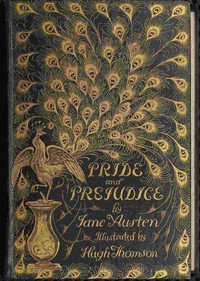
Sua's Quick Take
Pride and Prejudice is romantic because it is corrective. Elizabeth and Darcy do not simply discover love; they learn how painful it is to revise a confident judgment.
Austen's comedy is light on the surface and exact underneath. Every visit, ball, letter, proposal, and family embarrassment tests how people read one another. The happy ending feels earned because both central characters must become better interpreters before they can become good partners.
What the Book Is Really About
Pride and Prejudice was published in 1813 and is one of the great novels of manners. It is famous as a love story, but Austen's deeper subject is judgment: how people form opinions, how pride protects error, how prejudice flatters the mind, and how social conditions shape private feeling.
The novel originally appeared in three volumes. A useful structure is: first impressions at Meryton and Netherfield; intensifying misjudgment through Wickham, Collins, and Darcy's first proposal; then correction through Darcy's letter, Pemberley, Lydia's crisis, and the final proposals. The plot is social rather than sensational, but the stakes are real. Marriage affects money, security, reputation, and family survival.
The Bennet daughters live under an entail, which means the family estate will pass to a male relative instead of directly to them. That legal pressure is not background detail. It explains why Mrs. Bennet is frantic, why Charlotte Lucas makes a practical choice, and why Elizabeth's refusal of Collins is morally admirable but socially risky.
Plot Summary
1. Netherfield and the pressure of marriage
The novel begins with news that Charles Bingley, a wealthy unmarried man, has rented Netherfield Park. For Mrs. Bennet, this is not casual gossip. It is a possible solution to the future insecurity of her five daughters. Austen opens with comedy, but the comedy rests on economic pressure.
Mr. Bennet treats the situation with dry amusement, while Mrs. Bennet turns instantly toward matchmaking. Their marriage establishes one of the novel's central domestic tensions. Mrs. Bennet is foolish and embarrassing, but her anxiety is not imaginary. Mr. Bennet is clever and detached, but his detachment often becomes irresponsibility.
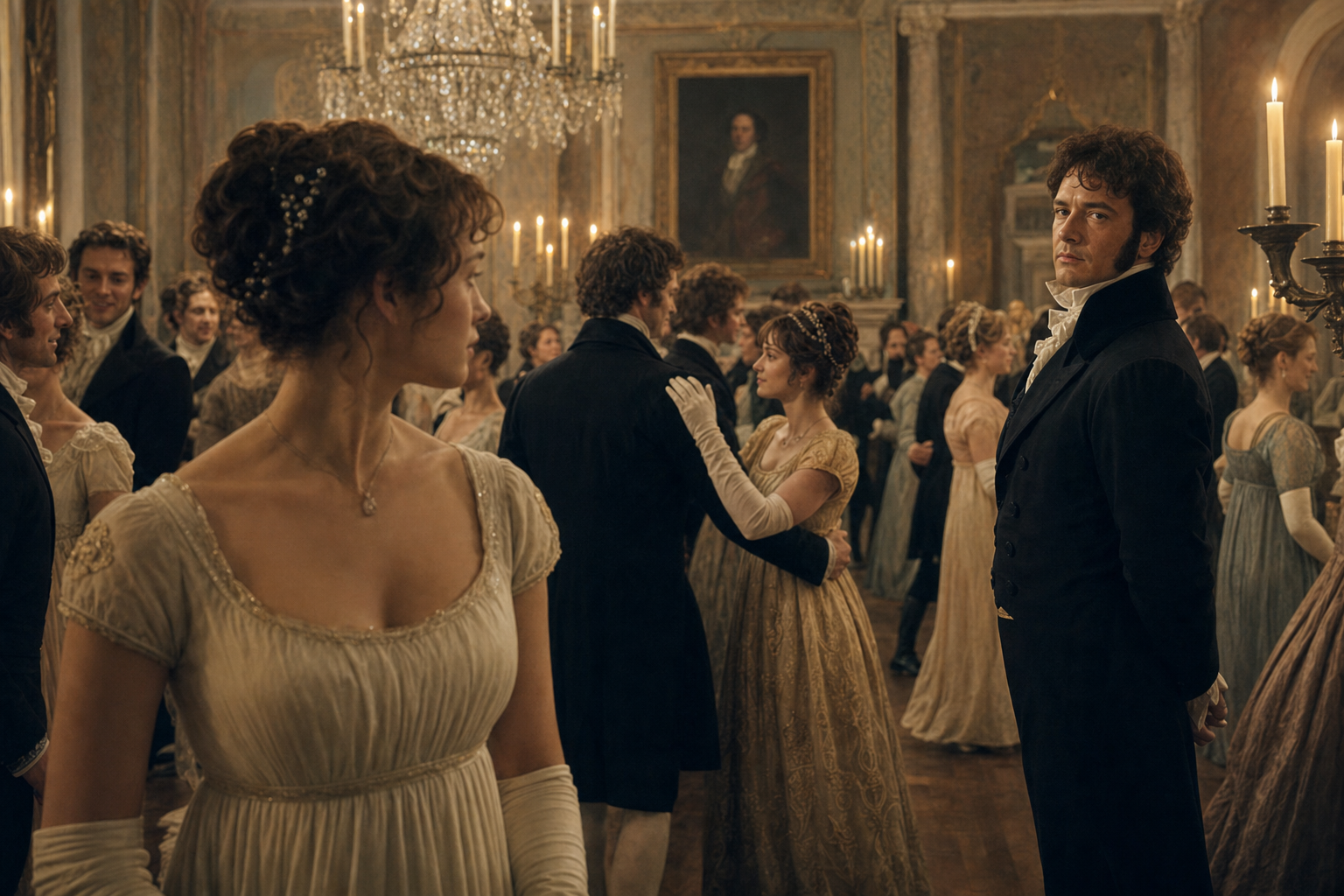
At the local assembly, Bingley is warm, sociable, and immediately drawn to Jane Bennet. Darcy, by contrast, appears proud and dismissive. His slight against Elizabeth wounds her pride and gives her an early reason to dislike him. Austen lets the title begin working immediately: Darcy has real pride, and Elizabeth develops real prejudice.
The ball is a social marketplace as much as an entertainment. Who dances, who refuses, who watches, and who speaks carelessly all become matters of reputation. Love in Austen is never purely private. It forms under observation, gossip, class expectation, and family pressure.
2. Jane at Netherfield and the education of social reading
Jane's visit to Netherfield and illness bring Elizabeth into closer contact with Bingley's circle. Elizabeth walks through mud to reach her sister, an act that shows affection and independence. To Caroline Bingley, it looks improper. To Darcy, it begins to look like vitality.
Netherfield is where Austen sharpens social perception. Caroline performs refinement while revealing jealousy and snobbery. Darcy remains guarded and difficult to read. Elizabeth responds with wit, but wit can protect error as well as expose foolishness.
Jane and Bingley's affection seems simple and gentle, yet that gentleness makes it vulnerable. Jane does not display her feelings strongly. Bingley is kind but persuadable. Darcy and Bingley's sisters interpret Jane's reserve as lack of attachment and separate the pair.
Austen makes this more than a misunderstanding between lovers. In this society, feeling must be performed carefully enough to be legible but not so openly that it becomes improper. Jane's modesty is morally attractive, yet socially risky. The code asks women to communicate desire while pretending not to pursue it too actively.
This part of the novel shows that feeling must be read, and reading can be wrong. A person's character is not always visible in the most socially convenient form. Jane's modesty hides feeling; Darcy's reserve hides moral seriousness; Wickham's charm will later hide corruption.
This is why Darcy's interference hurts so much later. He is not only proud in conversation; he acts on a mistaken interpretation and changes another person's happiness. In Austen's world, bad reading becomes ethically serious when it is backed by rank, money, and influence.
3. Collins, Charlotte, and the practical marriage plot
Mr. Collins enters as the legal heir to the Bennet estate. He is absurd, self-important, and constantly deferential to Lady Catherine de Bourgh. But he also represents a real structural problem: when Mr. Bennet dies, Longbourn will not belong to the Bennet women.
Collins proposes to Elizabeth with spectacular insensitivity. He assumes that his offer is reasonable, beneficial, and almost impossible to refuse. Elizabeth refuses anyway. Her refusal is one of the novel's key declarations of self-respect. She will not trade her judgment for security.
Charlotte Lucas then accepts Collins. Austen does not present Charlotte as romantic, but she does not reduce her to a joke either. Charlotte understands the limits placed on women without wealth. Her marriage is a practical arrangement in a world where practicality can be a form of survival.
Elizabeth struggles to approve Charlotte's choice. That struggle matters because it exposes Elizabeth's limits. She is right to want more from marriage, but not every woman has the same room to refuse. Austen uses Charlotte to keep the novel's romance honest about class and gender.
4. Wickham's charm and the strengthening of prejudice
George Wickham arrives as a charming officer with an apparently injured past. He tells Elizabeth that Darcy wronged him, denying him a promised living. Because Elizabeth already dislikes Darcy, Wickham's story fits the pattern she wants to believe.
This is Austen's anatomy of prejudice. Elizabeth is not foolish in a simple way. Her error grows from partial evidence, wounded pride, and a pleasing narrative. Darcy did behave badly at the assembly. Wickham is attractive and socially fluent. The false judgment feels reasonable because it is built from real impressions arranged in the wrong order.
Wickham's power is verbal. He knows how to present himself as a victim and how to invite sympathy without appearing desperate for it. Darcy, meanwhile, does not explain himself. In a social world where charm travels faster than truth, Wickham has the advantage.
Wickham also reveals Elizabeth's vulnerability. She is intelligent, but intelligence does not protect her from a story that flatters her existing judgment. Because Darcy has wounded her pride, Wickham's accusation feels like confirmation rather than evidence requiring testing.
By the time Jane and Bingley are separated, Elizabeth's judgment hardens. Darcy seems responsible for Jane's sorrow and Wickham's loss. The reader still enjoys Elizabeth's wit, but Austen begins showing its danger. Intelligence is not the same as fairness.
5. Hunsford, the first proposal, and Darcy's letter
At Hunsford, Darcy proposes to Elizabeth. The proposal is passionate but insulting. He confesses love while emphasizing the inferiority of her family and connections. His feelings are sincere, but his manner is shaped by pride. He wants to be accepted while making clear what he believes he is overcoming.
Elizabeth rejects him with force. She accuses him of separating Jane and Bingley and of ruining Wickham. This is one of the novel's great confrontations because both characters are partly right and partly wrong. Darcy's pride is real. Elizabeth's accusations, however, rest on incomplete knowledge.
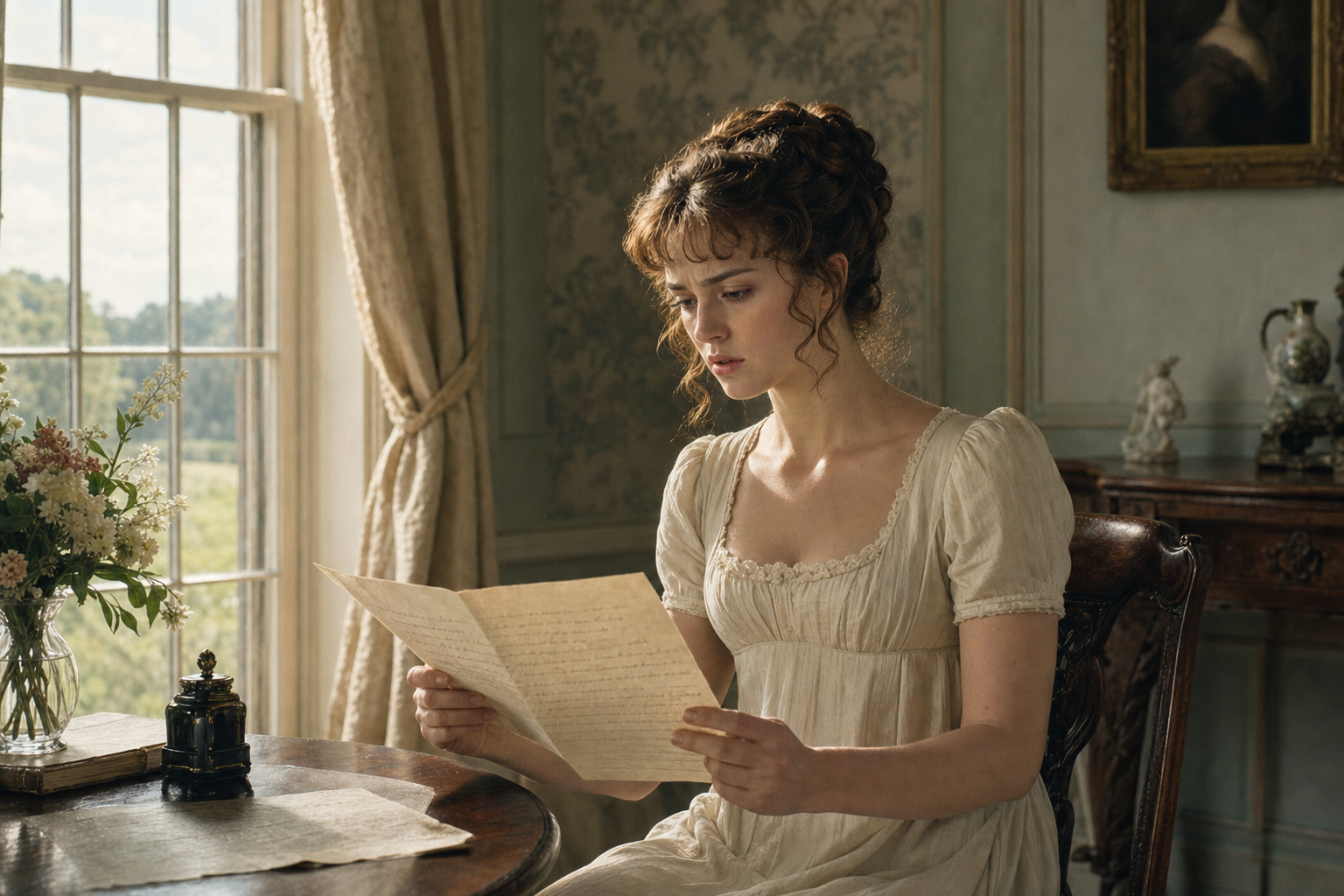
Darcy's letter changes the novel. It explains his role in separating Bingley from Jane and reveals Wickham's attempt to exploit Darcy's sister Georgiana. The letter does not make Darcy flawless, but it breaks Elizabeth's certainty. She must reexamine the pleasure she took in disliking him.
The letter scene is the moral center of the novel. Elizabeth's growth begins when she stops treating judgment as entertainment and starts treating it as responsibility. The romance can move forward only after self-knowledge begins.
6. Pemberley and Darcy's revised character
Elizabeth visits Pemberley with the Gardiners while believing Darcy is absent. The estate matters because it gives Darcy a context larger than a ballroom insult. Pemberley is grand, but Austen does not present it only as wealth. It suggests order, taste, responsibility, and continuity.
The housekeeper's testimony changes Elizabeth's view further. Darcy is described as a good master and devoted brother. This evidence does not come from flirtation or rumor. It comes from the people who live under his authority. Austen asks readers to judge character by patterns of responsibility, not only by public charm.
When Darcy appears, he is courteous to Elizabeth and to her relatives. This matters because the Gardiners are socially below him but morally admirable. Darcy's improved behavior is not theatrical. He has heard Elizabeth's criticism and changed how he acts.
Pemberley is therefore not just the place where Elizabeth begins to love Darcy. It is the place where judgment becomes more complete. She sees him in relation to home, servants, family, and responsibility. The man who looked only proud at Meryton now appears capable of humility and care.
The estate also changes how wealth functions in the novel. Austen does not pretend property is irrelevant. Pemberley impresses Elizabeth, and the novel is honest about that. But its moral force comes from stewardship rather than display. Darcy's home suggests order, responsibility, and care for dependents, which complicates the earlier image of mere arrogance.

7. Lydia's crisis and the moral test of love
The news that Lydia has run away with Wickham threatens the entire Bennet family. In the social world of the novel, Lydia's behavior can damage not only her own reputation but also the marriage prospects of her sisters. Private recklessness becomes family disaster.
Lydia is vain, immature, and unable to understand the consequences of her actions. But Austen also lets readers see the family failure around her. Mr. Bennet's detached amusement and Mrs. Bennet's uncontrolled excitement have not given Lydia discipline, prudence, or judgment.
Darcy quietly intervenes. He finds Wickham, arranges the marriage, and uses money and influence to contain the damage. Crucially, he does not advertise this action. The same man who once spoke proudly of Elizabeth's inferior connections now works to repair a scandal inside that family.
Lydia's crisis also exposes the Bennet household's failures. Mr. Bennet's amused detachment and Mrs. Bennet's noisy vanity have consequences. Lydia's recklessness is her own, but Austen shows that weak guidance, flirtation culture, and social pressure have helped create the disaster.
This is the novel's strongest proof of Darcy's change. The first proposal was full of feeling but morally clumsy. The Lydia crisis requires action, humility, and responsibility. Darcy's love becomes credible because he serves Elizabeth's reality rather than merely declaring his desire.
The ending works because both central characters have been educated. Elizabeth learns that wit can harden into prejudice. Darcy learns that rank and intelligence do not excuse contempt. Their marriage is satisfying because it follows correction, not because either person was perfect from the beginning.
Jane and Bingley's restoration also matters. Their happiness is gentler than Elizabeth and Darcy's, but it confirms that social interference can be repaired when pride no longer controls the situation. Bingley must become less persuadable, and Jane's quiet feeling must finally be trusted.
Charlotte's marriage remains as a counterpoint to the romantic ending. She does not receive the emotional fulfillment Elizabeth gains, but Austen does not mock her practical choice. Her plot keeps the novel honest about women's economic vulnerability. Elizabeth's happy marriage is possible, but not universally available.
The final marriages therefore do more than close a romance plot. They compare different ways of surviving a marriage market: practical compromise, reckless desire, gentle affection, and mutual moral education. Elizabeth and Darcy's ending stands out because both desire and judgment have been revised.
Austen's final movement also rewards better reading. Elizabeth can now read Darcy without reducing him to pride, and Darcy can read Elizabeth without reducing her family to social inferiority. Love becomes possible because interpretation improves.
That improvement is the novel's real closure.
8. Ending and final meaningThis section contains spoilers.
Lydia and Wickham marry, but their marriage is not a romantic triumph. It is a social repair. Lydia remains largely unaware of the seriousness of what happened, and Wickham remains morally unreliable. Austen does not treat every marriage as equally happy or wise.
Jane and Bingley reunite. Their happiness is gentle and sincere, but the delay has shown how vulnerable good feeling can be when others misread or manipulate it. Their ending is joyful, yet it also depends on corrected judgment.
Elizabeth and Darcy finally choose each other after both have changed. Elizabeth has recognized her prejudice; Darcy has corrected his pride. Their marriage is not merely a reward for attraction. It is the result of mutual moral education.
Lady Catherine's attempt to prevent the match only confirms Elizabeth's independence. Elizabeth refuses to surrender her choice to inherited rank. By the end, her courage is no longer just witty resistance. It is mature self-respect.
Major Characters
Elizabeth Bennet
witty judge who learns self-correction
Elizabeth is intelligent, lively, and independent. She sees through many social absurdities, but her wit also makes her overconfident. Her dislike of Darcy and trust in Wickham show that sharp perception can still become prejudice.
Her growth is the novel's moral center. She does not stop being witty; she learns that wit needs humility. By revising her judgment, she becomes capable of a love based on clearer knowledge rather than injured pride.
Fitzwilliam Darcy
proud gentleman who learns responsibility
Darcy begins as reserved, class-conscious, and often insulting. His first proposal reveals sincere love mixed with social arrogance. He expects Elizabeth to accept a confession that also diminishes her.
His change matters because it becomes action. He treats the Gardiners with respect, helps Lydia without public credit, and allows Elizabeth's criticism to reshape him. Darcy's love becomes persuasive when it becomes humility.
Jane Bennet and Charles Bingley
good feeling made vulnerable
Jane and Bingley are kind, generous, and well matched. Their weakness is not cruelty but passivity. Jane hides feeling too modestly, while Bingley relies too easily on others' interpretations.
Their plot shows that sincerity alone is not enough in a society of reading and misreading. Good love still needs courage, expression, and resistance to social manipulation.
George Wickham
charm that disguises corruption
Wickham is attractive because he understands social performance. He tells a story that makes him look injured and Darcy look cruel. Elizabeth believes him partly because the story flatters her existing judgment.
Wickham shows that danger can be charming. Austen contrasts his easy manners with Darcy's difficult integrity, forcing readers to ask whether pleasant appearance should be trusted too quickly.
Charlotte Lucas
practical realism about marriage
Charlotte chooses security over romance when she marries Collins. Austen does not idealize the choice, but she makes it understandable. Charlotte sees the economic reality that Elizabeth can afford to resist.
Her marriage keeps the novel socially honest. Elizabeth's standards are admirable, but Charlotte reminds readers that not every woman in this world has the same freedom to wait for love.
Best Quotes
Till this moment I never knew myself.
This is Elizabeth's central moment of self-recognition. The line turns the novel from social comedy into moral education. She discovers that judging others also requires judging the self.
I dearly love a laugh.
The line captures Elizabeth's charm and danger. Laughter helps her puncture vanity, but it can also let her enjoy judgment too quickly. Austen loves Elizabeth's wit while still testing it.
My courage always rises.
Elizabeth's courage becomes clearest under Lady Catherine's pressure. By the end, her resistance is not mere teasing or pride. It is a principled refusal to let rank decide her life.
Major Themes
Judgment
The education of judgment
The novel is built around revised interpretation. First impressions begin the plot, but corrected judgment makes the ending possible.
Marriage
Marriage and money
Marriage is emotional, economic, and social at once. Austen refuses to separate romance from inheritance, security, and reputation.
Class
Class and manners
Rank shapes how people speak, choose, and judge. Manners can reveal genuine care, but they can also hide snobbery and manipulation.
Language
Speech, letters, and rumor
Conversations and letters drive the plot. Wickham's story misleads, Darcy's letter corrects, and social talk constantly reshapes reputation.
Jane Austen and the Regency Context
Austen analyzes society through everyday forms: visits, dances, letters, proposals, family conversations, and polite insults. These scenes may look small, but they carry questions of inheritance, class, gender, and moral education.
The Bennet entail gives the novel its economic pressure. The daughters' future is uncertain because property will move through a male line. Mrs. Bennet's matchmaking is comic, but the fear beneath it is real. Austen's comedy works because the jokes are built on structural vulnerability.
Austen also measures character through conduct. Grand speeches matter less than how people treat relatives, servants, social inferiors, and inconvenient truths. Darcy's transformation becomes believable because it appears in changed behavior, not only in emotional language.
Why It Still Matters
The novel remains current because first impressions still govern social life. People judge quickly from background, tone, appearance, rumor, and curated self-presentation. Elizabeth's mistake is not old-fashioned. It is recognizable.
Darcy's change also matters now. He does not become worthy of Elizabeth by wanting her more intensely. He becomes worthy by hearing criticism and acting differently. Austen makes love accountable to ethical growth.
For AP Lit, SAT Reading, IB English, and essay writing, Pride and Prejudice is especially useful because it links plot structure to character revision. The assembly, letter, Pemberley, and Lydia crisis are not isolated events; each one changes the evidence by which characters are judged.
Frequently Asked Questions
What is Pride and Prejudice about?
It follows Elizabeth Bennet and Fitzwilliam Darcy as they move from mutual misjudgment to corrected understanding and love. The novel also studies marriage, money, inheritance, class, reputation, and the difficulty of revising first impressions.
Who represents pride and who represents prejudice?
Darcy clearly represents pride at first, while Elizabeth clearly forms prejudice against him. But Austen complicates the terms. Many characters are proud, prejudiced, or both in different ways. The title names a social pattern, not only two people.
Why is Darcy's letter important?
The letter forces Elizabeth to reconsider her judgment. It reveals Wickham's deception and explains Darcy's role in separating Jane and Bingley. More importantly, it begins Elizabeth's self-knowledge.
What should students focus on for essays?
Focus on scenes where judgment changes: the assembly, Darcy's letter, Pemberley, and Lydia's crisis. Strong essays connect those scenes to class, marriage, reputation, irony, and moral growth.
Read Next
- Jane Eyre: love, self-respect, class, and female choice in a Gothic mode.
- Emma: Austen's later and sharper novel about misreading others.
- Little Women: family, marriage, ambition, and women's choices in another social setting.
Adaptations
- 1995 BBC miniseries: gives space to social detail and gradual character change.
- 2005 film: compresses the plot into a more openly emotional visual style.
- Modern romantic adaptations: often reuse the first-impression, class-gap, and corrective-letter structure.