The Great Gatsby — The Green Light and the Broken American Dream
A detailed guide to Fitzgerald's glittering tragedy about money, class, memory, and the dream Gatsby cannot let go.
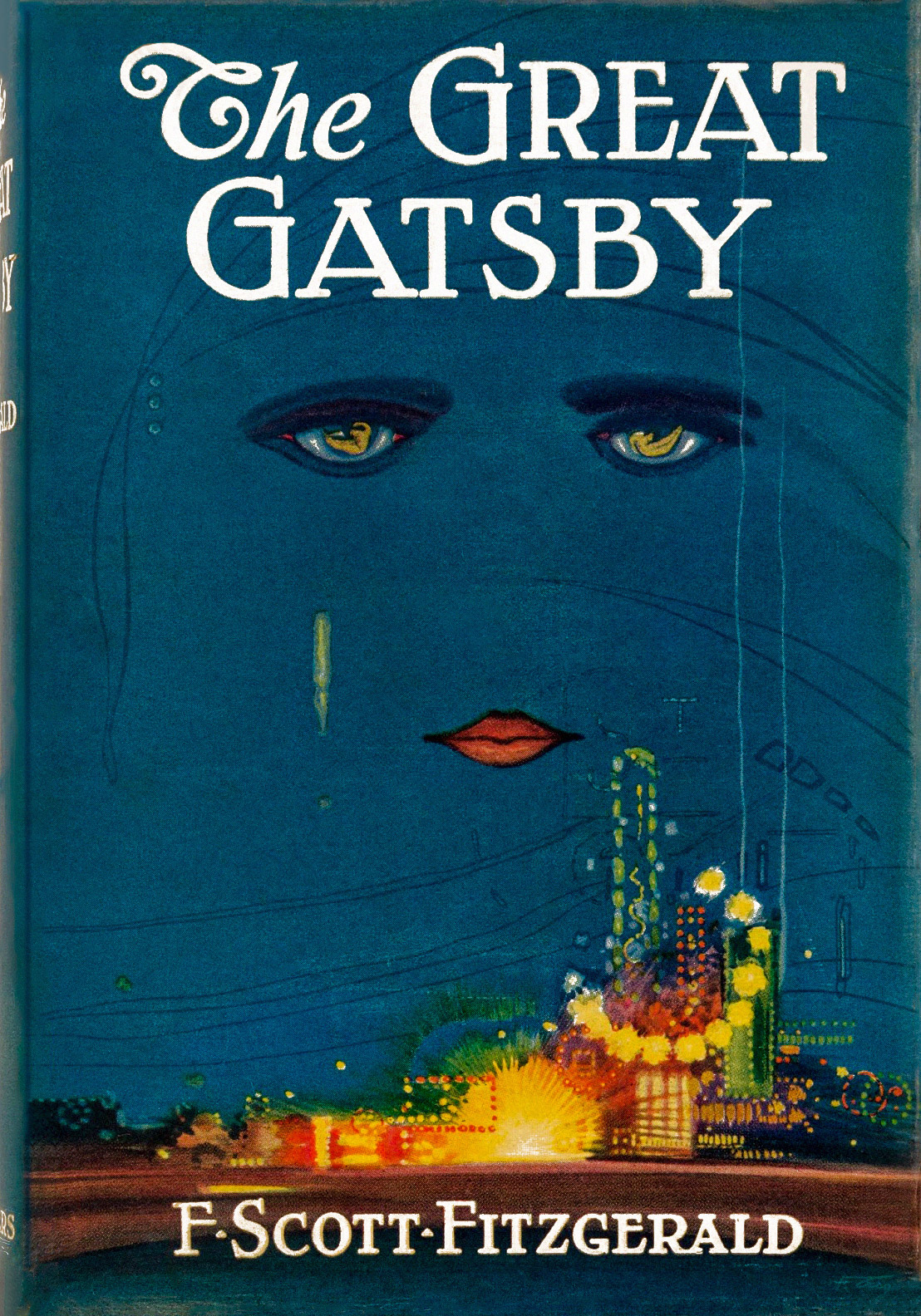
Sua's Quick Take
Honestly, The Great Gatsby looks like a love story from far away. Up close, it is about money, class, self-invention, and the dangerous belief that the past can be bought back if you make the party bright enough.
What the Book Is Really About
F. Scott Fitzgerald's novel is short, elegant, and quietly brutal. It follows Jay Gatsby, a self-made millionaire who builds a glittering life around one hope: that Daisy Buchanan, the woman he loved before the war, will return to him and erase the years between them.
But the book is not simply asking whether Daisy loves Gatsby. It is asking what happens when a person confuses love with a dream, wealth with belonging, and performance with identity. Gatsby can buy the mansion, the shirts, the parties, and the champagne. He cannot buy his way into the old-money world Daisy inhabits.
Plot Summary
1. Nick Carraway arrives in West Egg
The novel is narrated by Nick Carraway, a young man from the Midwest who moves east after World War I to learn the bond business. He rents a modest house in West Egg, Long Island, a wealthy but socially insecure area associated with new money. Once you notice that social insecurity, the parties start to look different.
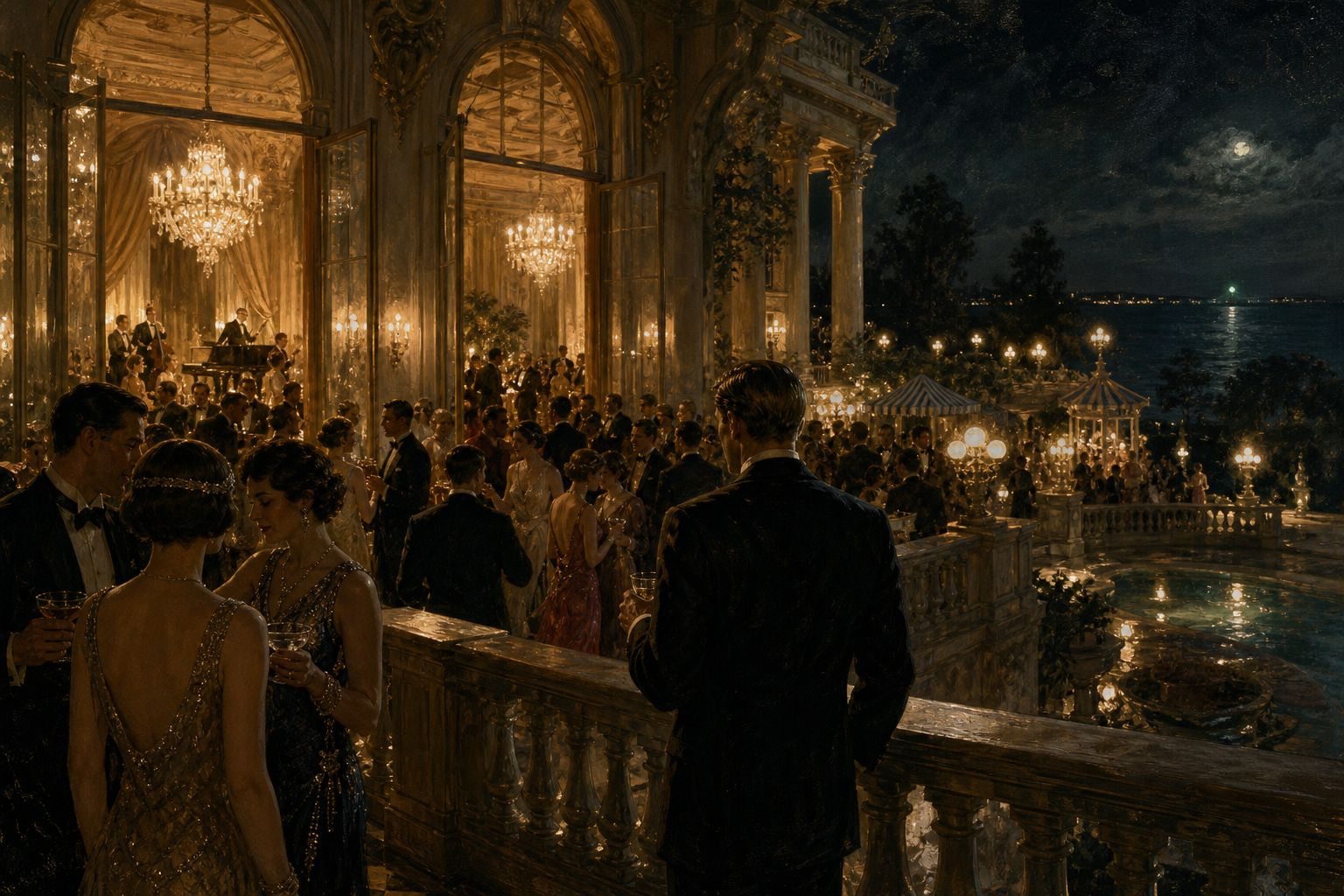
Next door is a huge mansion owned by Jay Gatsby. Nick does not know Gatsby at first. He only sees the parties: music, cars, strangers, champagne, and rumors. Gatsby's house seems to glow every weekend, but the man himself remains strangely hidden.
At first, Gatsby feels less like a person than a presence. Nick encounters him through lights, music, expensive cars, and voices drifting across the lawn. The house is always open, but the host is almost absent. That absence creates the first real pull of the story: what kind of man builds such a huge stage and then refuses to stand clearly at the center of it? From the start, Gatsby feels like a signal left on for someone else.
Across the bay is East Egg, home to older and more established wealth. Nick's cousin Daisy Buchanan lives there with her husband, Tom. Their house is beautiful, but the marriage inside it is already damaged. Tom is rich, powerful, racist, physically imposing, and openly unfaithful. Daisy is charming and restless, with a voice that seems to promise ease and privilege.
Nick visits Tom and Daisy and quickly learns that Tom has a mistress. The scene introduces the novel's basic pattern: beauty on the surface, carelessness underneath.
That first dinner also pulls Nick into the moral atmosphere of the book. Daisy speaks with charm, but her charm keeps brushing against despair. Her remark about wanting her daughter to be a "beautiful little fool" is not simple ignorance. It suggests that Daisy understands more than she wants to admit, and that she has learned to survive by turning knowledge into style.
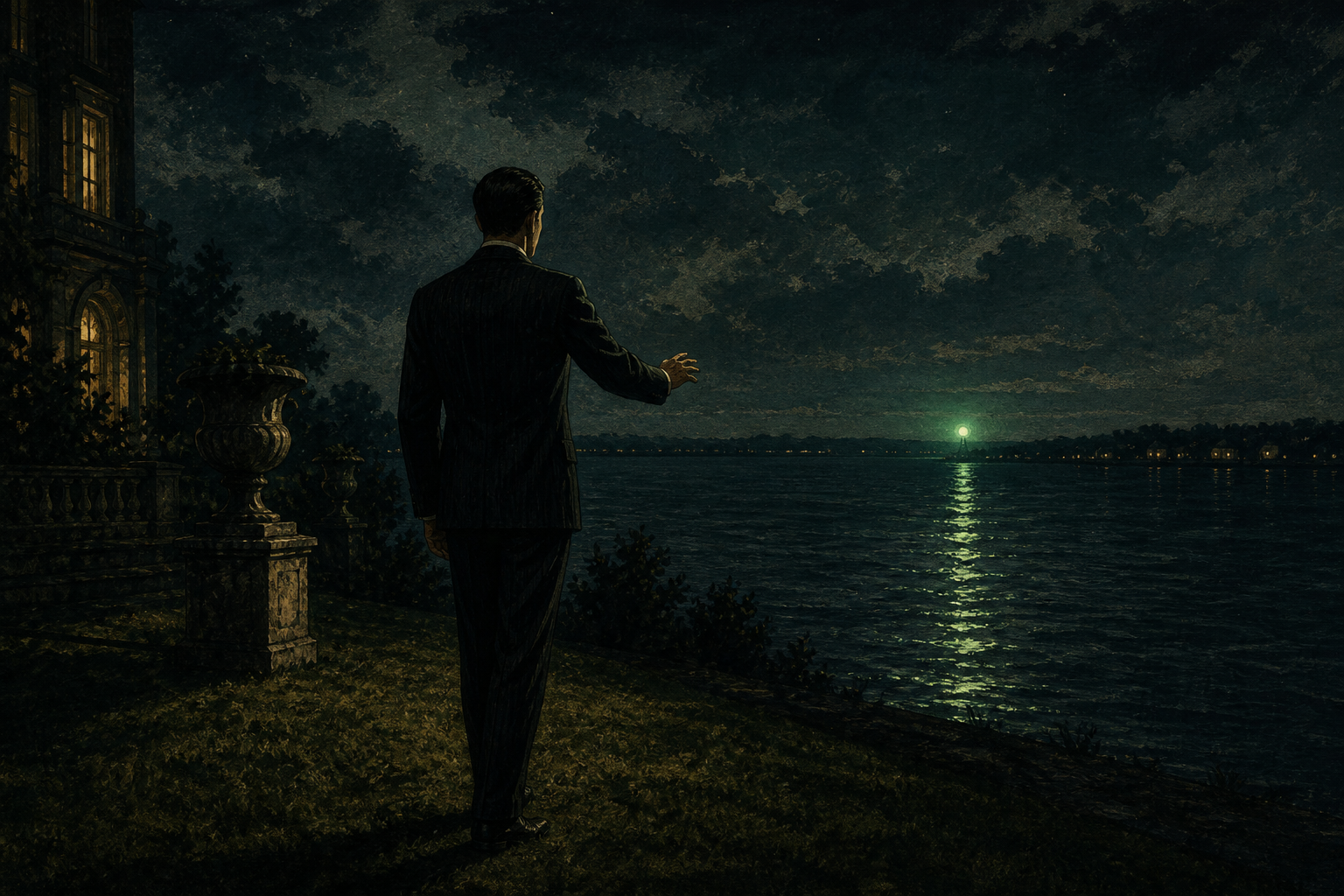
Tom, meanwhile, exposes the uglier side of inherited power. He talks confidently, interrupts people, and treats his prejudices as intellectual positions. Even before Gatsby enters the story directly, Fitzgerald has already shown the world Gatsby wants to enter: polished, rich, and rotten beneath the polish. At the end of this section, Nick sees Gatsby standing outside in the dark, reaching toward a small green light across the bay. Nick does not yet know what it means, but the image tells us that Gatsby's real life is aimed at something distant and almost impossible to touch.
The scene is powerful because almost nothing happens. Gatsby does not call out, cross the water, or explain himself. He only reaches. The green light therefore feels less like a destination than a visible measure of distance.
2. Gatsby's parties and the mystery around him
Nick eventually receives an invitation to one of Gatsby's parties. The party feels almost unreal. Guests arrive without knowing the host. They drink, dance, gossip, and invent stories about Gatsby. Some say he was a German spy. Others claim he killed a man.
When Nick finally meets Gatsby, the man is not what the rumors suggest. He is polite, controlled, and almost too carefully charming. His famous smile seems to offer complete understanding, as if he can make each person feel specially seen.
But Gatsby is not throwing parties because he loves crowds. He is waiting for one person: Daisy Buchanan. Gatsby hopes that Daisy will wander into his house one night, see what he has become, and return to him.
Once we know this, the parties change shape. What looked like excess becomes a signal. And honestly, it is lonely. The orchestra, the champagne, the laughter, and the rumors are all lights left burning in case Daisy happens to notice. Gatsby gathers crowds, but he is searching for one face inside them.
Two secondary figures make this section richer. Jordan Baker gives Nick the missing history between Gatsby and Daisy, turning Nick from observer into go-between. Owl Eyes, the drunken guest in Gatsby's library, notices that Gatsby's books are real. That small discovery matters: Gatsby's world is theatrical, but it is not purely fake. His life is built from performance and genuine longing at the same time.
The early party scenes also include Tom and Myrtle's New York apartment, which offers a harsher version of social performance. Myrtle tries to use Tom as an entrance into a higher class identity. She changes clothes, changes her voice, and behaves as if proximity to Tom can transform her life. Tom lets her perform that fantasy only as long as it serves him. When she pushes too far into his actual marriage, he answers with violence.
Taken together, these scenes make the parties more than decoration. Gatsby performs mystery, Myrtle performs wealth, Tom performs mastery, and Nick performs detachment. Fitzgerald is building a world where almost everyone is staging a version of the self, but the stage is unstable. Money can light the room, but it cannot make the performance true.
3. The green light and the dream of returning to the past
Gatsby and Daisy loved each other before the war, when Gatsby was a young officer without money. After he left, Daisy married Tom Buchanan, a man with the social position and wealth Gatsby lacked.
Gatsby never accepts this as final. He believes that money was the missing piece. If he becomes rich enough, impressive enough, and close enough to Daisy's world, he can restore the past.
The novel later reveals how deliberate Gatsby's self-invention has been. He was born James Gatz, the son of poor farmers, and remakes himself as Jay Gatsby. His time with Dan Cody, a wealthy yacht owner, teaches him the manners and atmosphere of privilege, even though Gatsby does not truly inherit Cody's fortune. Gatsby's elegance is therefore not natural old-money ease. It is a learned performance built out of hunger, discipline, and fantasy.
That is why Gatsby buys a mansion across the bay from Daisy's house. At night, he looks across the water at the small green light at the end of her dock. The light becomes more than a physical object. It is Daisy, the past, the future, status, longing, and the promise that everything lost might still be recovered.
Nick helps arrange a reunion between Gatsby and Daisy. At first Gatsby is almost painfully nervous. The dream he has rehearsed for years has become an actual afternoon, and reality cannot match the perfection of fantasy. Gradually, though, Gatsby and Daisy reconnect.
Gatsby shows Daisy his house. The scene with his shirts is famous because it turns wealth into emotion. Daisy cries over the beautiful shirts, and the moment feels romantic and unsettling at once. Is she moved by Gatsby, by regret, by money, or by the life she might have had? Fitzgerald leaves the answer deliberately unstable.
The reunion is not smooth at first, and that awkwardness matters. It rains, Gatsby panics, and Nick's modest cottage is almost too ordinary for the enormous dream Gatsby has built around this moment. When fantasy finally has to look into the face of an actual person, Gatsby becomes smaller, more fragile, and more human.
After the reunion, Gatsby tries to explain his past to Nick, but his story sounds too polished. Oxford, medals, inherited wealth, European travel: some details are true, some are exaggerated, and some are arranged to make Gatsby appear inevitable rather than invented. Nick is skeptical, but he also senses that Gatsby is not lying casually. Gatsby needs the story because he needs to live inside it.
Once Daisy returns to his life, Gatsby's parties lose their purpose. They were never really for the crowds. They were a signal fire. Yet when Daisy actually attends one, she does not fully admire it. The glitter that Gatsby sees as proof of triumph feels coarse and excessive to her old-money eye. Gatsby has mistaken visibility for acceptance. He thinks Daisy will be won by the scale of his success, but Daisy's world is trained to treat visible striving as a mark of inferiority.
4. Gatsby confronts Tom Buchanan
Gatsby does not only want Daisy to love him now. He wants her to say she never loved Tom. This is the impossible demand at the center of his tragedy. Gatsby wants to delete the years that separated them.
Tom senses the threat. He is not morally superior to Gatsby, but he knows how class power works. Gatsby may have money, but Tom sees him as an outsider: new money, suspicious money, someone trying to enter a world that people like Tom treat as inherited property.
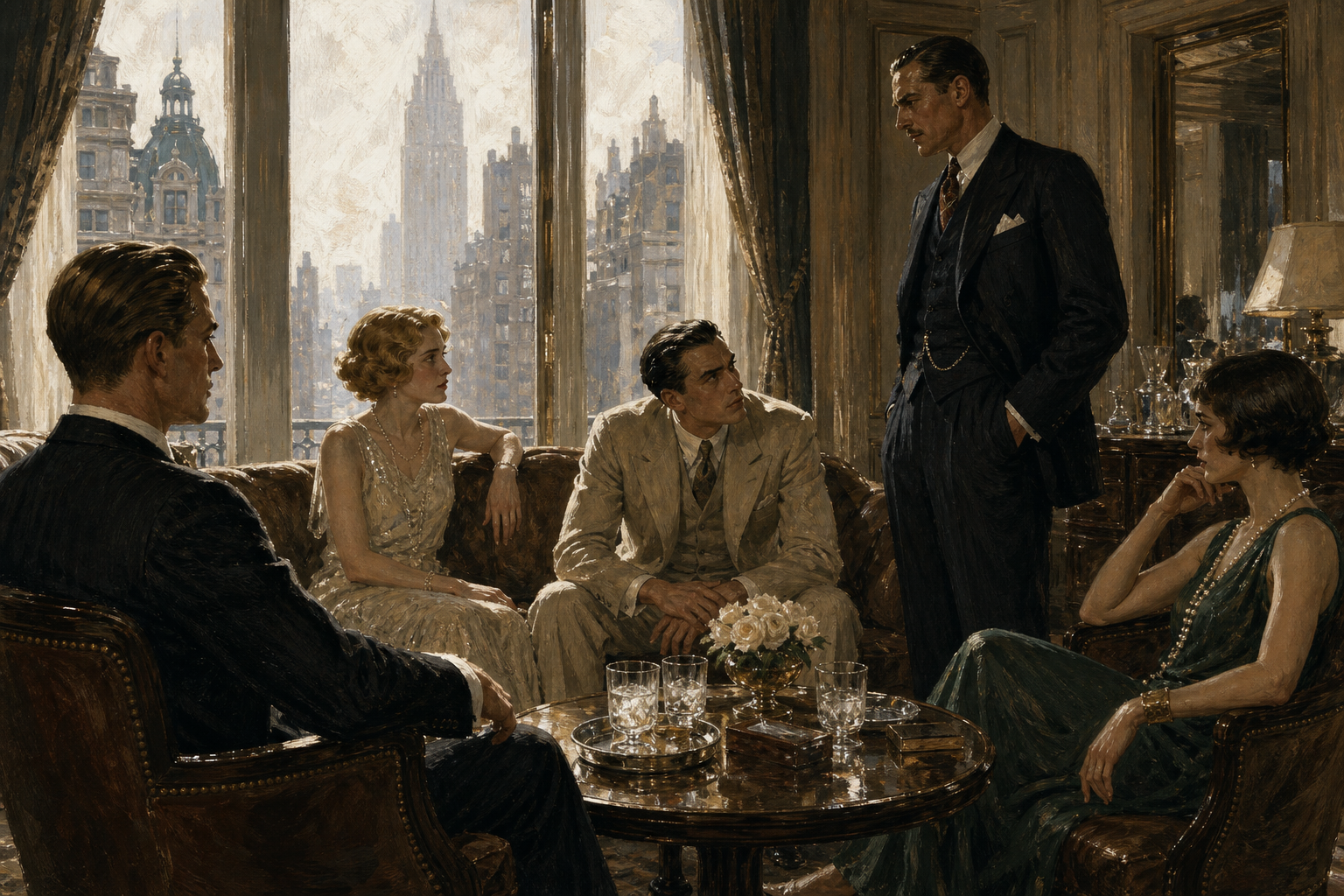
The confrontation comes at the Plaza Hotel in New York on a brutally hot day. Gatsby pushes Daisy to tell Tom that she never loved him. Daisy cannot do it. She loved Gatsby, but she also loved Tom. Her admission breaks the clean story Gatsby has built in his mind.
The heat in the hotel room is not just atmosphere. The city outside feels heavy; the room feels airless. Everyone keeps trying to sound civilized, but the language gets sharper and the masks begin to slip. Fitzgerald uses the pressure of the room to strip Gatsby's dream down to its impossible demand.
Tom then exposes Gatsby's criminal business connections. Gatsby's carefully built image begins to collapse. Daisy retreats emotionally. The scene makes the novel's social critique painfully clear: Gatsby has wealth, but old money still controls the rules of recognition.
Tom's attack centers on Meyer Wolfsheim and Gatsby's connection to bootlegging and shadowy business. That detail matters because Gatsby's romance is funded by the gray economy of Prohibition America. The dream looks beautiful from Daisy's dock, but its money has passed through a much dirtier world.
The Plaza scene matters because a love triangle turns into a class trial. Gatsby asks Daisy to confirm the purity of the past; Tom attacks Gatsby's background, manners, and money. Daisy retreats because the question is no longer only whom she loves. It becomes a question of which world can protect her.
Nick also changes during this scene. He remembers that it is his thirtieth birthday, a detail that makes the atmosphere suddenly older and more exhausted. The East no longer looks like pure possibility. It begins to look like a place where youth, money, and beauty are burning themselves out.
5. The valley of ashes and the road toward tragedy
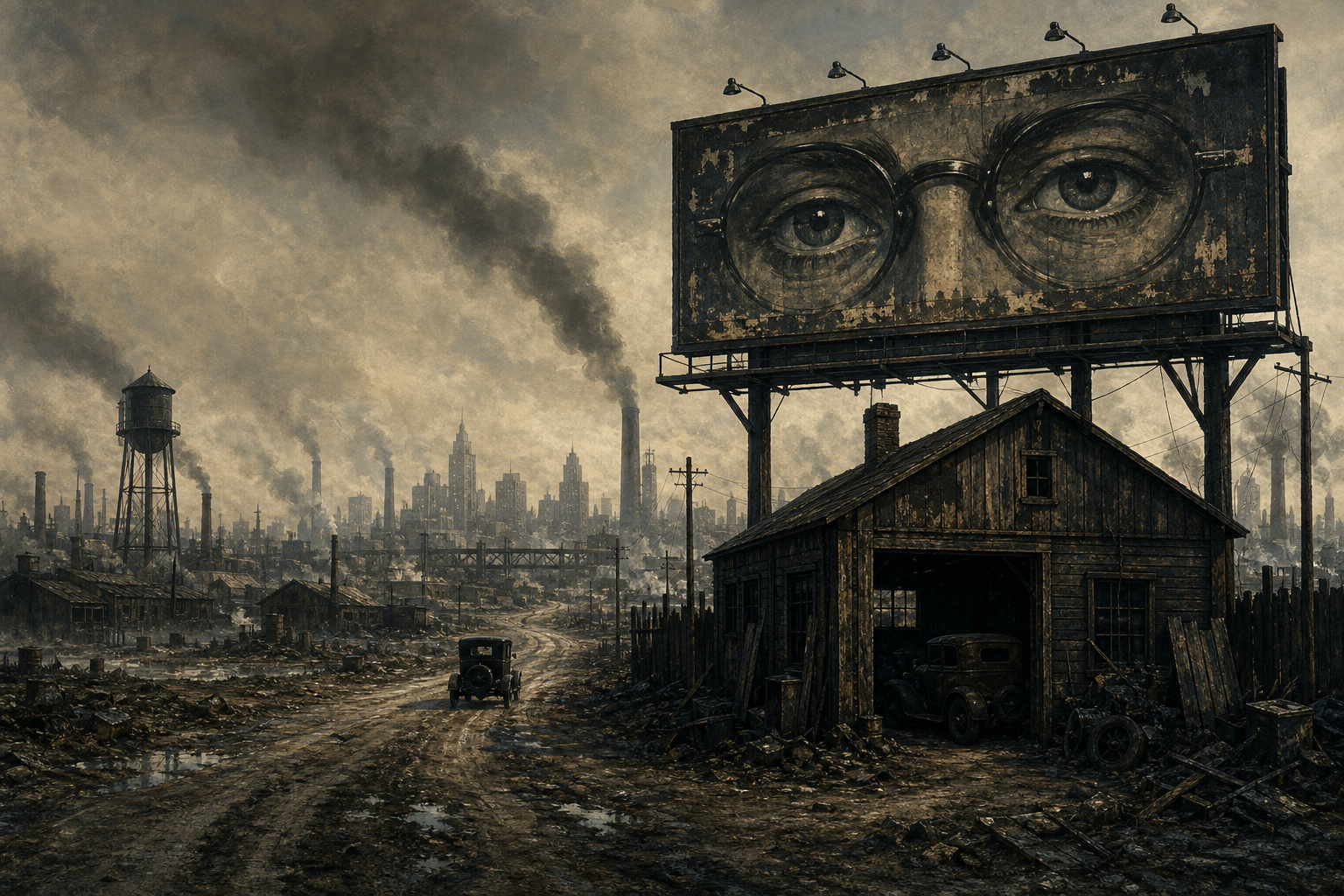
Between the Eggs and New York lies the valley of ashes, a gray industrial wasteland. It is one of the novel's most important settings because it shows what the glittering world depends on but refuses to see.
George and Myrtle Wilson live there. Myrtle is Tom's mistress, and she dreams of escaping her life through him. Tom uses her, but he will never truly bring her into his world. Like Gatsby, Myrtle reaches toward a higher class position. Unlike Gatsby, she has almost no protection.
After the Plaza confrontation, the characters drive back toward Long Island. Daisy, driving Gatsby's car, hits and kills Myrtle. Gatsby decides to protect Daisy by taking responsibility, even though he was not the driver.
The accident happens quickly, but it changes the moral shape of the novel. For Myrtle, the approaching car may look for a second like escape: Tom's world, money, movement, a way out of the garage and the dust. Instead, it brings destruction. The valley of ashes stops being only a symbol and becomes the physical place where the glittering drama produces a body.
Nick begins to see Gatsby more clearly. Gatsby's dream is delusional, but he is still loyal to it. Tom and Daisy, by contrast, are protected by money. They can damage lives and then retreat.
The night after the accident is one of the novel's clearest moral reversals. Gatsby waits outside Daisy's house, ready to protect her if Tom becomes violent. But Nick sees Tom and Daisy inside, sitting together at the kitchen table. They are not exactly reconciled in a romantic sense. They are quietly reorganizing their safety.
Gatsby does not understand this. He still believes Daisy will call, confess, choose, and return. His loyalty looks noble, but it is also another form of blindness. He keeps reading Daisy as the woman from his dream, not as the woman who has just retreated into her class position. The crash in the valley of ashes is therefore not only a plot event. It is the moment Gatsby's beautiful fantasy collides with a body, a road, and the social consequences he cannot control.
6. The ending and what it leaves behindThis section contains spoilers.
Gatsby waits for Daisy to call. She does not. His faith in the dream remains almost to the end, but Daisy has already withdrawn into the safety of her marriage and class position.
After Gatsby dies, the crowds who filled his parties disappear. The people who consumed his hospitality do not come to mourn him. Nick is left to handle the aftermath and to recognize the emptiness behind the spectacle.
Nick tries to arrange Gatsby's funeral, but almost no one will help. Wolfsheim keeps his distance. Daisy and Tom have vanished. The party guests do not appear. Gatsby's father, Henry Gatz, does come, and he brings a different view of his son: the young James Gatz who made schedules, dreamed of self-improvement, and wanted a larger life long before Daisy became the center of the dream.
Nick eventually returns to the Midwest. He judges Tom and Daisy as careless people who smash things and people, then retreat into their money. Gatsby is not innocent, but Nick sees something in him that the others lack: an extraordinary capacity for hope. Owl Eyes appearing at the funeral is also important. He cannot redeem the emptiness around Gatsby, but he does register that there was a real person behind the spectacle.
The final image of the novel turns Gatsby's private longing into a broader human condition. We push forward, but we are pulled backward by the past. The green light is no longer just Daisy. It is every future we imagine as if it could repair what time has already taken.
The ending matters because Gatsby is not only abandoned by Daisy. He is abandoned by the social world he tried to enter. Tom and Daisy survive by retreating into money, while Gatsby remains exposed in the dream he built for them. That is why the novel's ending is also its sharpest explanation of the American Dream: the promise of reinvention looks open to everyone, but the old structures of class still decide who is protected and who is expendable.
Major Characters
Jay Gatsby
Self-invention and romantic obsession
Gatsby is a self-invented man. Born James Gatz, he creates a new name, a new manner, a new fortune, and a new mythology around himself. His lies are real, but they are not casual lies. They are part of a desperate project to make a dream visible.
His tragedy is that he cannot separate Daisy from what she represents. He loves her, but he also needs her to confirm that his reinvented life has worked. Gatsby wants not only romance, but time travel.
Nick Carraway
Narrator, observer, and moral judge
Nick claims to reserve judgment, but the whole novel is shaped by his moral response to the people around him. He is fascinated by Gatsby and repelled by the Buchanans.
His final loyalty to Gatsby does not mean Gatsby is morally pure. It means that, in Nick's eyes, Gatsby's dream has more life and vulnerability than the careless privilege surrounding him.
Daisy Buchanan
The dream and the protection of old money
Daisy is often misread as simply shallow. She is more complicated than that, but she is also deeply protected by wealth. She can feel, regret, and hesitate, yet she ultimately chooses safety.
For Gatsby, Daisy is the dream. For the novel, she is also old money made seductive: beautiful, distant, and unwilling to bear the full cost of desire.
Tom Buchanan
Brute privilege and inherited power
Tom represents brute privilege. He is violent, entitled, hypocritical, and secure. He condemns Gatsby's criminality while committing his own moral violations without shame.
He matters because he shows that the old-money world does not need to be admirable in order to remain powerful. It only needs to protect itself.
Jordan Baker and Myrtle Wilson
Performance, escape, and social risk
Jordan is cool, modern, and emotionally evasive. Myrtle is hungry for a life beyond the valley of ashes. They occupy different social positions, but both reveal the novel's interest in performance, desire, and escape.
Myrtle's death is especially important because it exposes the violence hidden behind the upper-class drama. The wealthy characters treat movement between classes as romance or scandal. For Myrtle, the cost is physical and final.
Best Quotes
So we beat on, boats against the current, borne back ceaselessly into the past.
This final sentence gives the novel its deepest shape. Gatsby's backward-looking dream becomes a universal human struggle: we try to move forward, but memory keeps pulling us back.
Can't repeat the past? Why of course you can!
This is Gatsby's entire tragedy in one line. The sentence sounds hopeful, but it is also a refusal to accept reality.
They're a rotten crowd.
Nick says this to Gatsby, and it is one of the few moments when he speaks with complete moral clarity. Gatsby is flawed, but the people around him are worse because they lack responsibility.
Her voice is full of money.
This is one of Fitzgerald's sharpest descriptions of Daisy. Her beauty is inseparable from class. Gatsby is drawn not only to her as a person, but to the world her voice seems to contain.
Major Themes
Dream
The American Dream Turns Hollow
Gatsby rises from poverty, invents himself, and becomes rich, but Fitzgerald separates wealth from belonging. Gatsby can purchase spectacle, not legitimacy.
Time
The Past Cannot Be Repeated
Gatsby does not simply want to be loved. He wants Daisy to undo history. That demand turns romance into denial and prevents him from seeing Daisy as she is now.
Class
Class Is More Than Money
West Egg's new money is visible, anxious, and theatrical. East Egg's old money is quieter and more secure, which makes it harder to challenge.
Image
Image Is Not Truth
The green light, gossip, Gatsby's parties, and Eckleburg's eyes all involve looking. Yet almost no one sees clearly. Gatsby turns himself into an image, and Daisy becomes an image inside his mind.
Fitzgerald and the Jazz Age
Fitzgerald knew the glitter of the 1920s from the inside. The Jazz Age was a period of postwar energy, consumer culture, Prohibition, illegal liquor, fast money, and social performance. The Great Gatsby captures the excitement of that world while exposing its spiritual exhaustion.
That is why the novel still feels modern. Gatsby's parties are not far from social media: crowded, curated, spectacular, and lonely.
Britannica describes The Great Gatsby as Fitzgerald's third novel and one of his highest achievements. That reputation matters, but the stronger reason to read it is the novel's double vision. It makes Gatsby's dream beautiful enough to understand and corrupt enough to distrust. The result is not a simple warning against ambition, but a study of what happens when ambition needs another person to become a symbol.
Why It Still Matters
The book lasts because Gatsby's green light keeps changing shape. For one reader, it may be a person. For another, a school, a job, a house, a social class, a version of the self that always seems just out of reach.
Fitzgerald's warning is not that dreams are foolish. It is that dreams become dangerous when they require us to stop seeing people clearly.
FAQ: Summary, Ending, and Symbols
What is The Great Gatsby about?
The Great Gatsby is about Jay Gatsby, a self-made millionaire who tries to win back Daisy Buchanan, the woman he loved before the war. On the surface, it is a story of romance and wealth. Underneath, it is a tragedy about class, performance, memory, and the belief that money can repair the past.
What does the green light symbolize?
The green light first symbolizes Daisy because it shines at the end of her dock. As the novel develops, it also comes to represent Gatsby's dream, the future, social arrival, and the American Dream itself. It is powerful because it looks close enough to reach, while remaining across the water.
Why is the ending of The Great Gatsby important?
The ending shows the difference between Gatsby's vulnerable dream and the protection enjoyed by old money. Gatsby remains loyal to Daisy and to his fantasy of the past, but Daisy and Tom retreat into their wealth. The result turns a love story into a social critique.
Read Next
Read Pride and Prejudice for another classic about love and class, The Scarlet Letter for moral pressure in American fiction, and The Awakening for a very different story about desire, society, and selfhood.
Adaptations
- 1974 film: leans into period elegance and romantic restraint.
- Baz Luhrmann's 2013 film: turns the Jazz Age into a louder spectacle of music, speed, and excess.
- TV, radio, and stage adaptations: each version reinterprets Gatsby's parties, the green light, and the class tragedy in a different medium.