Twenty Years After Study Guide - AP Lit, SAT Reading, Close Reading, and Essay Practice
A practical guide for AP English Literature, SAT Reading, IB English, and school essays, with key passages, literary devices, practice questions, and essay-ready thesis work.
This study guide is built for students who need to discuss Twenty Years After with textual evidence. If you want the full plot explanation first, start with the main article.
Who This Guide Is For
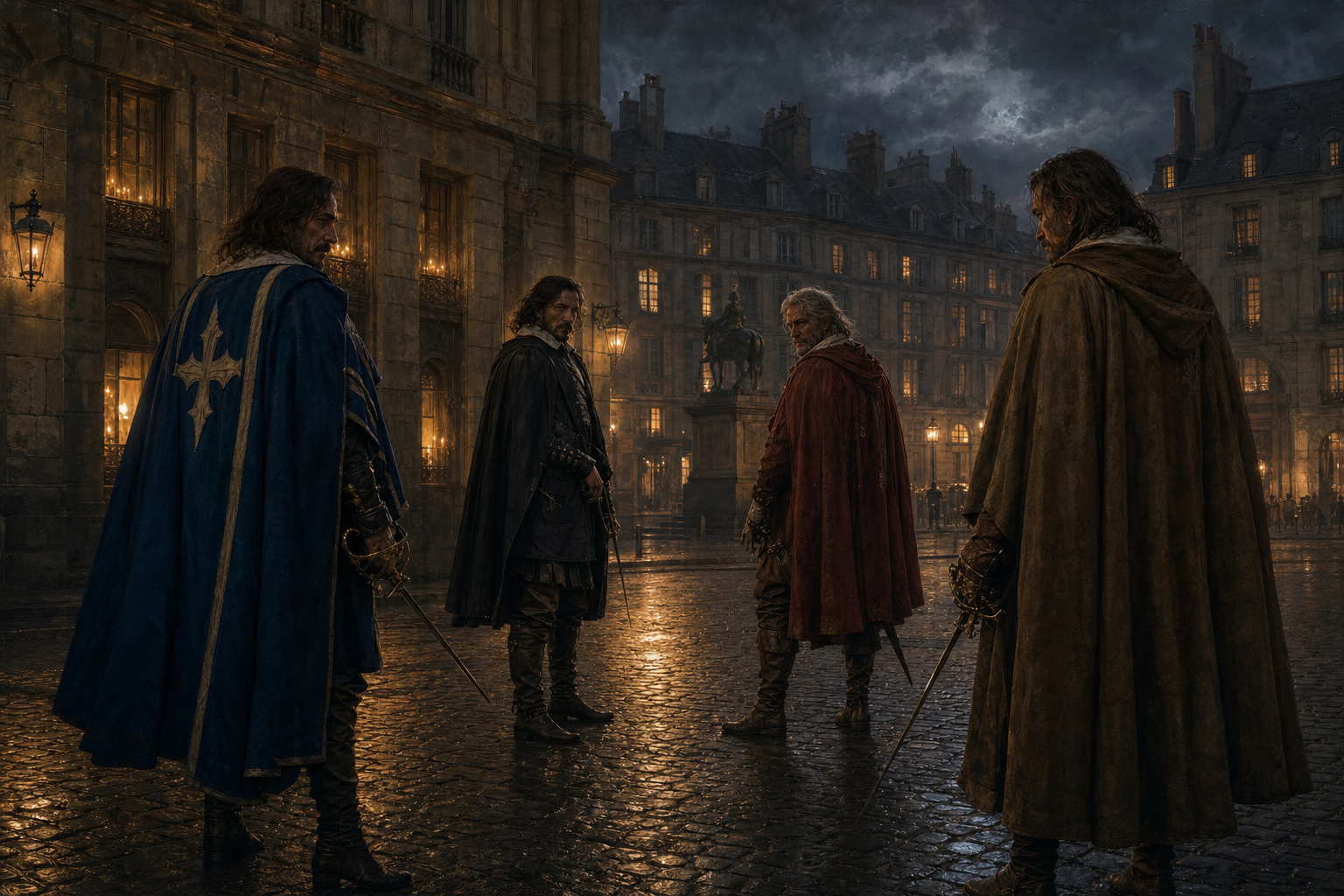
This guide is for AP English Literature, SAT Reading, IB English, and school essay work on Dumas and Maquet's historical adventure. The goal is not to memorize every intrigue of the Fronde. The goal is to explain how the novel uses sequel structure, aging heroes, political division, revenge, and historical spectacle to test the meaning of loyalty.
By the end, you should be able to:
- explain how the sequel changes the meaning of the musketeers' friendship
- use short passages about time, service, politics, and separation
- discuss D'Artagnan, Athos, Porthos, and Aramis as different models of loyalty
- connect the Fronde and English Civil War to the novel's moral pressure
- answer SAT-style questions about inference, function, tone, and diction
1. Quick Review
- Original title: Twenty Years After
- Authors: Alexandre Dumas and Auguste Maquet
- Published: serialized in 1845
- Main settings: Paris, Vincennes, Bragelonne, English Civil War London, Whitehall, the sea, Rueil, and Saint-Germain
- Series position: second D'Artagnan romance, after The Three Musketeers
- Central conflict: the old friends reunite in a Europe where political service, conscience, ambition, and revenge divide them
- Core themes: aging friendship, loyalty, political compromise, consequence, honor, class ambition, historical change
- Common exam angles: sequel structure, character foils, historical setting, tonal mixture, revenge plot, aphoristic narration
One-sentence summary:
Twenty years after their youthful adventures, the four musketeers reunite in a world of civil war and political compromise, where friendship remains real but no longer simple.
2. Plot Structure for Exams
Exposition
Mazarin governs anxiously under Anne of Austria while Paris turns toward the Fronde. D'Artagnan, still under-rewarded after twenty years, is recruited because he has the old courage and practical intelligence Mazarin needs.
Reunion and Division
D'Artagnan seeks Aramis, Porthos, and Athos. Aramis is tied to church and Frondeur intrigue, Porthos wants a title, and Athos is focused on honor and Raoul. The friends reunite emotionally, but politically they stand on different sides.
French Intrigue
The escape of the Duc de Beaufort and the unrest around Paris show that political action is both comic and dangerous. The four friends are repeatedly pulled between friendship and service.
English Crisis
Henrietta Maria seeks help for Charles I. The musketeers become involved in desperate attempts to save the king, but the trial and execution reveal that public history can defeat private heroism.
Revenge and Return
Mordaunt, Milady's son, pursues revenge. The sea episode forces the men to face the consequences of old actions. Back in France, they bargain with Mazarin, win limited rewards, and separate again.
Exam point: avoid writing that the novel is only "adventure." A stronger claim explains how adventure becomes a way to test political loyalty, aging, and moral consequence.
3. Key Original Passages for Close Reading
These passages are short enough to use in essays, but each one opens a larger issue: time, friendship, political service, consequence, or the limits of heroism. Read for speaker, situation, diction, syntax, and placement in the sequel.
Passage 1: twenty years in service
I have been a captain in the queen's guards for twenty years.
Context: Early in the novel, royal officers and Mazarin's circle discuss service, loyalty, and command while Paris grows unstable.
Close reading: The phrase "twenty years" turns service into duration and frustration. Time is not background; it is evidence of loyalty and also a measure of under-reward.
Essay use: Use this passage for arguments about aging heroes, delayed recognition, and the way political systems consume loyal men.
Passage 2: the Fronde named
My lord, Fronde is the name the discontented give to their party.
Context: Mazarin learns how street language, mockery, and factional identity are forming around opposition to him.
Close reading: "The discontented" turns politics into mood before doctrine. The naming of a party shows how language gives unrest a public shape.
Essay use: Use this passage to discuss historical setting, political theater, and the novel's interest in slogans and public feeling.
Passage 3: the old dinner
The second interview between the former musketeers was not so formal and threatening as the first.
Context: The friends try to recover their old ease around a supper table after discovering that politics has separated them.
Close reading: "Former musketeers" and "not so formal" both matter. The line marks continuity and distance at once: they are still themselves, but the old identity now belongs partly to the past.
Essay use: Use it for sequel structure, friendship under pressure, and the way Dumas stages reunion as negotiation.
Passage 4: past and future
Oh! the past is another thing, said Athos, sighing; the past and the future.
Context: During the reunion dinner, Athos's conscience turns from old adventures toward Milady, Mordaunt, and Raoul.
Close reading: The paired phrase "past and future" makes Athos the character most aware of consequence. He cannot isolate old violence from future cost.
Essay use: Use it for Athos, memory, moral burden, and the novel's treatment of inherited consequences.
Passage 5: public death
These men are going to behead your father. Do not forget that.
Context: Charles I speaks to his young son before his execution.
Close reading: The directness of "behead your father" strips monarchy of ceremony and turns political violence into family trauma. "Do not forget" makes memory a duty.
Essay use: Use it for the English Civil War chapters, royalist pathos, public history, and private grief.
Passage 6: success and sleeplessness
When we arrive at the summit of our wishes, success has usually the power to drive away sleep.
Context: Near the conclusion, D'Artagnan and Porthos have won long-desired rewards but cannot sleep.
Close reading: The aphoristic narrator complicates triumph. "Summit" suggests achievement, while sleeplessness suggests continuing restlessness.
Essay use: Use it for ambition, reward, comic realism, and endings that refuse perfect closure.
Passage 7: uncertain parting
Then they departed, without knowing whether they would ever see each other again.
Context: The four friends separate at the end after surviving political danger and personal revenge.
Close reading: The sentence is plain, but its emotional force comes from uncertainty. The old brotherhood survives, yet time and history still have power over it.
Essay use: Use it for endings, aging friendship, sequel structure, and mature loyalty.
4. Close Reading Procedure
Close reading Twenty Years After means tracking how adventure language changes when the heroes are older. Ask what the scene is doing with time: is it recalling the old musketeer bond, showing a new political pressure, or letting an old action return as consequence?
Focus first on role and obligation. D'Artagnan often speaks as a soldier and career man. Athos speaks as father and noble conscience. Porthos speaks through appetite, pride, and bodily courage. Aramis speaks through indirection and design. Their different voices create the novel's political and moral map.
Then identify the historical pressure around the passage. A street in Paris, a prison at Vincennes, a court in London, a scaffold at Whitehall, or a boat at sea is never only scenery. Setting turns private action into historical action.
Finally, convert the observation into a claim. Do not stop with "the friends are loyal." Ask what kind of loyalty is being tested and what it costs.
Worked example:
Through the plain uncertainty of "whether they would ever see each other again," Dumas and Maquet turn the musketeers' friendship from youthful certainty into mature loyalty, suggesting that the bond matters because it survives time rather than escaping it.
5. Why Literary Devices Matter
Sequel structure: recognition with change
The novel depends on readers remembering the earlier friendship, then noticing how time has altered it. Use sequel structure to argue that the book studies aging rather than merely repeating adventure.
Foil structure: four versions of loyalty
D'Artagnan, Athos, Porthos, and Aramis are foils. Each values loyalty, but each attaches it to a different object: career, conscience, status, or strategy.
Historical setting: private action inside public crisis
The Fronde and English Civil War are not decorative backgrounds. They create situations where swordplay and cleverness meet institutions, crowds, trials, executions, and treaties.
Tonal mixture: comedy beside tragedy
Porthos's vanity and D'Artagnan's jokes sit beside Charles I's execution and Mordaunt's revenge. This tonal mixture is central to Dumas: life stays comic even when history turns brutal.
Revenge plot: consequence made personal
Mordaunt makes the past visible. He converts Milady's execution from a finished judgment into a living consequence.
Aphoristic narration: adventure with commentary
The narrator often pauses for general observations about success, fortune, fear, and politics. These sentences help turn fast plot into moral reflection.
6. Turning Character Analysis into Essay Language
Use the character cards as starting points for arguments. A strong essay sentence should connect role, pressure, technique, and theme.
D'Artagnan
career loyalty and tactical intelligence
D'Artagnan serves the crown and Mazarin because service is his life path, but he also uses that service to pursue delayed recognition.
Essay sentence: D'Artagnan shows that loyalty in the sequel is practical as well as emotional, shaped by career, speed, and the need to survive politics.
Athos
conscience, fatherhood, and memory
Athos carries the past more heavily than the others and measures action by honor rather than reward.
Essay sentence: Through Athos, the novel turns adventure into moral accounting, asking whether past violence can be answered by future nobility.
Porthos
embodied friendship and social ambition
Porthos wants a title, but his comic vanity coexists with courage and deep affection.
Essay sentence: Porthos keeps the novel's politics grounded in bodily loyalty, appetite, and the human desire to be publicly recognized.
Aramis
strategy, secrecy, and divided sincerity
Aramis is both loyal friend and political operator, making him difficult to reduce to either faithless schemer or pure comrade.
Essay sentence: Aramis complicates friendship by showing how affection can coexist with manipulation and political ambition.
Mordaunt
revenge as inherited consequence
Mordaunt's violence is villainous, but his existence forces the earlier Milady judgment back into view.
Essay sentence: Mordaunt makes consequence personal, turning the musketeers' old victory into a new moral threat.
7. Thesis Builder for Major Themes
Friendship
Loyalty After Division
Weak thesis: The musketeers are still friends.
Strong thesis: Dumas and Maquet present friendship as a bond tested by age and politics, valuable because it returns after division rather than because it remains untouched.
Politics
History Limits Heroism
Weak thesis: The book has political events.
Strong thesis: By placing the musketeers inside the Fronde and the English Civil War, the novel shows that private courage can act nobly without always being able to redirect history.
Memory
The Past Is Not Finished
Weak thesis: Mordaunt wants revenge.
Strong thesis: Mordaunt transforms the earlier Milady plot into inherited consequence, forcing the heroes to confront what their youthful certainty left unresolved.
Ambition
Reward and Restlessness
Weak thesis: D'Artagnan wants a promotion.
Strong thesis: The conclusion treats promotion and nobility as satisfying but incomplete rewards, showing that ambition can survive even the achievement it seeks.
8. SAT Reading Sample
These are SAT-style practice questions, not official College Board questions. Each question is tied to a specific scene, passage, or recurring device from the work.
Question 1
The phrase "twenty years in the queen's service" mainly emphasizes:
- A. D'Artagnan's lack of military training
- B. the comic uselessness of royal guards
- C. the long duration of service without full reward
- D. the end of monarchy in France
Answer: C. The phrase turns time into evidence: D'Artagnan and other loyal officers have served for decades, but recognition remains uncertain. A and B contradict his competence, while D misstates the French political situation.
Question 2
When the Fronde is described as "the name the discontented give to their party," the wording suggests that political identity begins with:
- A. public feeling and shared grievance
- B. a completed military constitution
- C. foreign conquest
- D. private romance
Answer: A. The sentence links factional identity to discontent before formal ideology. B, C, and D do not fit the street-level unrest around Mazarin.
Question 3
The reunion dinner is important because it:
- A. proves the friends have no disagreements
- B. removes politics from the novel
- C. shows Porthos has lost his appetite
- D. briefly restores old intimacy while exposing old guilt
Answer: D. The dinner revives the old rhythm of the group, but it also brings back Milady, Mordaunt, and Athos's troubled conscience. A is too simple, B is false, and C reverses Porthos's characterization.
Question 4
Athos's phrase "the past and the future" connects memory with:
- A. comic relief only
- B. consequence across generations
- C. geographical description
- D. Mazarin's wealth
Answer: B. Athos is thinking about old guilt and Raoul's future, so the phrase links what has been done with what may be inherited. The other choices miss the moral pressure of the scene.
Question 5
Mordaunt's role in the novel is best described as:
- A. the past returning as revenge
- B. a neutral historian
- C. a comic servant
- D. the king of France
Answer: A. As Milady's son, Mordaunt personalizes the consequences of the earlier book. He is neither neutral nor comic, and he is unrelated to the French throne.
Question 6
The English Civil War chapters show that heroic rescue:
- A. always succeeds when friends cooperate
- B. is irrelevant to political history
- C. depends only on Porthos's appetite
- D. can be noble yet unable to stop public events
Answer: D. The musketeers act bravely, but Charles I is still tried and executed. The point is not the uselessness of courage, but its limits under historical machinery.
Question 7
Charles's words to his son before death mainly turn politics into:
- A. a discussion of food
- B. family trauma and remembered duty
- C. a joke about soldiers
- D. a map of Paris
Answer: B. The command not to forget makes public execution a private inheritance for the child. A, C, and D ignore the emotional and political function of the scene.
Question 8
Porthos's desire for a barony most clearly reveals:
- A. hatred of all friendship
- B. rejection of physical courage
- C. social ambition mixed with comic vanity
- D. secret loyalty to Cromwell
Answer: C. Porthos wants rank that matches his self-image. The desire is funny, but it also reveals a real need for recognition.
Question 9
Aramis functions as a foil to D'Artagnan because Aramis tends to favor:
- A. open military command over strategy
- B. hidden influence and political design
- C. complete withdrawal from intrigue
- D. ignorance of all factions
Answer: B. D'Artagnan often acts directly and tactically, while Aramis works through church connections, secrecy, and political arrangement.
Question 10
The line "success has usually the power to drive away sleep" implies that achievement:
- A. ends desire forever
- B. proves all politics moral
- C. makes friendship unnecessary
- D. can produce restlessness rather than peace
Answer: D. The aphorism complicates triumph by showing that fulfilled wishes can excite anxiety and renewed desire.
Question 11
The novel's use of Mazarin instead of Richelieu helps create:
- A. a contrast between anxious calculation and grand authority
- B. a setting without political power
- C. a purely romantic subplot
- D. a narrator who never comments
Answer: A. Mazarin's smaller, more cautious style is repeatedly measured against Richelieu's shadow, creating political and tonal contrast.
Question 12
Raoul matters structurally because he:
- A. replaces all four musketeers immediately
- B. has no connection to Athos
- C. carries the future of honor beyond the older generation
- D. leads the Fronde from the first chapter
Answer: C. Raoul is Athos's son and future-oriented hope, allowing the novel to contrast youthful honor with older compromise.
Question 13
The sea episode with Mordaunt mainly tests:
- A. whether the friends can still act together under mortal pressure
- B. whether Mazarin can cook
- C. whether Paris has enough taxes
- D. whether Charles becomes king of France
Answer: A. The danger at sea forces the old teamwork back into action while also confronting the men with revenge and consequence.
Question 14
The phrase "former musketeers" is significant because it:
- A. denies that the men ever knew each other
- B. marks both continuity and distance from youth
- C. names a new school
- D. describes Cromwell's army
Answer: B. They remain the same beloved figures, but the word "former" signals that time has changed their official role and emotional world.
Question 15
The Fronde setting most strongly supports which theme?
- A. Nature heals all conflict
- B. Childhood has no political meaning
- C. Loyalty becomes difficult when public factions multiply
- D. Wealth solves conscience
Answer: C. The unrest divides friends and makes service morally complicated. The other choices do not describe the political pressure of the plot.
Question 16
D'Artagnan's final wish to keep his old room suggests:
- A. practical awareness that fortune can change
- B. complete retirement from action
- C. contempt for all memory
- D. fear of ever seeing Porthos again
Answer: A. Even after promotion, D'Artagnan knows reversal is possible. The detail captures his practical intelligence and restless caution.
Question 17
The best description of the novel's tone is:
- A. only tragic from beginning to end
- B. purely comic with no danger
- C. documentary without adventure
- D. comic, nostalgic, political, and tragic at once
Answer: D. Dumas combines Porthos's comedy, reunion nostalgia, political intrigue, execution tragedy, and revenge melodrama.
Question 18
Athos differs from D'Artagnan most clearly in his emphasis on:
- A. conscience and inherited responsibility
- B. salary alone
- C. comic appetite
- D. indifference to Raoul
Answer: A. Athos is shaped by moral memory and fatherhood, while D'Artagnan is more tactical and career-oriented.
Question 19
Why does the book's ending separate the friends again?
- A. To show that friendship has been false all along
- B. To mature the old bond by placing it inside time and duty
- C. To erase all sequel possibilities
- D. To prove Porthos dislikes titles
Answer: B. The separation shows that the friendship remains meaningful even when each man returns to his own obligations. It is not a denial of the bond.
Question 20
Which claim best captures the novel as historical fiction?
- A. It uses public events to test private loyalty and moral action.
- B. It avoids all real political references.
- C. It treats history as less important than clothing.
- D. It argues that friendship prevents all executions.
Answer: A. The Fronde and English Civil War shape the plot and force the characters to act within public crises they cannot fully control.
9. AP Lit Essay Questions
Use these AP Lit-style practice questions to turn a specific scene into a thesis, outline, and evidence-based commentary.
Essay Question 1
Analyze how Twenty Years After uses sequel structure to change the meaning of friendship from youthful unity to mature loyalty. Use at least two of the four musketeers as evidence.
Essay Question 2
D'Artagnan serves Mazarin while often judging him. Explain how the novel uses D'Artagnan to explore practical loyalty, ambition, and political compromise.
Essay Question 3
Athos is shaped by fatherhood and memory. Analyze how his concern for Raoul and his guilt over Milady alter the adventure plot's moral tone.
Essay Question 4
Porthos is often comic, but his desire for a title reveals a serious social pressure. Analyze how Dumas and Maquet use Porthos to connect comedy with recognition.
Essay Question 5
Aramis combines religious office, friendship, and intrigue. Analyze how his character complicates simple definitions of loyalty.
Essay Question 6
The Fronde turns Paris into a space of rumor, slogans, street pressure, and political bargaining. Analyze how the setting makes private friendship politically difficult.
Essay Question 7
The escape of Beaufort mixes comedy, timing, servants, and political risk. Analyze how this episode shows Dumas's method of turning history into adventure.
Essay Question 8
Mordaunt is both villain and consequence. Analyze how his revenge plot forces the musketeers to revisit the moral certainty of their earlier actions.
Essay Question 9
The English Civil War chapters place the musketeers near events they cannot fully control. Analyze how the failed attempt to save Charles I limits the fantasy of heroic action.
Essay Question 10
Choose one scene of reunion or parting. Analyze how Dumas and Maquet use gesture, dialogue, or understatement to show the emotional cost of time.
Essay Question 11
Mazarin is often comic or unimpressive, yet he remains politically effective. Analyze how the novel distinguishes charisma from power.
Essay Question 12
Analyze how Raoul functions as a future-oriented figure in a novel dominated by aging heroes and returning consequences.
Essay Question 13
The novel often places jokes beside death or danger. Analyze how tonal mixture shapes the reader's understanding of adventure.
Essay Question 14
Analyze the significance of prisons and enclosed spaces, such as the Bastille, Vincennes, Whitehall, and Mazarin's oubliettes, in the novel's political imagination.
Essay Question 15
The four friends define success differently. Compare two definitions of success in the novel and explain what each reveals about character.
Essay Question 16
Analyze how Dumas and Maquet use public crowds, from Paris streets to the Whitehall execution, to turn politics into spectacle.
Essay Question 17
The novel repeatedly shows old enemies becoming temporary allies or old friends becoming temporary opponents. Analyze what this pattern suggests about time and political change.
Essay Question 18
Choose a passage in which the narrator offers a general observation. Analyze how aphoristic narration converts adventure into moral reflection.
Essay Question 19
Analyze how the sea episode with Mordaunt tests the musketeers' old teamwork while also exposing the unresolved violence of the past.
Essay Question 20
The conclusion grants rewards but not full closure. Analyze how the ending balances satisfaction, separation, ambition, and uncertainty.
10. Model Thesis Bank
Use these as models, then adapt them to the exact question.
- Dumas and Maquet use sequel structure to show that friendship becomes more meaningful, not less, when it survives age, division, and separate obligations.
- D'Artagnan's service to Mazarin reveals a practical form of loyalty in which ambition and duty are inseparable.
- Athos transforms the adventure plot into moral reckoning because he reads both Raoul and Mordaunt as consequences of the past.
- Porthos's comic desire for a barony exposes the serious human need for public recognition.
- Aramis complicates loyalty by combining sincere affection with secrecy, clerical authority, and political manipulation.
- The Fronde setting turns Paris into a pressure chamber where friendship must operate inside factional conflict.
- Beaufort's escape shows Dumas's talent for converting political history into suspenseful, comic, and practical action.
- Mordaunt makes inherited revenge the form through which the earlier novel's violence returns for judgment.
- The failed rescue of Charles I shows that private courage can be noble even when it cannot stop public history.
- Reunion scenes in the novel are powerful because they restore old intimacy while revealing that time has made restoration incomplete.
- Mazarin's anxious, calculating power proves that political effectiveness does not require grandeur.
- Raoul gives the novel a future beyond nostalgia, embodying Athos's hope that honor can be transmitted without repeating every old mistake.
- The novel's comic-tragic tone makes adventure feel mature, allowing laughter to exist beside execution, civil war, and revenge.
- Enclosed spaces in the novel turn politics into confinement, showing how power controls bodies before it controls loyalty.
- D'Artagnan and Athos define success differently: one seeks earned advancement, while the other seeks moral continuity.
- Public crowds in the novel transform politics into spectacle, making private decisions visible under social pressure.
- The shifting pattern of allies and enemies suggests that time changes political meaning faster than it changes emotional memory.
- Aphoristic narration slows the adventure plot long enough to make success, fortune, and loyalty objects of reflection.
- The sea episode proves that the old teamwork still exists, but it also reveals that survival cannot erase inherited guilt.
- The conclusion satisfies the desire for reward while refusing permanent closure, leaving the musketeers loyal, separated, and still unfinished.
11. Academic Vocabulary for Essays
- sequel structure: a narrative design that depends on earlier character history while showing change over time
- historical fiction: fiction that places invented or dramatized characters inside real historical pressures
- faction: a political group formed around shared interest, grievance, or power
- Fronde: a series of French civil conflicts during the minority of Louis XIV
- royalism: support for monarchy or royal authority
- political spectacle: public events staged or perceived as displays of power
- foil: a character who highlights another character by contrast
- aphorism: a compact general statement about life or human behavior
- consequence: the result or cost of earlier action
- inherited guilt: moral pressure passed from one generation or plot to another
- tonal mixture: the blending of comedy, tragedy, romance, and suspense
- intrigue: secret or complex political maneuvering
- pragmatism: practical action shaped by results rather than ideals alone
- conscience: inward moral judgment
- recognition: public acknowledgment of worth, rank, or service
- nostalgia: longing for an earlier time, often complicated by change
- pathos: emotional appeal through suffering or vulnerability
- legitimacy: accepted right to rule, command, or belong
- compromise: a settlement that gains something while giving up purity or completeness
- closure: the degree to which an ending resolves narrative and emotional tensions