Twenty Years After — The Musketeers Grow Older, Not Safer
A detailed guide to Dumas and Maquet's sequel about aging friendship, civil war, political service, and the cost of loyalty after the adventure is supposed to be over.
Sua's Quick Take
Twenty Years After is what happens when the bright oath of youth has to survive jobs, children, money, politics, grudges, and history. The swordplay is still here, but the sharper drama is that the four friends no longer serve the same cause.
What the Book Is Really About
Alexandre Dumas and Auguste Maquet return to D'Artagnan, Athos, Porthos, and Aramis two decades after The Three Musketeers. The old motto still haunts the story, but the sequel is not built on simple unity. D'Artagnan remains a soldier of the crown, Porthos wants rank, Athos has become a grave father, and Aramis has turned priest, intriguer, and Frondeur. Friendship is still powerful, but it has to negotiate with politics.
The plot moves through France during the Fronde and England during the Civil War. Cardinal Mazarin needs useful men. Anne of Austria needs the monarchy protected. Charles I needs rescue. The musketeers need to decide whether loyalty belongs to king, friend, conscience, reward, or memory. That is why this sequel feels older than the first book. The heroes have not lost courage. They have lost the innocent belief that courage alone can clarify the world.
Plot Summary
1. Mazarin's Paris and D'Artagnan's unfinished career
The novel opens in the Palais Royal under the shadow of Richelieu. Richelieu is dead, but his political machinery has not disappeared. Cardinal Mazarin occupies the old space with less grandeur and more anxiety. Paris is restless. Taxes, resentment, the Parliament of Paris, street songs, and rumors of barricades are beginning to form the Fronde. The young Louis XIV is still a child, Anne of Austria protects the regency, and Mazarin knows that charm and calculation may not be enough if the city turns.
D'Artagnan enters this world not as the reckless youth of the first novel, but as a man who has spent twenty years in service without receiving the advancement he thinks he deserves. He is still brave, practical, and quick-minded. He is also tired of being useful while others become powerful. Mazarin notices him because D'Artagnan has exactly the qualities a nervous minister needs: composure in the street, experience with intrigue, and the ability to act before other men finish planning.
The first task sends D'Artagnan to the Bastille, where he finds Rochefort, an old enemy from the earlier adventures. Dumas turns the reunion into a sign of the sequel's emotional method. Old hatred has cooled into old acquaintance. Men who once tried to destroy one another can now speak almost like veterans from the same campaign. The world has shifted, and the characters must decide which memories still matter.
Mazarin wants D'Artagnan to gather the old musketeers. That request creates the book's central tension. The minister imagines legendary men as tools. D'Artagnan imagines old comrades as possible allies. The reader knows both ideas are incomplete, because twenty years have not preserved the four friends in one political shape.
2. Aramis, Porthos, Athos, and the broken circle
D'Artagnan first seeks Aramis and finds not the romantic musketeer of memory, but the Abbe d'Herblay, a churchman with worldly intelligence and political appetite. Aramis is connected to the Fronde and to aristocratic opposition. He can still fence with words and steel, but now he prefers hidden influence. D'Artagnan sees enough to understand that Aramis cannot simply be recruited for Mazarin.
Porthos is living in wealth and dissatisfaction. He has estates, servants, food, and size enough to impress anyone, yet he wants a title. His comic vanity remains funny, but it also gives Mazarin a point of leverage. Porthos wants to become a baron; D'Artagnan knows how to turn that desire toward service. Their scenes keep the sequel from becoming only dark political fiction. Porthos still brings appetite, literal and social, into every room.
Athos has changed most deeply. As the Comte de la Fere, he has withdrawn into paternal responsibility for Raoul de Bragelonne. The old melancholy has become moral seriousness. Athos does not want reward. He wants honor preserved, his son educated, and the crimes of the past answered by nobler conduct. He and Aramis are drawn toward the Fronde and toward the cause of imprisoned or endangered royalty, not because their politics are simple, but because their code of nobility still matters.
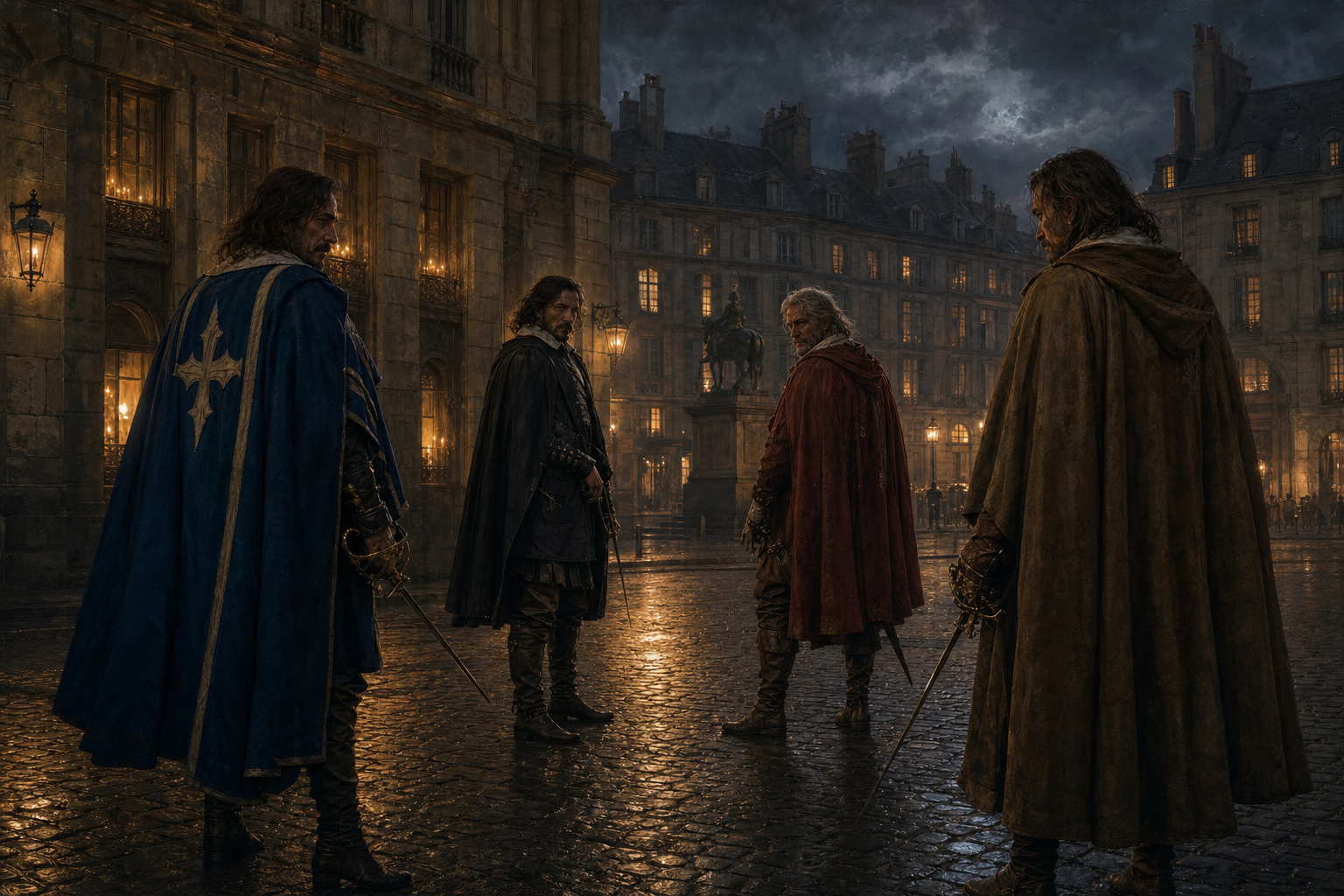
When the four friends finally come together, the reunion is not a clean restoration. They dine, laugh, remember, and briefly recover the rhythm that once made them inseparable. But the past also returns as guilt. The execution of Milady in the first novel has not vanished. Her son, Mordaunt, has grown into an avenger who understands confession, disguise, and murder. The sequel's plot is therefore driven by two kinds of return: the return of friendship and the return of consequences.
3. The Fronde: revolt, escape, and divided service
The Fronde gives the French half of the novel its pressure. Dumas treats politics as street theater, court intrigue, and practical danger at once. Mazarin wants order and money. The Parliament wants influence. The people want relief. Nobles want advantage. The young king is both a child and a symbol. In this world, slogans move faster than arguments.
The Duc de Beaufort becomes one of the first major tests. Imprisoned in Vincennes, he is connected to Frondeur hopes, and his escape becomes a comic-adventure operation full of food, disguise, servants, timing, and nerve. Athos and Aramis help the anti-Mazarin side, while D'Artagnan and Porthos are drawn into Mazarin's service. The result is not simple betrayal. The four friends are not suddenly enemies in their hearts. They are men whose obligations now point in different directions.
This is the strongest structural move in the book. The sequel refuses to pretend that loyalty is easy after youth. D'Artagnan serves the minister because that is where his military career and chance of promotion lie. Porthos follows him because a title may finally crown his wealth. Athos helps royal distress when it appeals to honor. Aramis loves political design and hidden command. Each motive is understandable; none is pure.
The French chapters also introduce Raoul, whose youthful honor contrasts with the older generation's compromises. Raoul's love for Louise de la Valliere is still delicate here, but his real function is broader. He is Athos's answer to time. If the fathers cannot restore the purity of the old oath, perhaps the son can inherit its best part without its sins.
4. England, Charles I, and the failure of heroic rescue
The novel then crosses into the English Civil War. Henrietta Maria seeks help for Charles I, and the musketeers become involved in a rescue effort that feels both thrilling and doomed. The English chapters enlarge the book's political imagination. France's unrest is not isolated; monarchy across Europe is under pressure, and the old codes of kingship, nobility, and service are being tested by new institutions and military power.
D'Artagnan and Porthos may be working from one side, while Athos and Aramis move from another, but the crisis around Charles pulls them back toward shared action. They witness the king's trial and plan desperate interventions. Dumas stages Charles with dignity, especially in the scenes with his children and in the approach to Whitehall. The book's sympathies are royalist, but the more important dramatic effect is that heroism meets history and cannot simply win.
The attempt to save Charles fails. That failure matters because it limits the musketeer fantasy. In the first novel, cleverness, courage, disguise, and speed could change the direction of a queen's honor and a kingdom's diplomacy. Here, those same qualities cannot stop a public execution once political machinery has reached full momentum. Athos's anguish beneath the scaffold gives the adventure plot tragic weight.
Mordaunt intensifies the English sequence. As Milady's son, he is a private vengeance moving through public catastrophe. He murders, disguises himself, pursues the musketeers, and turns inherited grievance into a cold mission. He is not merely a villain added for excitement. He is the past insisting on payment.
5. Mordaunt, the sea, and the cost of old sins
After Charles's execution, the musketeers' conflict with Mordaunt becomes more direct. His revenge is tied to Milady's death, and each of the friends responds differently because each carries the memory differently. Athos feels the moral burden most severely. D'Artagnan sees danger and acts. Porthos returns to physical courage. Aramis intellectualizes guilt and justice. Their reactions turn a melodramatic revenge plot into a study of conscience.
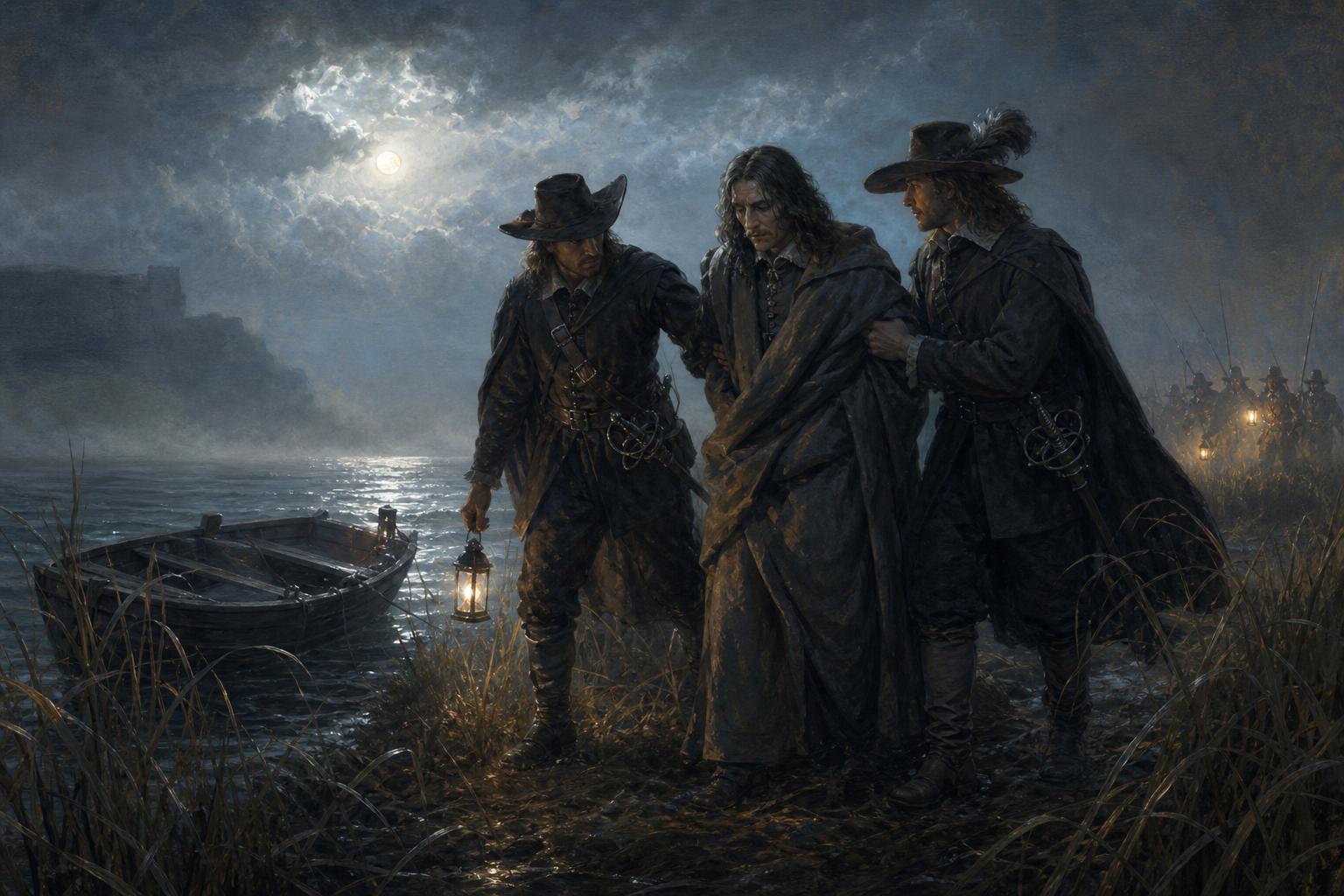
The sea episode, with the skiff and the shipboard danger, is one of the sequel's great adventure movements. Dumas uses darkness, water, fire, and cramped escape to make the old teamwork visible again. The friends still know how to survive together. They read danger quickly, take risks, and trust one another's instincts. Yet survival does not erase the moral ugliness of the confrontation. Mordaunt is monstrous in action, but his existence is also the consequence of a judgment the musketeers once carried out without thinking of the child left behind.
This is where Twenty Years After becomes more than a nostalgic sequel. It asks what happens when youthful certainty ages into memory. The men can still fight, but they can no longer believe every enemy is only an enemy. Athos's response to Milady's son keeps troubling the book because it makes room for pity without surrendering judgment.
6. Return to France and the uneasy settlement
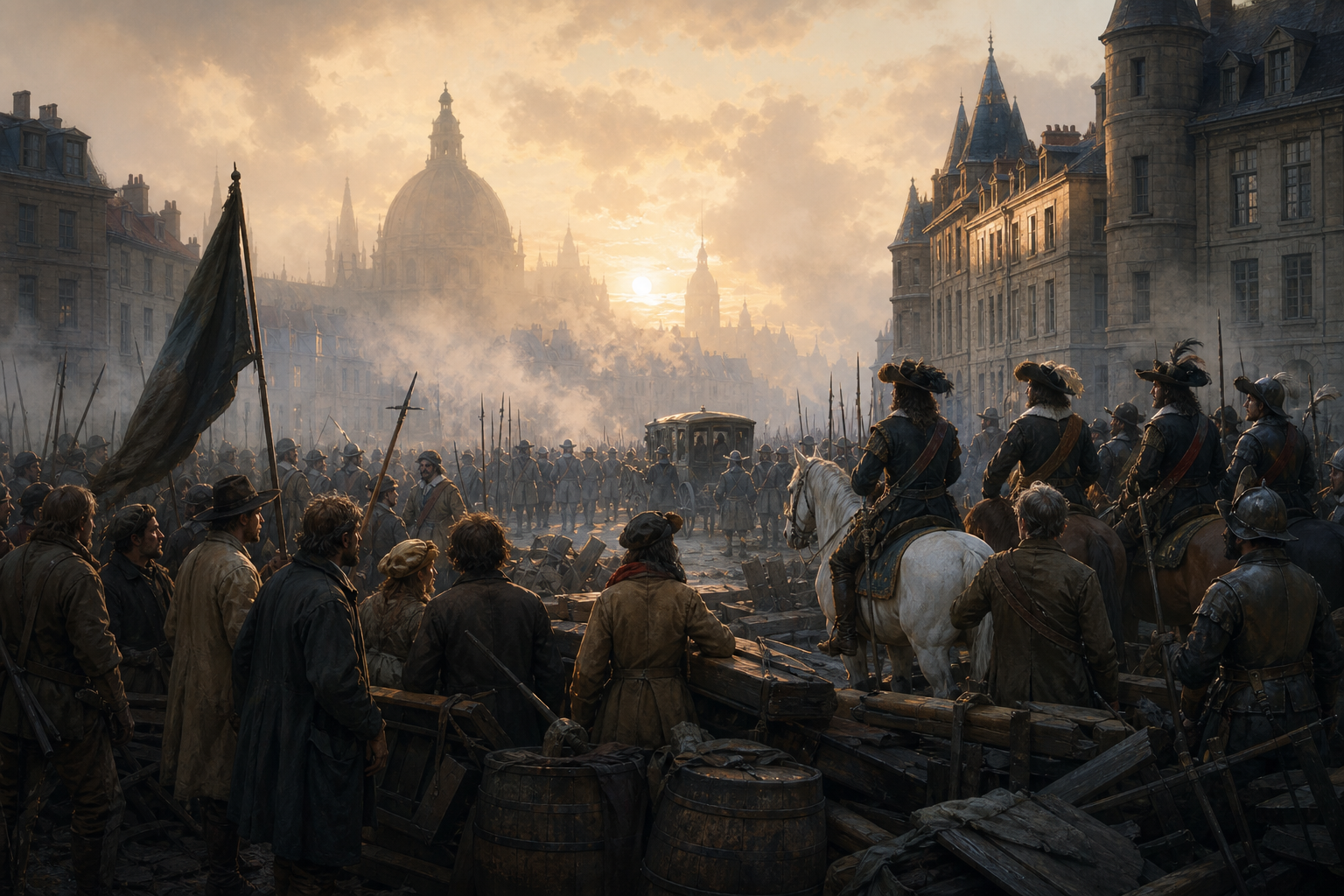
Back in France, the Fronde has not become a clean revolution. Negotiation, arrests, bargaining, and self-interest take over. D'Artagnan and Porthos are captured, threatened, and forced into the strange practical game of surviving Mazarin's politics. Athos and Aramis maneuver to help them. The four friends again become most effective when they stop pretending politics has moral clarity and start using their different strengths together.
Mazarin, who often looks ridiculous beside Richelieu's memory, proves harder to defeat than he first appears. He survives because he understands delay, money, paperwork, and the weaknesses of men who despise him. D'Artagnan understands this too. By the end, he uses pressure and negotiation to get what he has long been denied: a captaincy. Porthos receives his barony. These rewards are comic and satisfying, but they are not a full restoration of youth. They are compromises won from a compromised world.
7. The ending and what it leaves behindThis section contains spoilers.
The ending separates the friends again. Athos returns to Bragelonne and entrusts Raoul to D'Artagnan's military care. Aramis leaves for new church and political work. Porthos goes to enjoy his new barony. D'Artagnan, now captain in the royal musketeers, remains restless and ambitious, already thinking of the next campaign and even joking toward the highest military glory.
The final mood is not despair. It is mature incompletion. The friends have survived, helped one another, gained something, and lost the illusion that they can live permanently as the inseparables. The old bond remains real precisely because it survives separation.
The last joke about Bonacieux also matters. Dumas closes with comedy, but the comedy sits beside death, civil war, execution, revenge, and political bargaining. That tonal mixture is the signature of the sequel. Twenty years have passed, and the world is less innocent; still, D'Artagnan keeps a room upstairs because "one never knows what may happen."
Major Characters
D'Artagnan
Practical loyalty, ambition, and survival
D'Artagnan is older, sharper, and more openly aware that service should be rewarded. He serves Mazarin not because he worships Mazarin, but because the crown's service is still his professional world and his path to captaincy.
His greatness in the sequel is tactical intelligence. He reads streets, rooms, motives, and danger faster than almost anyone. His limitation is that practical action can look morally thin beside Athos's conscience, yet the book also shows that conscience without D'Artagnan's speed may fail to save anyone.
Athos
Honor, fatherhood, and troubled memory
Athos has become the moral center of the sequel. He is no longer defined mainly by melancholy romance; he is a father to Raoul and a nobleman who tries to give political action an ethical shape.
His guilt over Milady and his compassion for royal suffering make him the character most aware of consequence. Athos gives the book its grave tone: adventure is exciting, but every oath and execution leaves a human remainder.
Porthos
Strength, appetite, and social ambition
Porthos remains comic, warm, vain, and physically magnificent. His wish to become a baron is funny, but it is not meaningless. He wants public recognition for the largeness he already feels in himself.
Porthos matters because he keeps friendship embodied. He eats, fights, laughs, fears, forgets, remembers, and returns. In a novel full of coded politics, his directness is a kind of moral relief.
Aramis
Intrigue, religious office, and political design
Aramis has changed from romantic musketeer into clerical strategist. His church position does not remove him from the world; it gives him another route into influence.
He is graceful, intelligent, and dangerous because he often sees people as pieces in a design. Yet his affection for the old group remains real. The sequel's tension around Aramis comes from that double truth: sincere friend, practiced manipulator.
Cardinal Mazarin
Anxious power after Richelieu
Mazarin is not Richelieu. Dumas repeatedly lets readers feel the difference. Mazarin is smaller, more cautious, more comic, and more concerned with money. Still, he survives.
His power lies in patience, secrecy, calculation, and the ability to buy or delay what he cannot command. He is an excellent antagonist for older heroes because he rarely offers them a clean heroic target.
Mordaunt
The past returning as vengeance
Mordaunt, Milady's son, turns inherited injury into a program of revenge. He is cold, disguised, patient, and murderous, a dark mirror of the musketeers' own capacity for decisive action.
His presence forces the book to revisit the moral certainty of The Three Musketeers. Even if Milady was guilty, the abandoned child makes justice look less finished than the earlier adventure allowed.
Best Quotes
The friends went to bed early, but neither of them slept.
This quiet sentence from the conclusion catches the sequel's mature mood. Success does not bring peace. After years of frustration, reward itself becomes too charged to sleep through.
Then they departed, without knowing whether they would ever see each other again.
The line is simple, but it changes the meaning of the old friendship. The bond is not proven by permanent togetherness; it is proven by the pain of parting and the knowledge that history may interrupt any reunion.
I have not a friend in the world but you, Rochefort.
D'Artagnan's confession to a former enemy shows how time alters rivalry. In the sequel, friendship is no longer a youthful abundance. It is scarce, strategic, and emotionally valuable because so many old certainties have vanished.
When we arrive at the summit of our wishes, success has usually the power to drive away sleep.
Dumas uses an aphoristic narrator to turn an adventure ending into psychological observation. Getting what one wants is not the same as becoming settled. D'Artagnan and Porthos win rewards, but desire remains awake.
Major Themes
Time
Friendship After Youth
The novel tests whether the musketeers' bond can survive age, careers, children, money, politics, and guilt. It can, but not in the same form. The sequel values loyalty that returns after division more than loyalty that never faces conflict.
Power
Politics Without Clean Heroes
The Fronde and the English Civil War make politics unstable. Kings can be vulnerable, ministers can be ridiculous and effective, rebels can be principled and self-interested. The heroes must act in a world where every side is mixed.
Memory
The Past Demands Payment
Mordaunt turns the Milady plot from past victory into present consequence. Dumas shows that adventure never ends exactly where the heroes think it ends; someone else may inherit the wound.
Honor
Reward Versus Conscience
D'Artagnan wants captaincy, Porthos wants nobility, Athos wants moral honor, and Aramis wants influence. The novel studies different definitions of success and asks which ones can survive moral pressure.
Dumas, Maquet, and the Age of Sequels
Twenty Years After was serialized in 1845 as the continuation of The Three Musketeers. Dumas worked with Auguste Maquet, whose plotting collaboration helped shape several of the great Dumas romances. The Project Gutenberg edition identifies the book as the second volume of the D'Artagnan series and places its events in 1648-1649.
That timing matters. The book is not simply "more musketeers." It moves from the era of Richelieu and Buckingham into the crises of Mazarin, the Fronde, Cromwell, and Charles I. Dumas compresses history into melodrama, but he does not remove history's force. Public events repeatedly defeat private bravery.
The novel also understands sequel pleasure. It lets readers enjoy recognition: the old names, habits, jokes, swordplay, and reversals. But it earns that pleasure by changing the emotional stakes. The heroes are older, and the world has become harder to simplify.
Why It Still Matters
Modern readers often meet franchise sequels that keep characters frozen. Twenty Years After does the opposite. It asks what happens when beloved heroes age into compromise. That makes it feel surprisingly current. Careers stall. Friend groups scatter. Politics divides people who once shared everything. Old choices return through people who were not consulted at the time.
The book is also useful for students because it shows historical fiction doing several jobs at once. It entertains, teaches political atmosphere, dramatizes ethical conflict, and uses recurring characters to study time. Its best scenes are not just fights or escapes; they are reunions in which everyone knows the old language of friendship but no longer lives inside the old world.
FAQ: Summary, Sequel, and Context
Is Twenty Years After a direct sequel to The Three Musketeers?
Yes. It is the second major D'Artagnan romance and follows the same core group roughly two decades later. Readers can enjoy its adventure plot on its own, but the emotional weight is stronger if you know Milady, Rochefort, the old friendship, and the earlier motto of unity.
What historical events shape the novel?
The two major contexts are the Fronde in France and the English Civil War. In France, Mazarin and Anne of Austria face unrest around taxation, royal authority, Parliament, and aristocratic opposition. In England, Charles I is tried and executed under the power of Parliament and Cromwell's forces.
Why are the musketeers divided?
They are divided because twenty years have given them different lives. D'Artagnan remains in royal military service, Porthos wants social promotion, Athos acts from aristocratic honor and fatherhood, and Aramis works through church and political intrigue. Their friendship remains, but their obligations no longer match.
Who is Mordaunt?
Mordaunt is Milady's son. He seeks revenge for his mother's execution and becomes the private avenger shadowing the public political plot. His role forces readers to reconsider whether the earlier adventure's justice was as complete as it seemed.
Read Next
Read The Three Musketeers first if you want the youthful origin of the friendship, then continue to The Vicomte de Bragelonne and The Man in the Iron Mask for the long aftermath of power, service, and age. For parallel political adventure, A Tale of Two Cities and Les Miserables also turn public upheaval into private moral testing.
Adaptations
- Dumas's musketeer cycle has been adapted many times for film, television, radio, stage, and comics, though this middle sequel is adapted less often than The Three Musketeers.
- Adaptations usually simplify the Fronde and English Civil War material, so the novel remains the best place to see the older musketeers divided by politics.
- The book's strongest adaptation challenge is tonal: it must balance comedy, nostalgia, historical tragedy, and revenge.