A Tale of Two Cities Study Guide - AP Lit, SAT Reading, Close Reading, and Essay Practice
A practical guide for AP English Literature, SAT Reading, IB English, and school essays, with key passages, literary devices, practice questions, and thesis models.
This study guide is built for students who need to turn A Tale of Two Cities into literary argument. If you want the full plot explanation first, start with the main article.
Who This Guide Is For
Use this page when you need evidence, not just plot memory. The novel is especially useful for essays about resurrection, political violence, doubles, memory, trauma, family loyalty, sacrifice, and the difference between justice and revenge.
The main study mistake is to treat the book as if it has only one important event: Sydney Carton dies for Charles Darnay. That ending matters, but it becomes persuasive only because Dickens has built a pattern around it. People return, names return, documents return, and objects store history. A strong essay tracks those returns before it talks about sacrifice.
By the end, you should be able to:
- explain how resurrection works as more than a Christian reference
- compare Lucie's restorative memory with Madame Defarge's punitive memory
- analyze Carton and Darnay as doubles
- connect shoemaking, knitting, wine, footsteps, and documents to theme
- answer SAT-style questions about function, inference, tone, and symbolism
- build an essay paragraph that moves from scene evidence to device to argument
1. Quick Review
- Original title: A Tale of Two Cities
- Author: Charles Dickens
- Published: 1859
- Main settings: London; Dover road; Saint Antoine; Tellson's Bank; Paris prisons and Revolutionary courts
- Central conflict: a family restored from Bastille trauma is threatened when the French Revolution revives the crimes of the Evrémonde aristocracy
- Core themes: resurrection, memory, justice, revenge, sacrifice, doubles, trauma, family, political violence
- Common exam angles: symbolism, historical setting, foil characters, irony, narrative structure, sacrifice
One-sentence summary:
Dr. Manette is restored from the Bastille, but the Revolution turns his old suffering into evidence against Charles Darnay until Sydney Carton saves the family through substitution.
2. Plot Structure for Exams
Exposition
Jarvis Lorry travels to recover Dr. Manette, who has survived eighteen years in the Bastille and now lives in a damaged state under Defarge's care. Lucie Manette becomes the emotional force that begins restoring her father to life, but Dickens makes the recovery unstable: Manette's body is free before his mind is free.
Inciting Pattern
The novel's key pattern is introduced early: people, documents, and memories thought buried return with power. The message "Recalled to Life" names both hope and danger.
Rising Action
Charles Darnay is saved in a London treason trial partly because Sydney Carton looks like him. Darnay marries Lucie and tries to live apart from his aristocratic French family, while the Revolution grows in Paris through hunger, surveillance, the Jacques network, and hatred of the Evrémonde name.
Crisis
Darnay returns to France to help Gabelle and is imprisoned as an Evrémonde. Dr. Manette's former status briefly saves him, but Manette's own Bastille document later condemns him. This reversal is the key crisis: the past that once gives Manette authority becomes evidence against Lucie's husband.
Climax
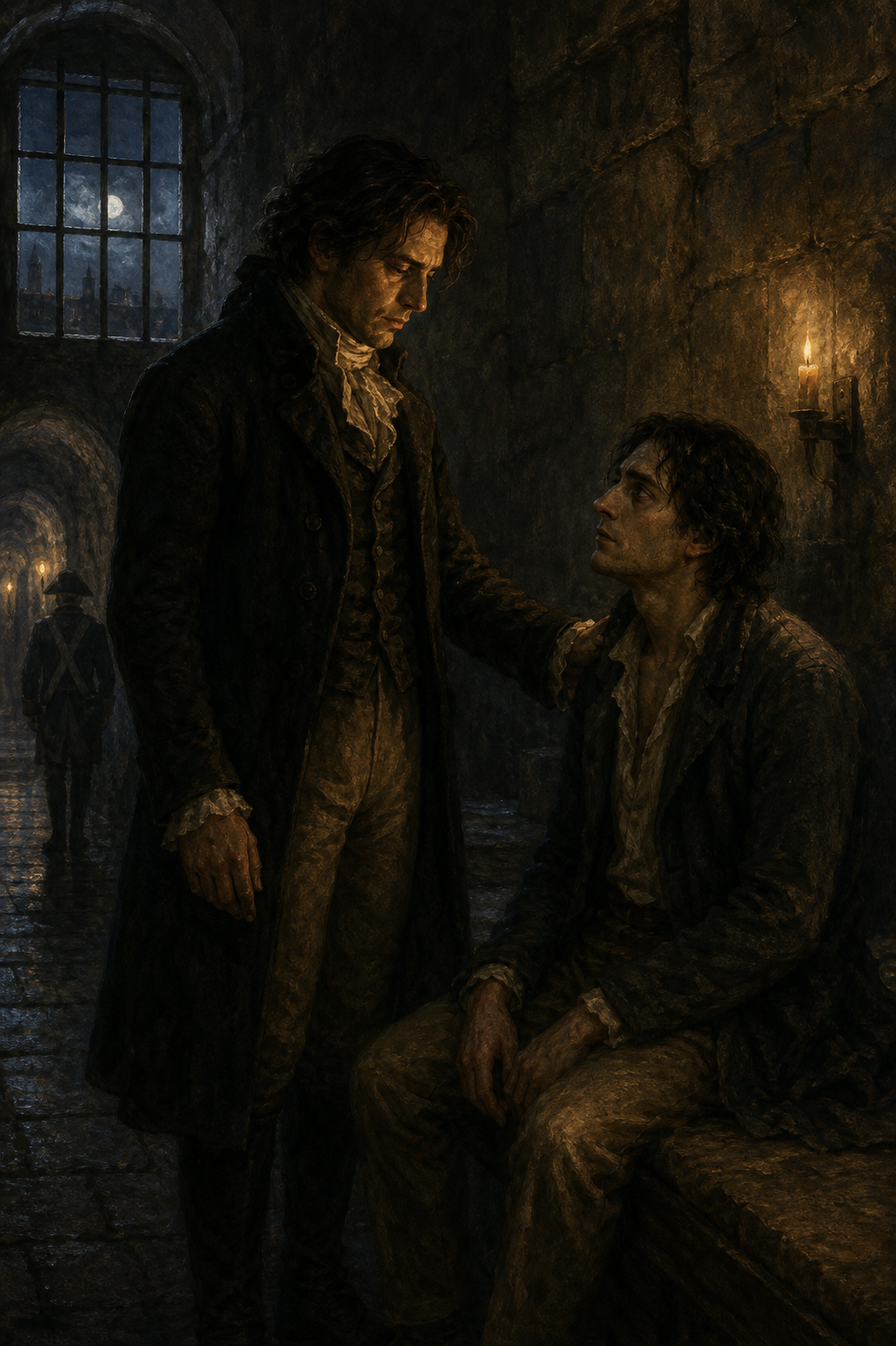
Carton uses his resemblance to Darnay to exchange places with him. The double plot becomes sacrifice rather than legal confusion.
Resolution
Darnay escapes with Lucie, Dr. Manette, and the child. Carton dies in Darnay's place, imagining a future in which his act gives meaning to his otherwise wasted life.
Exam point: do not reduce the novel to "Carton dies for Darnay." A stronger claim explains why the sacrifice completes the book's patterns of resurrection, doubles, and memory.
3. Key Original Passages for Close Reading
These passages are not just famous lines. Each one gives you a way to connect wording, scene function, and theme. For AP Lit, SAT Reading, IB English, and school essays, the useful question is not "What does this quote mean?" but "How does this exact wording make the novel's argument visible?"
Read each passage in three passes. First, identify the speaker or narrative situation. Second, mark the device: antithesis, repetition, symbol, irony, diction, narrative commentary, or allusion. Third, turn the device into a claim about resurrection, memory, justice, doubles, or sacrifice.
For essay practice, use the Context, Close reading, and Essay use notes as a bridge from quotation to commentary. The goal is to avoid plot summary and make the language do analytical work.
Passage 1: Historical contradiction
It was the best of times, it was the worst of times, it was the age of wisdom, it was the age of foolishness.
Context: The opening sentence frames the age before revolution as a period of contradiction.
Close reading: The balanced antithesis creates a world where progress and catastrophe exist together. The repeated "it was" makes contradiction feel structural, not accidental.
Essay use: Use it to argue that Dickens refuses to make the Revolution purely heroic or purely monstrous. The sentence gives you a framework for discussing both aristocratic cruelty and revolutionary terror.
Passage 2: The first resurrection code
“You know that you are recalled to life?” “They tell me so.”
Context: Lorry imagines speaking with the buried man he is traveling to recover: Dr. Manette after eighteen years in the Bastille.
Close reading: The question sounds miraculous, but the answer is uncertain. "They tell me so" suggests that resurrection can be announced before it is inwardly felt.
Essay use: Use it for the novel's recurring pattern of return: Manette, Darnay, Carton, names, and buried documents. Strong essays emphasize that return can restore and threaten at the same time.
Passage 3: Human unknowability
A wonderful fact to reflect upon, that every human creature is constituted to be that profound secret and mystery to every other.
Context: The narrator reflects on how little any person can fully know another.
Close reading: The abstract nouns "secret" and "mystery" make ordinary people difficult to read. Dickens prepares a world where names, faces, and social roles never tell the whole truth.
Essay use: Use it for secrecy, hidden trauma, and the limits of social judgment.
Passage 4: Wine and blood
The wine was red wine, and had stained the ground of the narrow street in the suburb of Saint Antoine.
Context: A wine cask breaks in Saint Antoine, and the poor rush to drink from the street.
Close reading: The repeated red staining turns hunger into visual foreshadowing. The spilled wine is literal food scarcity and symbolic blood at once.
Essay use: Use it for social critique and foreshadowing. Dickens makes revolutionary violence grow out of material deprivation, not abstract evil.
Passage 5: Carton's self-contempt
I am a disappointed drudge, sir. I care for no man on earth, and no man on earth cares for me.
Context: After Darnay's trial, Carton describes himself to Darnay with bitter clarity.
Close reading: "Disappointed drudge" combines wasted labor with failed hope. The mirrored negative clause makes Carton's isolation sound total.
Essay use: Use it to track the movement from self-waste to self-gift. His final sacrifice matters because it answers this despair without pretending his earlier life was whole.
Passage 6: Carton's promise
For you, and for any dear to you, I would do anything.
Context: Carton privately tells Lucie that his love asks for no return, but could become service.
Close reading: The movement from "you" to "any dear to you" shifts love from possession to protection. Carton imagines sacrifice before the plot requires it.
Essay use: Use it to show that the ending fulfills an earlier moral vow. The prison exchange is not a surprise rescue only; it is the ethical completion of this sentence.
Passage 7: Defarge's archive
It would be easier for the weakest poltroon that lives, to erase himself from existence, than to erase one letter of his name or crimes from the knitted register of Madame Defarge.
Context: Defarge explains Madame Defarge's coded knitting as a record of names and crimes.
Close reading: The phrase "knitted register" turns domestic labor into bureaucratic power. Memory becomes a document that cannot be erased.
Essay use: Use it for memory, gendered power, and the transformation of grievance into sentence. This passage pairs well with Lucie's restorative memory.
Passage 8: Manette's document and Carton's final meaning
I, Alexandre Manette, unhappy prisoner, do this last night of the year 1767, in my unbearable agony, denounce to the times when all these things shall be answered for.
Context: Manette's hidden Bastille manuscript is read at Darnay's trial.
Close reading: The formal first-person testimony turns private agony into public accusation. The future-facing phrase "to the times" shows that documents can wait for history to become dangerous.
Essay use: Use it for historical irony: Manette's truthful witness exposes aristocratic crime but condemns the husband of the daughter who restored him.
For Carton's ending, pair this passage with his final imagined words: "It is a far, far better thing that I do, than I have ever done." The contrast between Manette's denunciation and Carton's self-gift helps you discuss two kinds of memory: one demands answer, the other protects a future.
4. Close Reading Procedure
Step 1: Identify the kind of return
Ask what is coming back: a person, name, document, trauma, debt, or political memory. Dickens rarely lets the past stay buried.
Manette returns from the Bastille, but his prison habits return too. Darnay tries to leave the Evrémonde name behind, but the Revolution returns it to him. Carton's resemblance to Darnay returns at the end as a practical means of escape. A good paragraph names the return and explains whether it heals, threatens, or transforms.
Step 2: Track objects as evidence
Shoes, knitting, wine, letters, bank records, and prison manuscripts are not props. They store history.
Shoemaking stores Manette's trauma in bodily habit. Knitting stores Madame Defarge's vengeance in coded domestic labor. Wine stores hunger and foreshadows blood. Documents move across borders and outlive emotion. Strong essays show how an object turns private suffering into public consequence.
Step 3: Separate justice from revenge
Dickens understands why revolution happens, but he distrusts revenge that loses sight of individual persons.
Do not write that the novel simply condemns the poor. The Evrémondes are guilty; Saint Antoine suffers real hunger; the Bastille is a real horror. The sharper argument is that oppression creates a moral demand for justice, but Madame Defarge's absolutism shows how justice becomes revenge when guilt is inherited without limit.
Step 4: Read doubles as moral structure
Carton and Darnay look alike, but the point is not only suspense. Their resemblance creates an ethical question: what can one person do for another?
The first trial uses resemblance to create doubt. The final prison exchange uses resemblance to create salvation. That movement lets Dickens turn a plot device into a moral pattern.
Step 5: Convert observation into a claim
Move from "Carton changes" to a device-based thesis.
Through doubles and resurrection imagery, Dickens turns Sydney Carton's resemblance to Darnay into a moral structure in which a wasted life becomes meaningful through chosen sacrifice.
That thesis names devices, character, and meaning. Use the same pattern for Madame Defarge, Dr. Manette, Lucie, or the Revolution.
Step 6: Test whether the claim needs London and Paris
Many weak essays stay in only one city. Stronger essays ask how the cities answer each other. London gives Darnay a courtroom rescue through resemblance; Paris makes resemblance a matter of life and death. London gives Lucie a home where Manette can recover; Paris sends the document that tests that recovery. London stores family loyalty; Paris releases public vengeance.
If your thesis can work without both cities, check whether it is too broad. The title itself invites comparison.
5. Why Literary Devices Matter
Resurrection motif
The novel's repeated returns make resurrection both hopeful and unstable. Manette is restored to Lucie, but trauma remains. Darnay is restored to life through Carton, but only because Carton dies. Carton is spiritually restored through an act that ends his physical life.
For essays, treat resurrection as a pattern of return with consequences, not simply as a happy reversal. The same language that makes Manette's recovery moving also makes the return of old documents dangerous. Dickens keeps asking what returns with the person: memory, bodily habit, family name, legal evidence, or moral possibility.
Foil and double structure
Darnay and Carton are doubles; Lucie and Madame Defarge are moral opposites in how they handle memory; Manette and Defarge are linked through the Bastille but diverge in response to suffering.
The double structure changes function as the plot develops. In the London trial, resemblance creates uncertainty and saves Darnay from conviction. In Paris, resemblance becomes chosen substitution. A strong paragraph should name that movement from legal doubt to ethical action instead of stopping at the fact that the two men look alike.
Symbolism: knitting, wine, shoes
Knitting turns memory into a death-list. Wine turns hunger into an image of future blood. Shoes turn imprisonment into repeated bodily labor. Each symbol connects an individual scene to the historical argument.
These symbols also show how private objects become public evidence. Shoes reveal what the Bastille has done to Manette's body. Wine makes poverty visible in the street before it becomes political violence. Knitting converts domestic patience into an archive of names. In each case, Dickens lets an object carry history more efficiently than exposition would.
Historical irony
Manette's suffering gives him power to save Darnay, then his written testimony helps condemn Darnay. The same past becomes protection and danger.
That reversal matters because the novel is suspicious of any easy belief that truth automatically heals. Manette's manuscript exposes real aristocratic crimes, but it also threatens the restored family that his daughter built. Historical irony lets Dickens show how evidence can be morally necessary and personally devastating at the same time.
Narrative suspense
Dickens uses delayed identities, hidden documents, resemblance, and cross-city movement to make private revelations arrive with public force.
Suspense is therefore not only a plot engine. It is a way of teaching the reader that no private life in the novel is sealed off from history. A hidden name can become a political category; a prison document can become courtroom evidence; a resemblance that once seemed accidental can become the mechanism of sacrifice.
Echoing footsteps: sound as historical pressure
The footsteps around Lucie's London home create a sound motif for approaching consequences. At first, the footsteps can seem like ordinary domestic suspense: people will come, news will arrive, lives will change. Later, they feel historical. France, family names, documents, and political violence are all walking toward the supposedly safe house.
Use the footsteps when an essay prompt asks about structure or foreshadowing. They let you connect private space to public history without summarizing the whole Revolution.
Documents and legal language: records that outlive feeling
Tellson's Bank, travel papers, letters, prison registers, and Manette's manuscript all show that writing can preserve truth and endanger life. Dickens is fascinated by records because they appear objective, yet they move through emotional and political systems.
In essays, use documents to complicate "truth." Manette's paper tells the truth about the Evrémonde brothers, but its courtroom function is lethal. A strong claim might argue that Dickens treats records as necessary but morally incomplete when they are separated from mercy.
6. Turning Character Analysis into Essay Language
Sydney Carton
self-wasted double who chooses sacrifice
Carton's arc is not simple self-improvement. He remains socially ruined, but he finds one act that gives his life moral shape.
Essay sentence: Carton's sacrifice transforms resemblance from a courtroom accident into the novel's deepest form of resurrection.
Charles Darnay
renounced aristocrat judged by inherited history
Darnay is honorable, but his honor is not enough to protect him from the Evrémonde name. His mistake is believing that personal conscience can speak clearly inside Revolutionary categories of guilt.
Essay sentence: Darnay's return to France exposes the novel's anxiety that inherited violence can survive individual renunciation.
Madame Defarge
memory without mercy
Madame Defarge's grievance is rooted in real aristocratic violence, but her justice becomes unlimited.
Essay sentence: Through Madame Defarge's knitting, Dickens imagines memory as an archive that can preserve truth while destroying mercy.
Dr. Manette
trauma survivor and unwilling witness
Manette is restored by Lucie, yet his prison manuscript returns as evidence against Darnay.
Essay sentence: Manette's relapse and testimony show that trauma survives both as private wound and public record.
Lucie Manette
restorative love under historical pressure
Lucie's love heals, gathers, and protects, but it cannot erase political violence.
Essay sentence: Lucie represents restorative memory, a force that recalls the deadened self to life without turning suffering into vengeance.
Jarvis Lorry and Miss Pross
practical care and domestic courage
Lorry and Pross show that loyalty often looks like ordinary work: papers, travel plans, household guarding, and staying clear-headed when larger systems fail.
Essay sentence: Dickens uses Lorry and Pross to show that private loyalty needs practical forms when public history becomes dangerous.
7. Thesis Builder for Major Themes
Resurrection
Return With Scars
Weak thesis: The novel is about people coming back to life.
Strong thesis: Dickens presents resurrection as a painful return in which the past is restored along with the wounds it created.
Justice
Revenge and Revolution
Weak thesis: The Revolution is bad.
Strong thesis: Dickens shows that aristocratic cruelty makes revolution morally intelligible, but revenge becomes corrupt when it treats identity as inherited guilt.
Doubles
Likeness and Substitution
Weak thesis: Carton and Darnay look alike.
Strong thesis: The double motif lets Dickens turn physical resemblance into ethical substitution, moving from legal doubt to sacrificial love.
Memory
Restoration Versus Record
Weak thesis: Characters remember the past.
Strong thesis: Lucie and Madame Defarge reveal two opposed uses of memory: one recalls the wounded into life, while the other records injury for punishment.
8. SAT Reading Sample
These are SAT-style practice questions, not official College Board questions. Each one is tied to a scene, symbol, or recurring device from A Tale of Two Cities.
Question 1
The opening contrast between best and worst times primarily establishes:
- A. a comic misunderstanding about travel
- B. a historical world defined by contradiction
- C. a purely optimistic view of revolution
- D. a private romance without public meaning
Answer: B. The antithesis frames the period as morally mixed. A is too narrow, C ignores terror, and D misses the historical scope.
Question 2
The message "Recalled to Life" first refers to:
- A. Dr. Manette's release and restoration
- B. Darnay's aristocratic inheritance
- C. Madame Defarge's knitting
- D. Miss Pross's loyalty
Answer: A. The phrase concerns Manette's return from the Bastille, while later echoes broaden the resurrection motif.
Question 3
Dr. Manette's shoemaking mainly symbolizes:
- A. his desire to become wealthy
- B. a fashionable craft in London
- C. trauma surviving as repeated bodily habit
- D. Darnay's guilt in the first trial
Answer: C. The habit was formed in prison and returns during relapse, making trauma visible.
Question 4
Madame Defarge's knitting functions as:
- A. a harmless hobby with no plot role
- B. proof that she rejects politics
- C. a sign of aristocratic luxury
- D. a coded archive of vengeance
Answer: D. The knitting records names and transforms memory into punishment.
Question 5
Carton's resemblance to Darnay first helps create:
- A. reasonable doubt in the London trial
- B. a quarrel between Lucie and Lorry
- C. Defarge's sympathy for aristocrats
- D. Manette's first imprisonment
Answer: A. The likeness undermines confident identification, helping Darnay escape conviction.
Question 6
The broken wine cask scene most strongly foreshadows:
- A. peaceful prosperity in Saint Antoine
- B. Carton's legal career in London
- C. Lucie's childhood in England
- D. future bloodshed rooted in hunger
Answer: D. The red wine and desperate crowd link poverty to coming violence.
Question 7
Darnay's return to France shows that he:
- A. understands the Revolution perfectly
- B. wants to reclaim aristocratic privilege
- C. believes personal honor can overcome inherited suspicion
- D. has forgotten Lucie completely
Answer: C. His decision is honorable but naive about Revolutionary categories of guilt.
Question 8
Dr. Manette's Bastille document is ironic because it:
- A. saves Madame Defarge from danger
- B. condemns the husband of the daughter who restored him
- C. proves Tellson's Bank is modern
- D. removes all suspense from the plot
Answer: B. His old testimony against the Evrémondes returns against Darnay.
Question 9
Lucie and Madame Defarge are best contrasted as:
- A. two versions of restorative and punitive memory
- B. two aristocrats fighting for wealth
- C. two characters who never affect the plot
- D. two comic servants in London
Answer: A. Lucie recalls Manette to life; Defarge records injury for death.
Question 10
Sydney Carton's sacrifice is prepared by:
- A. his hatred of all children
- B. his desire for Evrémonde property
- C. his official role as a judge
- D. his earlier promise to Lucie
Answer: D. His private vow becomes public action in the prison exchange.
Question 11
Tellson's Bank often represents:
- A. emotional spontaneity
- B. institutional continuity, record, and businesslike restraint
- C. Revolutionary mob rule
- D. pastoral escape
Answer: B. Tellson's language and spaces frame history as documents, accounts, and cautious transactions.
Question 12
The Revolution in the novel is portrayed as:
- A. entirely imaginary
- B. morally pure in every action
- C. caused by real oppression but capable of new cruelty
- D. unrelated to class
Answer: C. Dickens condemns aristocratic injustice while warning against indiscriminate vengeance.
Question 13
Miss Pross's confrontation with Madame Defarge mainly dramatizes:
- A. domestic loyalty resisting political vengeance
- B. legal debate in the courtroom
- C. aristocratic boredom
- D. Carton's jealousy
Answer: A. Pross protects Lucie's family in a domestic space against Defarge's pursuit.
Question 14
Carton and Darnay as doubles allow Dickens to explore:
- A. the price of wine in Paris
- B. why banks need ledgers
- C. comic mistaken identity only
- D. whether one life can be substituted for another
Answer: D. The resemblance begins as legal ambiguity and ends as sacrificial substitution.
Question 15
Madame Defarge's motive is most accurately described as:
- A. random cruelty without history
- B. vengeance rooted in family suffering
- C. loyalty to Darnay
- D. fear of Tellson's Bank
Answer: B. Her family history explains her hatred, though it does not justify unlimited revenge.
Question 16
Carton's final vision primarily gives his death:
- A. social status in London
- B. a financial reward
- C. a future meaning beyond his own life
- D. a legal promotion
Answer: C. He imagines Lucie's family safe and his name remembered through love.
Question 17
The title's two cities are important because:
- A. the novel treats London and Paris as connected moral worlds
- B. all events happen in one room
- C. Paris is irrelevant after Book One
- D. London causes the French Revolution
Answer: A. The cities mirror and affect each other through family, banking, exile, and politics.
Question 18
The recurring footsteps around Lucie's home suggest:
- A. a purely comic household habit
- B. the absence of public danger
- C. Darnay's skill as a musician
- D. approaching private and historical consequences
Answer: D. Footsteps turn future arrivals into a sound pattern of fate and history.
Question 19
The novel's use of documents suggests that:
- A. writing cannot affect anyone
- B. records can preserve truth and also endanger lives
- C. oral speech is always false
- D. banks are the only moral institutions
Answer: B. Manette's manuscript proves old crimes but also condemns Darnay.
Question 20
The best interpretation of Carton's redemption is that:
- A. he becomes successful by social standards
- B. he escapes all consequences
- C. he finds meaning through an act of chosen love
- D. he proves Darnay guilty
Answer: C. Carton is redeemed not through status or survival, but through self-giving action.
9. AP Lit Essay Questions
Use these AP Lit-style prompts to turn scenes into thesis-driven essays.
Essay Question 1
Analyze how Dickens uses the opening antithesis to frame the moral contradictions of revolutionary history. Connect the sentence's balanced structure to at least two later scenes: one showing justified anger and one showing terror or excess.
Essay Question 2
Discuss the phrase "Recalled to Life" as a motif. How does its meaning change from Manette's recovery to Darnay's rescue and Carton's final act?
Essay Question 3
Analyze Dr. Manette's shoemaking as a symbol of trauma and incomplete recovery. Include the garret scene and the relapse after Lucie's wedding.
Essay Question 4
Compare Lucie Manette and Madame Defarge as opposing figures of memory. How does each woman use the past to act in the present?
Essay Question 5
Analyze the broken wine cask scene as foreshadowing and social critique. Explain how Dickens makes hunger visible before it becomes political violence.
Essay Question 6
Write about Madame Defarge's knitting as a form of political power. Discuss why Dickens makes the record domestic, coded, and nearly impossible to erase.
Essay Question 7
Discuss Charles Darnay's attempt to reject the Evrémonde inheritance. What does the novel suggest about inherited guilt, personal conscience, and public judgment?
Essay Question 8
Analyze Sydney Carton as a double of Darnay. How does doubling move from a legal device in London to a moral structure in Paris?
Essay Question 9
Explain how Dickens presents the French Revolution as both justified by suffering and corrupted by vengeance. Use the Evrémonde crimes, Saint Antoine, and Madame Defarge's final pursuit.
Essay Question 10
Analyze Tellson's Bank as a symbol of institutional continuity and emotional restraint. How do its records, caution, and business language both help and limit the characters?
Essay Question 11
Discuss the role of documents, letters, and written testimony in shaping the plot. Include Gabelle's letter and Manette's Bastille manuscript.
Essay Question 12
Analyze Carton's promise to Lucie as preparation for the ending. How does the promise define love as protection rather than possession?
Essay Question 13
Write about the Bastille as both historical setting and psychological force. How does it shape Manette after he leaves it, and how does its hidden document shape Darnay's trial?
Essay Question 14
Analyze how Dickens uses suspense and delayed revelation to connect private family history with public revolution. Consider hidden names, resemblance, and the late discovery of documents.
Essay Question 15
Compare Miss Pross and Madame Defarge in the final confrontation. How does Dickens stage domestic loyalty against revolutionary vengeance?
Essay Question 16
Discuss the role of children and future generations in the novel's moral vision. Include the Marquis's killing of the child, little Lucie, and Carton's final imagined future.
Essay Question 17
Analyze the novel's treatment of names: Manette, Darnay, Evrémonde, and Carton. How do names act as evidence, disguise, burden, or future memory?
Essay Question 18
Explain how the novel distinguishes sacrifice from self-destruction. Why is Carton's death not simply a desire to disappear?
Essay Question 19
Analyze the ending as religious, political, and personal resolution. What does the ending resolve for Carton, and what does it leave unresolved about history?
Essay Question 20
Write a thesis-driven essay about whether A Tale of Two Cities is more hopeful or tragic. Your answer should account for both Carton's redeemed action and the Revolution's continuing violence.
10. Model Thesis Bank
Use these as models, then adapt them to the exact prompt.
- Dickens uses the opening antithesis to present revolution as an age of moral contradiction, where justice and terror grow from the same historical pressure.
- The phrase "Recalled to Life" develops from Manette's physical release into Carton's spiritual redemption, making resurrection both restorative and sacrificial.
- Dr. Manette's shoemaking shows that trauma survives as bodily repetition even after legal freedom has been restored.
- Lucie and Madame Defarge embody opposed uses of memory: one heals the wounded self, while the other preserves injury for revenge.
- The wine cask scene converts hunger into foreshadowing, suggesting that neglected suffering will return as public bloodshed.
- Madame Defarge's knitting transforms domestic labor into political record, showing how private grief can become collective punishment.
- Darnay's failed escape from the Evrémonde name reveals the novel's anxiety over whether moral choice can overcome inherited violence.
- Carton and Darnay's resemblance lets Dickens transform physical likeness into ethical substitution.
- Dickens presents the Revolution as morally understandable in origin but corrupted when justice becomes indiscriminate vengeance.
- Tellson's Bank represents a world of records and restraint that cannot fully contain the emotional and political forces it documents.
- Written testimony in the novel preserves truth, but it also shows how records can return with consequences no writer can control.
- Carton's promise to Lucie turns romantic renunciation into a future-oriented vow of protection.
- The Bastille functions as both political institution and psychological wound, shaping Manette long after he leaves prison.
- Dickens uses delayed revelation to show that family secrets and national history are not separate narratives.
- Miss Pross and Madame Defarge dramatize two kinds of loyalty: protective love and punitive vengeance.
- The novel's children represent the future that private sacrifice tries to save from inherited violence.
- Names in the novel act as historical evidence, linking identity to family, class, and guilt.
- Carton's death becomes sacrifice rather than self-destruction because it preserves others and fulfills an earlier promise of love.
- The ending combines Christian resurrection language, political terror, and personal redemption without pretending that history itself is healed.
- A Tale of Two Cities is tragic in its view of history but hopeful in its belief that one chosen act can protect a future.
11. Academic Vocabulary for Essays
- antithesis: a balanced contrast between opposing ideas
- resurrection motif: repeated imagery of return from death, imprisonment, or despair
- foil: a character who clarifies another character by contrast
- double: a character whose resemblance or parallel role creates thematic meaning
- inherited guilt: responsibility or danger attached to family history rather than individual action
- collective memory: shared remembrance that shapes group identity or politics
- vengeance: punishment driven by injury, anger, or retaliation rather than measured justice
- social critique: literary exposure of institutional or class injustice
- historical irony: a reversal created by the pressure of historical events
- symbolic object: an object that carries thematic meaning beyond its plot function
- trauma: lasting psychological wound from violence, confinement, or fear
- self-sacrifice: voluntary loss undertaken to protect or redeem another
- foreshadowing: an early detail that prepares later events
- narrative frame: a structural pattern that shapes how events are interpreted
- moral ambiguity: a situation in which right and wrong cannot be reduced to a simple binary
- antithesis: a balanced contrast that makes contradiction part of the sentence structure
- motif development: the way a repeated image or phrase changes meaning as the plot advances
- legal irony: a reversal in which evidence or procedure produces an outcome that is technically grounded but morally painful
- restorative memory: remembrance that aims to heal, recover, or protect
- punitive memory: remembrance that preserves injury for accusation or revenge