A Tale of Two Cities - Revolution, Memory, and Sydney Carton's Sacrifice
A detailed guide to Charles Dickens's French Revolution novel about resurrection, family, revenge, doubles, and the cost of turning private pain into public violence.
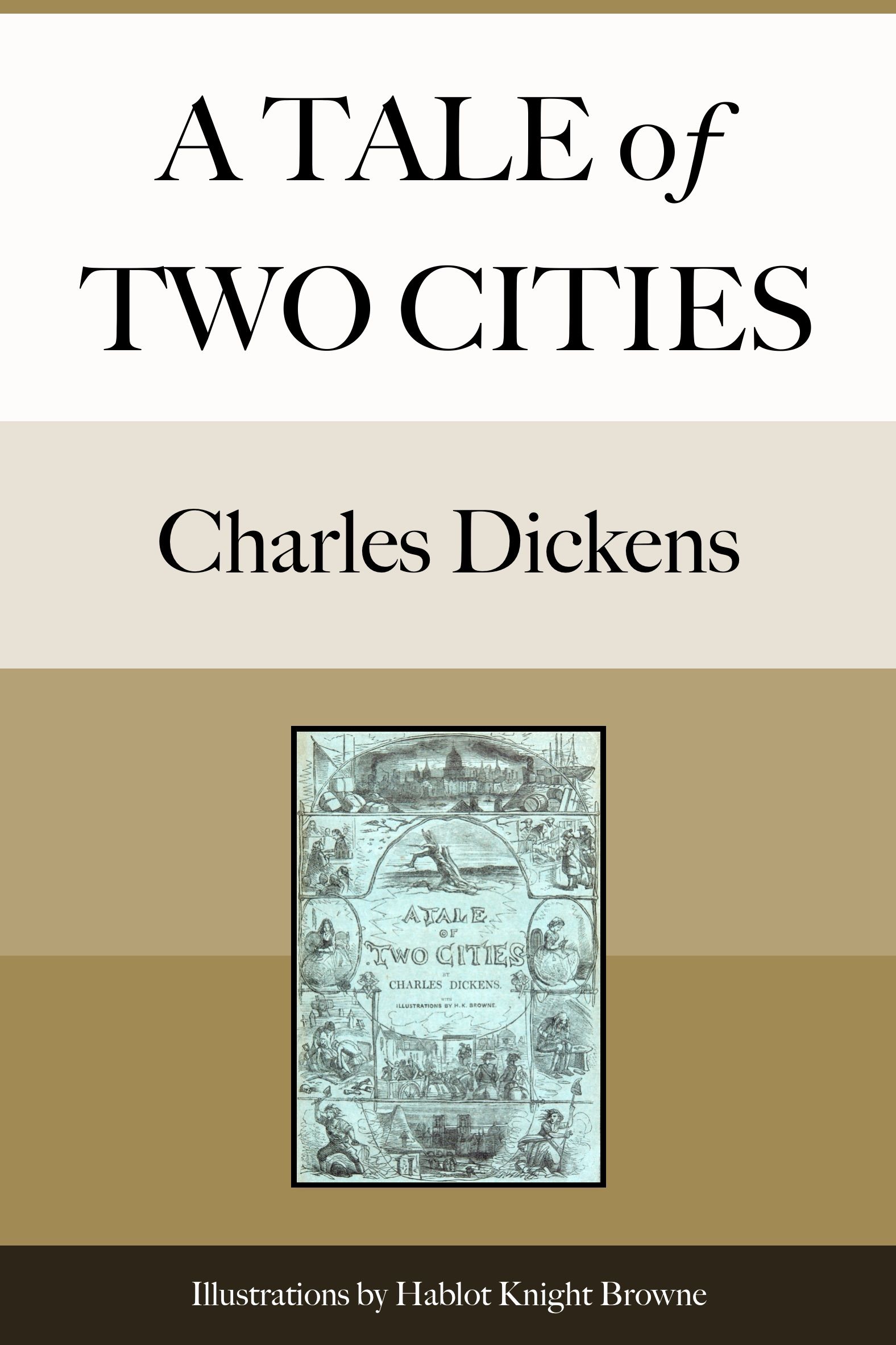
Sua's Quick Take
A Tale of Two Cities is famous for revolution, prisons, and the guillotine, but its deepest question is quieter: what happens when the buried parts of a life are forced back into the present? Dickens makes resurrection both a miracle and a danger. Dr. Manette is recalled to life by love; a prison manuscript is recalled to life as legal evidence; Madame Defarge recalls old injuries as vengeance; Sydney Carton recalls his wasted self long enough to give it meaning.
What the Book Is Really About
Charles Dickens sets the novel between London and Paris before and during the French Revolution. The two cities are not just locations. London is the place of legal paperwork, family refuge, and delayed secrets. Paris is the place where poverty, aristocratic cruelty, and collective rage finally ignite. The story moves between them until private family history and public history become inseparable.
The main plot gathers around Lucie Manette, her father Dr. Alexandre Manette, the French aristocrat-turned-emigrant Charles Darnay, the banker Jarvis Lorry, the lawyer Sydney Carton, and the implacable Madame Defarge. At first the novel looks like a mystery about a man released from the Bastille and restored to his daughter. By the end, that old prison story becomes the key to a Revolutionary trial and to Carton's famous act of substitution.
Dickens is not neutral about aristocratic oppression. The Evrémonde family has done terrible things, and the Revolution grows from real suffering. But he is equally alert to what happens when justice becomes appetite. The book's emotional force comes from that double vision: cruelty creates revolution, and revolution can learn to imitate cruelty.
That double vision is why the novel should not be reduced to a slogan about sacrifice. Carton's ending matters because Dickens has spent the whole book tracking returns: a father returns from prison but not from trauma, an aristocratic name returns after being renounced, a domestic object becomes a political record, and a resemblance first used in a London courtroom returns in a Paris prison. The plot is a machine of echoes. If you follow those echoes, the famous ending feels earned rather than decorative.
Plot Summary
1. A mail coach, a buried message, and a man recalled to life
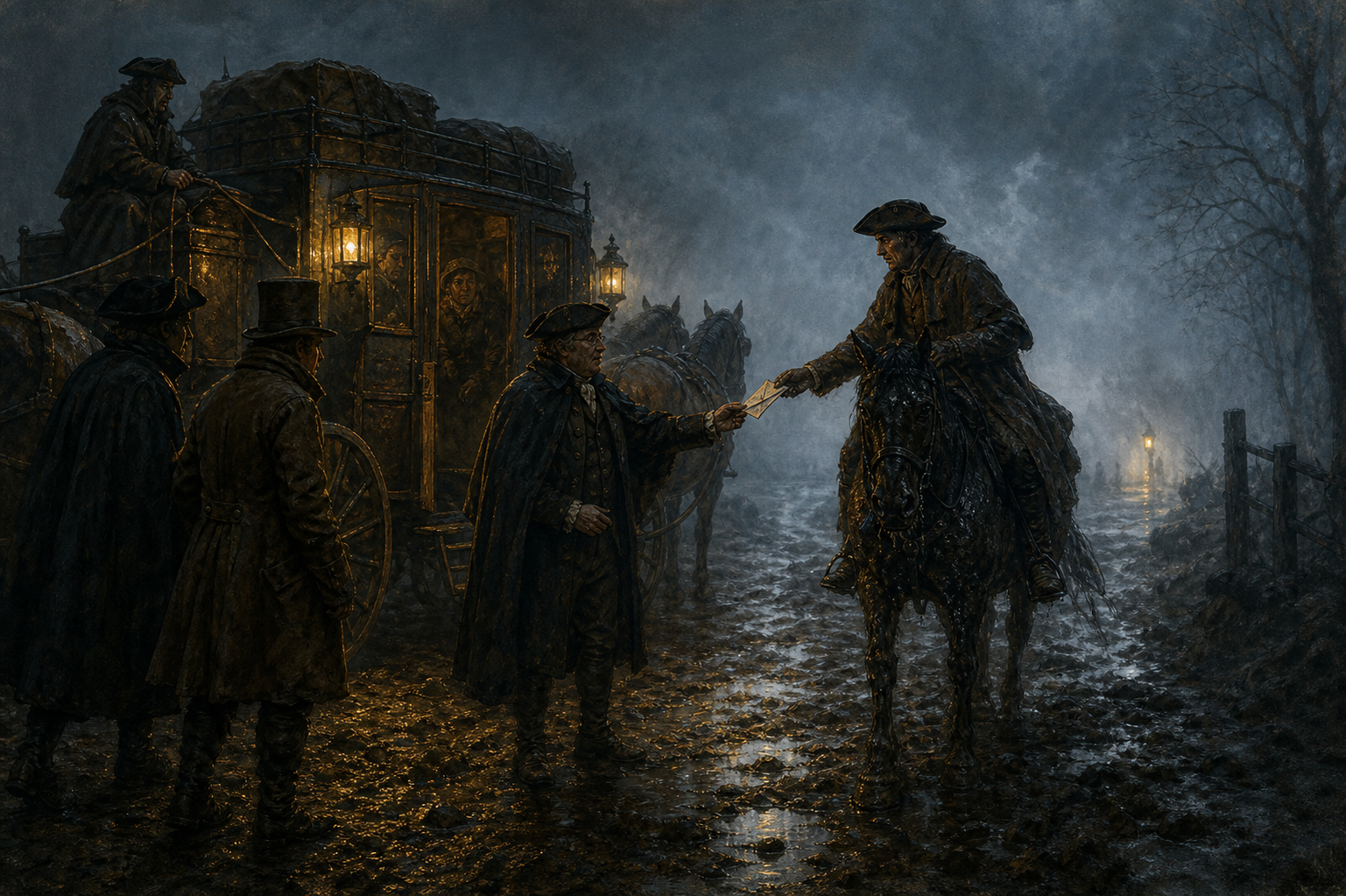
The novel opens in 1775, as a Dover mail coach crawls through darkness, mud, and distrust. The passengers suspect one another; the road is dangerous; everyone seems armed by fear. Jarvis Lorry, a trusted man from Tellson's Bank, receives a strange message: "Recalled to Life." His answer is just as strange, because he knows the message concerns a living person who has been treated almost like the dead.
That person is Dr. Alexandre Manette. Years earlier, he disappeared into the Bastille without public explanation. Now he has been released after eighteen years. His daughter Lucie, who grew up believing both parents lost, is brought to meet him in Paris. Lorry frames the trip as business because Tellson's language helps him control emotion, but the scene he enters is beyond ordinary banking.
Dr. Manette is not simply free. He has been psychologically broken by imprisonment. He sits in Defarge's garret making shoes, repeating habits formed in the cell. He cannot fully inhabit his name, history, or fatherhood. Lucie's first task is not to ask him for a story but to give him presence: voice, touch, hair, tears, and patient recognition.
This is the novel's first version of resurrection. It is tender, but not easy. Being "recalled to life" does not erase trauma. It begins a long recovery in which the past keeps returning.
Dickens prepares that uneasiness before Manette appears. The opening chapter moves from grand antithesis to practical fear: English roads are full of suspicion, French institutions glide toward violence, and the future guillotine is imagined before the characters understand its reach. Lorry's night thoughts turn the banker's errand into a grave-digging fantasy. He keeps imagining a buried man asked whether he wants to live. That dream matters because the novel treats resurrection as a question, not a guarantee. A person can be dug out of history and still not know how to answer life.
2. Saint Antoine, the wine-shop, and hunger learning to remember
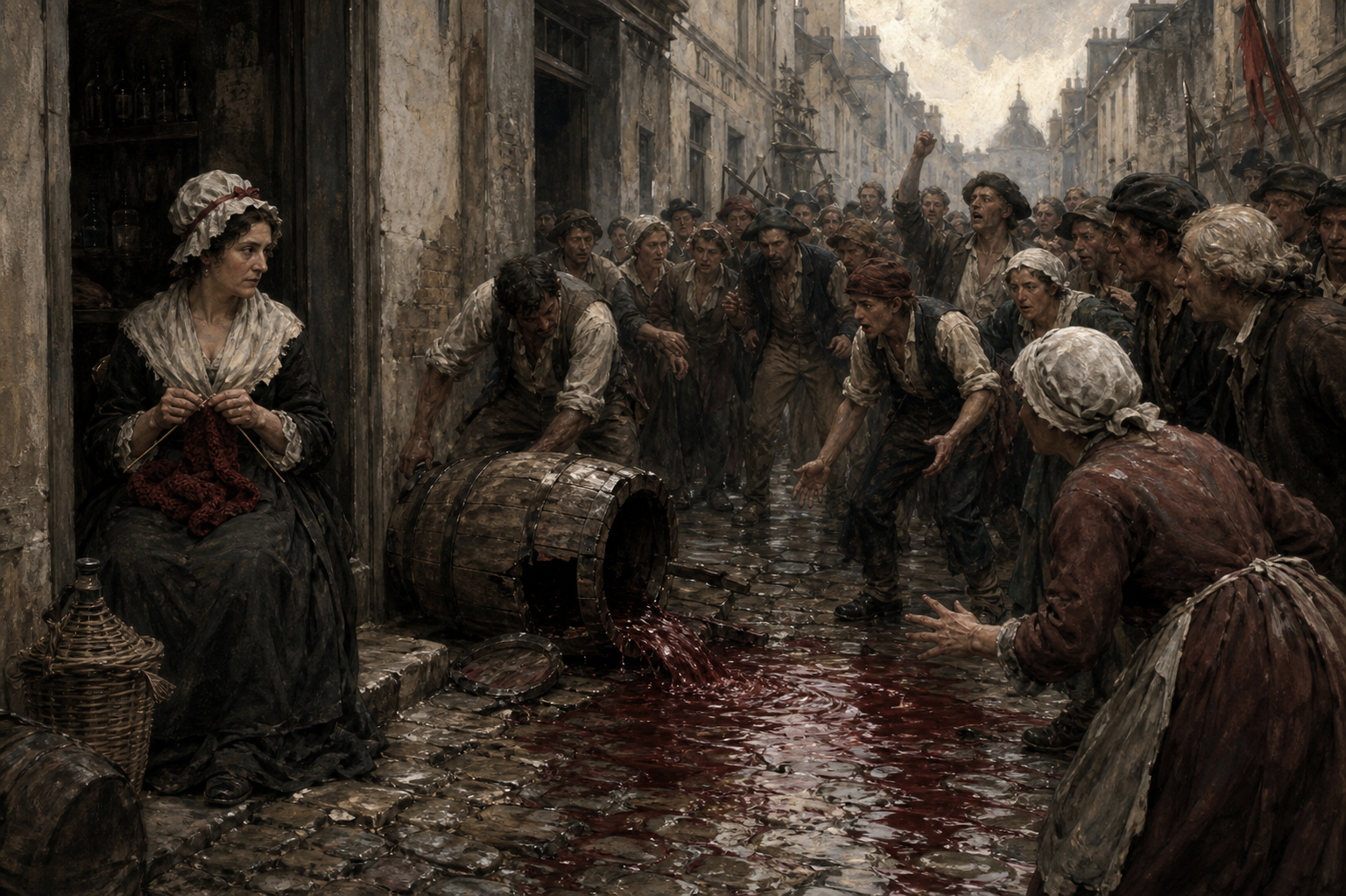
Paris introduces another kind of memory. In the poor quarter of Saint Antoine, a wine cask breaks in the street and people rush to lap the spilled wine from the stones. Dickens makes the scene vivid because hunger has become public theatre. The red wine foreshadows blood, but the people are not monsters. They are poor, watched, mocked, and starved.
Monsieur and Madame Defarge run the wine-shop. Defarge was once Dr. Manette's servant and helps protect the old prisoner. Madame Defarge is quieter and more frightening. She knits, observes, and records names. Her knitting is a political archive: patient, domestic, and deadly. It turns private memory into a list of future punishments.
The contrast between Lucie and Madame Defarge begins here. Lucie uses memory to restore a father. Madame Defarge uses memory to preserve injury until vengeance is possible. Dickens does not make either woman socially powerful in a conventional sense, but each becomes a force through what she remembers and how she remembers it.
Saint Antoine also teaches the reader how revolution is organized before it has a public name. The Jacques network listens, watches, and stores stories. The mender of roads tells the Defarges about Gaspard, the grieving father who hangs beneath the Marquis's carriage after the Marquis's coach kills his child. The scene is grotesque, but Dickens does not make it random: aristocratic speed literally crushes the poor, and the official response treats the dead child as an inconvenience.
The Marquis St. Evrémonde's world is built on that contempt. In town, Monseigneur's circle turns privilege into ritual and boredom. In the country, the Marquis treats peasants as objects beneath notice. When he is murdered in his bed after Gaspard's revenge, Dickens makes the killing understandable without making revenge morally complete. The old order has manufactured hatred, and Saint Antoine is learning to remember every name.
3. Charles Darnay, Sydney Carton, and the problem of doubles
Five years later, Charles Darnay is tried in London for treason. He is accused of passing information between England and France. The trial introduces a central device: likeness. Sydney Carton, a brilliant but self-destructive lawyer working with Stryver, looks enough like Darnay that the identification of the prisoner becomes uncertain. That resemblance helps save Darnay.
Darnay is honorable, restrained, and already trying to separate himself from his French aristocratic inheritance. Carton is gifted but wasted. He drinks, mocks himself, and seems to believe he has already failed at life. The two men become doubles not because they are identical, but because they reveal alternate possibilities: the respected life Darnay tries to live and the ruined life Carton believes he deserves.
Lucie and Dr. Manette become the emotional center around which these men turn. Darnay loves Lucie sincerely. Carton also loves her, but he knows she cannot build a future with him. His private confession to Lucie is one of Dickens's strongest character moments: Carton asks for no reward, but he promises that he would give his life for someone she loves.
That promise matters because Dickens plants it long before the ending. Carton's sacrifice is not a sudden trick. It is the final form of a vow made by a man who thinks his life has no worth unless it can protect another.
The London trial also shows how uncertain public truth can be. Witnesses speak confidently, lawyers turn memory into performance, and the court is ready to convert resemblance into guilt until Carton's face interrupts the certainty. This is one reason the double motif is so useful for essays: Dickens uses physical likeness to expose the fragility of legal judgment before he uses it for sacrifice.
Carton's self-hatred should not be mistaken for laziness alone. He has intelligence, speed, and insight, but he has surrendered the idea that those gifts can form a life. Stryver benefits from Carton's labor while presenting himself as the successful man. Darnay lives the honorable domestic future Carton cannot imagine for himself. Lucie does not "fix" Carton, and Dickens is careful about that. She becomes the witness before whom Carton can say one true thing: he has wasted himself, but he can still love without possession.
4. Marriage, hidden names, and the return of the Bastille
Darnay asks Dr. Manette for Lucie's hand. He also tries to disclose his true family name, but the Doctor asks him to wait until the wedding morning. The secrecy matters. Darnay has rejected his aristocratic family, especially the cruelty associated with the Evrémonde name, but history does not disappear because a person changes countries.
Lucie and Darnay marry, and the news of Darnay's identity shocks Dr. Manette into relapse. He returns to shoemaking, as if the Bastille has reopened inside him. The episode shows how trauma survives beneath restored domestic life. Lucie's home can heal, but it cannot magically remove the past.
Meanwhile, France moves toward revolution. The Marquis St. Evrémonde's cruelty and the wider arrogance of the old order show why the people hate the aristocracy. When the Bastille falls, Defarge finds Dr. Manette's old written account hidden in the prison. That document will later become devastating evidence.
The revolution first appears as historical justice: the prison that swallowed Manette is broken. But Dickens quickly shows how revolutionary energy can become ritual violence. Crowds, courts, denunciations, and executions begin to replace one machinery of power with another.
Dickens keeps returning to Lucie's London home as a fragile space of order. The "echoing footsteps" around the house turn domestic quiet into suspense: arrivals are coming, but the family cannot yet know whether they are friends, suitors, refugees, or consequences. This is not filler. It is how Dickens connects private happiness with historical pressure. The more peaceful the home becomes, the more sharply the reader feels how many old steps are moving toward it.
Dr. Manette's relapse after the wedding is one of the novel's clearest trauma scenes. The Doctor can bless the marriage in public and collapse in private because the Evrémonde name has reached the place where he is most vulnerable. Mr. Lorry and Miss Pross protect him by removing the shoemaking bench when he recovers, but the solution is practical rather than complete. The object is gone; the wound remains.
5. Darnay returns to France and is trapped by history
Years later, Darnay receives a desperate letter from Gabelle, a former servant of the Evrémonde estate, who has been imprisoned by revolutionaries because of his connection to the family. Darnay believes he can return to France as a man who renounced aristocratic privilege and explain himself honorably. This is his mistake. He thinks moral intention can speak clearly inside a political system built on inherited guilt.
He travels to Paris and is arrested. Lucie, Dr. Manette, little Lucie, Miss Pross, and Mr. Lorry follow. For a time, Dr. Manette's status as a former Bastille prisoner gives him influence. He uses his suffering as a shield for Darnay, and Darnay is briefly released.
But history turns again. Darnay is rearrested because of the written testimony Dr. Manette left in the Bastille. The old document names the Evrémonde family as guilty of destroying a peasant family and condemns their descendants. The cruel irony is sharp: Manette's prison record, written from agony, threatens the husband of the daughter who restored him.
Madame Defarge's personal motive is also revealed. She is connected to the family ruined by the Evrémondes. Her vengeance is not abstract politics. It is family memory hardened into a demand that every Evrémonde line must end, including Lucie and her child.
Darnay's return is not foolish because he lacks courage. It is foolish because he misreads the kind of world he is entering. In England, his character, profession, and marriage can matter. In Revolutionary France, his old name organizes the evidence before he speaks. The checkpoint system, prison bureaucracy, and courtroom ritual all teach him that a private conscience cannot easily argue with a public category.
Manette's temporary power is one of Dickens's most painful reversals. The Doctor's suffering gives him moral authority with the revolutionaries: he was a Bastille prisoner, so he can speak as a victim of the old regime. But the same past contains a document written in rage and despair. When that manuscript is read aloud, Manette becomes witness against the family he has tried to protect. The novel's question is not whether the document tells the truth. It does. The question is what truth does when it returns in a court hungry for blood.
6. Carton sees the last possible exchange
Sydney Carton comes to Paris and understands what others cannot. Darnay cannot talk his way out. Dr. Manette's influence has failed. Lucie's love cannot soften Madame Defarge. The machinery is moving.
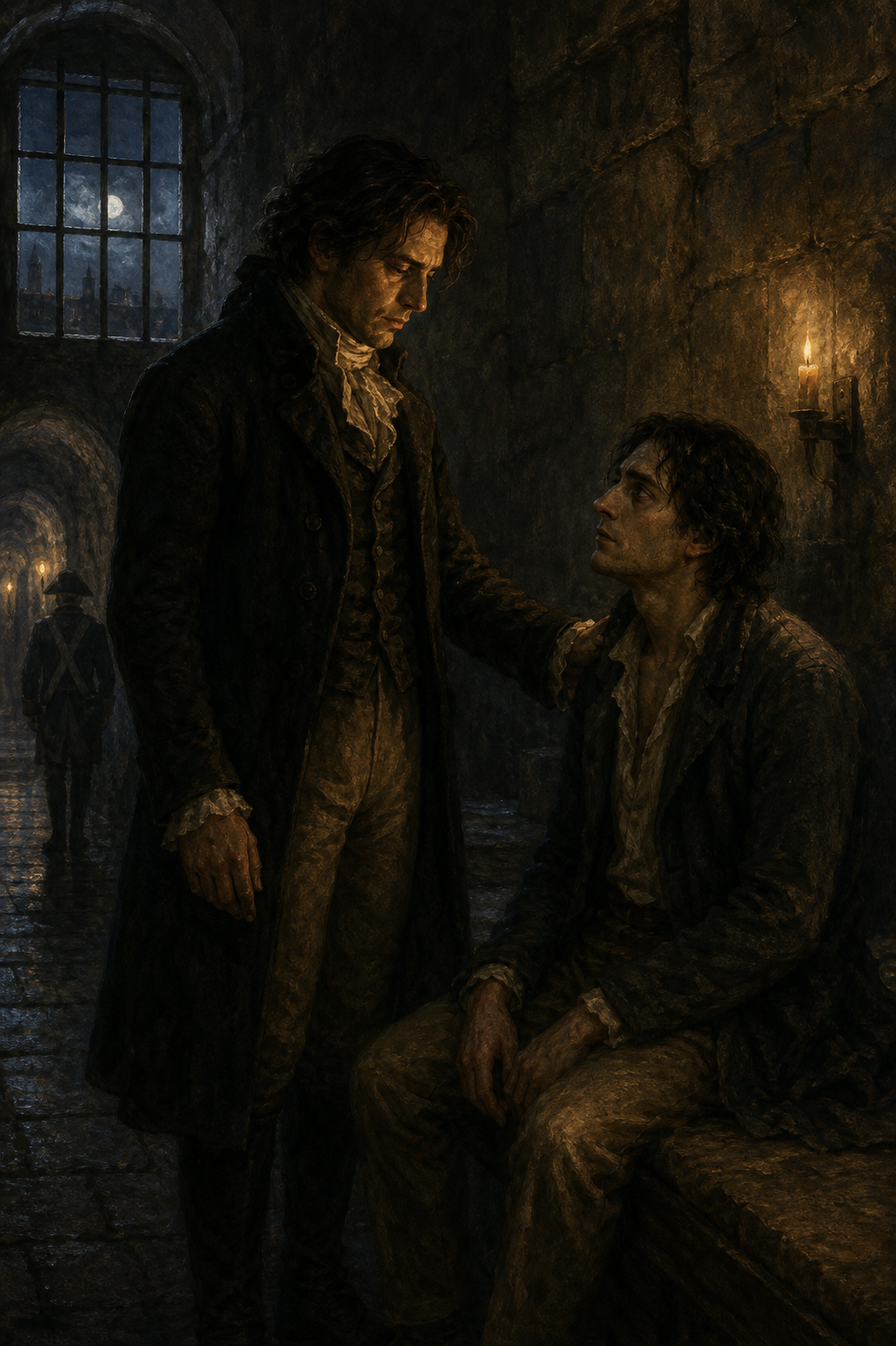
Carton notices that his resemblance to Darnay, first useful in the London trial, can now become a means of substitution. He obtains access to Darnay, drugs him, changes clothes with him, and arranges for the unconscious Darnay to be carried out with Lucie's group. The double image that once created legal doubt now becomes moral action.
At the same time, Miss Pross confronts Madame Defarge when Defarge comes seeking Lucie. Their struggle ends with Madame Defarge's death. It is a strange mirror to Carton's sacrifice: one woman protects Lucie's family through fierce domestic loyalty, while Carton protects them through self-offering.
Carton's plan depends on more than resemblance. He reads the city, recognizes Barsad as a compromised spy, uses Jerry Cruncher's knowledge of grave-robbing to pressure him, and moves through the prison system with a coolness that contrasts with his earlier wasted energy. Dickens lets us see that Carton always had capacity. What changes is the direction of that capacity. His intelligence stops circling self-contempt and becomes service.
Miss Pross's struggle with Madame Defarge is just as important as the prison exchange, though it is easy to treat it as a side scene. Pross does not understand Defarge's language, and Defarge does not understand Pross's love. Their fight stages two forms of loyalty that cannot translate each other: domestic devotion and revolutionary vengeance. The pistol shot that kills Defarge also deafens Pross, making protection costly even when it succeeds.
7. The ending and what it meansThis section contains major ending spoilers.
Carton goes to the guillotine in Darnay's place. He comforts a frightened young seamstress who realizes he is not the condemned man he seems to be. His final imagined vision reaches beyond his own death: Lucie and Darnay safe, their child carrying his name, and a future in which his wasted life is remembered through love rather than failure.
The ending is famous because Carton finds redemption without escaping death. Dickens does not pretend that sacrifice fixes history. The Revolution continues; many innocent people die; trauma remains. But Carton's act creates one protected future inside the catastrophe.
His substitution also completes the book's resurrection pattern. Dr. Manette is restored from prison to family. Darnay is restored from death to life by another man's choice. Carton, paradoxically, is restored by giving up the life he thought worthless. Dickens turns resemblance into grace: the double who once seemed like a ruined version of Darnay becomes the person who saves him.
The seamstress matters because Carton's last act is not only directed toward Lucie's family. He also gives courage to a stranger who has no power, no plot advantage, and no way out. That small kindness keeps the ending from becoming a purely theatrical switch. Carton is not merely executing a plan; he is becoming the kind of person his earlier life had hidden.
His final vision also widens the novel beyond one household. He imagines the violent era wearing itself out, Lucie's family living, and a child bearing his name. Dickens does not say that history is redeemed. He says that a single act can refuse history's demand that every injury reproduce itself. Carton's death interrupts one chain of vengeance and leaves behind a memory not based on punishment.
Major Characters
Sydney Carton
wasted advocate who becomes the novel's sacrificial double
Carton begins as a man who has talent without discipline and self-knowledge without hope. He sees through other people's pretensions, including Stryver's vanity and Darnay's vulnerability, but he turns that insight against himself. His resemblance to Darnay first looks like a courtroom convenience, but it becomes the structure of his final act.
He matters because Dickens does not make redemption easy or social. Carton does not become respectable, marry Lucie, or escape death. He becomes capable of love that asks for nothing except the beloved's survival, and his wasted gifts finally become purposeful in the prison exchange.
Charles Darnay
French aristocrat trying to renounce inherited guilt
Darnay rejects the cruelty of the Evrémonde family and tries to live as an honorable teacher in England. He is morally serious, but he also underestimates history. His return to France assumes that personal honor can explain itself inside a system determined to judge names, property, and bloodline.
His story asks whether a person can step outside inherited violence. Dickens's answer is uneasy: morally yes, historically not always. Darnay is innocent of his uncle's crimes, but the novel refuses to pretend that inherited privilege leaves no debt behind.
Lucie Manette
daughter, wife, and restorative center
Lucie is sometimes described as passive, but her function is powerful. She gives Dr. Manette a reason to return from psychological death and holds together a fragile circle of loyalty around her father, husband, child, Lorry, Pross, and Carton.
Her limitation is also important. Love can restore, but it cannot control courts, mobs, or vengeance once history has become political machinery. Dickens uses Lucie to show both the force and the boundary of private care.
Dr. Alexandre Manette
Bastille survivor and living archive of trauma
Manette embodies the long afterlife of imprisonment. His shoemaking relapses show that freedom does not automatically cure the mind, and his recovered social authority remains fragile whenever the Bastille past is touched.
His old written testimony turns him into a tragic witness against his own family by marriage. Dickens uses him to show how pain can be both evidence and wound: it tells the truth about aristocratic violence while endangering the people his restored life most loves.
Madame Defarge
revolutionary memory transformed into vengeance
Madame Defarge is calm, disciplined, and terrifying because she treats revenge as duty. Her knitting converts grief into a ledger of death, making a domestic gesture into revolutionary administration.
She is not merely evil; her hatred has a historical cause in the Evrémonde crimes against her family. The tragedy is that her justice has become unlimited, extending from guilty aristocrats to children and wives.
Jarvis Lorry, Miss Pross, and Jerry Cruncher
ordinary loyalty inside historical crisis
These secondary figures keep the novel from becoming only a clash of symbols. Lorry translates feeling into practical care, Pross turns domestic devotion into physical courage, and Cruncher's comic underworld knowledge becomes unexpectedly useful when Carton needs leverage over Barsad.
They matter because Dickens often gives moral survival to unglamorous work: errands, records, household care, travel papers, and risky favors. Their loyalty helps private love move through public danger.
Best Quotes
It was the best of times, it was the worst of times, it was the age of wisdom, it was the age of foolishness.
The famous opening works because it refuses a single historical mood. The balanced oppositions make revolution feel like contradiction before the plot begins: hope and terror, justice and frenzy, new birth and destruction at once.
“You know that you are recalled to life?” “They tell me so.”
This exchange from Lorry's dream gives the novel its first key. Manette returns from prison, but the answer is hesitant, not triumphant. Resurrection begins with uncertainty, and the phrase later points toward Darnay's rescue and Carton's moral rebirth.
I care for no man on earth, and no man on earth cares for me.
Carton's self-description is bleak, but it prepares his transformation. The man who thinks he belongs to no one will later choose to belong, finally, through sacrifice.
Think now and then that there is a man who would give his life, to keep a life you love beside you!
Carton's promise to Lucie is the emotional seed of the ending. The sentence matters because his love does not demand possession. It defines love as protection, even if the protected future excludes him.
It is a far, far better thing that I do, than I have ever done.
Carton's final imagined words are powerful because they are not only about death. They are about finding an action better than the self he has been living with.
Major Themes
Resurrection
Coming Back Is Not Simple
The novel repeats returns from death, prison, despair, and political erasure. But resurrection always carries scars: Manette relapses, Darnay survives through another's death, documents return as accusation, and Carton is renewed only by sacrifice.
Memory
Love Remembers Differently Than Revenge
Lucie remembers in order to restore. Madame Defarge remembers in order to punish. Manette's manuscript remembers in order to testify. Dickens builds the moral conflict around what the past is allowed to demand from the present.
Justice
Oppression Creates Its Own Reckoning
The French aristocracy's cruelty makes revolution understandable. Yet Dickens shows that righteous anger can become indiscriminate once people are reduced to categories: aristocrat, Evrémonde, wife, child, enemy.
Doubles
Resemblance Becomes Responsibility
Carton and Darnay look alike, but their doubling is more than plot mechanics. In London it creates reasonable doubt; in Paris it creates substitution. Dickens asks whether one life can answer for another and whether likeness can become love.
Dickens and the French Revolution
Dickens published A Tale of Two Cities in 1859, drawing on the popular nineteenth-century understanding of the French Revolution, especially the sense that aristocratic injustice and mob violence were morally linked. The novel is historical fiction rather than a textbook. Its Paris is theatrical, symbolic, and compressed for moral effect.
That compression is part of the design. Dickens is less interested in explaining every faction of the Revolution than in showing how systems treat persons. The Bastille turns Manette into a number and a shoemaker. The Revolutionary court turns Darnay into an Evrémonde before it can see him as a man. Tellson's Bank turns emotion into records and dispatches. Against these systems, the novel places smaller human bonds: a daughter holding her father, a friend guarding a family, a wasted lawyer keeping one promise.
The book's politics are therefore not simple nostalgia for aristocracy. Dickens condemns the old order through the Evrémonde story, the killing of the child, and the hidden history behind Manette's imprisonment. But he also fears any politics that stops seeing individuals. That is why Madame Defarge is one of his most memorable figures: she is justice with a real grievance, but without mercy.
Dickens also builds the book as a tighter, more symbolic novel than many of his large social panoramas. The short chapters, recurring objects, paired cities, and delayed revelations make it feel almost architectural. For readers who find Dickens sprawling, A Tale of Two Cities is often a good entry point because its melodrama is disciplined by pattern: prison and home, London and Paris, record and rumor, revenge and rescue, Darnay and Carton.
Why It Still Matters
The novel still works because it understands how private lives get caught in public history. A family can try to live quietly, but old crimes, inherited names, documents, borders, and courts keep returning. Students can use the book to think about trauma, collective memory, political revenge, and the ethics of sacrifice.
It also remains one of the clearest AP Lit novels for symbolism. The wine, knitting, shoemaking bench, doubles, footsteps, and resurrection language are not decorative. They are the machinery by which Dickens turns plot into argument.
The most modern part of the novel may be its suspicion of inherited categories. Darnay cannot escape being read as an Evrémonde; Madame Defarge cannot stop reading every Evrémonde as the old crime renewed; Carton is dismissed as a wasted man until one action reveals another meaning. Dickens keeps asking whether a person can be more than the label history, class, law, or self-contempt has fixed on them.
FAQ: Summary, Ending, and Study Notes
What is A Tale of Two Cities about?
It follows the Manette-Darnay family across London and Paris before and during the French Revolution. Dr. Manette is released from the Bastille, his daughter Lucie restores him to life, Charles Darnay tries to escape his aristocratic family history, and Sydney Carton ultimately saves Darnay through substitution.
Why does Sydney Carton sacrifice himself?
Carton loves Lucie and once promised that he would give his life for someone dear to her. His resemblance to Darnay gives him a way to keep that promise. The sacrifice turns a wasted life into a meaningful act without making him conventionally successful. That distinction matters: Dickens does not rewrite Carton into a respectable hero; he lets one chosen act redeem the meaning of his life.
Is Madame Defarge a villain?
She is an antagonist, but Dickens gives her hatred a cause. Her family suffered under aristocratic violence. The moral problem is that her demand for justice becomes absolute, extending vengeance to people who did not commit the original crimes.
Why is the title about two cities?
London and Paris represent different social orders and different ways of managing history. London offers refuge, law, banking, and family continuity. Paris exposes hunger, memory, revolution, and revenge. The plot needs both because private safety and public upheaval keep crossing.
What does "Recalled to Life" mean?
At first it refers to Dr. Manette's release from the Bastille and his return to Lucie. As the novel develops, it becomes a broader resurrection motif. Darnay is recalled from death by Carton's substitution, Carton is morally recalled from self-waste, and buried documents are recalled into public judgment. The phrase is hopeful, but it is never simple.
Why is Dr. Manette's letter so important?
The letter is the novel's sharpest example of historical irony. It truthfully records the Evrémonde crimes that led to Manette's imprisonment, so it is morally necessary evidence. Yet when it returns during the Revolution, it condemns Darnay, the husband of Manette's daughter. Dickens uses the document to show that truth can heal public memory and still wound private life.
What is the best study angle for AP Lit or school essays?
The strongest angle is usually not "sacrifice" by itself. Pair Carton's sacrifice with a device: resurrection motif, double structure, legal irony, or memory. For example, argue that Dickens turns physical resemblance into ethical substitution, or that the novel contrasts Lucie's restorative memory with Madame Defarge's punitive memory.
Read Next
Read Les Misérables for another large novel about revolution, law, mercy, and social suffering. Read Jane Eyre for a first-person Victorian study of conscience and self-respect. Read The Scarlet Letter for public punishment, hidden guilt, and the pressure of communal judgment.
Adaptation note
- The 1935 film emphasizes melodrama, romance, and Carton's heroic self-sacrifice.
- Stage and radio versions often sharpen the double plot because the resemblance between Darnay and Carton is the story's most theatrical device.
- For school essays, the novel is usually stronger as a text about resurrection, memory, and political violence than as a simple romance.