Romeo and Juliet Study Guide - AP Lit, SAT Reading, Close Reading, and Essay Practice
A practical guide for AP English Literature, SAT Reading, IB English, and school essays, with key passages, literary devices, practice questions, and thesis models.
This study guide is built for students who need to discuss Romeo and Juliet with textual evidence. If you want the full plot explanation first, start with the main article.
Who This Guide Is For
This guide is for AP English Literature, SAT Reading, IB English, and high school or college students who need to move beyond "two teenagers fall in love and die." The goal is to explain how Shakespeare creates tragedy through prologue, sonnet form, dramatic irony, public violence, names, speed, and failed adult mediation.
By the end, you should be able to:
- use short quotations about fate, names, love, and feud
- explain why the prologue matters even though it reveals the ending
- analyze the balcony scene as an argument about identity
- discuss Mercutio and Tybalt as more than side characters
- build defensible AP Lit theses about fate, youth, public violence, and adult failure
- answer SAT-style questions about inference, function, tone, and word choice
1. Quick Review
- Original title: The Tragedy of Romeo and Juliet
- Author: William Shakespeare
- First printed: 1597
- Main settings: Verona and Mantua
- Genre: tragedy, early modern drama
- Central conflict: private love tries to survive inside a public feud
- Core themes: love and hate, names and identity, fate and choice, youth and haste, masculine honor, failed communication
- Common exam angles: prologue and fate, balcony scene, sonnet form, Mercutio's curse, Friar Lawrence's warning, dramatic irony in the tomb scene
One-sentence summary:
Romeo and Juliet fall in love across a family feud, and their private marriage is destroyed by public violence, secrecy, and failed communication.
2. Plot Structure for Exams
Exposition
The Montagues and Capulets disturb Verona with repeated street violence. Prince Escalus threatens death for future brawls. Romeo begins as a melancholy lover of Rosaline, while Paris begins negotiating for Juliet's hand.
Rising Action
Romeo sees Juliet at the Capulet feast, and their first conversation forms a shared poetic pattern. After learning each other's names, they meet in the balcony scene and secretly marry with Friar Lawrence's help.
Turning Point
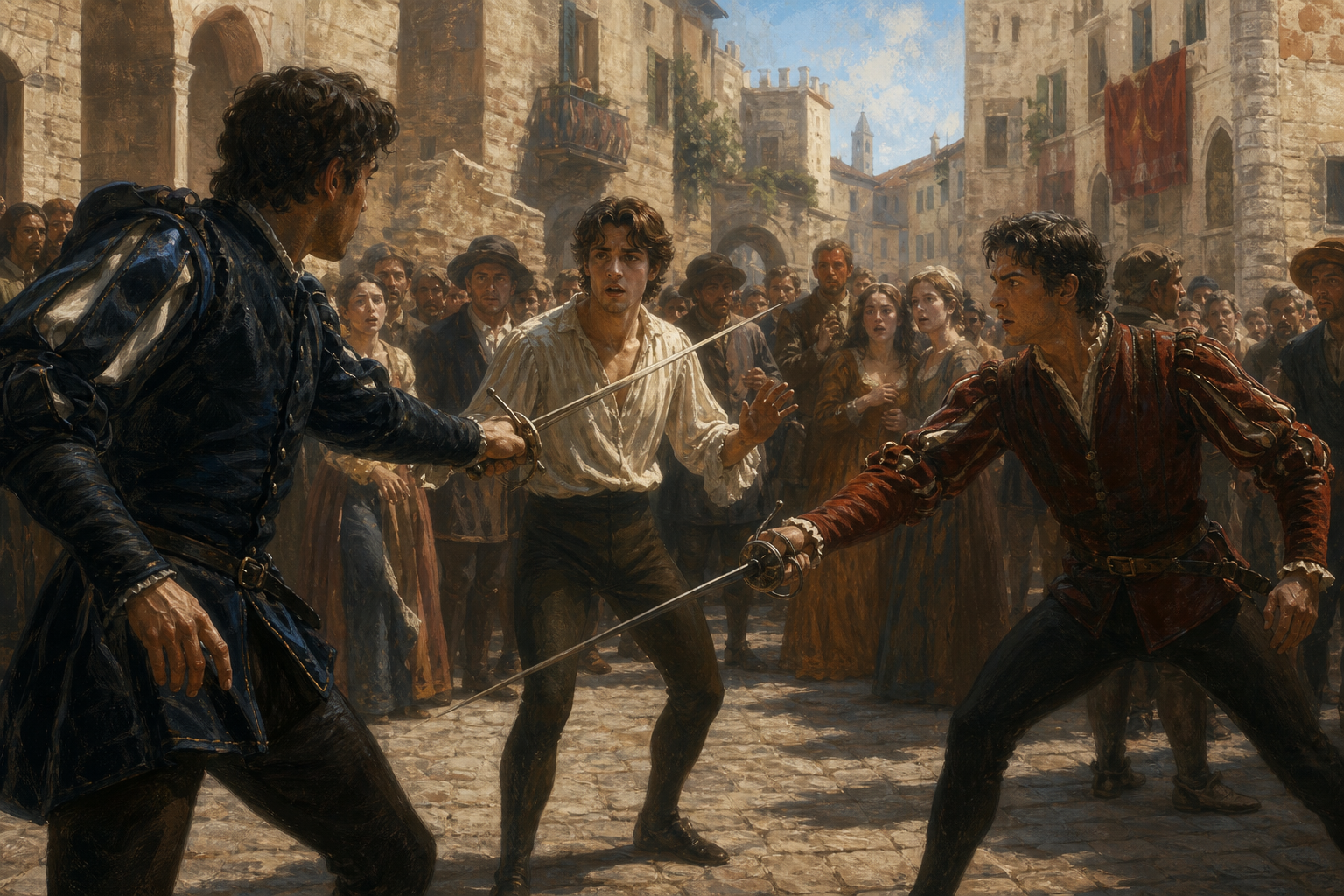
Tybalt challenges Romeo. Romeo refuses because Tybalt is now his secret kinsman by marriage. Mercutio fights instead and dies; Romeo kills Tybalt and is banished.
Crisis
Capulet pressures Juliet to marry Paris. Juliet seeks Friar Lawrence, who gives her a potion that will make her appear dead while he sends word to Romeo.
Resolution
The letter fails to reach Romeo. He believes Juliet is dead, returns to Verona, kills Paris at the tomb, and dies by poison. Juliet wakes, finds Romeo dead, and dies with his dagger. The families reconcile too late.
3. Key Original Passages for Close Reading
These passages are compact testing grounds for close reading. For each one, identify the speaker, situation, diction, structure, and larger theme. The goal is to turn a short line into commentary rather than plot summary.
Passage 1: star-crossed lovers
A pair of star-cross'd lovers take their life.
Context: The prologue announces the lovers' deaths before the plot begins.
Close reading: "Star-cross'd" frames the lovers as opposed by forces larger than private feeling; "take their life" points toward both self-action and loss.
Essay use: Use it for fate, dramatic irony, and the prologue's effect on audience attention.
Passage 2: civil blood
Where civil blood makes civil hands unclean.
Context: The prologue describes Verona's feud as a civic stain.
Close reading: The repeated "civil" makes the city both the source and victim of its violence.
Essay use: Use it for public violence, social responsibility, and the feud as more than family drama.
Passage 3: my only love
My only love sprung from my only hate!
Context: Juliet learns that Romeo is a Montague.
Close reading: The balanced structure of "only love" and "only hate" compresses private desire and inherited identity into one shock.
Essay use: Use it for the collision between love and family names.
Passage 4: what's in a name
What's in a name? That which we call a rose by any other name would smell as sweet.
Context: Juliet tries to imagine Romeo apart from the Montague name.
Close reading: The rhetorical question and rose metaphor separate essence from social label, while the plot shows how hard that separation is to live.
Essay use: Use it for names, identity, social pressure, and Juliet's maturity.
Passage 5: violent delights
These violent delights have violent ends.
Context: Friar Lawrence warns the lovers before their marriage.
Close reading: The repetition of "violent" links emotional intensity with destructive consequence.
Essay use: Use it for foreshadowing, haste, and the danger of love inside a violent society.
Passage 6: a plague
A plague o' both your houses!
Context: Mercutio curses both families after being fatally wounded.
Close reading: "Both" expands blame beyond a single person and turns Mercutio into the feud's moral witness.
Essay use: Use it for collective responsibility, tonal shift, and Mercutio's dramatic function.
Passage 7: never was a story
For never was a story of more woe than this of Juliet and her Romeo.
Context: The Prince closes the play after the families reconcile.
Close reading: The reversed order, "Juliet and her Romeo," reframes the familiar pair through mourning and public memory.
Essay use: Use it for ending interpretation, delayed reconciliation, and the cost of public hatred.
4. Close Reading Procedure
Close reading Romeo and Juliet means asking how language turns private feeling into public consequence. The plot is famous, so strong essays need technique: who speaks, what words repeat, what structure shapes the scene, and how the scene changes the play's moral pressure.
Step 1: Locate the scene's public or private pressure
The street, feast, balcony, Friar's cell, bedroom, and tomb all create different pressures. A street scene is about honor and witnesses. A balcony scene allows private language but also requires secrecy. The tomb turns secrecy into public reckoning.
Step 2: Track paired opposites
Mark love/hate, light/dark, name/body, haste/delay, youth/age, life/death. Shakespeare often builds meaning by holding opposites together instead of choosing one simple moral.
Step 3: Identify the communication problem
The play is full of messages: invitations, vows, challenges, orders, letters, rumors, and reports. Ask whether the message is public or secret, successful or failed, honest or distorted.
Step 4: Connect the device to tragedy
Do not stop at "this is imagery" or "this is foreshadowing." Explain what the device reveals about the feud, the lovers, or the adult world around them.
Worked example: Juliet's rose metaphor
When Juliet asks, "What's in a name?" the literal situation is that she loves Romeo but recognizes the danger of the Montague label. The rose metaphor argues that essence survives a change in label. Yet the play's action proves that names have public force: they trigger hatred, duels, secrecy, and parental control.
That gives you a paragraph claim:
Through Juliet's rose metaphor, Shakespeare lets love imagine identity beyond inherited names, while the tragedy shows that Verona's public world still gives those names lethal power.
5. Why Literary Devices Matter
In Romeo and Juliet, devices matter because they keep private love tied to public consequence. Form, imagery, irony, and wordplay are not decoration; they are the way the play thinks.
Prologue: suspense replaced by responsibility
The prologue reveals the deaths, so the audience watches causes rather than outcomes. Use it to argue that the play's real question is why the deaths become unavoidable.
Dramatic irony: knowledge arrives unevenly
The audience knows Juliet is not truly dead, but Romeo does not. This gap turns the final act into a tragedy of failed information.
Sonnet form: love as shared language
The lovers' first dialogue works like a shared sonnet. The form makes their attraction mutual, not simply Romeo's performance.
Oxymoron: a divided world
Romeo's "loving hate" and similar phrases show a world where opposites are fused. The language prepares us for a love born inside enmity.
Light and dark imagery: shelter and exposure
Romeo often sees Juliet as light, but night is also the space that hides their relationship. Darkness protects love while making it secret.
Foil characters: different responses to violence
Benvolio, Mercutio, and Tybalt reveal alternate masculine roles: peacekeeper, witty challenger, and honor-driven fighter.
Wordplay: comedy near danger
The servants' puns and Mercutio's jokes make the play lively, but wordplay often sits close to sexual aggression, insult, and violence.
Foreshadowing: warnings that cannot save
The prologue, Friar's warning, and Juliet's fears all anticipate the ending. The tragedy is that warning does not become prevention.
6. Turning Character Analysis into Essay Language
Character analysis should connect role, pressure, device, and theme. Avoid only saying "Romeo is impulsive" or "Juliet is brave." Ask how Shakespeare uses each character to make the tragedy work.
Romeo
lover caught between private devotion and public masculinity
Essay sentence: Romeo's tragedy lies in the gap between his desire for private love and the public masculine code that pulls him back into revenge.
Juliet
young speaker who thinks beyond inherited names
Essay sentence: Juliet's language about names shows intellectual maturity, but her limited social power forces that insight into secrecy rather than public change.
Mercutio
comic energy turned tragic witness
Essay sentence: Mercutio's death changes witty masculine competition into irreversible tragedy and exposes both houses as morally responsible.
Tybalt
honor culture in its purest form
Essay sentence: Tybalt embodies a feud culture where peace sounds like weakness and identity is defended through violence.
Friar Lawrence
adult mediator whose plan depends on fragile timing
Essay sentence: Friar Lawrence's good intentions reveal the danger of solving public hatred through secret private schemes.
7. Thesis Builder for Major Themes
Names
Identity
Weak thesis: Names are important.
Strong thesis: Shakespeare makes inherited names socially powerful enough to endanger bodies, even as Juliet imagines a love beyond those labels.
Fate
Choice and Structure
Weak thesis: Fate kills the lovers.
Strong thesis: The play frames the lovers as star-crossed while showing that human choices, feud culture, and failed communication make fate visible.
Violence
Public Feud
Weak thesis: The families fight too much.
Strong thesis: Verona's feud turns private identity into public violence, making even love depend on secrecy, speed, and risk.
Youth
Speed
Weak thesis: Romeo and Juliet are impulsive.
Strong thesis: The lovers' haste becomes tragic because it develops inside a society that also acts with dangerous speed: duels, commands, threats, and forced marriage.
8. SAT Reading Sample
These are SAT-style practice questions, not official College Board questions. Each question is tied to a specific scene, passage, or recurring device from the play.
Question 1
The prologue's phrase "star-cross'd lovers" primarily suggests that the lovers are:
- A. guided by ordinary family advice
- B. opposed by forces larger than private feeling
- C. uninterested in public reputation
- D. protected by Verona's laws
Answer: B. "Star-cross'd" places the lovers under pressure from fate, society, and family history. A and D contradict the danger around them, while C ignores how public identity defines the plot.
Question 2
In the prologue, the repetition of "civil" emphasizes:
- A. the city's own society becoming violent
- B. Romeo's private sadness
- C. Juliet's obedience to her mother
- D. Friar Lawrence's religious training
Answer: A. "Civil blood" and "civil hands" make Verona both civic community and source of civic violence. The line is about public disorder, not one character's private feeling.
Question 3
Romeo's shift from Rosaline to Juliet most strongly reveals:
- A. his complete emotional stability
- B. his rejection of all poetic language
- C. the speed and intensity of his desire
- D. his legal authority over the feud
Answer: C. Romeo's quick movement from Rosaline to Juliet shows emotional speed. The play does not present him as stable or legally powerful, and his language becomes more poetic, not less.
Question 4
The lovers' first shared dialogue is important because it:
- A. proves their families approve
- B. removes all danger from the plot
- C. explains the Prince's law
- D. forms a shared poetic pattern
Answer: D. Their first exchange interlocks like a sonnet, making love feel mutual and formally balanced. Family approval and legal explanation are absent from the scene.
Question 5
Juliet's "rose" comparison argues that:
- A. family names define moral worth completely
- B. Romeo should become Prince of Verona
- C. outward labels do not change inner reality
- D. flowers control the plot
Answer: C. Juliet separates Romeo's essence from the Montague name. The metaphor does not deny that names have social power; it argues that labels should not define inner worth.
Question 6
Friar Lawrence's warning about "violent delights" functions mainly as:
- A. comic relief
- B. foreshadowing
- C. a business contract
- D. a public law
Answer: B. The warning anticipates the destructive end of intense love inside a violent context. It is serious moral foreshadowing, not comedy or law.
Question 7
Tybalt's reaction to Romeo at the feast shows that he:
- A. treats peace as higher than honor
- B. ignores family identity
- C. wants Juliet to choose freely
- D. reads Romeo's presence as an insult
Answer: D. Tybalt interprets Romeo's presence as a family insult that must be answered. His reaction is driven by honor and feud identity.
Question 8
Mercutio's curse, "A plague o' both your houses," assigns blame to:
- A. only Romeo
- B. only Juliet
- C. both feuding families
- D. the Nurse's household
Answer: C. "Both" is the key evidence. Mercutio's dying curse expands responsibility to the feud itself.
Question 9
Romeo's refusal to fight Tybalt becomes misunderstood because:
- A. Romeo secretly knows Tybalt is now connected to him by marriage
- B. Benvolio has banned all language
- C. Juliet has publicly announced the marriage
- D. the Prince has pardoned Tybalt
Answer: A. Romeo's private marriage changes his relationship to Tybalt, but others do not know that. Secrecy makes peace look like dishonor.
Question 10
The morning-after scene with the lark and nightingale dramatizes:
- A. the lovers' wish to delay separation
- B. the end of all family pressure
- C. a simple lesson about birds
- D. Mercutio's return
Answer: A. The bird debate lets the lovers resist dawn because dawn means Romeo must leave. The scene turns natural sound into emotional pressure.
Question 11
Capulet's later treatment of Juliet reveals:
- A. Juliet's full political power
- B. Romeo's control of the Capulet house
- C. paternal authority turning coercive
- D. Mercutio's legal plan
Answer: C. Capulet moves from fatherly concern to threats and insults when Juliet resists marriage to Paris. The scene exposes coercive family power.
Question 12
The Nurse's advice to marry Paris is painful to Juliet because it:
- A. confirms Romeo is legally present
- B. abandons Juliet's private commitment for social safety
- C. reveals that Paris is a Montague
- D. solves the conflict honestly
Answer: B. The Nurse chooses practical safety over Juliet's marriage to Romeo. Juliet experiences that advice as betrayal.
Question 13
Friar Lawrence's potion plan is risky mainly because it depends on:
- A. Tybalt forgiving Mercutio
- B. the Prince reading poetry
- C. Rosaline joining the Capulets
- D. perfect timing and successful communication
Answer: D. The plan depends on Juliet waking at the right time and Romeo receiving the letter. Its weakness is fragile timing.
Question 14
The failed letter to Romeo is an example of:
- A. a successful public trial
- B. dramatic irony and broken communication
- C. comic misunderstanding without consequence
- D. Juliet's lack of courage
Answer: B. The audience knows the plan, but Romeo does not. The missed letter turns information failure into tragic action.
Question 15
Paris's death in the tomb scene complicates the ending because it shows:
- A. Paris controls the feud
- B. Juliet never mattered to anyone
- C. the tragedy harms more than the central lovers
- D. the apothecary is the hero
Answer: C. Paris is another casualty of secrecy, grief, and social expectation. His death widens the play's cost beyond Romeo and Juliet.
Question 16
The final line "Juliet and her Romeo" is notable because it:
- A. removes Juliet from the tragedy
- B. praises Tybalt as ruler
- C. denies that sorrow exists
- D. reverses the usual title order
Answer: D. The reversed order reframes the pair in public mourning. It does not erase Juliet or deny grief.
Question 17
The play's repeated light imagery most often presents Juliet as:
- A. a legal judge
- B. a figure Romeo sees as transforming darkness
- C. a military commander
- D. a symbol of old age
Answer: B. Romeo repeatedly imagines Juliet through brightness, stars, torches, and sun imagery. The pattern presents her as transformative light.
Question 18
Benvolio functions in the play mainly as:
- A. the cause of Juliet's potion
- B. the ruler of Mantua
- C. Romeo's enemy
- D. a peace-seeking foil to more aggressive men
Answer: D. Benvolio tries to stop fights and report accurately. He contrasts with Tybalt's aggression and Mercutio's volatility.
Question 19
The play's treatment of fate is best described as:
- A. fate alone acts while humans do nothing
- B. fate language works together with human choices and social systems
- C. fate is mentioned only in the final line
- D. fate protects the lovers from error
Answer: B. The prologue frames the lovers as fated, but the plot unfolds through human systems: feud, secrecy, law, coercion, and failed communication.
Question 20
The reconciliation of the families is bitter because:
- A. prevents all mourning
- B. happens before Romeo meets Juliet
- C. comes only after irreversible loss
- D. proves the feud was harmless
Answer: C. The families finally recognize the cost of hatred only after Romeo and Juliet die. That timing makes the peace morally painful.
9. AP Lit Essay Questions
Use these AP Lit-style practice questions to turn a specific scene into a thesis, outline, and evidence-based commentary.
Essay Question 1
The prologue reveals the ending before the play begins. Analyze how Shakespeare uses the prologue to shift attention from suspense to fate, responsibility, and social cause.
Essay Question 2
The opening street fight is more than background. Explain how the scene introduces civic disorder, masculine honor, and the feud's reach across social classes.
Essay Question 3
Compare Romeo's love language for Rosaline with his language for Juliet. Analyze how the difference affects the audience's understanding of desire, performance, and mutuality.
Essay Question 4
Romeo and Juliet's first conversation uses religious imagery and sonnet-like structure. Analyze how form makes their connection feel immediate and shared.
Essay Question 5
In the balcony scene, Juliet questions the relationship between names and identity. Explain how the scene presents both romantic possibility and social danger.
Essay Question 6
Friar Lawrence wants reconciliation but creates a risky private plan. Analyze how his role complicates the relationship between good intentions and tragic consequences.
Essay Question 7
Mercutio's wit gives the early play comic energy, but his death changes the dramatic direction. Analyze Mercutio's role in the play's tonal shift.
Essay Question 8
Tybalt can be read less as an individual villain than as a product of honor culture. Analyze how Shakespeare presents violent identity through Tybalt.
Essay Question 9
The secret marriage protects the lovers' bond but also creates public misunderstanding. Explain how secrecy functions as both shelter and danger.
Essay Question 10
Juliet matures rapidly after meeting Romeo. Use scenes with her parents, the Nurse, or Friar Lawrence to analyze how she gains a language of choice.
Essay Question 11
Analyze Capulet's pressure on Juliet to marry Paris. Explain how family authority shifts from protection to control.
Essay Question 12
Night and day imagery recur throughout the lovers' relationship. Analyze how darkness functions as both protection and risk.
Essay Question 13
Messages, rumors, vows, orders, and letters drive the plot. Analyze how communication and miscommunication shape the tragedy.
Essay Question 14
Romeo tries to avoid fighting Tybalt but later kills him. Analyze how this change reveals conflict among love, masculinity, friendship, and public honor.
Essay Question 15
Paris is often treated as a minor obstacle. Analyze how Paris reveals social expectations around marriage, grief, and Juliet's consent.
Essay Question 16
Juliet's potion soliloquy combines fear and resolve. Analyze how the speech presents Juliet as an active chooser rather than a passive victim.
Essay Question 17
The tomb scene depends on dramatic irony. Explain how the gap between audience knowledge and Romeo's knowledge intensifies the tragedy.
Essay Question 18
The families reconcile at the end, but too late. Analyze what judgment the ending makes about love, hatred, and public responsibility.
Essay Question 19
The play uses fate imagery while still showing human decisions. Analyze how fate and choice work together rather than simply oppose each other.
Essay Question 20
Read Romeo and Juliet as a tragedy of adult failure, not only youthful impulsiveness. Use at least two adult authority figures in your analysis.
10. Model Thesis Bank
Use these as models, then adapt them to the exact question.
- Shakespeare uses the prologue to shift suspense away from outcome and toward the social failures that make the outcome unavoidable.
- The opening street fight presents Verona as a city where public identity has already been trained into violence.
- Romeo's language changes from self-conscious melancholy with Rosaline to shared poetic invention with Juliet, making the new love feel reciprocal but dangerously swift.
- The lovers' first sonnet makes attraction sound sacred and mutual, even as the surrounding feast preserves the feud that will endanger them.
- Juliet's rose metaphor imagines identity beyond inherited names, while the tragedy proves that names still govern bodies in public life.
- Friar Lawrence's mediation shows that good intentions cannot repair public hatred when they depend on secrecy and perfect timing.
- Mercutio's death turns comic wordplay into tragic judgment, exposing both houses as responsible for violence that reaches beyond the lovers.
- Tybalt embodies honor culture so completely that peace itself sounds like an insult to him.
- The secret marriage protects Romeo and Juliet's bond privately while making Romeo's public behavior unreadable to other men.
- Juliet's maturation is visible in her movement from obedient daughter to speaker who risks language, body, and social place for a chosen commitment.
- Capulet's authority becomes tragic when paternal care turns into coercive control over Juliet's body and future.
- Shakespeare uses night as both shelter and danger, allowing love to speak while forcing it into secrecy.
- Failed communication, especially the undelivered letter, turns human planning into tragic accident.
- Romeo's revenge after Mercutio's death shows how public masculinity can overpower private love.
- Paris reveals that socially approved love can still erase Juliet's consent.
- Juliet's potion soliloquy makes courage visible as fear fully imagined and still faced.
- The tomb scene's dramatic irony makes the audience experience tragedy as a preventable failure of timing and knowledge.
- The final reconciliation is morally bitter because peace arrives only after the children have paid for the parents' feud.
- Fate in the play works through human systems: feud, law, secrecy, haste, and failed messages.
- The play critiques adult failure by showing that every authority figure recognizes the cost of hatred only after the young are dead.
11. Academic Vocabulary for Essays
- prologue: an opening speech that frames the action
- dramatic irony: a gap between what the audience knows and what characters know
- sonnet: a fourteen-line poetic form, echoed in the lovers' first exchange
- oxymoron: a phrase that joins contradictory terms
- foreshadowing: a warning or pattern that anticipates later events
- feud: a long-running conflict between families or groups
- masculine honor: a social code linking manhood to reputation and retaliation
- public order: civic peace maintained by law and authority
- private desire: personal feeling or choice separate from public identity
- coercion: pressure that limits free choice
- agency: the capacity to choose and act
- mediation: intervention meant to resolve conflict
- banishment: exile from a place or community
- miscommunication: failed or distorted transmission of information
- imagery: repeated sensory language or symbolic pattern
- fate: a force or pattern that seems to shape events beyond individual control
- haste: dangerous speed or urgency
- reconciliation: restoration of relationship after conflict
- tragedy: drama in which choices, structures, and losses lead to irreversible suffering
- commentary: explanation of how evidence supports a literary claim