Romeo and Juliet — Love, Names, and the Cost of an Old Feud
A detailed guide to Shakespeare's tragedy about young love, public violence, family identity, and the adults who understand too late.

Sua's Quick Take
Romeo and Juliet is easy to remember as the ultimate teenage love story. Read closely, though, and the play becomes more unsettling: two young people move too quickly, but the adults and the city have been moving in the wrong direction for much longer.
What the Play Is Really About
Shakespeare's tragedy is about love, but it is also about names. Romeo and Juliet meet as individuals, speak to each other with startling poetic intimacy, and imagine a selfhood beyond the labels Montague and Capulet. Verona refuses that imagination. In this city, a name is not just a name; it is a social command, a public risk, and sometimes a death sentence.
The play is also about speed. The lovers fall in love, marry, separate, and die in a breathtakingly short span. But the surrounding world is fast too: servants turn jokes into brawls, Tybalt turns insult into challenge, Capulet turns grief into forced marriage, and Friar Lawrence turns hope into a plan that depends on perfect timing. The tragedy does not belong to youth alone.
This guide uses Project Gutenberg eBook #1513 as its public-domain source. The Gutenberg page identifies the text as English, credits the PG Shakespeare Team, lists the release date as November 1, 1998, and marks the eBook as public domain in the United States.
Plot Summary
1. Verona opens in public violence
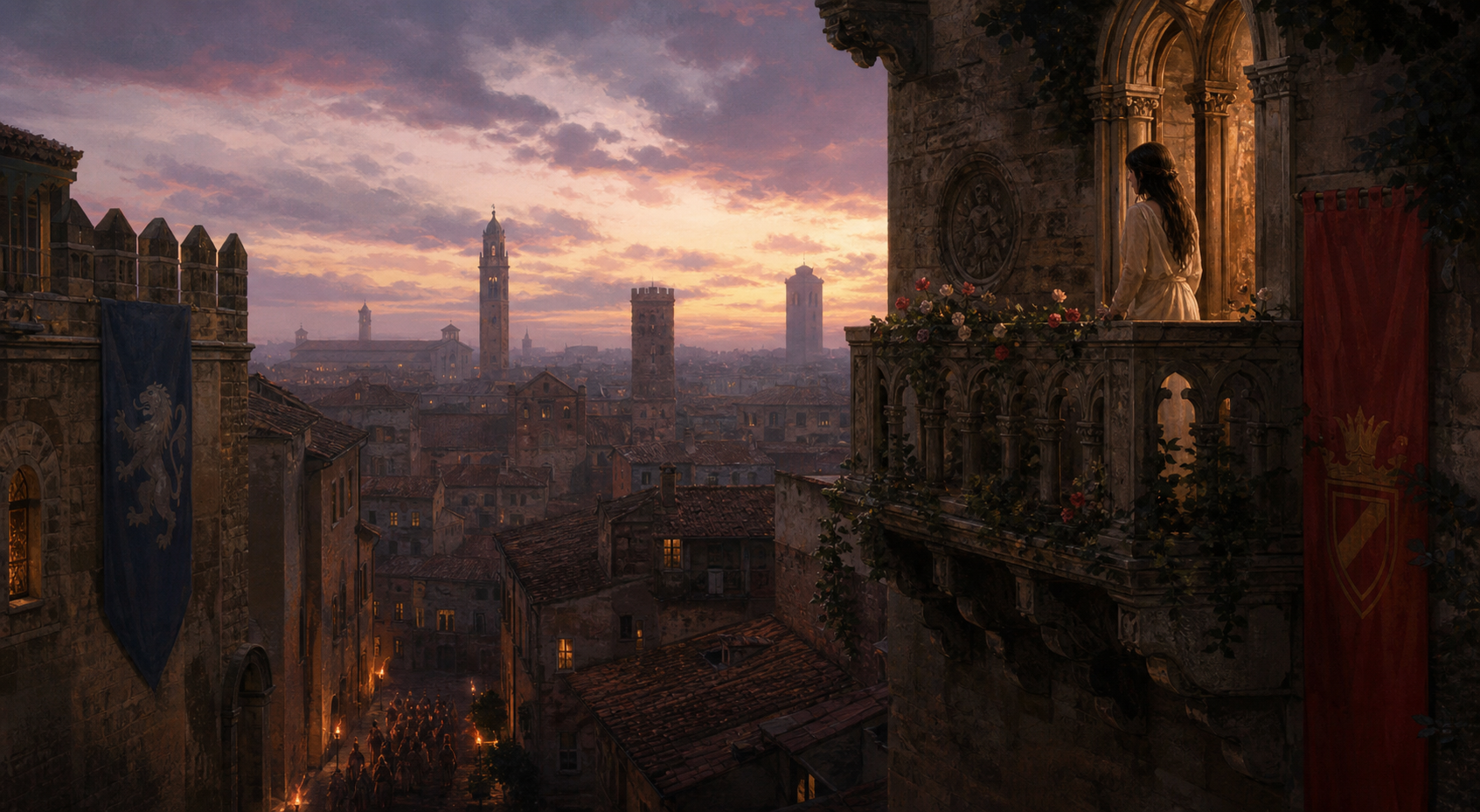
The play begins before the lovers appear. Two Capulet servants, Sampson and Gregory, joke, boast, and provoke Montague servants in the street. Their wordplay turns into a fight almost immediately. This opening matters because Shakespeare shows violence as a civic habit. The feud is not confined to noble drawing rooms; it has entered the language and bodies of servants, kinsmen, citizens, and old men.
Benvolio tries to stop the fight, but Tybalt enters and treats peace as contemptible. He hates the word as he hates hell, Montagues, and Benvolio himself. The contrast is efficient: Benvolio wants order; Tybalt wants honor through conflict. When citizens and family heads rush in, the city looks infected by inherited anger.
Prince Escalus breaks up the brawl and warns both houses that future disorder will be punished by death. His speech establishes the law, but it also reveals that law is already late. Three civil brawls have disturbed Verona. The public authority can threaten punishment, but it has not healed the culture that keeps producing the fights.
Romeo is introduced indirectly as a melancholy young man. He avoids daylight, shuts himself in, and speaks of Rosaline with elaborate sadness. His early love language is self-conscious and theatrical. It matters that Romeo is already in love before he meets Juliet, because the play will ask whether his later passion is merely another pose or something more mutual and transforming.
On the Capulet side, Paris asks to marry Juliet. Capulet first seems cautious: she is young, and Paris should win her affection. Yet Juliet's future is already being discussed as an arrangement among men. Juliet has not yet entered the main action, but family, marriage, and social expectation are already gathering around her.
2. The Capulet feast changes the scale of love
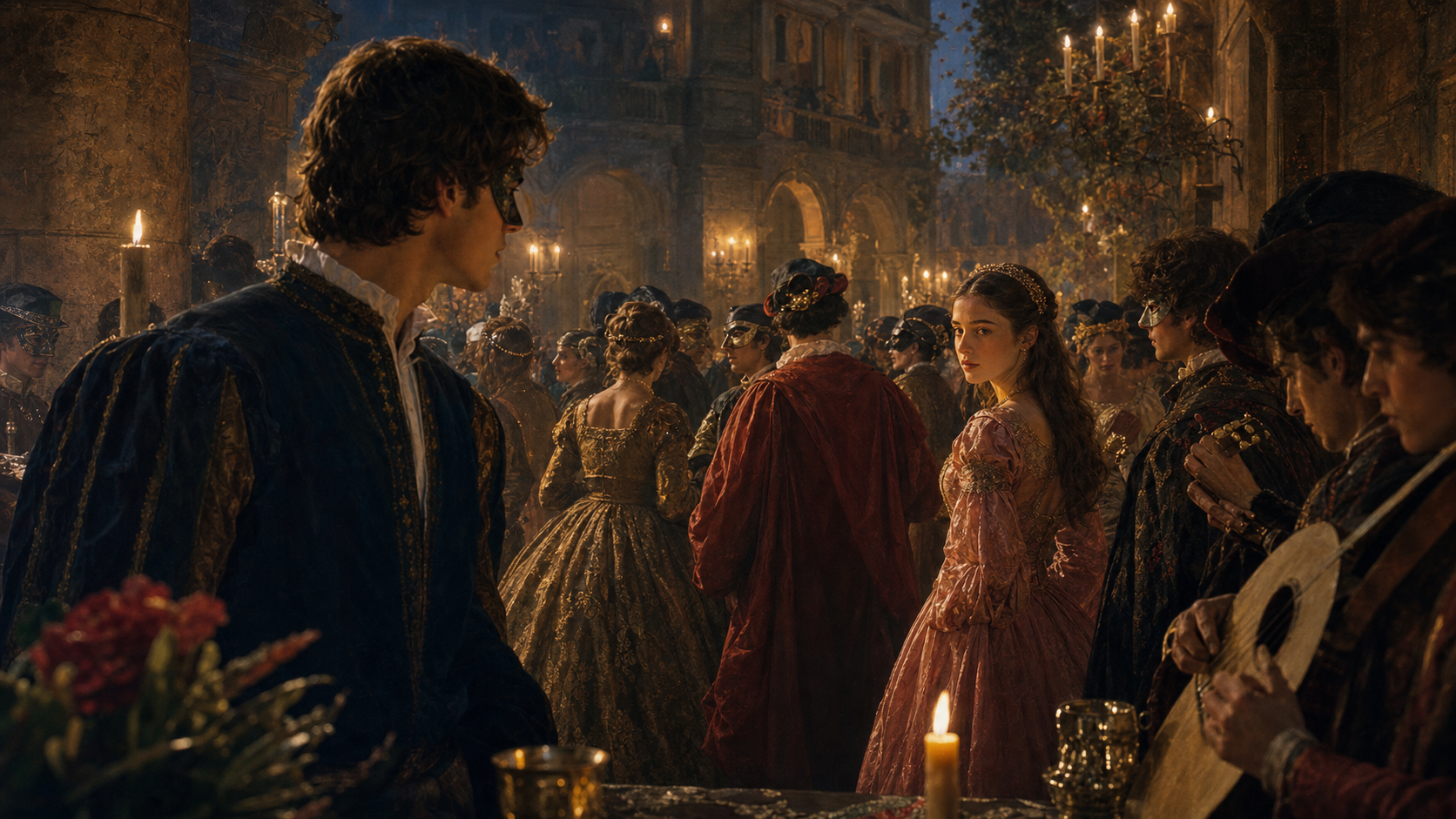
Romeo goes to the Capulet feast with his friends, partly to see Rosaline. The plan is reckless but socially playful until Romeo sees Juliet. His language changes at once. He describes her as light, jewel, brightness, and sacred presence. Compared with his Rosaline speeches, this response feels more immediate and more outward-looking.
The lovers' first conversation is one of the most formally beautiful moments in the play. Their lines interlock like a sonnet. They speak through images of pilgrims, saints, hands, lips, prayer, and sin. The form matters because the dialogue itself proves mutuality: Romeo does not simply perform at Juliet; Juliet answers, revises, and completes the poetic pattern.
Yet the feast also keeps danger close. Tybalt recognizes Romeo's voice and wants to confront him. Capulet stops him, partly because Romeo has a decent reputation and partly because the party must not be disturbed. Tybalt obeys outwardly but stores the insult. A romantic scene is therefore framed by suspended violence.
After the lovers learn each other's names, the private miracle becomes a public problem. Juliet's line about her only love springing from her only hate compresses the play's central contradiction. She has not chosen the feud, but the feud has already named the person she loves as an enemy.
3. The balcony scene asks whether a name can be refused
After the feast, Romeo enters the Capulet orchard and hears Juliet speak before she knows he is there. The famous balcony scene is often treated as pure romance, but it is also the play's sharpest argument about identity. Juliet asks why Romeo must be Romeo, then imagines him without the Montague name.
Her rose metaphor separates essence from label: a rose would smell sweet under another name. Juliet is not being silly. She understands the problem precisely. She loves Romeo as a person, but Verona recognizes him as a Montague. The scene's beauty comes from her attempt to think her way out of inherited categories.
Romeo answers and offers to discard his name. The language is thrilling, but the scene also knows its own danger. Juliet worries that their vows are too sudden, too rash, too like lightning. She is young, but she is not mindless. She is the first person in the play to name the risk of speed.
Still, the lovers decide to marry. Romeo asks Friar Lawrence for help. The Friar notices how quickly Romeo has moved from Rosaline to Juliet, but he agrees because he hopes the marriage might turn the families' hatred into love. His intention is generous. The method is fragile: a private secret is being asked to solve a public feud.
The marriage itself is brief onstage. Shakespeare does not linger in happiness. Instead, Friar Lawrence warns that violent delights have violent ends. The warning does not mean love is false. It means love placed inside a violent city may absorb the city's violence.
4. Mercutio and Tybalt turn secrecy into catastrophe
The central turning point comes in Act III. Tybalt seeks Romeo and challenges him. Romeo, now secretly married to Juliet, refuses to fight. He calls Tybalt's name tenderly because Tybalt is now kin by marriage, but no one else knows why Romeo has changed. The secret that protects the lovers privately makes Romeo illegible publicly.
Mercutio reads Romeo's refusal as dishonorable submission. He fights Tybalt in Romeo's place. When Romeo tries to intervene, Tybalt wounds Mercutio under Romeo's arm. Mercutio dies cursing both houses. His curse matters because he is not simply blaming Tybalt or Romeo. He sees the feud as a shared disease.
Romeo then kills Tybalt. This revenge collapses every role he has tried to hold: lover, husband, peacemaker, friend, and man of honor. Minutes after becoming Juliet's husband, he becomes the killer of her cousin. The Prince banishes him instead of executing him, a sentence that saves his life while destroying the practical possibility of the marriage.
Juliet's response is complex. She grieves Tybalt, recoils from Romeo's deed, and then chooses her husband. This is not simple blindness. Juliet is learning to separate inherited loyalty from chosen commitment, but that separation leaves her more isolated inside her own house.

5. Forced marriage and a plan built on fragile messages
Romeo and Juliet spend one night together before he leaves for Mantua. At dawn they argue over whether the bird they hear is the nightingale or the lark. The exchange is tender because both know what morning means. If it is still night, Romeo can stay; if it is morning, he must flee. Nature itself becomes a clock they want to misread.
After Romeo leaves, Juliet's father accelerates the plan to marry her to Paris. Capulet's earlier caution disappears. He interprets Juliet's grief as something marriage will cure and treats her refusal as disobedience, ingratitude, and shame. The scene is brutal because family authority turns from protection into coercion.
The Nurse advises Juliet to marry Paris and treat Romeo as good as dead. The advice is practical, but to Juliet it feels like betrayal. The person who helped carry messages now retreats into social safety. Juliet is left with almost no trusted adult.
She goes to Friar Lawrence, who offers the sleeping potion plan. Juliet will appear dead, be placed in the Capulet tomb, and wake when Romeo arrives. The Friar will send a letter explaining everything. The plan is clever in the abstract and reckless in practice. It relies on the body, the family, the funeral timetable, the letter system, and Romeo's patience all functioning perfectly.
Juliet's soliloquy before drinking the potion is one of her strongest moments. She imagines suffocation, madness, bones, Tybalt's ghost, and waking alone in the tomb. Courage here is not fearlessness. It is fear fully imagined and still faced.
6. The ending and what it leaves behindThis section contains spoilers.
Friar Lawrence's letter never reaches Romeo because Friar John is detained during a quarantine. Romeo hears only that Juliet is dead. He buys poison from a poor apothecary and returns to Verona. Again, speed matters: Romeo chooses action before verification, but he does so inside a communication system that has already failed him.
At the tomb, Paris is mourning Juliet. Romeo and Paris misunderstand each other and fight; Romeo kills him. Paris's death complicates the ending because the tragedy widens beyond the central lovers. He is not the play's deepest lover, but he is another person pulled into the machinery of secrecy, status, and grief.
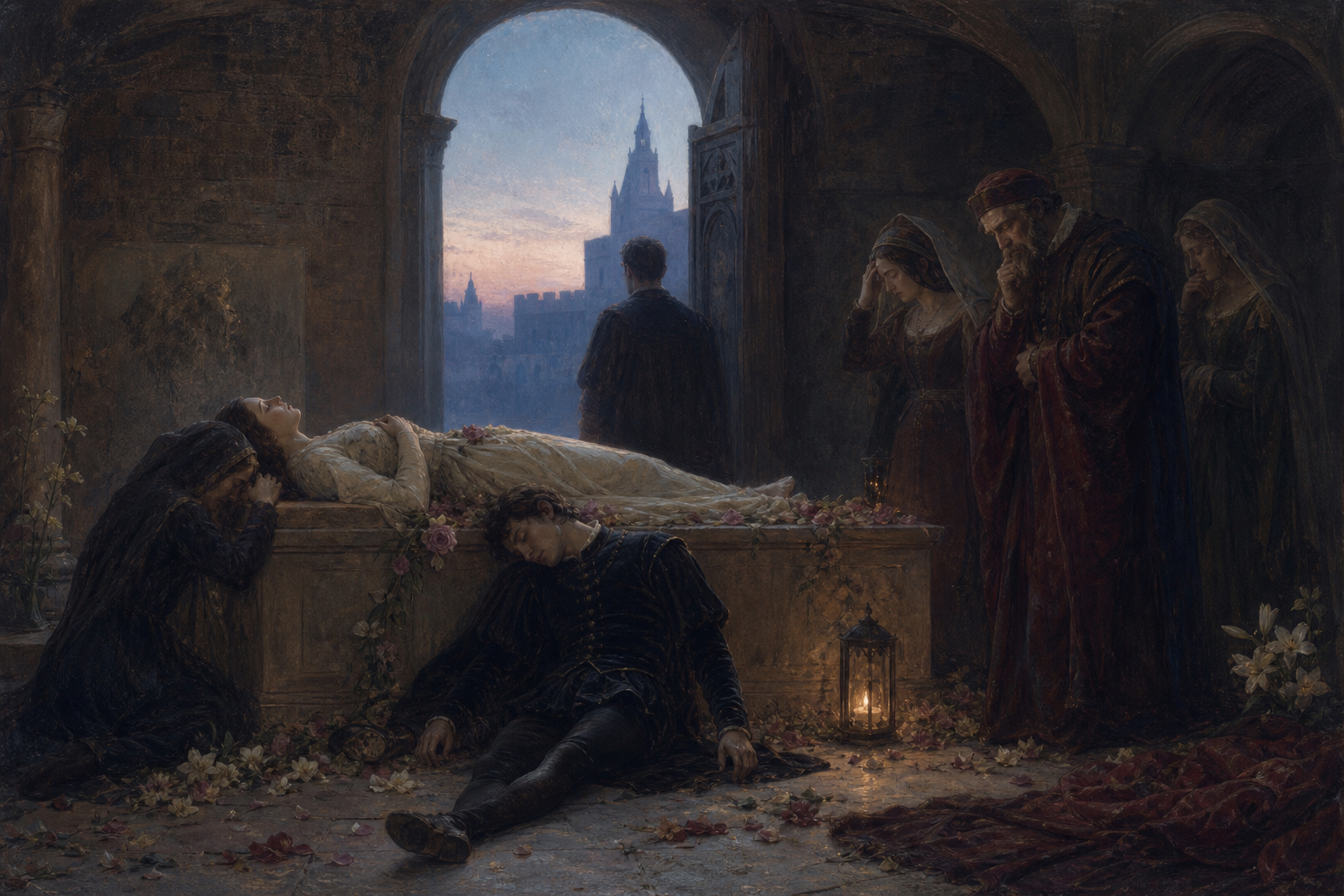
Romeo enters the tomb, sees Juliet, and dies beside her before she wakes. Juliet wakes moments later. Friar Lawrence urges her to leave, but she refuses and dies with Romeo's dagger. The scene is devastating because the audience knows how close rescue came. The tragedy is not only that the lovers die, but that they die inside preventable gaps of timing and knowledge.
The Prince gathers the families and explains the cost. Capulet and Montague reconcile and promise memorial statues. But the reconciliation is morally bitter. Peace arrives after the children have paid for the parents' feud. The final public lesson is real, but it cannot restore the private lives destroyed to teach it.
Major Characters
Romeo Montague
A lover shaped by language, speed, and public masculinity
Romeo is emotionally quick, verbally rich, and vulnerable to the codes around him. His love for Juliet feels different from his Rosaline melancholy because it becomes mutual poetry rather than private performance.
His tragedy is that private love cannot fully free him from public masculinity. He tries to refuse Tybalt's challenge, but after Mercutio dies, revenge pulls him back into the feud's logic.
Juliet Capulet
A young woman who thinks beyond inherited names
Juliet begins inside family obedience, but she grows into the play's most intellectually precise speaker. She understands that Romeo's name is socially dangerous without believing the name defines his essence.
Her courage is not impulsive simplicity. She questions the speed of love, weighs the potion's horrors, and makes choices in a world that gives her almost no safe choices.
Mercutio
Comic brilliance turned tragic witness
Mercutio brings wit, sexual punning, skepticism, and volatile imagination. His Queen Mab speech mocks dreams while revealing how unstable desire and fantasy can be.
His death changes the play's genre temperature. The friend who seemed to keep romance from becoming too serious becomes the body that proves the feud kills more than the named enemies.
Tybalt
The blade of honor culture
Tybalt treats identity as something defended through challenge. Peace sounds like dishonor to him, and Romeo's presence at the feast becomes an injury that must be answered.
He matters because he is less a private villain than a perfect product of Verona's feud. Killing him does not end the violence because the code that formed him remains active.
Friar Lawrence and the Nurse
Adults who help, then reveal the limits of help
Friar Lawrence and the Nurse both assist the lovers, but neither can safely change the public world around them. The Friar trusts secrecy and timing; the Nurse eventually trusts social survival.
Their failure is not pure malice. It is the failure of partial adult support in a crisis that requires public courage, honest communication, and an end to the feud itself.
Best Quotes
My only love sprung from my only hate!
Juliet's shock after learning Romeo's identity compresses the whole play. Love is personal, but the feud has already named her beloved as an enemy.
What's in a name? That which we call a rose by any other name would smell as sweet.
This is Juliet's great argument against inherited labels. She imagines a person beyond the social name, while the plot proves how violently society enforces names.
These violent delights have violent ends.
Friar Lawrence does not deny the lovers' sincerity. He warns that intense joy inside a violent world can become part of that world's destructive speed.
A plague o' both your houses!
Mercutio's curse is the play's clearest moral accusation. The feud is not one family's fault alone; both houses have made the city dangerous.
Major Themes
Name
Names and Identity
Romeo and Juliet love each other as people, but Verona reads them as Montague and Capulet. The play asks whether private identity can survive public labels enforced by family and violence.
Fate
Fate Working Through Human Systems
The prologue calls the lovers star-crossed, but the tragedy unfolds through human choices: duels, secrecy, parental coercion, quarantine, and failed messages.
Speed
Youth, Haste, and Social Pressure
The lovers move quickly, but so does everyone else. The play's haste includes challenges, commands, threats, marriage arrangements, and desperate plans.
Feud
Public Violence and Adult Failure
The feud is an inherited system that adults keep normalizing until young people die inside it. The final reconciliation exposes how late moral clarity can arrive.
Shakespeare, Verona, and Early Modern Pressure
Shakespeare sets the play in Verona, but the social questions would have been legible to early modern English audiences: family authority, marriage negotiation, masculine honor, religious mediation, and civic order. The Italian setting gives distance while keeping the pressures recognizable.
Juliet's age matters. She is very young, and the adults around her discuss her future before she has much room to speak. The play does not simply endorse that structure. As Juliet's voice becomes stronger, the family system around her becomes more visibly coercive.
The male world of the play is just as important. Romeo, Mercutio, Tybalt, Benvolio, and the Prince all move through rules about honor, insult, peace, and public reputation. Romeo's tragedy is not only that he loves the wrong person; it is that he cannot fully escape the public code that tells men when to draw swords.
Why It Still Matters
The play lasts because its central question keeps changing shape: can two people see each other clearly when their communities insist on seeing labels first? In a world of family loyalty, class identity, race, religion, nationality, school cliques, and online tribes, the question is not old-fashioned.
It also lasts because it refuses to make young feeling trivial. Romeo and Juliet are immature in some ways, but the play does not kill them because their love is fake. It kills them because their love has to move through a city that has made honesty dangerous.
Sua's one-line take: the tragedy is not only that the lovers were too fast. It is that the feud was far too old.
FAQ: Summary, Ending, and Symbols
What is Romeo and Juliet about?
Romeo and Juliet is about two young people from feuding families who fall in love, marry secretly, and are destroyed by public violence, forced marriage pressure, exile, and failed communication. It is a love tragedy, but it is also a critique of inherited hatred.
Why is the balcony scene important?
The balcony scene is important because Juliet asks whether Romeo's name should define him. Her rose metaphor imagines identity beyond family labels, while the rest of the play shows how hard it is to live beyond those labels in a violent society.
Is the ending a victory for love?
Only in a bitter, limited sense. The lovers' deaths end the feud, but the peace comes too late. The ending shows that reconciliation achieved through sacrifice is not romantic triumph; it is an indictment of the adults who needed death before they learned.
Read Next
Read Pride and Prejudice for another classic about love and social expectation, The Great Gatsby for desire trapped inside class fantasy, and The Scarlet Letter for public shame, private love, and community judgment.
Adaptations
- Franco Zeffirelli's 1968 film: emphasizes youth, Renaissance atmosphere, and intimate tragedy.
- Baz Luhrmann's 1996 film: translates the play's speed, violence, and youth culture into a modern visual language.
- Ballet, opera, stage, and musical adaptations: the feud-and-lover structure keeps returning because it can absorb many eras' anxieties.