The Picture of Dorian Gray Study Guide - AP Lit, SAT Reading, Close Reading, and Essay Practice
A practical guide for AP English Literature, SAT Reading, IB English, and school essays, with key passages, literary devices, practice questions, and thesis models.
This study guide is built for students who need to discuss The Picture of Dorian Gray with textual evidence. If you want the full plot explanation first, start with the main article.
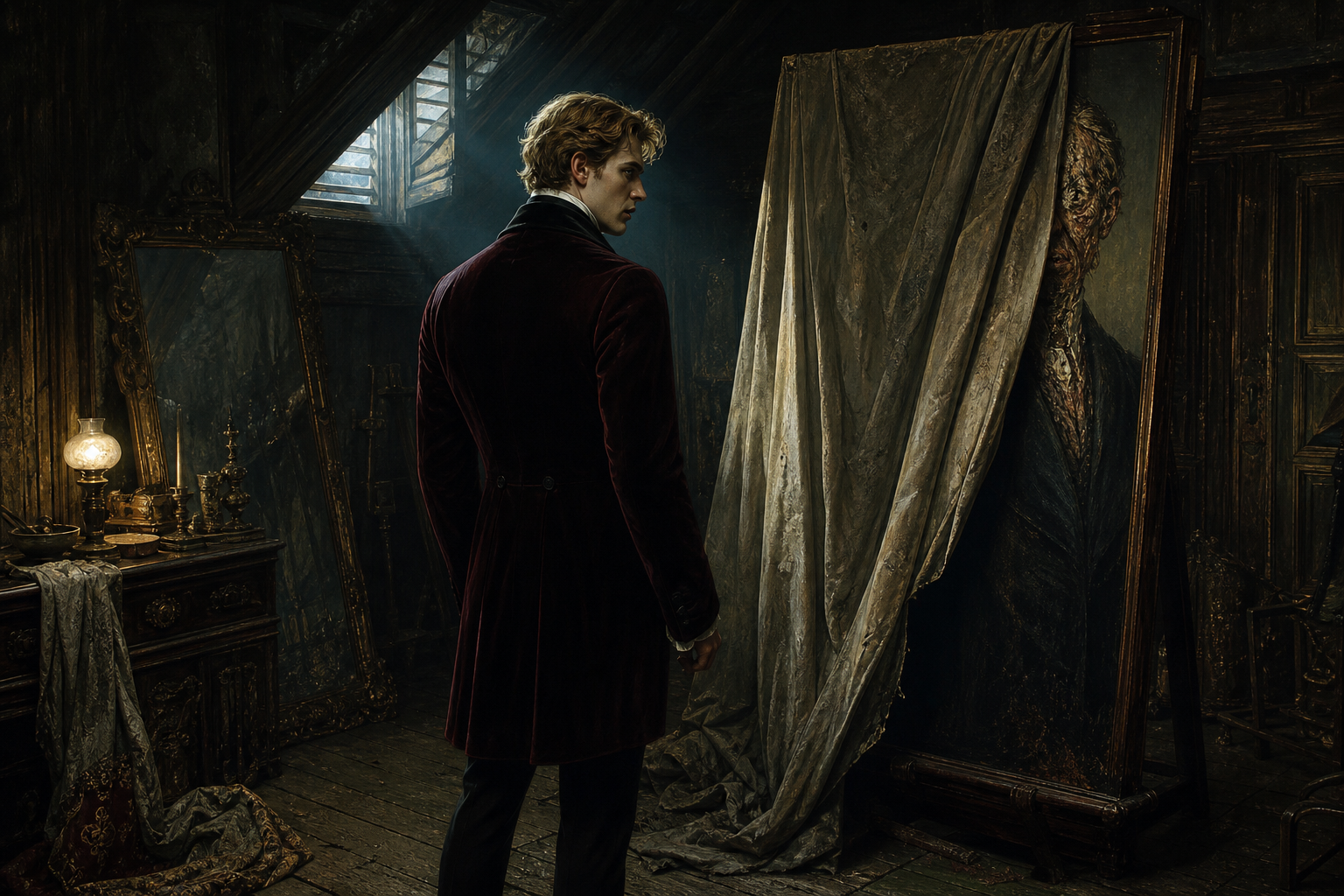
Who This Guide Is For
Use this page to move from plot memory to literary argument. The Picture of Dorian Gray is especially useful for essays about art and morality, influence, Gothic doubling, youth, reputation, social hypocrisy, and the difference between surface and inner life.
By the end, you should be able to:
- explain how the portrait functions as symbol, evidence, double, and conscience
- connect Lord Henry's language to Dorian's choices without treating Henry as the only cause
- discuss Basil, Sybil, Alan Campbell, and James Vane as people harmed by Dorian's aesthetic self-fashioning
- write about Wilde's preface without reducing the novel to a simple moral lesson
- answer SAT-style questions about inference, function, tone, symbol, and characterization
1. Quick Review
- Original title: The Picture of Dorian Gray
- Author: Oscar Wilde
- Book version: 1891
- Main settings: Basil Hallward's studio; aristocratic London rooms; Sybil Vane's theatre; Dorian's locked schoolroom; opium dens; country house scenes
- Central conflict: Dorian wants beauty without time and pleasure without consequence, while the portrait records what his public body conceals
- Core themes: beauty, influence, art, conscience, double lives, moral evasion, reputation, social hypocrisy
- Common exam angles: portrait symbolism, Lord Henry's paradoxes, Basil as artist-conscience, Sybil Vane and performance, Gothic doubling, ending reversal
One-sentence summary:
Dorian Gray remains outwardly young while his portrait bears the age and corruption of his choices, exposing the danger of treating life as art without responsibility.
2. Plot Structure for Exams
Exposition
Basil Hallward paints Dorian Gray and admits that the portrait contains too much of his own feeling. Lord Henry meets Dorian and introduces a seductive philosophy of youth, pleasure, and self-development.
Inciting Incident
Dorian sees the completed portrait and wishes that the painting would age instead of him. The wish becomes the novel's supernatural premise and the starting point of Dorian's divided life.
Rising Action
Dorian falls in love with Sybil Vane as an actress, rejects her when real love ruins her performance, and discovers that the portrait has changed. Sybil's death becomes the first major test of his conscience, but Lord Henry helps him translate guilt into aesthetic fascination.
Complication
Years pass. Dorian remains physically beautiful while rumors of corruption gather around him. He hides the portrait in a locked room, uses a decadent book as a model for sensation, and becomes increasingly separated from ordinary moral consequence.
Crisis
Basil confronts Dorian, hoping for denial or repentance. Dorian shows him the portrait, then murders him and blackmails Alan Campbell into destroying the body.
Resolution
James Vane threatens revenge but dies accidentally. Dorian attempts a shallow reform, sees hypocrisy in the portrait, and stabs the painting. The portrait becomes beautiful again while Dorian's body becomes aged and ruined in death.
Exam point: do not write only that "the portrait is his soul." Stronger analysis explains how the portrait changes function: artwork, mirror, conscience, evidence, secret, and finally judge.
3. Key Original Passages for Close Reading
These passages are short enough to use in essays but rich enough to support device-based analysis. For each passage, identify the speaker or narrative situation, mark the diction, and connect the line to a larger claim about art, influence, conscience, or hidden identity.
Passage 1: art and morality
There is no such thing as a moral or an immoral book.
Context: Wilde's preface defends art against crude moral judgment before the Gothic plot begins.
Close reading: The balanced phrasing rejects simple labeling. The line is provocative because it separates artistic form from moral instruction, yet the novel that follows explores what happens when people misuse aesthetic language to avoid responsibility.
Essay use: Use it to discuss the tension between the preface and the plot. A strong essay does not claim Wilde secretly cancels the preface; it argues that the novel dramatizes the danger of reading aesthetic freedom shallowly.
Passage 2: surface and peril
Those who go beneath the surface do so at their peril.
Context: The preface warns that art contains surface and symbol, and that interpretation can be risky.
Close reading: "Surface" is not treated as empty decoration. In this novel, surface has power: Dorian's face protects him, the portrait reveals him, and society misreads both.
Essay use: Use it for essays on appearance, interpretation, and the novel's double movement between beauty and hidden truth.
Passage 3: the wish
If it were I who was to be always young!
Context: Dorian reacts to Basil's finished portrait after Lord Henry has made youth sound more precious than conscience.
Close reading: The exclamation turns admiration into envy. Dorian does not merely love the portrait; he resents it for preserving the beauty he fears losing.
Essay use: Use it to connect influence, mortality, and the birth of the supernatural double.
Passage 4: language as influence
Words! Mere words! How terrible they were!
Context: Dorian feels the effect of Lord Henry's speech about youth and desire.
Close reading: The repetition first minimizes language as "mere" words, then immediately calls them terrible. The contradiction reveals that language in the novel is not harmless decoration.
Essay use: Use it to discuss Lord Henry's role. The line helps you argue that influence works through style, rhythm, paradox, and emotional timing.
Passage 5: Sybil and illusion
You have killed my love.
Context: Dorian rejects Sybil after her poor performance, because she has become emotionally real rather than artistically convincing.
Close reading: The sentence reverses moral reality. Sybil has not killed love; Dorian's aesthetic demands have killed his ability to see her humanity.
Essay use: Use it for essays about performance, objectification, and the human cost of Dorian's worship of artifice.
Passage 6: the soul made visible
The soul is a terrible reality.
Context: Basil confronts Dorian after seeing the altered portrait.
Close reading: The abstract noun "soul" becomes concrete through "reality." Basil's sentence matters because the portrait has made inward corruption visible.
Essay use: Use it to discuss Gothic externalization: the hidden moral life appears as a physical image.
Passage 7: divided self
Each of us has Heaven and Hell in him.
Context: Lord Henry frames human nature as internally divided.
Close reading: The sentence sounds witty, but the plot literalizes division. Dorian's public beauty and private corruption become separate but connected realities.
Essay use: Use it for double-life essays, especially if you compare Dorian with Jekyll or other Gothic divided selves.
4. Close Reading Procedure
Step 1: Ask what kind of surface is being trusted
The novel repeatedly asks readers to notice who trusts surfaces and why. Basil trusts Dorian's beauty as a sign of artistic and spiritual possibility. Society trusts Dorian's face as evidence against rumor. Dorian trusts his own unchanged body as permission to continue. The portrait, however, becomes a surface that tells the truth. Strong close reading should therefore avoid saying "surface is false" too simply. Wilde makes some surfaces deceptive and one surface terrifyingly accurate.
In a paragraph, name the surface first: face, portrait, performance, room, reputation, or language. Then ask what social work that surface does. Dorian's face allows him to move through drawing rooms without visible consequence. Sybil's stage roles allow Dorian to love her as an image rather than a person. Basil's portrait begins as ideal beauty and becomes the record that society refuses to read.
Step 2: Track influence through language, not only plot
Lord Henry does not force Dorian to act. His danger lies in making certain desires sound intelligent, brave, and beautiful. When Dorian responds to Henry's words as "terrible," the novel shows influence happening before any supernatural event. The key is timing: Dorian hears the philosophy of youth at the exact moment when the portrait makes aging visible to him.
A strong essay can argue that Henry provides vocabulary while Dorian provides choice. That distinction prevents a weak answer that blames Henry for everything. Dorian becomes responsible because he repeatedly chooses the interpretation that flatters him.
Step 3: Separate aesthetic theory from Dorian's behavior
Wilde's preface is not the same as Dorian's excuse-making. The preface rejects moralistic censorship of art; Dorian turns aesthetic pleasure into a way of dismissing other people's pain. Those are related but not identical positions.
When writing, use "aestheticism" carefully. Do not say the novel simply proves art is immoral. Instead, argue that Wilde tests what happens when aesthetic language is severed from compassion, self-knowledge, and accountability. The problem is not beauty itself; the problem is Dorian's desire to enjoy beauty without truth.
Step 4: Convert the portrait into multiple functions
The portrait is not one symbol only. It is Basil's artwork, Dorian's double, a Gothic secret, a visible conscience, criminal evidence, and a distorted diary. Its function changes as the plot changes.
Early: the portrait shows what Dorian fears losing. After Sybil: it shows cruelty. During the middle years: it becomes the hidden archive of reputation and rumor. With Basil: it becomes proof. At the end: it becomes the object Dorian tries to destroy because he cannot destroy the truth about himself.
Worked example: the first change in the portrait
Literal situation: Dorian returns after rejecting Sybil and notices a cruel alteration in the painted face.
Evidence: changed mouth, hidden room, Dorian's attempt to explain away what he sees.
Device: Gothic doubling, visual symbolism, irony.
Meaning: The portrait makes cruelty visible at the exact moment Dorian would prefer to treat Sybil's pain as theatrical. The painting refuses his aesthetic evasion.
Essay sentence: Wilde uses the portrait's first alteration to transform conscience into image, forcing Dorian to see that a beautiful surface can hide but not erase moral injury.
5. Why Literary Devices Matter
Gothic double: the portrait as second self
The portrait carries the visible marks that Dorian's body refuses. This double allows Wilde to dramatize hidden guilt without turning the novel into ordinary confession.
The double is especially effective because it is made by art. Basil does not create a monster in a laboratory; he paints an ideal image. The horror begins when ideal beauty becomes a more truthful witness than the living person.
Paradox: Lord Henry's dangerous style
Lord Henry speaks in reversals that sound clever enough to suspend moral judgment. His paradoxes make self-indulgence feel like sophistication.
Paradox matters because students often quote Henry as if he were Wilde's spokesperson. A better essay asks how style creates distance. Henry's lines sparkle, but the plot tracks what happens when Dorian treats performance as doctrine.
Symbolic setting: studio, theatre, locked room, opium den
Each major space teaches Dorian a different relationship to appearance. The studio makes him visible as art. The theatre lets him confuse acting with personhood. The locked room hides conscience. The opium den exposes the social underside of his pleasures.
Setting in this novel is therefore not background. It is moral architecture. Ask what each room permits Dorian to see, hide, or misread.
Irony: innocence that protects corruption
Dorian's face appears innocent because it remains young, but that innocence becomes a tool of deception. The more beautiful he looks, the less society wants to believe the rumors.
This irony connects supernatural plot to social critique. The portrait is magical, but social trust in beauty is painfully realistic.
Allusion and art references: life as curated performance
The novel fills Dorian's world with Shakespeare, music, jewels, tapestries, Catholic ritual, perfumes, and decorative objects. These references show his hunger to curate experience.
The danger is not knowledge or art itself. The danger is collection without compassion: Dorian gathers sensations while refusing the claims other people make on him.
Foil characters: Basil, Henry, Sybil, and Dorian
Basil responds to beauty with reverence, Henry with talk, Sybil with living emotion, and Dorian with possession. Their differences reveal that beauty does not dictate one moral response.
Foil analysis helps avoid broad claims like "beauty corrupts." The novel shows that people interpret beauty differently, and Dorian chooses the interpretation that excuses him.
6. Turning Character Analysis into Essay Language
Character analysis in The Picture of Dorian Gray works best when you avoid treating characters as moral labels. Basil is not simply "good," Henry is not simply "evil," and Dorian is not simply "corrupt from the start." Each character shows a different response to beauty, influence, performance, secrecy, or consequence.
Use this four-part method before writing:
- Role: What function does the character serve in the novel's argument about beauty or influence?
- Pressure: What desire, fear, ideal, or social expectation shapes the character?
- Device: How does Wilde present that character through dialogue, setting, contrast, symbolism, or irony?
- Essay sentence: What claim can this character support about the meaning of the work as a whole?
A useful sentence frame:
Basil functions as an artist-conscience figure, and Wilde uses his portrait to test whether beauty can remain separate from truth.
The cards below are not plot summaries. They are starting claims you can turn into paragraphs with scene evidence.
Dorian Gray
beautiful surface divided from moral record
Essay sentence: Dorian's tragedy lies in his attempt to turn beauty into immunity, while the portrait preserves the history his face conceals.
Lord Henry
speaker whose wit becomes temptation
Essay sentence: Lord Henry's influence works through style: he makes selfish desire sound like intellectual freedom before Dorian turns the performance into practice.
Basil Hallward
artist whose idealism becomes conscience
Essay sentence: Basil's portrait begins as an act of worship but becomes the only image honest enough to challenge Dorian's self-deception.
Sybil Vane
actress who exposes the cruelty of aesthetic possession
Essay sentence: Sybil's failed performance reveals that Dorian loves artifice more than personhood, making her humanity the first casualty of his philosophy.
James Vane and Alan Campbell
consequence returning through bodies and coercion
Essay sentence: James and Alan show that Dorian's hidden life is not merely inward corruption; it produces fear, blackmail, ruined trust, and physical danger.
7. Thesis Builder for Major Themes
A strong thesis should name a theme, a technique, and the novel's larger meaning. Avoid stopping at "the portrait symbolizes Dorian's soul." That is a topic, not an argument. A better thesis explains how the portrait's function changes and why that change matters.
Beauty
Surface
Weak thesis: Dorian is beautiful.
Strong thesis: Wilde makes Dorian's beauty socially powerful enough to delay judgment, showing how admiration can become a form of moral blindness.
Influence
Language
Weak thesis: Lord Henry influences Dorian.
Strong thesis: Lord Henry's language does not remove Dorian's agency; it gives Dorian a seductive vocabulary for choices he later owns.
Art
Aestheticism
Weak thesis: Art is bad in the novel.
Strong thesis: Wilde defends art from simplistic moral policing while exposing Dorian's misuse of aesthetic ideas as an escape from accountability.
Double
Hidden Self
Weak thesis: The portrait is Dorian's soul.
Strong thesis: The portrait functions as artwork, double, conscience, and evidence, changing from beautiful object into the record Dorian cannot publicly bear.
8. SAT Reading Sample
These are SAT-style practice questions, not official College Board questions. Each question is tied to a specific scene, passage, or recurring device from the novel.
Question 1
The preface's claim about moral and immoral books primarily challenges:
- A. the need for any artistic form
- B. simple moral labeling of art
- C. Basil's ability to paint
- D. Sybil's theatrical training
Answer: B. The preface resists judging art by crude moral categories. It does not reject form, painting, or theatre.
Question 2
Basil's reluctance to exhibit Dorian's portrait suggests that:
- A. the picture feels too personally revealing
- B. the portrait is technically unfinished
- C. Lord Henry owns the studio
- D. Dorian has forbidden all painting
Answer: A. Basil says he has put too much of himself into the picture, making exhibition feel emotionally risky.
Question 3
Lord Henry's first effect on Dorian is best described as:
- A. giving Dorian a philosophy for fearing age
- B. teaching Dorian to paint landscapes
- C. persuading Dorian to avoid society
- D. proving Basil dislikes beauty
Answer: A. Henry's speech makes youth seem urgent and irreplaceable, shaping Dorian's reaction to the portrait.
Question 4
Dorian's wish about the portrait is important because it:
- A. ends Basil's career immediately
- B. restores Sybil's acting
- C. explains Henry's childhood
- D. creates the novel's divided body-and-image structure
Answer: D. The wish separates Dorian's outward youth from the portrait's record of time and corruption.
Question 5
Dorian loves Sybil at first mainly as:
- A. a political leader
- B. an embodiment of dramatic art
- C. Basil's rival painter
- D. James Vane's guardian
Answer: B. Dorian calls Sybil by her roles and loves the artistry she seems to make real.
Question 6
The portrait's first change after Dorian rejects Sybil functions as:
- A. comic relief
- B. a financial contract
- C. visible evidence of cruelty
- D. a travel map
Answer: C. The altered expression makes Dorian's moral injury visible before he fully accepts responsibility.
Question 7
Lord Henry's response to Sybil's death encourages Dorian to:
- A. treat tragedy as aesthetic experience
- B. confess publicly at once
- C. give up all beauty
- D. destroy the yellow book
Answer: A. Henry frames the death as dramatic and fascinating, helping Dorian convert guilt into style.
Question 8
The locked schoolroom mainly represents:
- A. open public accountability
- B. Dorian's attempt to hide conscience
- C. Sybil's professional success
- D. Basil's childhood home
Answer: B. Dorian hides the portrait there, separating public appearance from private evidence.
Question 9
The yellow book influences Dorian because it:
- A. provides a script for cultivated sensation
- B. proves Henry is poor
- C. prevents all rumors
- D. explains Basil's murder in advance
Answer: A. Dorian reads the book as a model for arranging life around rare moods and experiences.
Question 10
Society's willingness to keep inviting Dorian despite rumors shows:
- A. the power of appearance and class protection
- B. the total absence of gossip
- C. Basil's public confession
- D. James Vane's social popularity
Answer: A. Dorian's beauty and status make others reluctant to connect his surface with corruption.
Question 11
Basil's confrontation with Dorian is driven mainly by:
- A. a desire to sell the portrait abroad
- B. hatred of all art
- C. hope that Dorian can still tell the truth
- D. fear of Sybil's acting teacher
Answer: C. Basil wants Dorian to deny the rumors or repent, which makes him a conscience figure.
Question 12
Dorian's murder of Basil is especially significant because Basil:
- A. has never known Dorian
- B. is the person who created and still morally reads the portrait
- C. works for James Vane
- D. rejects painting as a practice
Answer: B. Killing Basil means destroying the artist-witness who connects beauty to truth.
Question 13
Alan Campbell's role shows that Dorian's corruption:
- A. harms only Dorian's imagination
- B. has no connection to other people
- C. can be forced onto former friends through blackmail
- D. is resolved by music alone
Answer: C. Alan is coerced into helping conceal the murder, proving Dorian's hidden life damages others.
Question 14
James Vane nearly fails to identify Dorian because:
- A. Dorian's unchanged youth contradicts the passage of years
- B. James cannot remember Sybil
- C. Lord Henry hides the portrait
- D. Basil warns him away
Answer: A. Dorian's young face makes his old crime seem impossible to James.
Question 15
The opium-den scenes most strongly connect Dorian's life to:
- A. pure pastoral innocence
- B. public school comedy
- C. royal ceremony
- D. the social damage beneath aristocratic pleasure
Answer: D. The scenes expose the darker urban world linked to Dorian's hidden desires and reputation.
Question 16
Dorian's attempt to count sparing Hetty as reform fails because:
- A. the portrait suggests vanity and hypocrisy rather than true change
- B. Henry forces him to marry her
- C. Basil returns unharmed
- D. James becomes his servant
Answer: A. The portrait does not improve; it exposes Dorian's self-congratulation.
Question 17
The ending's exchange between portrait and body reveals that:
- A. appearance and hidden truth can remain divided forever
- B. Dorian's concealed history finally becomes visible on his body
- C. the portrait was never important
- D. society had understood everything from the beginning
Answer: B. Dorian's body receives the age and corruption the portrait carried.
Question 18
Wilde's use of witty dialogue mainly:
- A. removes all danger from the novel
- B. makes the novel a legal document
- C. gives temptation an attractive surface
- D. eliminates characterization
Answer: C. Wit makes dangerous ideas sound elegant, especially in Lord Henry's speeches.
Question 19
The best description of Basil's tragedy is that he:
- A. sees beauty as meaningful but misjudges Dorian's moral depth
- B. never values art
- C. controls Lord Henry completely
- D. causes Sybil's poor acting
Answer: A. Basil's idealism gives the portrait power but also blinds him to Dorian's capacity for harm.
Question 20
The novel's treatment of art is best described as:
- A. simple proof that all art corrupts
- B. a ban on interpretation
- C. a purely comic defense of gossip
- D. a tension between art's autonomy and life lived without accountability
Answer: D. The preface defends art, while the plot tests what happens when aesthetic ideas become excuses.
9. AP Lit Essay Questions
Use these AP Lit-style practice questions to turn a specific scene into a thesis, outline, and evidence-based commentary.
Essay Question 1
Analyze how Wilde uses Basil's studio in the opening chapters to introduce beauty, artistic creation, influence, and danger.
Essay Question 2
Lord Henry often speaks in paradoxes. Explain how his style shapes Dorian's imagination without removing Dorian's responsibility.
Essay Question 3
Dorian's first view of the portrait changes his relation to time. Analyze how the portrait transforms beauty into fear.
Essay Question 4
Analyze Sybil Vane's role in the novel's treatment of art, performance, and personhood.
Essay Question 5
The portrait first changes after Dorian rejects Sybil. Explain how this moment turns conscience into visible form.
Essay Question 6
Compare Basil's love of beauty with Lord Henry's love of influence. What different moral risks does each man represent?
Essay Question 7
Analyze the function of the yellow book in Dorian's development. How does reading become a model for living?
Essay Question 8
Discuss how Wilde uses rumors and social invitations to criticize Victorian respectability.
Essay Question 9
The locked room is one of the novel's most important settings. Analyze how secrecy changes Dorian's relation to guilt.
Essay Question 10
Explain how Basil's final confrontation with Dorian revises the meaning of the portrait.
Essay Question 11
Analyze Dorian's murder of Basil as a symbolic act as well as a plot event.
Essay Question 12
Alan Campbell appears briefly but memorably. Discuss how his role expands the consequences of Dorian's corruption.
Essay Question 13
James Vane turns the past into a threat. Analyze how his pursuit challenges Dorian's dependence on youthful appearance.
Essay Question 14
Discuss the novel's use of Gothic conventions such as doubling, secret rooms, hidden guilt, and final revelation.
Essay Question 15
Wilde's preface seems to defend art from morality. Analyze how the novel complicates, tests, or dramatizes that defense.
Essay Question 16
Analyze the role of theatrical language and performance in the novel, including Sybil's acting and Dorian's social persona.
Essay Question 17
The ending restores the portrait and destroys Dorian. Explain how this reversal resolves the novel's conflict between surface and record.
Essay Question 18
Read the novel as a critique of influence. Use at least two characters to explain how speech, admiration, or reputation changes behavior.
Essay Question 19
Analyze how Wilde presents beauty as both gift and danger.
Essay Question 20
Discuss whether the novel should be read primarily as moral fable, aesthetic experiment, Gothic horror, or social satire. Build an argument that can account for more than one mode.
10. Model Thesis Bank
Use these as models, then adapt them to the exact question.
- Wilde uses Basil's studio as a charged artistic space where beauty first appears sacred, social, and dangerous at the same time.
- Lord Henry's paradoxes tempt Dorian because they make self-indulgence sound like intellectual courage, but Dorian remains responsible for turning talk into action.
- The portrait transforms beauty from a source of admiration into a measure of mortality, creating Dorian's desire to separate surface from time.
- Sybil Vane exposes Dorian's inability to love a person once she stops functioning as an aesthetic illusion.
- The first alteration of the portrait turns private cruelty into visible evidence, making conscience impossible to dismiss completely.
- Basil's reverence and Henry's detachment reveal two different dangers in responding to beauty: idealization and experimentation.
- The yellow book gives Dorian a script of cultivated sensation, showing how reading can become self-fashioning when separated from judgment.
- Society's continued acceptance of Dorian reveals a culture willing to protect beauty and status from the consequences of rumor.
- The locked room externalizes repression by making guilt both hidden from society and constantly available to Dorian's private gaze.
- Basil's final confrontation changes the portrait from private secret into moral proof, forcing Dorian to face an honest witness.
- Dorian's murder of Basil symbolically destroys the artist-conscience who can still connect beauty with truth.
- Alan Campbell's coerced assistance proves that Dorian's secrecy creates practical harm, not merely inward decay.
- James Vane threatens Dorian because revenge reads past the beautiful face and insists that history still matters.
- Wilde adapts Gothic doubling to a fashionable social world, making terror emerge from salons, artworks, and reputation rather than remote castles.
- The preface and plot create productive tension: art resists simple moral labeling, yet aesthetic language can become morally dangerous in Dorian's hands.
- Performance in the novel moves from theatre to society, showing Dorian learning to act innocence after losing it.
- The ending restores the portrait's beauty because the hidden record returns to Dorian's body, collapsing the split he has depended on.
- Influence in the novel is powerful because it operates through admiration, style, and timing rather than direct command.
- Wilde presents beauty as dangerous when it becomes social evidence strong enough to silence suspicion and self-knowledge.
- The novel works as Gothic horror and social satire because Dorian's supernatural secret depends on a very ordinary culture of appearances.
11. Academic Vocabulary for Essays
- aestheticism: an artistic movement emphasizing beauty, form, and art's autonomy
- preface: an introductory statement that frames how a work may be read
- paradox: a statement that seems contradictory but reveals a point
- epigram: a short, witty, memorable statement
- Gothic double: a second self or external form that reveals hidden identity
- symbolism: an object, image, or action carrying layered meaning
- conscience: inward moral awareness or judgment
- decadence: cultivated excess associated with decline or artificiality
- influence: the shaping of another person's thought or desire
- agency: the capacity to choose and act
- social hypocrisy: public morality contradicted by private behavior
- reputation: public image or social standing
- objectification: treating a person as an object, image, or function
- foreshadowing: a detail that anticipates later events
- irony: a gap between appearance and reality, statement and meaning, or expectation and result
- allusion: reference to another work, tradition, or cultural object
- motif: a recurring image, idea, or pattern
- doubling: paired or split identities that mirror and distort each other
- confession: admission of guilt or truth
- commentary: explanation of how evidence supports a literary claim