The Picture of Dorian Gray - Beauty, Influence, and the Hidden Portrait
A detailed guide to Oscar Wilde's Gothic novel about youth, art, conscience, performance, and the cost of treating life as an aesthetic experiment.
Sua's Quick Take
The Picture of Dorian Gray looks, at first, like a supernatural bargain about staying young. Read closely, and it becomes more disturbing: Dorian does not simply sell his soul to beauty. He learns how to make beauty into an excuse for not having a soul at all.
What the Book Is Really About
Oscar Wilde's only novel is about a portrait, but the portrait is not the whole danger. The real danger begins when Dorian Gray discovers that other people will excuse him because he is beautiful, that language can make vice sound elegant, and that a private life can be hidden behind a public surface.
The book is also about influence. Basil Hallward paints Dorian because he sees him as an artistic revelation. Lord Henry Wotton talks to Dorian because he enjoys turning experience into paradox. Dorian receives both kinds of attention and learns to treat himself as a work of art, not as a person responsible to other people.
This guide uses Project Gutenberg eBook #174 as its public-domain source. The text is Wilde's revised book version, with the famous preface defending art's autonomy and a twenty-chapter Gothic plot that turns aesthetic theory into moral pressure.
Plot Summary
1. Basil's studio and the first lesson in influence
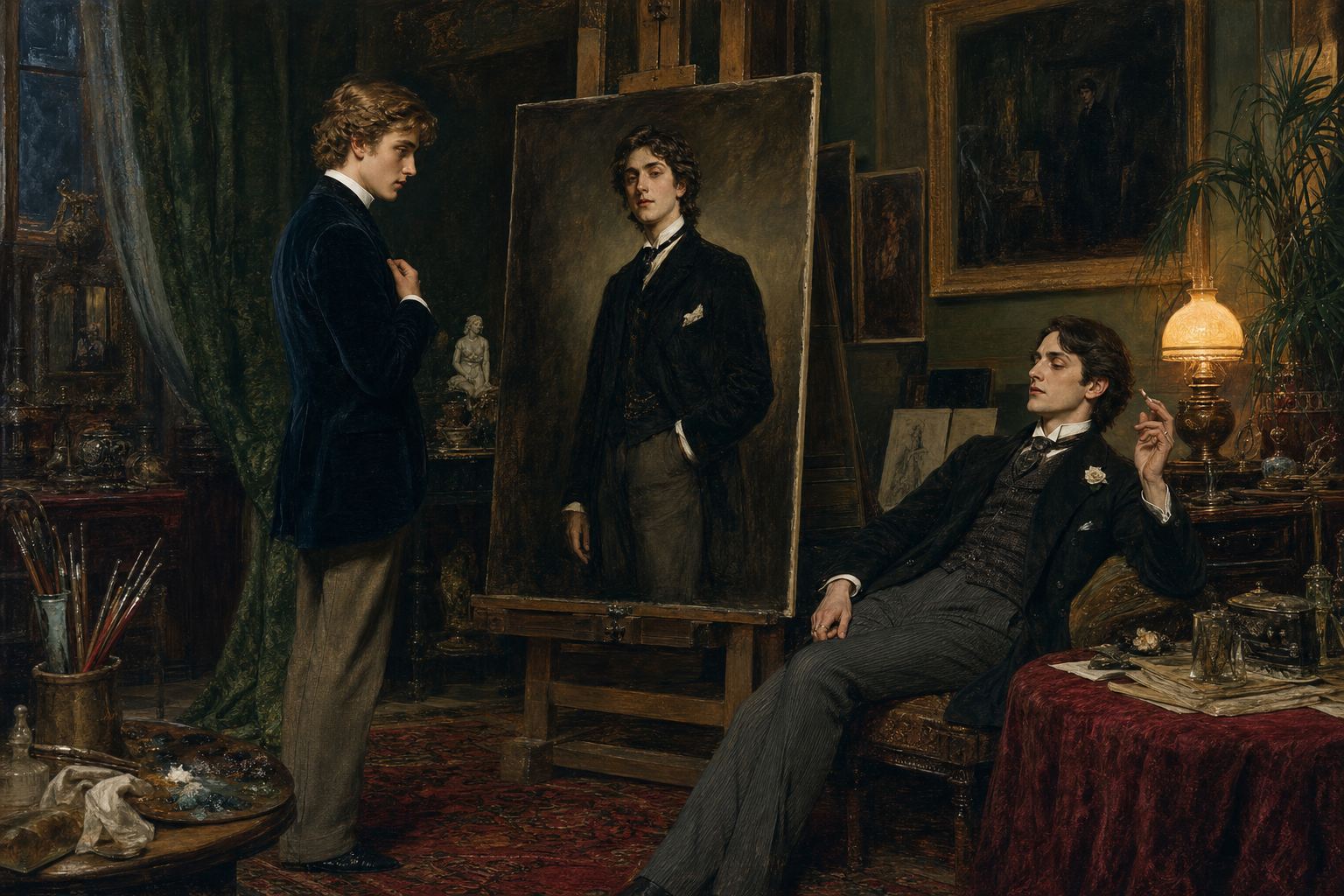
The novel opens in Basil Hallward's studio, where the painter has just completed an extraordinary portrait of Dorian Gray. Basil tells Lord Henry Wotton that the picture is too personal to exhibit. He has put too much of himself into it, not literally in technique alone but emotionally: Dorian's beauty has changed Basil's art and disturbed his self-control.
Lord Henry becomes curious before he even meets Dorian. Basil tries to protect the young man from Henry's influence, but that warning only makes Henry more interested. When Dorian enters, the three men form the novel's first triangle: Basil sees Dorian as sacred inspiration, Henry sees him as a beautiful mind to experiment on, and Dorian sees himself through their attention.
Henry's conversation is brilliant and poisonous. He tells Dorian that youth is the only thing worth having and that moral seriousness wastes life. The speech matters because Dorian is still impressionable. He has been admired before, but Henry gives admiration a philosophy. Beauty becomes not just a gift but an argument for appetite.
The danger is not that Henry hypnotizes Dorian in a simple cause-and-effect way. Wilde is more precise than that. Henry speaks in polished paradoxes, Basil protests too weakly, and Dorian hears exactly the theory that flatters his fear of aging. Influence in the novel is therefore social and stylistic: it enters through conversation, admiration, timing, and the desire to be seen as exceptional.
When Dorian sees the finished portrait, he understands that the painting will remain young while he ages. The thought horrifies him. In a rush of envy and fear, he wishes the portrait could bear time and corruption while he remains unchanged. The wish sounds theatrical, but the novel will make it literal.
2. Sybil Vane and the first visible change
Dorian's first great romance is with Sybil Vane, a young actress performing Shakespeare in a cheap theatre. He falls in love less with Sybil as a whole person than with the roles she plays: Juliet, Rosalind, Imogen. To Dorian, she seems to turn art into life. He calls her by theatrical names and imagines her as proof that beauty can redeem ordinary existence.
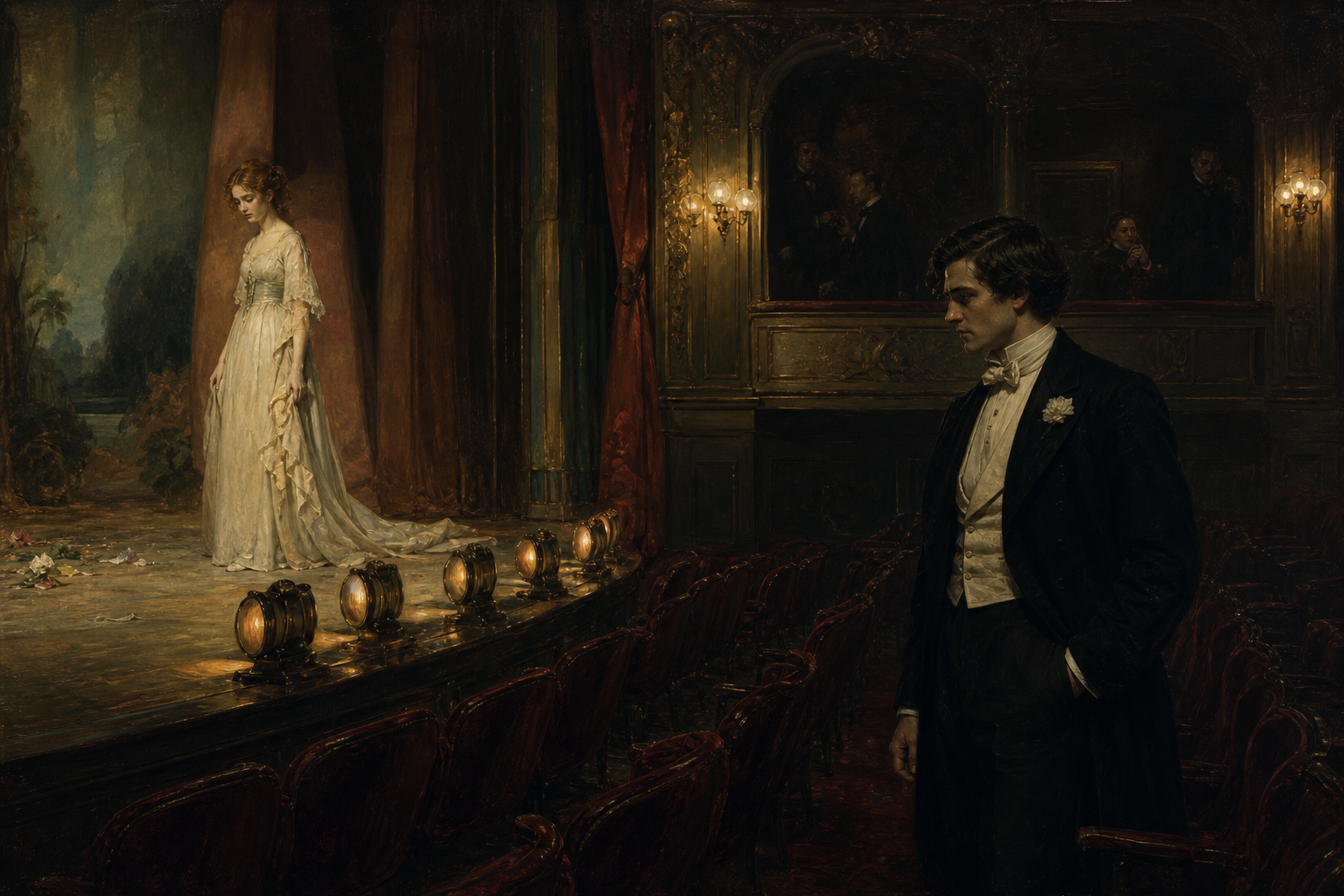
Sybil loves Dorian with equal intensity, but her love changes her art. Once she experiences real feeling, acting begins to feel false to her. On the night Dorian brings Basil and Lord Henry to see her, she performs badly. Dorian is humiliated because the fantasy he loved has collapsed in public. Instead of seeing Sybil's new humanity, he treats her lost artistry as a betrayal.
His rejection is brutal. He tells Sybil that she has killed his love because she has killed his illusion. Afterward, he returns home and notices the portrait has altered. A line of cruelty appears around the painted mouth. This is the first proof that the portrait has become Dorian's conscience, or at least the visible record of what his conscience would rather not feel.
Sybil dies by suicide after Dorian abandons her. For a moment he is shaken, but Lord Henry quickly reframes the death as tragic art. That response is one of the novel's sharpest turns. Dorian learns that even another person's death can be converted into aesthetic experience if one has the right words for it.
Sybil's family keeps the episode from becoming only a symbolic lesson. Her mother sees the theatre as survival; her brother James distrusts Dorian's upper-class glamour and warns that he will punish the man who harms her. Dorian does not yet feel the force of that warning, but the plot stores it away. What Dorian turns into a beautiful tragedy will later return as a brother's anger, not as an aesthetic mood.
3. The yellow book and the long education in surfaces
After Sybil's death, Basil urges Dorian toward repentance. Henry gives him a different education by sending a decadent French book that seems to describe a life of sensation, rare objects, moods, perfumes, music, jewels, ecclesiastical ornaments, and carefully cultivated corruption. Dorian reads it as if it were a script for his own future.
Years pass. Dorian remains outwardly young and beautiful, while rumors gather around him. Men are ruined after knowing him; women are disgraced; friends withdraw; society whispers but continues to invite him because his face seems innocent. Wilde makes this social hypocrisy important. Dorian's double life depends not only on supernatural concealment but also on a culture willing to separate appearance from consequence.
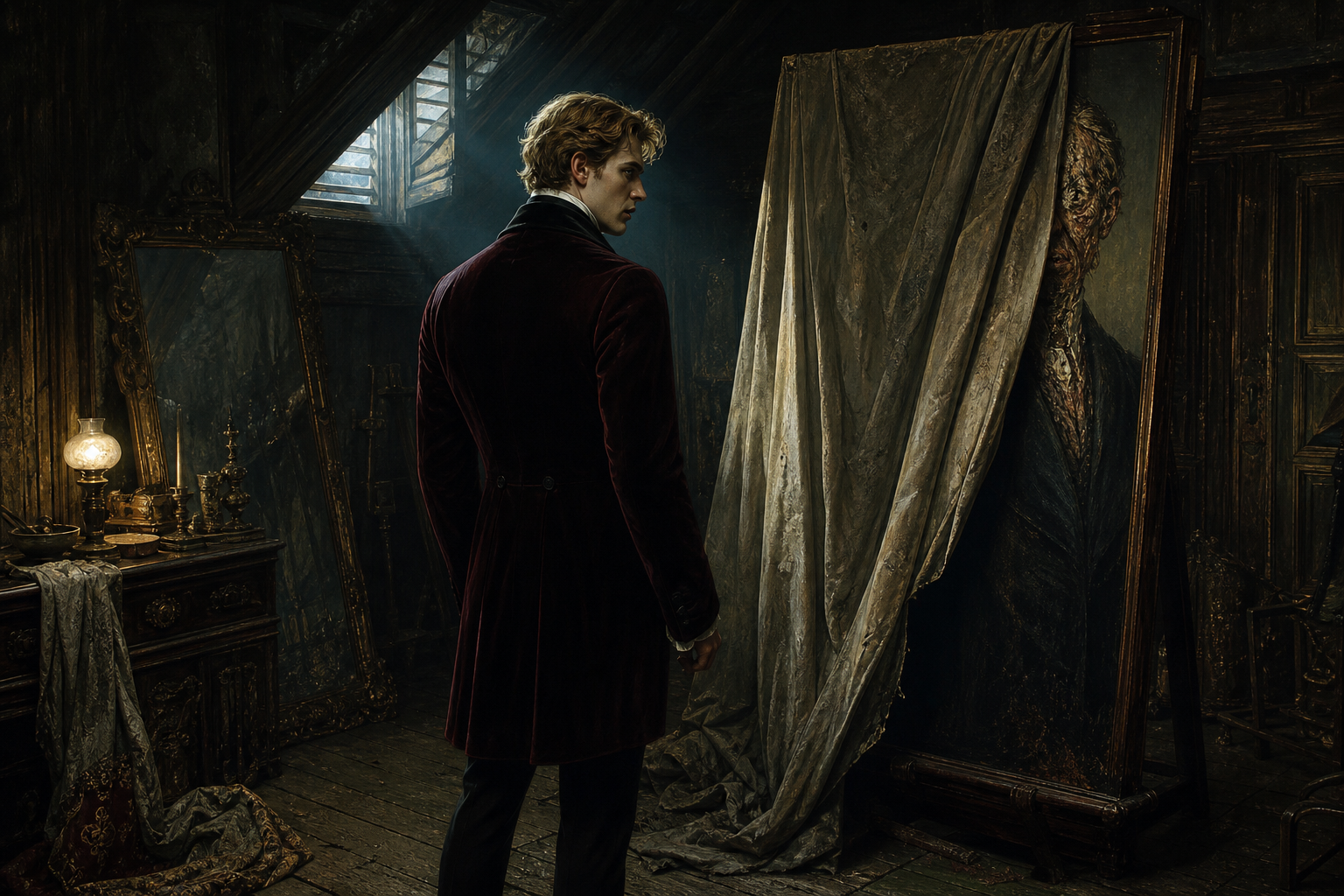
The portrait is locked away in the old schoolroom under a covering. Dorian visits it to see what he has become. The painting grows older, uglier, and more marked by vice, while his public body remains untouched. The room becomes an anti-confessional: instead of admitting guilt to another person, Dorian privately inspects it and then returns to the world unchanged.
This long middle movement can feel episodic, but its function is precise. Wilde shows how a person can turn self-fashioning into self-erasure. Dorian collects sensations, poses, and reputations, yet the portrait proves that the self he refuses to acknowledge has not disappeared. It has merely been hidden.
The yellow book matters because it gives Dorian a way to narrate decline as cultivation. He becomes fascinated by jewels, tapestries, perfumes, music, religious ritual, and rare sensations, but the abundance is not real growth. It is a museum of moods arranged around a shrinking moral center. The more carefully Dorian curates his life, the less able he becomes to meet another person's claim on him.
Wilde also keeps widening the cost. Dorian's beauty protects him in drawing rooms, but other people pay for the hidden life behind that beauty. The rumors are not vague atmosphere; they suggest broken friendships, damaged reputations, coerced silence, and lives pushed toward ruin. The portrait records Dorian's corruption, but society's willingness to keep looking away helps that corruption continue.
4. Basil's return and the portrait revealed
Basil eventually confronts Dorian before leaving for Paris. He has heard terrible stories and wants Dorian to deny them. Basil still hopes that the beautiful young man he loved as artistic inspiration cannot truly be corrupt. That hope is both loyal and naive.
Dorian decides to show Basil the portrait. The revelation is a cruel reversal of the studio scene. Basil once created an image of Dorian's beauty; now he sees an image of Dorian's moral ruin. He understands that the painting is somehow connected to Dorian's life and begs him to pray.
Dorian responds not with repentance but with murder. He kills Basil in the locked room, then forces Alan Campbell, a former friend, to dispose of the body through chemistry. The Gothic plot becomes more openly criminal, but the deeper horror is psychological. Dorian destroys the man who loved him most honestly because Basil's love now demands truth.
Alan Campbell's episode shows that Dorian's secret is no longer contained by the portrait. Dorian can still look innocent, but he now needs another person's compromised expertise to erase physical evidence. The blackmail also suggests a past relationship that has curdled into fear. Later news of Alan's death by suicide makes clear that Dorian's hidden life does not merely stain a canvas; it breaks human beings.
5. Opium dens, James Vane, and the fear of being seen
After Basil's murder, Dorian tries to escape himself through the city at night. In the opium dens, his polished society life touches the ruined world it has helped create. He is recognized by a woman as Prince Charming, the name Sybil once used for him. The nickname brings the past back with dangerous clarity.
James Vane, Sybil's brother, has long sworn revenge. He nearly kills Dorian, but Dorian saves himself by pointing to his youthful face. If Dorian looks too young to have wronged Sybil eighteen years earlier, James must have the wrong man. The trick works because the body lies more persuasively than speech.
James later realizes the truth and stalks Dorian. For once Dorian feels hunted by consequence. The fear is brief because James is accidentally shot during a hunting party. Dorian is relieved, but the accident does not restore him. It only removes one external threat while leaving the portrait and his own knowledge intact.
The hunting-party sequence is important because Dorian briefly becomes the frightened object rather than the admired subject. He has lived by controlling appearances, but James Vane represents a memory that does not care how young he looks. When James dies by accident, Dorian mistakes relief for moral release. Wilde lets the plot remove the pursuer so that the final conflict returns to the more difficult enemy: Dorian's own record of himself.
6. The ending and what it exposesThis section contains spoilers.
Dorian tries to imagine moral reform. He spares Hetty Merton, a young country woman, and decides that this restraint proves he can become good. Yet when he checks the portrait, it has not improved. If anything, it now shows hypocrisy. Wilde refuses to let Dorian count one self-flattering gesture as redemption.
Desperate to be free from the evidence of his life, Dorian takes the knife he used against Basil and stabs the portrait. Servants hear a cry. When they enter, they find the portrait restored to its original beauty and an old, withered, disfigured man dead on the floor. They recognize Dorian only by his rings.
The ending reverses the bargain. The portrait becomes beautiful again because it no longer has to carry the burden Dorian refused. Dorian's body receives the marks that were always his. The final shock is not simply punishment; it is revelation. The hidden self becomes visible at last.
That is why the ending is more than a twist. Dorian tries to destroy evidence, not to confess. He wants relief from being seen, but the act restores sight to everyone else. The servants, who could never read the secret history of the house, finally see the truth in the only form left: a body that can no longer perform innocence.
Major Characters
Dorian Gray
beauty, impressionability, and concealed corruption
Dorian begins as a young man whose beauty is interpreted by others before he understands its power. Basil idealizes him, Henry theorizes him, and society excuses him. Dorian's tragedy is that he accepts those interpretations as permission.
His double life turns him into both artwork and spectator. He watches the portrait decay while treating his own life as performance, until the split between surface and soul can no longer be sustained.
Lord Henry Wotton
paradox, temptation, and irresponsible influence
Lord Henry rarely acts directly, but his language changes the air around Dorian. He makes selfishness sound elegant, youth sound like a moral law, and experience sound more important than responsibility.
He is dangerous because he treats influence as entertainment. Dorian lives out ideas that Henry enjoys as conversation, exposing the gap between witty detachment and lived harm.
Basil Hallward
artist, conscience, and wounded idealism
Basil loves Dorian as artistic revelation and moral possibility. His portrait is not just a technical achievement; it records the moment when beauty feels spiritually meaningful to him.
Yet Basil also helps create the problem by idealizing Dorian too completely. His final confrontation matters because he is the one person who still asks Dorian to become truthful.
Sybil Vane
actress, illusion, and the human cost of aesthetic worship
Sybil first appears to Dorian through roles, not ordinary personhood. He loves her as Juliet and Rosalind, then rejects her when love makes performance impossible.
Her death reveals the cruelty of treating people as art objects. Dorian's response to her becomes the portrait's first visible wound.
James Vane and Alan Campbell
consequence returning through revenge and coercion
James Vane represents the past that refuses to remain aestheticized. He wants practical revenge for Sybil, not elegant interpretation.
Alan Campbell shows a different cost of Dorian's corruption: former intimacy converted into blackmail. Together they make Dorian's hidden life touch the bodies of others.
Best Quotes
There is no such thing as a moral or an immoral book.
The preface separates art from simple moral labeling, but the novel complicates that claim. Dorian misuses aesthetic freedom as if it erased responsibility.
Those who go beneath the surface do so at their peril.
This line is almost a reading instruction for the whole novel. Dorian's face, Basil's portrait, Sybil's stage roles, and London society all ask readers to decide which surfaces conceal truth and which surfaces reveal it.
The soul is a terrible reality.
Basil's language cuts through Henry's glittering talk. The sentence matters because Dorian's soul is not abstract in the novel; it has become visible, aging, and accusatory.
Each of us has Heaven and Hell in him.
Lord Henry says this lightly, but the plot makes the line literal. Dorian's beauty and corruption occupy the same life, separated only by concealment.
Words! Mere words! How terrible they were!
Dorian's reaction to Henry's speech identifies influence as a central force. Language does not merely decorate the novel; it alters desire.
You have killed my love.
Dorian's accusation against Sybil reverses the moral reality of the scene. Sybil has not killed love; Dorian has revealed that he loved theatrical illusion more than a living person.
Major Themes
Surface
Beauty as Social Power
Dorian's face becomes evidence that overrides rumor, guilt, and memory. Wilde shows how beauty can become a social shield when people prefer surfaces to truth.
Influence
Ideas Without Responsibility
Lord Henry's paradoxes are entertaining until Dorian lives by them. The novel asks whether influence can remain innocent when speech reshapes another person's conscience.
Art
Aestheticism Under Pressure
The preface defends art from moral policing, but the plot tests what happens when aesthetic language is used to avoid moral accountability.
Double Life
The Hidden Self Will Return
The portrait lets Dorian divide public appearance from private corruption. The ending insists that the divided self eventually demands recognition.
Wilde, Aestheticism, and Victorian Pressure
The novel first appeared in 1890 and was revised as a book in 1891 with added chapters and the preface. That history matters because the book lives inside Victorian debates about art, morality, scandal, and respectability. Wilde's preface answers readers who wanted fiction to deliver clear moral instruction.
Aestheticism valued beauty, form, sensation, and artistic autonomy. Wilde's novel does not simply reject that movement; it dramatizes its risks when a shallow reader turns subtle ideas into selfish rules. Lord Henry can praise experience from a drawing-room chair, but Dorian tests those phrases on real people.
The Gothic elements also connect the novel to older moral and supernatural traditions: the double, the secret room, the cursed object, the visible mark of hidden guilt. Wilde's originality is to put those devices inside a world of salons, art talk, fashion, and witty conversation. Evil does not arrive with thunder; it arrives with a compliment.
The 1891 book version also gives the novel a sharper architecture than the scandal around it sometimes suggests. The preface pushes back against moralistic reading; the plot then refuses to let aesthetic language become a blank check for cruelty. Holding both pieces together is the key. Wilde can defend art from crude moral policing while still showing a character who uses beauty and art talk to dodge ordinary human responsibility.
Why It Still Matters
Dorian still feels modern because image culture has not become less powerful. People still build public selves, curate beauty, hide harm, and mistake being admired for being known. The portrait is a Victorian object, but its logic belongs to every age that lets the visible profile replace the accountable person.
The book is also useful for study because it resists simple answers. Is it a moral fable? A defense of art? A satire of social hypocrisy? A Gothic punishment plot? Strong essays usually argue that Wilde lets these modes clash rather than choosing only one.
Sua's one-line take: the portrait is frightening because it gives Dorian exactly what he wants. It lets him postpone truth until truth has nowhere left to go.
FAQ: Summary, Ending, and Symbols
What is The Picture of Dorian Gray about?
The Picture of Dorian Gray follows a beautiful young man whose portrait ages and decays while he remains outwardly young. Influenced by Lord Henry's philosophy of pleasure, Dorian hurts others, hides his guilt, murders Basil Hallward, and finally destroys himself when he tries to destroy the portrait.
What does the portrait symbolize?
The portrait symbolizes Dorian's hidden conscience, moral history, and divided self. It also complicates art itself: Basil's beautiful painting becomes both artwork and evidence, both ideal image and truthful record.
Why is the ending important?
The ending matters because Dorian cannot permanently separate appearance from reality. When he stabs the portrait, the body and image exchange truths: the painting recovers beauty, and Dorian's body receives the age and corruption he tried to hide.
Is Lord Henry responsible for Dorian's corruption?
Lord Henry is responsible for influence, not for every choice Dorian makes. His language gives Dorian a seductive vocabulary for fearing age, pursuing sensation, and treating morality as a pose. But Dorian repeatedly chooses the interpretation that flatters him, even when the portrait gives him visible warnings.
Is the novel anti-art?
No. The preface resists simplistic moral judgment of art, and Basil's painting begins as a serious artistic achievement. The novel's critique is aimed at Dorian's misuse of aesthetic ideas. He treats art and beauty as excuses for evasion, while the portrait itself becomes the most truthful object in the book.
What is the yellow book?
The yellow book is an unnamed decadent French novel that shapes Dorian's imagination for years. It matters less as a specific title than as a model of life arranged around cultivated sensation. Dorian reads it not as art to interpret, but as a script for living without moral self-scrutiny.
Read Next
Read Frankenstein for another Gothic story about creation and responsibility, Dr. Jekyll and Mr. Hyde for the divided self in Victorian London, and The Great Gatsby for beauty, performance, and moral emptiness in a later social world.
Adaptations
- Albert Lewin's 1945 film: emphasizes the supernatural portrait and moral melodrama.
- Modern stage versions: often sharpen the novel's questions about performance, desire, and public image.
- Visual-art adaptations: the portrait motif remains powerful because it turns invisible guilt into a visible object.