Jane Eyre Study Guide - AP Lit, SAT Reading, Close Reading, and Essay Practice
A practical guide for AP English Literature, SAT Reading, IB English, and school essays, with key passages, literary devices, practice questions, and essay-ready thesis work.
This study guide is built for students who need to discuss Jane Eyre with textual evidence. If you want the full plot explanation first, start with the main article.
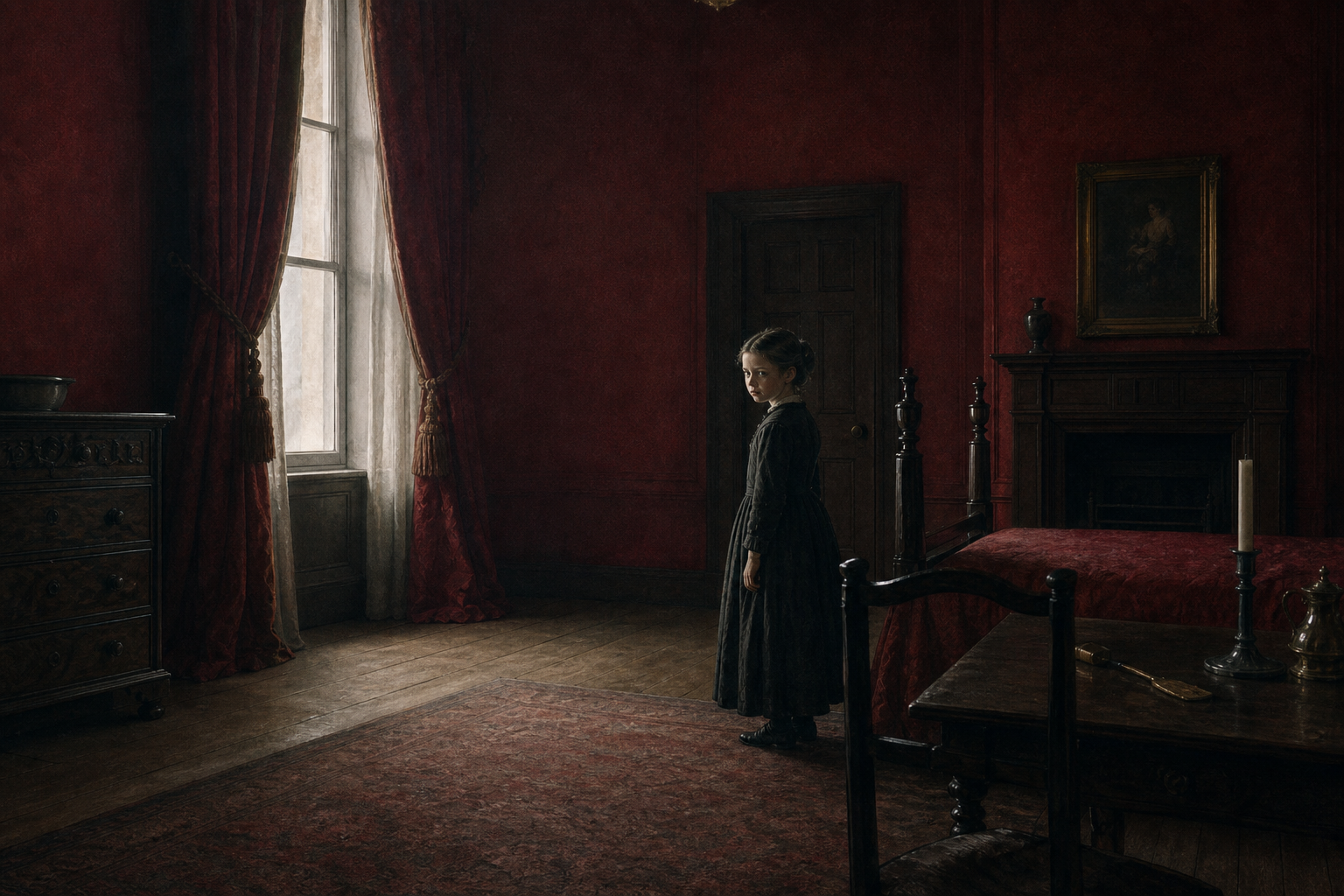
Who This Guide Is For
This guide is for AP English Literature, SAT Reading, IB English, and school essays that ask you to move beyond plot summary. Jane Eyre is especially useful for practicing first-person narration, bildungsroman structure, Gothic symbolism, religious conflict, class pressure, and claims about gender and moral independence.
By the end, you should be able to:
- explain how Jane's voice shapes reader judgment
- connect Gothic settings to hidden social and moral conflicts
- distinguish passion, conscience, and self-respect in Jane's choices
- write about Rochester without reducing him to either hero or villain
- use short original passages as evidence in AP-style paragraphs
- answer SAT-style questions about inference, function, tone, and diction
1. Quick Review
- Original title: Jane Eyre: An Autobiography
- Author: Charlotte Bronte
- Published: 1847
- Main settings: Gateshead, Lowood School, Thornfield Hall, Moor House, Ferndean
- Narrator: Jane Eyre, looking back on her own life
- Central conflict: Jane wants love and belonging without surrendering conscience or self-respect
- Core themes: independence, class, gender, faith, desire, moral equality, hidden domestic violence
- Common exam angles: the red room, Lowood discipline, Thornfield's Gothic secret, the "I am no bird" speech, St. John's proposal, the ending's grammar
One-sentence summary:
Jane Eyre grows from a punished orphan into a self-possessed woman who chooses love only after she can meet it with conscience, independence, and equality.
2. Plot Structure for Exams
Exposition
Jane lives at Gateshead with the Reed family, where she is bullied, excluded, and treated as morally defective. The red room turns that childhood injustice into a symbolic setting: a child is locked inside a beautiful room associated with death, family authority, and the lie that her anger is the problem rather than the cruelty around her.
Development
At Lowood, Jane meets institutional religion in its harsh form through Mr. Brocklehurst, but she also meets Helen Burns and Miss Temple, who help her distinguish faith, patience, justice, and self-command. Jane becomes educated and useful, then leaves because stability without growth feels like another confinement.
Thornfield romance and Gothic complication
Jane works as Adele's governess at Thornfield and develops a charged intellectual and emotional bond with Rochester. Their relationship tests social hierarchy: he is rich, male, experienced, and her employer; she is poor, plain, young, and dependent. Yet Jane's voice repeatedly insists on spiritual equality. The Gothic mystery around Thornfield's laughter, fire, and attacks reveals that Rochester is already married to Bertha Mason.
Crisis
After the interrupted wedding, Rochester asks Jane to stay with him outside the law. Jane's central choice is not whether she loves him; she clearly does. The crisis is whether love can justify self-betrayal. She leaves Thornfield to preserve the moral self the whole novel has been building.
Second test
Jane nearly dies on the moors, is rescued by the Rivers siblings, inherits money, and discovers family. St. John Rivers then asks her to marry him and become a missionary wife. This is a different temptation: duty without love. Jane refuses because spiritual purpose cannot require the death of her emotional self.
Resolution
Jane returns after hearing Rochester's voice, finds Thornfield burned, and reunites with him at Ferndean. Rochester has been physically diminished and morally humbled; Jane has gained money, family, and choice. "Reader, I married him" frames the ending as Jane's active decision, not her passive rescue.
Exam point: do not write that the novel simply rewards obedience. A stronger claim is that Jane learns to separate conscience from submission and love from possession.
3. Key Original Passages for Close Reading
These passages are testing grounds for close reading. For each, identify speaker, situation, diction, imagery, syntax, and theme. Jane Eyre rewards attention to first-person narration: the older Jane often interprets the younger Jane's emotion with precision, so a single sentence can carry memory, judgment, and self-defense at once.
Use each passage in three steps. First, locate the literal scene. Second, mark charged language: confinement, freedom, hunger, law, spirit, equality, or sight. Third, turn that observation into an argument about how Bronte makes inward life visible.
Passage 1: I resisted all the way
I resisted all the way: a new thing for me, and a circumstance which greatly strengthened the bad opinion Bessie and Miss Abbot were disposed to entertain of me.
Context: Jane is taken to the red room after fighting back against John Reed.
Close reading: The adult narrator names resistance as "a new thing," showing both the child's fear and the birth of active self-defense.
Essay use: Use it for childhood injustice, narration, rebellion, and the beginning of Jane's moral voice.
Passage 2: human beings must love something
Human beings must love something, and, in the dearth of worthier objects of affection, I contrived to find a pleasure in loving and cherishing a faded graven image.
Context: Young Jane takes her doll to bed in the lonely nursery.
Close reading: The general statement "human beings must love something" turns a child's toy into evidence of emotional deprivation.
Essay use: Use it for loneliness, attachment, and Jane's lifelong hunger for chosen affection.
Passage 3: I must keep in good health
I must keep in good health, and not die.
Context: Jane answers Brocklehurst's religious questioning before being sent to Lowood.
Close reading: The blunt syntax strips away Brocklehurst's spiritual performance and foregrounds survival.
Essay use: Use it for Bronte's critique of punitive religion and Jane's practical honesty.
Passage 4: as much soul as you
Do you think, because I am poor, obscure, plain, and little, I am soulless and heartless? You think wrong!
Context: Jane speaks to Rochester before his first proposal.
Close reading: The list of social disadvantages becomes a rejected verdict; the exclamation turns inward equality into spoken resistance.
Essay use: Use it for gender, class, spiritual equality, and voice.
Passage 5: I am no bird
I am no bird; and no net ensnares me; I am a free human being with an independent will.
Context: Rochester tries to restrain Jane emotionally and physically during the proposal scene.
Close reading: Jane reverses his bird metaphor and rejects imagery of capture, decoration, and possession.
Essay use: Use it for freedom, bodily autonomy, and the novel's anti-captivity language.
Passage 6: I care for myself
I care for myself. The more solitary, the more friendless, the more unsustained I am, the more I will respect myself.
Context: Jane decides to leave Rochester after learning he is already married.
Close reading: Repetition of "more" turns deprivation into moral intensity; self-respect becomes strongest when external support disappears.
Essay use: Use it for conscience, temptation, and the difference between love and self-erasure.
Passage 7: I am my own mistress
I told you I am independent, sir, as well as rich: I am my own mistress.
Context: Jane returns to Rochester after inheriting money and finding kinship.
Close reading: The phrase "my own mistress" uses social language of mastery to describe self-possession rather than domination over others.
Essay use: Use it for economic independence, changed power balance, and the ending.
Passage 8: Reader, I married him
Reader, I married him.
Context: Jane narrates her marriage to Rochester in the conclusion.
Close reading: The direct address and active verb make Jane the chooser and storyteller of the ending.
Essay use: Use it for narrative control, marriage, and the novel's revision of romance conventions.
4. Close Reading Procedure
Start with grammar. Jane's strongest claims often appear in first-person statements: "I resisted," "I care," "I am," "I married." Those verbs matter because the novel tracks a child who is repeatedly spoken about by others until she can define herself in her own syntax.
Next, identify the pressure around the sentence. A quote from Jane Eyre usually responds to a social force: aunt, schoolmaster, employer, lover, clergyman, poverty, hunger, or law. A strong close reading names that pressure before explaining Jane's language.
Then track images of space. Red room, schoolroom, attic, moor, and Ferndean are not just settings. They organize power. Rooms can imprison, shelter, hide, or humble. Movement between houses gives the novel its bildungsroman structure.
Worked example:
- Literal situation: Jane has discovered Rochester's existing marriage and is tempted to stay.
- Key words: "care," "solitary," "friendless," "unsustained," "respect."
- Device: Bronte uses anaphora and escalation; each loss makes Jane's self-respect more necessary.
- Interpretation: the sentence turns loneliness from a sign of failure into proof of ethical independence.
- Claim: By making Jane's self-respect intensify as social support disappears, Bronte argues that conscience is most meaningful when it cannot rely on comfort, approval, or reward.
5. Why Literary Devices Matter
First-person retrospective narration
The adult Jane narrates the child Jane with sympathy and analysis. This gives the novel emotional immediacy and interpretive control. Readers feel the injustice as it happens, but they also hear a mature voice shaping its meaning.
Gothic setting
The red room and Thornfield use Gothic atmosphere to expose real social pressures. Darkness, locked spaces, laughter, fire, and architectural secrecy reveal what respectable households suppress.
Fire and ice imagery
Fire often marks passion, anger, danger, and life. Ice or cold marks deprivation, repression, and spiritual hardness. Rochester tends toward fire; St. John tends toward ice; Jane has to keep warmth without being consumed.
Biblical and religious allusion
The novel is saturated with religious language, but Bronte distinguishes humane faith from controlling piety. Brocklehurst and St. John use religion in ways that diminish others; Helen and Miss Temple connect faith to mercy and steadiness.
Direct address
Jane's "Reader" moments create intimacy and authority. She does not only tell a story; she manages the reader's ethical relation to her choices.
Symbolic houses
Each major house represents a different pressure: Gateshead is exclusion, Lowood discipline, Thornfield desire and secrecy, Moor House kinship and duty, Ferndean humbled companionship. The plot can be read as Jane learning what kind of house can become home.
Foil characters
Helen, Blanche, Bertha, Diana, Mary, and St. John all clarify Jane by contrast. The strongest essays avoid treating them as mere plot devices; they show how each offers a possible version of womanhood, faith, speech, or self-denial.
6. Turning Character Analysis into Essay Language
Use this four-part method:
- Role: What function does the character serve in Jane's development?
- Pressure: What desire, fear, rule, or social structure shapes the character?
- Device: How does Bronte present the character through narration, dialogue, setting, imagery, or contrast?
- Essay sentence: What arguable claim can this character support?
Example:
| Character | Essay-ready angle |
|---|---|
| Jane Eyre | Bronte makes Jane's moral authority grow through speech: each major stage gives her a new way to say no before she can say yes freely. |
| Rochester | Rochester recognizes Jane's mind but must lose the mastery that makes his love ethically dangerous. |
| Bertha Mason | Bertha exposes Thornfield's buried violence and the limits of a romance built on secrecy. |
| Helen Burns | Helen gives Jane spiritual language, but her patience also shows what Jane cannot fully become without losing her appetite for justice. |
| St. John Rivers | St. John turns duty into a form of possession, testing whether Jane will confuse holiness with self-erasure. |
7. Thesis Builder for Major Themes
Use these as models, not memorized answers:
- Self-respect: Bronte presents self-respect as the condition that makes love moral rather than possessive.
- Class and gender: Jane's poverty makes her socially vulnerable, but her narration repeatedly asserts a spiritual equality that class cannot erase.
- Gothic secrecy: Thornfield's Gothic atmosphere reveals that domestic respectability can hide moral disorder.
- Religion: The novel distinguishes faith that enlarges the self from piety that disciplines, humiliates, or consumes it.
- Bildungsroman: Jane's growth depends less on outward success than on her increasing ability to interpret and defend her own conscience.
8. SAT Reading Sample
These questions are original practice items, not official SAT questions. They are designed to train inference, function, vocabulary-in-context, and evidence reasoning.
Question 1
In the red-room passage, Jane's resistance most directly reveals:
- A. her desire to impress Bessie
- B. her first active refusal of an unjust role
- C. her indifference to punishment
- D. her wish to remain at Gateshead
Answer: B. The phrase "a new thing for me" shows that Jane's resistance marks a shift from endured mistreatment to active self-defense. The other options ignore the scene's pressure and her fear.
Question 2
The sentence "human beings must love something" functions mainly to:
- A. turn a child's attachment to a doll into evidence of emotional deprivation
- B. prove that Jane prefers toys to people
- C. introduce Rochester's romantic influence
- D. criticize all forms of childhood imagination
Answer: A. The line generalizes from Jane's lonely nursery to a human need for affection. It does not reject imagination or introduce Thornfield; it shows how deprivation redirects love toward a substitute.
Question 3
Jane's answer to Brocklehurst, "I must keep in good health, and not die," is best read as:
- A. a theological argument about heaven
- B. a sign that she understands his doctrine perfectly
- C. a comic refusal to attend school
- D. a practical answer that exposes the harshness of his questioning
Answer: D. Jane answers death-focused religious pressure with bodily survival. The bluntness makes Brocklehurst's piety look punitive rather than compassionate.
Question 4
In the proposal scene, Jane's list "poor, obscure, plain, and little" emphasizes:
- A. qualities she hopes Rochester will correct with wealth
- B. the social labels used to underestimate her inward worth
- C. her complete lack of emotional feeling
- D. Blanche Ingram's superiority as a narrator
Answer: B. Jane names the categories that make others misread her, then rejects the idea that they make her soulless. The point is equality, not self-pity or social makeover.
Question 5
The bird-and-net metaphor is important because Jane:
- A. rejects being imagined as trapped, decorative, or owned
- B. asks Rochester to protect her from nature
- C. admits that she cannot survive outside Thornfield
- D. describes Lowood's educational method
Answer: A. Rochester's bird language suggests capture; Jane reverses it to insist on independent will. The metaphor has nothing to do with nature study or Lowood.
Question 6
When Jane says, "I care for myself," the phrase "myself" chiefly stresses:
- A. selfish disregard for others
- B. rejection of all religion
- C. loyalty to Mrs. Reed
- D. the self-respect she must preserve when no one else protects her
Answer: D. Jane is alone and tempted, so self-care means moral preservation rather than selfishness. The sentence is about conscience under pressure.
Question 7
The structure of the novel's major houses most strongly supports which interpretation?
- A. Jane's growth happens through changing spaces that test different forms of power
- B. Jane travels because she dislikes all domestic life
- C. Bronte treats setting as decorative background only
- D. Rochester controls every place Jane enters
Answer: A. Gateshead, Lowood, Thornfield, Moor House, and Ferndean each create a different moral test. The settings are symbolic structures, not neutral scenery.
Question 8
Why is St. John's proposal a serious temptation for Jane?
- A. It offers the wealth she lost at Thornfield
- B. It offers purpose and religious duty without emotional love
- C. It proves Rochester never mattered
- D. It lets her return to Gateshead with power
Answer: B. St. John appeals to Jane's discipline and conscience, but his plan would use her without cherishing her. The temptation is duty, not wealth or revenge.
Question 9
The phrase "Reader, I married him" is notable because it:
- A. removes Jane from the action
- B. uses passive grammar to emphasize fate
- C. shows that Rochester narrates the conclusion
- D. makes Jane the active subject of her marriage story
Answer: D. Jane's grammar makes her the chooser and narrator. The sentence revises romance convention by centering her agency.
Question 10
Brocklehurst and St. John are alike in that both:
- A. connect religious language to control over others
- B. encourage Jane's artistic independence
- C. reject discipline as useless
- D. serve as comic relief
Answer: A. Brocklehurst humiliates through piety, while St. John pressures through holy purpose. Their forms differ, but both show religion becoming coercive.
Question 11
Bertha Mason's role in the Thornfield plot primarily reveals:
- A. Jane's secret inheritance
- B. Adele's parentage
- C. the hidden violence beneath Rochester's domestic world
- D. Miss Temple's educational method
Answer: C. Bertha's confinement exposes the secret on which Thornfield's romance rests. The attic makes private history into Gothic structure.
Question 12
Which statement best captures Jane's relation to Rochester before the interrupted wedding?
- A. She is emotionally indifferent to him.
- B. She loves him but resists being reduced to a dependent possession.
- C. She wants only his money.
- D. She plans to convert him into a missionary.
Answer: B. Jane's love is real, but her strongest speeches insist on equality and independent will. The romance is charged because affection and hierarchy collide.
Question 13
The moorland chapters after Jane leaves Thornfield emphasize:
- A. the comfort of inherited property
- B. the ease of moral decision
- C. the comic failure of Gothic suspense
- D. the material cost of preserving conscience
Answer: D. Jane's choice is morally necessary but physically brutal. Hunger and homelessness show that self-respect has real material risk.
Question 14
Helen Burns is most useful as a foil because she:
- A. models patience and forgiveness that both influence and contrast with Jane's demand for justice
- B. proves that Jane should never resist
- C. teaches Rochester how to govern Thornfield
- D. explains Bertha's backstory
Answer: A. Helen expands Jane's moral imagination, but Jane cannot simply become Helen. Their contrast helps define the novel's balance between endurance and protest.
Question 15
The fire imagery at Thornfield most often suggests:
- A. ordinary household warmth only
- B. Jane's dislike of nature
- C. passion, danger, exposure, and destructive revelation
- D. St. John's calm religious logic
Answer: C. Fire in Thornfield scenes connects desire to danger and brings hidden disorder into view. It is not merely cozy atmosphere.
Question 16
Jane's inheritance changes the ending because it:
- A. makes her economically independent before she chooses Rochester
- B. forces her to accept St. John's proposal
- C. proves Mrs. Reed was generous
- D. erases the importance of Lowood
Answer: A. Money gives Jane the ability to choose without dependence. That new independence changes the moral balance of her return.
Question 17
Which reading best explains Ferndean's importance?
- A. It restores Rochester to full social command.
- B. It repeats Gateshead exactly.
- C. It lets St. John supervise the marriage.
- D. It replaces Thornfield's display and secrecy with a humbler setting for chosen companionship.
Answer: D. Ferndean is smaller and darker than Thornfield, but that reduction matters. The relationship can restart outside the old structure of mastery and concealment.
Question 18
Jane's first-person narration most strongly affects the novel by:
- A. preventing readers from knowing any emotion
- B. turning experience into moral interpretation as well as memory
- C. making Rochester the only reliable judge
- D. removing social context from private feeling
Answer: B. Jane narrates with feeling and retrospective judgment. Her voice turns events into claims about justice, faith, class, and selfhood.
Question 19
Blanche Ingram's function in the Thornfield section is mainly to:
- A. reveal how class performance and marriage-market display threaten Jane's hopes
- B. narrate Jane's childhood
- C. rescue Bertha from the attic
- D. replace Miss Temple as Jane's teacher
Answer: A. Blanche dramatizes the social world Jane cannot easily enter. Rochester's use of Blanche also exposes the cruelty of testing Jane through jealousy.
Question 20
The strongest interpretation of Jane's final marriage is that:
- A. Jane gives up all independence for romance
- B. Bronte rejects love as morally dangerous
- C. marriage becomes acceptable only after Jane can choose it from independence rather than need
- D. Rochester's original deception is proven harmless
Answer: C. The ending follows Jane's money, family, and self-command. She returns to love when it no longer requires legal falsehood or economic dependence.
9. AP Lit Essay Questions
Essay Question 1
Analyze how Bronte uses the red room to establish a conflict between social judgment and Jane's inner sense of justice.
Essay Question 2
Discuss how first-person retrospective narration shapes the reader's understanding of Jane's childhood anger.
Essay Question 3
In what ways does Lowood School teach Jane both discipline and resistance? Use Helen Burns and Miss Temple as part of your evidence.
Essay Question 4
Analyze Rochester as a character who both recognizes and threatens Jane's independence.
Essay Question 5
How does Bronte use Gothic elements at Thornfield to reveal moral problems inside domestic respectability?
Essay Question 6
Compare Rochester's proposal and St. John's proposal as two different tests of Jane's selfhood.
Essay Question 7
Write about fire imagery in the novel. How does it connect passion, danger, exposure, and transformation?
Essay Question 8
Analyze the role of economic dependence and inheritance in Jane's movement toward free choice.
Essay Question 9
How does Bronte distinguish religious faith from religious control?
Essay Question 10
Discuss the importance of direct address, especially the novel's use of "Reader."
Essay Question 11
How does the governess position make Jane both socially vulnerable and unusually observant?
Essay Question 12
Analyze Bertha Mason's function as a Gothic figure and as a challenge for modern readers.
Essay Question 13
How do the novel's houses create a symbolic map of Jane's development?
Essay Question 14
Discuss the relationship between plainness, visibility, and moral worth in Jane's self-presentation.
Essay Question 15
How does Bronte use dialogue to turn romance into argument about equality?
Essay Question 16
Analyze St. John Rivers as a foil to Rochester and as a separate danger to Jane.
Essay Question 17
How does the novel represent solitude as both suffering and moral protection?
Essay Question 18
Discuss whether the ending resolves or preserves the novel's tensions around equality and power.
Essay Question 19
How does Bronte use physical disability and changed setting in the ending to alter the power balance between Jane and Rochester?
Essay Question 20
Analyze Jane Eyre as a bildungsroman in which growth means learning what forms of belonging must be refused.
10. Model Thesis Bank
- Bronte uses the red room to transform childhood punishment into a symbolic origin for Jane's lifelong resistance to unjust authority.
- Jane's retrospective narration turns anger into moral evidence, allowing readers to see rebellion as interpretation rather than mere disobedience.
- Lowood teaches Jane that endurance and justice must be held together: Helen offers spiritual patience, while Miss Temple models humane authority.
- Rochester becomes compelling because he recognizes Jane's mind, but dangerous because he tries to arrange love around secrecy and possession.
- Thornfield's Gothic atmosphere externalizes domestic concealment, making locked rooms and night fires reveal what polite society hides.
- The two proposals test Jane from opposite directions: Rochester tempts her through passion without law, while St. John tempts her through duty without love.
- Bronte's fire imagery links emotional intensity to revelation, showing that passion can warm, expose, and destroy.
- Jane's inheritance matters because it changes love from economic dependence into chosen companionship.
- The novel critiques religious control by contrasting Brocklehurst's humiliation and St. John's cold zeal with Helen's mercy and Miss Temple's justice.
- Direct address gives Jane narrative authority, making the reader a witness to her self-definition rather than a distant observer.
- As a governess, Jane occupies an unstable class position that makes her both vulnerable to dismissal and able to read the household's contradictions.
- Bertha Mason exposes the violence beneath Rochester's romantic secrecy while also revealing the novel's own limits around race, madness, and narrative sympathy.
- Each house in the novel stages a different version of power, so Jane's movement through space becomes the structure of her moral education.
- Jane's plainness challenges a marriage market that confuses beauty and rank with value, forcing the novel to locate worth in speech and conscience.
- Dialogue between Jane and Rochester turns courtship into debate, making equality something argued into language before it can become a relationship.
- St. John Rivers shows that virtue without tenderness can become another form of domination.
- Jane's solitude is painful, but Bronte makes it the condition under which conscience proves stronger than need.
- The ending resolves the legal obstacle to marriage while preserving questions about the cost at which Gothic secrets are removed.
- Ferndean changes the romance by placing Jane's independence beside Rochester's dependence, creating a humbler relation than Thornfield allowed.
- Jane Eyre is a bildungsroman of refusal: Jane matures by learning which homes, loves, and duties cannot be accepted without self-loss.
11. Academic Vocabulary for Essays
| Term | How to use it for Jane Eyre |
|---|---|
| bildungsroman | Use for Jane's development from punished child to self-narrating adult. |
| Gothic | Use for Thornfield's secrecy, locked rooms, fire, and hidden violence. |
| retrospective narration | Use when older Jane interprets younger Jane's experience. |
| foil | Use for Helen, Blanche, Bertha, and St. John as contrasts to Jane. |
| spiritual equality | Use for Jane's argument that class and appearance do not measure the soul. |
| autonomy | Use for Jane's right to choose without economic, romantic, or religious coercion. |
| piety | Use carefully to distinguish sincere faith from performative control. |
| domestic ideology | Use for Victorian ideas about home, gender, marriage, and obedience. |
12. Return to the Main Article
For the full plot summary, character guide, quote analysis, and ending explanation, return to the Jane Eyre main article.