The Great Gatsby Study Guide — AP Lit, SAT Reading, Close Reading, and Essay Practice
A practical guide for AP English Literature, SAT Reading, IB English, and school essays, with key passages, literary devices, practice questions, and essay-ready thesis work.
This study guide is built for students who need to discuss The Great Gatsby with textual evidence. If you want the full plot explanation first, start with the main article.
Who This Guide Is For
This guide is for AP English Literature, SAT Reading, IB English, and high school or college students who need to write about The Great Gatsby with evidence. The goal is not to memorize plot. The goal is to explain how Fitzgerald creates meaning through narration, symbols, diction, class conflict, and recurring images.
By the end, you should be able to:
- identify the novel's most testable symbols and themes
- use short textual evidence in a paragraph
- explain Nick's narration as interpretation, not neutral reporting
- build a defensible AP-style thesis
- answer SAT-style questions about inference, function, tone, and word choice
1. Quick Review
- Original title: The Great Gatsby
- Author: F. Scott Fitzgerald
- Published: 1925
- Setting: West Egg, East Egg, New York City, the valley of ashes
- Narrator: Nick Carraway
- Central conflict: Gatsby tries to recover Daisy and the past she represents
- Core themes: the American Dream, class, memory, self-invention, appearance versus reality
- Common exam angles: the green light, Nick's moral judgment, old money versus new money, the final sentence
One-sentence summary:
Jay Gatsby builds a glamorous life to win back Daisy Buchanan, but Fitzgerald turns that romantic dream into a critique of class privilege and the broken promise of the American Dream.
2. Plot Structure for Exams
Exposition
Nick Carraway moves from the Midwest to West Egg, Long Island, where he rents a modest house next to Gatsby's mansion. Fitzgerald immediately maps the novel through social geography: West Egg represents new money, East Egg represents inherited status, New York City becomes a site of appetite and performance, and the valley of ashes exposes the waste underneath wealth.
Rising Action
Nick learns that Gatsby's parties are designed around one hope: Daisy Buchanan might someday appear. Gatsby and Daisy reunite through Nick. For a brief period, Gatsby seems to transform wealth into proof that the past can be restored. The important exam point is that the romance is never only romance; it is also Gatsby's attempt to cross a class boundary.
Climax
At the Plaza Hotel, Gatsby demands that Daisy say she never loved Tom. Daisy cannot do it. Tom exposes Gatsby's criminal connections, and Gatsby's carefully performed identity begins to collapse. The scene matters because Gatsby asks for an impossible emotional revision of history, while Tom uses social power to protect himself.
Falling Action
Daisy drives Gatsby's car and kills Myrtle Wilson. Gatsby takes the blame to protect Daisy. Tom and Daisy retreat into the safety of wealth, while George Wilson is pushed toward revenge. Fitzgerald shifts the novel from glamorous surfaces to consequences.
Resolution
Gatsby dies waiting for Daisy, who never calls. The party crowds disappear. Nick rejects the carelessness of the East and returns to the Midwest. The final sentence frames human life as a struggle to move forward while being pulled backward into the past.
Exam point: do not treat the ending as only a sad romance. The ending shows how class protects Tom and Daisy while leaving Gatsby exposed.
3. Key Original Passages for Close Reading
These passages are not just memorable quotations. Each one is a compact testing ground for close reading: speaker, situation, diction, syntax, image, tone, and theme all have to work together. In AP Lit, SAT Reading, IB English, and school essays, a short quotation only becomes useful when you can explain how its wording changes the meaning of the scene and the work as a whole.
Read each passage in three passes. First, establish the literal situation. Second, mark charged words or images. Third, turn that observation into an arguable claim. A strong paragraph does not merely identify a theme; it shows how a specific phrase, image, or sentence movement produces that theme.
For exam practice, treat the Context, Close reading, and Essay use notes as a three-part bridge: where the line appears, how it works, and how it can support an essay claim. The goal is to move from quotation to commentary without falling into plot summary.
Passage 1: arms toward the dark water
He stretched out his arms toward the dark water in a curious way, and, far as I was from him, I could have sworn he was trembling.
Context: Nick first sees Gatsby reaching toward Daisy’s green light.
Close reading: Gesture, distance, and trembling make desire visible before Gatsby is explained.
Essay use: Use it for longing, class distance, and Nick’s symbolic narration.
Passage 2: beautiful little fool
I hope she’ll be a fool—that’s the best thing a girl can be in this world, a beautiful little fool.
Context: Daisy speaks about her daughter and her own disappointment.
Close reading: Bitter irony shows ignorance as protection in a gendered, class-bound world.
Essay use: Use it for Daisy’s complexity, gender performance, and privilege.
Passage 3: repeat the past
“Can’t repeat the past?” he cried incredulously. “Why of course you can!”
Context: Gatsby rejects Nick’s warning about time.
Close reading: The exclamation makes hope forceful, but the force reveals denial.
Essay use: Use it for memory, illusion, and tragic idealism.
Passage 4: voice full of money
Her voice is full of money, he said suddenly.
Context: Gatsby names Daisy’s allure.
Close reading: The metaphor fuses sound with class, making romance inseparable from inherited wealth.
Essay use: Use it for class aspiration and commodified desire.
Passage 5: careless people
They were careless people, Tom and Daisy—they smashed up things and creatures and then retreated back into their money.
Context: Nick judges the Buchanans after Gatsby’s death.
Close reading: Plain diction and “retreated” show wealth as protection from consequence.
Essay use: Use it for class carelessness and moral insulation.
Passage 6: the green light
Gatsby believed in the green light, the orgastic future that year by year recedes before us.
Context: Nick expands Gatsby’s private longing into a historical pattern.
Close reading: The symbol shifts from Daisy to a future that continually withdraws.
Essay use: Use it for the American Dream, time, and symbolic development.
Passage 7: boats against the current
So we beat on, boats against the current, borne back ceaselessly into the past.
Context: The final sentence widens Gatsby’s dream into a human condition.
Close reading: The motion image combines striving with resistance, so progress is haunted by history.
Essay use: Use it for endings, historical longing, and the novel’s final expansion.
4. Close Reading Procedure
Close reading in The Great Gatsby usually begins with Nick's act of looking. The novel gives you glittering surfaces, then asks whether the narrator's memory can sort desire from damage. A strong exam paragraph does not jump straight from "green light" to "American Dream." It tracks how Fitzgerald's images, social details, and retrospective narration make hope feel both beautiful and compromised.
Step 1: Establish the literal situation
Name the exact social pressure in the scene. Is Gatsby reaching across the bay before Nick knows his story? Is Daisy speaking from inside Tom's protected world? Is Myrtle trying to borrow status through Tom? In this novel, setting and class position are part of the literal situation, so include East Egg, West Egg, the valley of ashes, New York, or Gatsby's mansion when they shape the moment.
Step 2: Identify the narrative position
Ask how Nick is filtering the event. He is often both witness and later judge: he admires Gatsby's "extraordinary gift for hope" while condemning the carelessness around him. On SAT-style questions, that double position matters because Nick's tone can be sympathetic, ironic, morally disgusted, or elegiac in the same chapter.
Step 3: Mark charged diction
Track words that carry money, distance, glamour, or damage. "Full of money" turns Daisy's voice into class privilege; "careless" turns Tom and Daisy's behavior into moral judgment; "retreated" makes wealth sound like a shelter after harm has been done. Choose words that reveal how charm and corruption occupy the same sentence.
Step 4: Notice syntax and tone
Watch how Fitzgerald shifts from quick social observation to lyrical expansion. The party scenes often accumulate details until pleasure feels excessive; Gatsby's insistence that the past can be repeated sounds absolute and brittle; the final sentence stretches backward and forward at once. Syntax is useful evidence when it shows longing trying to outrun time.
Step 5: Connect image to abstraction
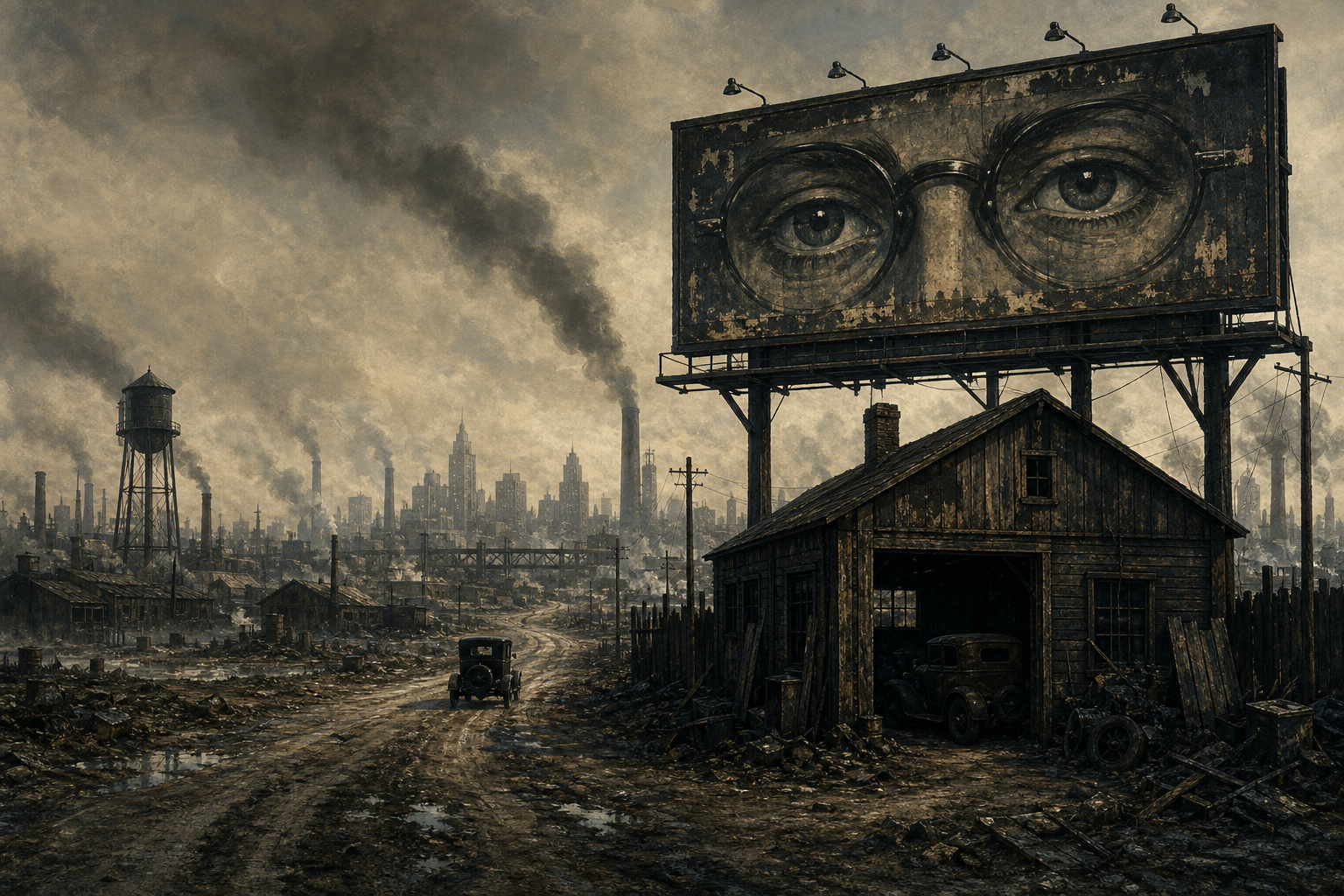
Let the image change as the plot develops. The green light first appears as a distant physical signal, then becomes Gatsby's private promise, then becomes part of Nick's historical meditation. Cars begin as signs of speed and status but end as instruments of injury and evasion. The valley of ashes is not just gloomy scenery; it makes the human cost of luxury visible.
Step 6: Convert observation into a claim
Turn the detail into a claim about illusion, class, time, or moral responsibility. Avoid "the green light symbolizes hope" by itself. A stronger claim explains what kind of hope the image creates, how distance shapes it, and why the novel later asks readers to judge that hope.
Worked example: Gatsby reaching toward the green light
- Literal situation: Nick sees Gatsby alone at night, standing outside his mansion and stretching his arms toward a green light across the water.
- Narrative position: Nick does not yet understand Gatsby's history with Daisy, so the gesture is mysterious before it becomes biographical.
- Device: Fitzgerald uses symbolism and spatial imagery: the light is visible, but the "dark water" makes it unreachable.
- Interpretation: the image turns desire into distance. Gatsby's dream depends on a sign he can see but cannot possess.
- Claim: By placing Gatsby's longing across the bay, Fitzgerald makes aspiration feel luminous and impossible at once, showing that the dream's beauty comes partly from the distance that keeps it intact.
Use the same method on Daisy's voice, the valley of ashes, the car accident, or the final image of boats. The best paragraph keeps returning to the page: who is looking, what object is being described, which words carry pressure, and how the scene changes the novel's judgment of Gatsby's dream.
5. Why Literary Devices Matter
Fitzgerald's devices matter because The Great Gatsby is built from surfaces that cannot be trusted: beautiful rooms, expensive shirts, bright cars, polished voices, and stories people tell about themselves. For AP Lit, SAT Reading, IB English, and school essays, the device is the bridge between the glamorous surface and the moral pressure underneath.
Symbolism: green light and unreachable desire
The green light is never only "hope." In the first scene it is a small distant object; by the ending it has become part of Nick's meditation on the American habit of imagining the future as recoverable. Scene evidence: Gatsby reaches toward the light across dark water, then later discovers that Daisy's actual presence cannot match the dream. Essay use: argue that Fitzgerald makes aspiration seductive while showing that symbolic desire can survive only by simplifying reality.
Diction: money inside the voice
When Gatsby says Daisy's voice is "full of money," the diction fuses romance with class. Scene evidence: Daisy's charm is auditory, but Gatsby and Nick hear inherited ease, protection, and social power inside it. Essay use: use this device to show that Gatsby loves Daisy as a person and as an emblem of a world that will never fully admit him.
Imagery: ash beneath glitter
The valley of ashes makes the cost of wealth sensory. Scene evidence: between the Eggs and New York, the landscape of dust, labor, and exhaustion interrupts the novel's parties and hotel rooms. Essay use: connect this imagery to Fitzgerald's class critique: luxury depends on zones of waste that wealthy characters can pass through without responsibility.
Irony: parties without community
Gatsby's parties look socially abundant, but they do not create loyalty. Scene evidence: crowds consume his hospitality while rumors replace knowledge; almost none of those guests come to his funeral. Essay use: use the party/funeral contrast to argue that the Jazz Age world offers spectacle instead of relationship.
Point of view: Nick's divided judgment
Nick's first-person narration is both intimate and evaluative. Scene evidence: he criticizes Gatsby's criminal associations and impossible dream, yet still separates Gatsby from the "foul dust" around him. Essay use: discuss how the narration creates moral complexity: Gatsby is not innocent, but Nick makes him seem more alive than the careless people who survive him.
Setting: East Egg, West Egg, and class geography
The Eggs organize social hierarchy before characters explain it. Scene evidence: Gatsby's West Egg mansion imitates aristocratic style, while Tom and Daisy's East Egg world carries the security of inherited status. Essay use: show how setting turns class into geography: Gatsby can face Daisy across the bay, but proximity does not equal belonging.
Motif: cars, speed, and evasion
Cars repeat as signs of modern freedom, carelessness, and danger. Scene evidence: reckless driving appears as comic privilege before Myrtle's death makes speed deadly and morally revealing. Essay use: trace the motif to argue that movement in the novel often means escape from consequences, especially for the wealthy.
Contrast: Gatsby's dream versus Tom and Daisy's survival
The novel contrasts Gatsby's excessive belief with Tom and Daisy's protected carelessness. Scene evidence: Gatsby waits outside Daisy's house after the accident, while Tom and Daisy retreat into their money. Essay use: this contrast helps explain why Nick both critiques Gatsby's illusion and reserves his harshest moral judgment for those who damage others and remain safe.
Allusion and historical framing: the Dutch sailors
The final pages shift from Gatsby's private dream to a national origin story. Scene evidence: Nick imagines earlier sailors seeing the fresh green breast of the new world, then links that wonder to Gatsby's belief in the future. Essay use: use the allusion to broaden an essay from character analysis to the novel's argument about American longing, repetition, and historical self-deception.
6. Turning Character Analysis into Essay Language
Character analysis is not a list of personality traits. In literary essays, a character matters because the character carries pressure: desire, fear, social expectation, moral conflict, self-deception, or change. A strong essay connects character to technique and theme in the same line of argument.
Use this four-part method before writing:
- Role: What function does the character serve in the work?
- Pressure: What desire, fear, rule, or conflict shapes the character?
- Device: How does the author present that character: contrast, irony, narration, symbolism, dialogue, setting?
- Essay sentence: What arguable claim can this character support?
A useful sentence frame:
Gatsby functions as a figure of romantic self-invention, and Fitzgerald's symbolism reveals how desire becomes trapped inside class power.
The cards below are meant to turn character notes into essay-ready claims, not to replace close reading. Use them as starting points for paragraphs that still need textual evidence.
Jay Gatsby
self-invention and impossible desire
Gatsby is a self-invented man whose wealth cannot secure true belonging. He represents both the beauty and danger of the American Dream.
Essay sentence: Gatsby's tragedy is not that he dreams, but that he turns Daisy and the past into an ideal no real person can satisfy.
Nick Carraway
participant-observer and moral interpreter
Nick is not a neutral camera. His retrospective narration shapes the novel's moral meaning.
Essay sentence: Nick's admiration for Gatsby and disgust with the Buchanans guide the reader toward a critique of careless privilege.
Daisy Buchanan
desire, privilege, and safety
Daisy is charming and emotionally complicated, but she ultimately chooses protection. Gatsby sees her as a dream; the novel also presents her as old money made seductive.
Essay sentence: Daisy functions as both a character and a symbol of the class world Gatsby cannot truly enter.
Tom Buchanan
inherited power and moral carelessness
Tom is violent, hypocritical, and socially secure. He is not admirable, but he remains protected.
Essay sentence: Tom reveals that inherited privilege does not need moral worth in order to keep power.
Jordan Baker
modernity, performance, and detachment
Jordan's cool self-possession reflects a modern social world built on surfaces, competition, and emotional distance.
Essay sentence: Jordan's detachment reinforces Fitzgerald's portrait of a society that treats charm as a substitute for responsibility.
Myrtle Wilson
aspiration and social vulnerability
Myrtle wants escape, but she lacks the protection that Tom and Daisy possess. Her death shows how aspiration can be punished when it is not backed by class power.
Essay sentence: Myrtle's fate exposes the brutal difference between desiring mobility and possessing the social protection to survive its risks.
7. Thesis Builder for Major Themes
A strong thesis is arguable, specific, and connected to the meaning of the work as a whole. Compare the weak and strong versions below to see how a topic becomes a defensible argument.
Dream
The American Dream
Weak thesis: Gatsby shows the American Dream.
Strong thesis: Through Gatsby's rise and failure, Fitzgerald presents the American Dream as seductive but corrupted by inherited class power.
Time
The Past
Weak thesis: Gatsby wants the past.
Strong thesis: Gatsby's desire to repeat the past transforms romance into denial, revealing the danger of turning memory into an absolute ideal.
Class
Old Money vs New Money
Weak thesis: The book is about rich people.
Strong thesis: The contrast between West Egg and East Egg shows that class in the novel depends not only on wealth but on inherited legitimacy.
Narration
Nick's Moral Lens
Weak thesis: Nick tells the story.
Strong thesis: Nick's narration shapes Gatsby as both flawed and admirable, guiding the reader toward a critique of careless privilege.
8. SAT Reading Sample
These are SAT-style practice questions, not official College Board questions. Each question is tied to a specific scene, passage, or recurring device from the work.
Question 1
In “Her voice is full of money,” Daisy’s appeal is:
- A. based only on singing
- B. inseparable from wealth and inherited ease
- C. created by Nick’s jealousy
- D. proof of independence
Answer: B. Gatsby hears Daisy’s charm as class power: the phrase makes her voice carry inherited ease, not musical talent, Nick’s jealousy, or independence from wealth.
Question 2
Nick’s narration is best described as:
- A. objective reporting
- B. factless fantasy
- C. omniscient access
- D. first-person recollection shaped by moral judgment
Answer: D. Nick tells the story after the events and repeatedly judges what he witnessed, so his narration is personal memory shaped by moral evaluation rather than neutral reporting or omniscience.
Question 3
The valley of ashes functions as:
- A. symbol of waste and human cost beneath wealth
- B. neutral road
- C. romantic refuge
- D. old-money paradise
Answer: A. The valley sits between privilege and pleasure, turning dust, labor, and decay into visible evidence of the cost hidden beneath the Eggs and New York.
Question 4
Gatsby’s central mistake is that he:
- A. refuses wealth
- B. misunderstands Nick
- C. believes money and will can restore an idealized past
- D. leaves too early
Answer: C. Gatsby’s insistence that the past can be repeated shows his belief that money, performance, and willpower can recover an earlier Daisy who no longer exists in that form.
Question 5
The “dark water” in the green light scene emphasizes:
- A. Nick’s fear of sailing
- B. Gatsby’s dislike of water
- C. physical and symbolic distance
- D. Daisy’s dislike of parties
Answer: C. The water matters because Gatsby can see the light but cannot cross the emotional and social distance it represents; the scene is not about sailing or Daisy’s party habits.
Question 6
Gatsby’s parties function to:
- A. perform wealth while hoping Daisy appears
- B. prove intimate friendship
- C. make Tom sympathetic
- D. end rumors
Answer: A. Gatsby’s parties advertise abundance and draw strangers, but their deeper purpose is to make his house visible enough that Daisy might enter it.
Question 7
Boats “against the current” suggests:
- A. effortless progress
- B. comic confusion
- C. freedom from memory
- D. striving under resistance from history and time
Answer: D. The final boat image makes human desire active but resisted: the current of time and history pushes backward even as people keep rowing toward imagined futures.
Question 8
Calling Tom and Daisy “careless” implies they:
- A. lack intelligence
- B. avoid responsibility because money protects them
- C. plan poorly
- D. regret everything
Answer: B. Nick’s judgment of Tom and Daisy depends on their ability to cause harm and then disappear into wealth, leaving Gatsby, Myrtle, and Wilson exposed.
Question 9
Cars develop into symbols of:
- A. status, speed, carelessness, and violence
- B. rural simplicity
- C. democratic equality
- D. religious certainty
Answer: A. Cars begin as signs of Jazz Age speed and status, but Myrtle’s death turns the motif into evidence of reckless privilege and the violence it can escape.
Question 10
Daisy’s “beautiful little fool” line is:
- A. proof she lacks insight
- B. unrelated joke
- C. bitter recognition of gendered limits
- D. rejection of wealth
Answer: C. Daisy’s line is bitter because she knows a woman may be safer if she is charming and unaware; the joke exposes gender limits rather than simple foolishness.
Question 11
The party/funeral contrast reveals:
- A. Nick’s indifference
- B. spectacle without loyalty
- C. Daisy’s loyalty
- D. Gatsby’s stable community
Answer: B. The crowded parties and empty funeral expose the difference between consuming Gatsby’s spectacle and caring about him as a person.
Question 12
In “retreated back into their money,” “retreated” means:
- A. advanced
- B. apologized
- C. surrendered
- D. withdrew into protection
Answer: D. “Retreated” suggests withdrawal into safety: after damage has been done, Tom and Daisy use money as protection from consequence.
Question 13
Gatsby’s mansion functions as:
- A. neutral home
- B. inherited tradition
- C. performance of identity and aspiration
- D. class-free space
Answer: C. The mansion is staged identity: it displays wealth and aspiration for Daisy’s gaze, but it cannot become inherited belonging.
Question 14
The James Gatz name change develops:
- A. self-invention
- B. farm labor
- C. religious certainty
- D. political reform
Answer: A. The name change marks Gatsby’s self-invention, separating the invented social figure from James Gatz’s poorer origins.
Question 15
Eckleburg’s eyes are:
- A. a simple religious answer
- B. proof Wilson is wealthy
- C. comic signage only
- D. an ambiguous image of watching and moral vacancy
Answer: D. The billboard eyes appear watchful, but their meaning remains unstable; Wilson reads moral judgment into an image the novel also presents as empty advertising.
Question 16
Gatsby’s wealth cannot secure Daisy because:
- A. Daisy hates luxury
- B. money cannot buy old-money legitimacy
- C. Tom lacks power
- D. he hides wealth
Answer: B. Gatsby can buy display, but Daisy’s world is protected by inherited status and family legitimacy that his new money cannot fully reproduce.
Question 17
By the end, Nick’s attitude toward Gatsby is:
- A. hero worship
- B. contempt
- C. critical admiration
- D. indifference
Answer: C. Nick remains critical of Gatsby’s illusion, yet he admires the intensity of Gatsby’s hope more than the insulated carelessness around him.
Question 18
East Egg represents:
- A. poverty
- B. democratic openness
- C. innocence
- D. inherited privilege and social security
Answer: D. East Egg represents old money’s security: Tom and Daisy belong to a world that can absorb scandal and preserve social authority.
Question 19
The ending broadens beyond Gatsby because Nick:
- A. turns one man’s dream into human striving
- B. lets Daisy narrate
- C. abandons memory
- D. claims Gatsby succeeded
Answer: A. Nick’s ending turns Gatsby’s private longing into a wider pattern of human and American striving toward a future imagined as recoverable.
Question 20
Which evidence best supports class carelessness?
- A. Gatsby’s schedule
- B. Tom and Daisy retreating into money after damage
- C. Jordan’s golf
- D. Nick’s rental
Answer: B. Tom and Daisy’s retreat after the deaths is the clearest evidence because it shows damage followed by protection, not repentance or accountability.
9. AP Lit Essay Questions
Use these AP Lit-style practice questions to turn a specific scene into a thesis, outline, and evidence-based commentary.
Essay Question 1
The green light appears first as a physical object across the bay and later as a symbol of historical longing. Analyze how Fitzgerald develops this image from private desire into a broader statement about the American Dream. Include two scene references and one comment on symbolism.
Essay Question 2
Gatsby changes his name, invents a public persona, and builds a mansion around a hoped-for reunion. Explain how self-invention both empowers Gatsby and exposes the limits of social mobility. Use two scenes and one detail about performance or setting.
Essay Question 3
Nick tells the story from a later point in time, mixing admiration with moral judgment. Analyze how his retrospective narration shapes the reader's understanding of Gatsby. Include one moment of sympathy and one moment of critique.
Essay Question 4
Choose one major setting, such as East Egg, West Egg, New York, or the valley of ashes. Explain how Fitzgerald uses that setting to turn geography into social criticism. Use two concrete details from the novel.
Essay Question 5
Old money and new money are not merely economic categories in the novel. Analyze how Fitzgerald presents them as different kinds of power, protection, and exclusion. Include Gatsby and at least one Buchanan in your answer.
Essay Question 6
Daisy is both a person Gatsby loves and a symbol of the world he wants to enter. Analyze how Fitzgerald keeps those two roles in tension. Include one scene involving Daisy's voice, choice, or silence.
Essay Question 7
Gatsby believes the past can be repeated, while the novel continually shows time resisting him. Analyze how memory shapes Gatsby’s dream and its failure. Use one early sign of longing and one later consequence.
Essay Question 8
The parties at Gatsby’s mansion create glamour, rumor, and emptiness at the same time. Analyze how Fitzgerald uses spectacle to reveal the gap between appearance and reality. Include a contrast between crowd and intimacy.
Essay Question 9
Cars in the novel begin as signs of speed, luxury, and modern freedom, but they become tied to harm. Analyze how Fitzgerald uses cars and driving to connect status with carelessness and violence.
Essay Question 10
Nick calls Tom and Daisy “careless,” but the novel shows carelessness as more than personality. Analyze how wealth allows moral carelessness to become socially protected. Use two scenes involving damage and retreat.
Essay Question 11
Compare Gatsby’s parties with his funeral. Explain how the contrast changes the reader’s understanding of social belonging, loyalty, and spectacle. Include one detail about absence or abandonment.
Essay Question 12
The valley of ashes and the eyes of Doctor T. J. Eckleburg create one of the novel’s most important symbolic landscapes. Analyze how these images connect waste, class, and moral vision.
Essay Question 13
The final sentence moves beyond Gatsby as one individual. Analyze how Fitzgerald uses its image of boats and current to broaden the novel’s meaning. Connect the ending to at least one earlier image.
Essay Question 14
Choose a character protected by social power despite moral failure, such as Tom, Daisy, or Jordan. Analyze how the novel distinguishes personal charm from ethical responsibility.
Essay Question 15
Daisy, Jordan, and Myrtle each perform gender within a world shaped by class expectation. Analyze how Fitzgerald uses one or two of these women to reveal the pressures and limits of social performance.
Essay Question 16
Choose one character whose choices are shaped by illusion. Explain how that illusion becomes emotionally powerful but practically destructive. Use one scene of hope and one scene of disillusionment.
Essay Question 17
Distance matters throughout the novel: the bay, the eggs, the city, the valley, and the past all separate desire from possession. Analyze how Fitzgerald turns distance into a structural motif.
Essay Question 18
Choose a minor character, such as Myrtle, George Wilson, Jordan, Wolfsheim, or Gatsby’s father. Explain how that character reveals a major theme that the central romance alone cannot fully show.
Essay Question 19
The novel is often read as a critique of social mobility. Analyze how Fitzgerald shows both the attraction of rising and the structures that prevent true acceptance. Include Gatsby’s wealth and his exclusion.
Essay Question 20
The ending invites sympathy for Gatsby while criticizing the dream that consumes him. Analyze how Fitzgerald holds those two responses together. Use one detail from Gatsby’s hope and one from the novel’s final judgment.
10. Model Thesis Bank
Use these as models, then adapt them to the exact question.
- Fitzgerald uses the green light to transform Gatsby's private longing for Daisy into a broader critique of the American Dream's unreachable promises.
- Gatsby's self-invention reveals the appeal of American mobility, but his failure shows that class legitimacy cannot be purchased through spectacle.
- Nick's retrospective narration makes Gatsby both flawed and admirable, guiding readers to value hope while questioning illusion.
- The valley of ashes exposes the human cost hidden beneath the glamour of East Egg and West Egg.
- Daisy's voice links romance to wealth, revealing that Gatsby's desire is inseparable from class aspiration.
- Tom's security shows that inherited power can survive moral failure.
- Fitzgerald uses parties to reveal a society skilled at pleasure but empty of responsibility.
- Gatsby's dream becomes tragic because it treats memory as something that can be restored by will and money.
- The contrast between Gatsby's party crowds and his funeral exposes the loneliness beneath social spectacle.
- Cars in the novel connect modern speed and status to carelessness and violence.
- Daisy's choice of Tom reveals the force of safety over desire.
- Myrtle's fate exposes the danger of aspiration without protection.
- Jordan's detachment reflects a modern world in which charm often replaces responsibility.
- The final sentence expands Gatsby's failure into a universal struggle between hope and the pull of the past.
- Fitzgerald presents the American Dream as emotionally powerful but structurally corrupted by class.
- Gatsby's mansion is less a home than a stage for the identity he wants others to accept.
- Nick's moral judgment turns a story of romance into a critique of privileged carelessness.
- The eyes of Doctor T. J. Eckleburg suggest a world watched but not morally repaired.
- Gatsby's love for Daisy is inseparable from his desire to enter the world she represents.
- The novel's tragedy lies in the mismatch between Gatsby's extraordinary hope and the social reality that makes that hope impossible.
11. Academic Vocabulary for Essays
- self-invention: the deliberate remaking of identity
- inherited privilege: social power passed down through class position
- moral carelessness: failure to take responsibility for harm
- unattainable ideal: an object of desire that cannot truly be reached
- retrospective narration: narration from a later point in time
- social mobility: movement between social classes
- disillusionment: the collapse of a cherished belief
- performative identity: identity presented as an intentional performance
- class legitimacy: recognition granted by an established social class
- symbolic distance: physical distance that also carries abstract meaning
- moral insulation: protection from consequences through wealth or status
- romantic idealism: belief that love can overcome reality
- social geography: the way places map social hierarchy
- ambiguity: a deliberate openness of meaning
- commodification: turning value or desire into something linked with money
- spectacle: a public display designed to impress
- fatalism: the sense that outcomes are shaped by forces beyond control
- complicity: participation in or benefit from wrongdoing
- aspiration: the desire to rise beyond one's current condition
- critique: an argument that exposes limits or failures