Frankenstein Study Guide - AP Lit, SAT Reading, Close Reading, and Essay Practice
A practical guide for AP English Literature, SAT Reading, IB English, and school essays, with key passages, literary devices, practice questions, and essay-ready thesis work.
This study guide is built for students who need to discuss Frankenstein with textual evidence. If you want the full plot explanation first, start with the main article.
Who This Guide Is For
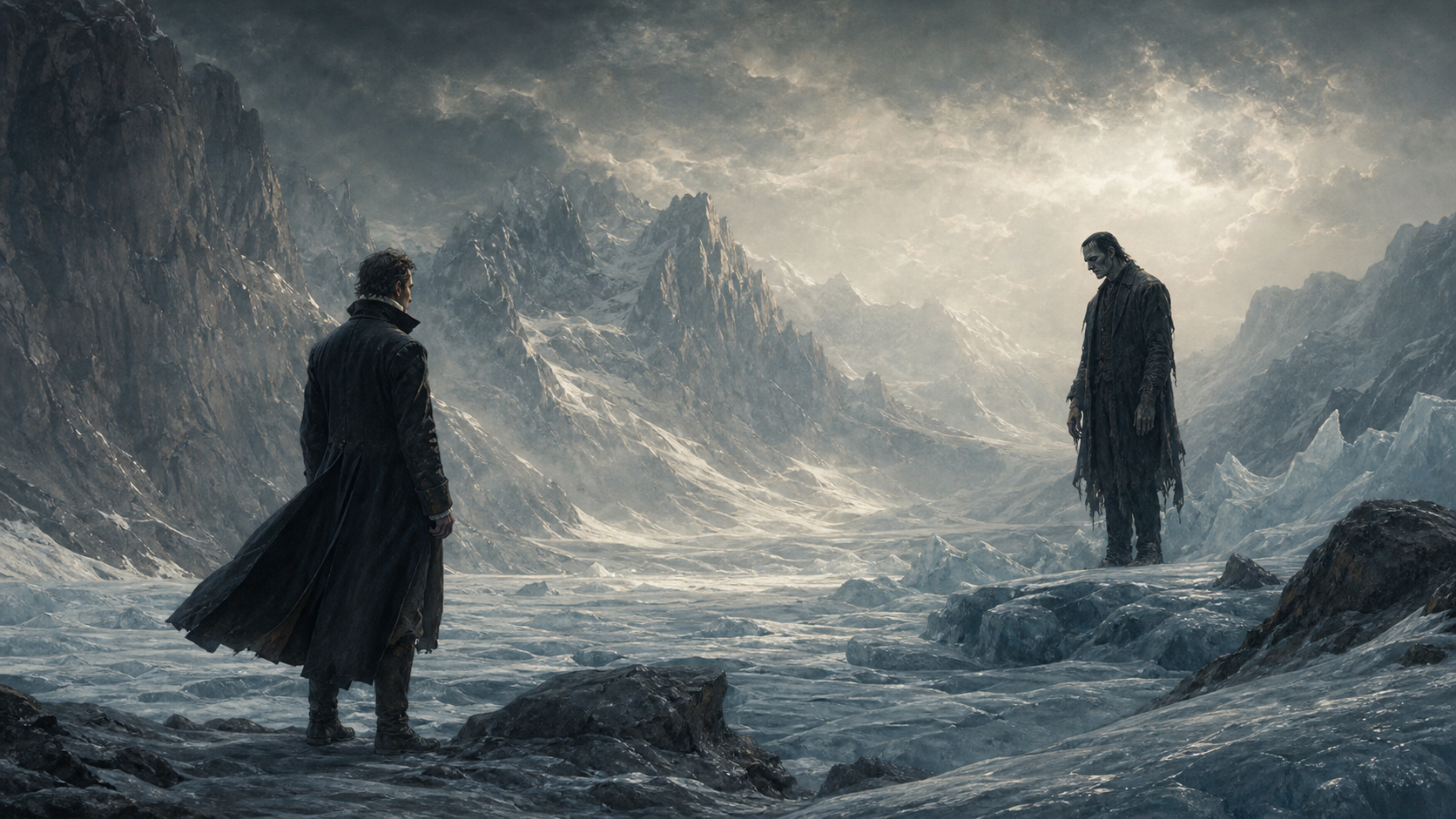
This guide is for AP English Literature, SAT Reading, IB English, and high school or college students who need to write about Frankenstein with evidence. The goal is not to memorize the creature's revenge. The goal is to explain how Mary Shelley creates meaning through frame narration, Gothic setting, Romantic landscape, allusion, diction, and moral contrast.
By the end, you should be able to:
- explain why Victor and Walton mirror each other
- use short quotations about creation, rejection, and revenge
- discuss the creature as both victim and moral agent
- build defensible theses about responsibility, isolation, and ambition
- answer SAT-style questions about inference, function, tone, and word choice
1. Quick Review
- Original title: Frankenstein; Or, The Modern Prometheus
- Author: Mary Wollstonecraft Shelley
- Published: 1818; revised edition 1831
- Main settings: Geneva, Ingolstadt, the Alps, the Orkneys, Ireland, the Arctic
- Narrators: Walton, Victor Frankenstein, and the creature
- Central conflict: Victor creates life, abandons it, and is pursued by the consequences
- Core themes: creation and responsibility, isolation, ambition, appearance and judgment, revenge, education
- Common exam angles: frame narration, the Prometheus allusion, the creature's education, sublime nature, Victor's unreliable self-presentation
One-sentence summary:
Victor Frankenstein creates a living being and rejects him, turning scientific ambition into a tragedy about responsibility, loneliness, and revenge.
2. Plot Structure for Exams
Exposition
Walton's Arctic letters introduce the novel's central pattern: a lonely man seeks glory through dangerous discovery. Victor is rescued from the ice and begins his story as a warning.
Rising Action
Victor grows fascinated by hidden natural powers, studies at Ingolstadt, creates the creature, and immediately abandons him. William is murdered, Justine is executed, and Victor's private experiment becomes public suffering.
Creature's Narrative
The creature tells his own story. He learns language and sympathy by watching the De Lacey family, reads major books, and tries to join human society. Rejection turns his pain into rage.
Climax
Victor destroys the female companion he had begun to make. The creature vows revenge, and the conflict shifts from request to punishment.
Falling Action
Henry and Elizabeth are killed. Victor's family collapses, and he turns his life into pursuit.
Resolution
Victor dies on Walton's ship. The creature mourns him and announces his own intended death. Walton turns back, choosing human life over dangerous glory.
Exam point: do not write that the novel is simply "science is bad." A stronger claim is that Shelley criticizes ambition when it separates creation from care.
3. Key Original Passages for Close Reading
These passages are not just memorable quotations. Each one is a compact testing ground for close reading: speaker, situation, diction, syntax, image, tone, and theme all have to work together. In AP Lit, SAT Reading, IB English, and school essays, a short quotation only becomes useful when you can explain how its wording changes the meaning of the scene and the work as a whole.
Read each passage in three passes. First, establish the literal situation. Second, mark charged words or images. Third, turn that observation into an arguable claim. A strong paragraph does not merely identify a theme; it shows how a specific phrase, image, or sentence movement produces that theme.
For exam practice, treat the Context, Close reading, and Essay use notes as a three-part bridge: where the line appears, how it works, and how it can support an essay claim. The goal is to move from quotation to commentary without falling into plot summary.
Passage 1: Learn from me
Learn from me, if not by my precepts, at least by my example, how dangerous is the acquirement of knowledge.
Context: Victor turns his life story into a warning for Walton.
Close reading: Instructional diction makes narration ethically charged; suffering becomes evidence.
Essay use: Use it for frame narration, ambition, and knowledge versus wisdom.
Passage 2: Life and death appeared to me ideal bounds
Life and death appeared to me ideal bounds, which I should first break through, and pour a torrent of light into our dark world.
Context: Victor imagines creating life.
Close reading: Boundary and light imagery make discovery sound heroic while exposing hubris.
Essay use: Use it to critique ambition before responsibility.
Passage 3: a new species would bless me
A new species would bless me as its creator and source; many happy and excellent natures would owe their being to me.
Context: Victor imagines future beings praising him.
Close reading: The future-tense fantasy centers Victor’s glory before care.
Essay use: Use it for creation, pride, and ethical blindness.
Passage 4: Adam and fallen angel
I ought to be thy Adam; but I am rather the fallen angel, whom thou drivest from joy for no misdeed.
Context: The creature confronts Victor in the Alps.
Close reading: Biblical allusion gives him a language for innocence and exclusion.
Essay use: Use it for allusion, creature voice, and responsibility.
Passage 5: love and fear
If I cannot inspire love, I will cause fear; and chiefly towards you my arch-enemy, because my creator, do I swear inextinguishable hatred.
Context: The creature turns rejection into revenge.
Close reading: Balanced syntax makes violence a terrible substitute for denied affection.
Essay use: Use it to discuss sympathy without excusing revenge.
Passage 6: a hell within me
I, like the arch-fiend, bore a hell within me; and finding myself unsympathised with, wished to tear up the trees.
Context: The creature describes rejection’s aftermath.
Close reading: Allusion and inward imagery make monstrosity psychological before physical action.
Essay use: Use it for isolation, allusion, and destructive agency.
Passage 7: returning to England
I am returning to England. I have lost my hopes of utility and glory; I have lost my friend.
Context: Walton turns back from the Arctic quest.
Close reading: Plain syntax turns renunciation into the frame’s ethical answer to Victor.
Essay use: Use it for endings, restraint, and Walton as foil.
4. Close Reading Procedure
Close reading Frankenstein means asking who is telling the story, who is listening, and what responsibility the speaker is trying to claim or avoid. Shelley builds the novel through nested narratives: Walton writes to his sister, Victor warns Walton, and the creature argues his case to Victor. Every passage has a speaker, an audience, and a moral pressure.
Step 1: Identify the narrator and audience
Before interpreting a line, ask who is speaking and why. Victor's warning to Walton is not neutral advice; it is a dying man's attempt to turn failure into instruction. The creature's Alpine speech is not only complaint; it is an argument addressed to the creator who abandoned him.
Step 2: Place the passage in the responsibility chain
Locate the scene in the sequence of ambition, creation, abandonment, education, rejection, revenge, and belated recognition. This keeps a paragraph from saying only "Victor is ambitious" or "the creature is lonely." The question is what responsibility has been created and who refuses or accepts it.
Step 3: Mark creation, kinship, and judgment words
Words such as "creator," "source," "Adam," "fallen angel," "wretch," "daemon," "father," "friend," and "glory" carry moral weight. Explain whether the diction creates kinship, denies kinship, judges appearance, or exposes Victor's desire for praise.
Step 4: Track allusion and self-interpretation
The Prometheus subtitle, the creature's Adam and fallen-angel language, and the Lazarus-like hope of renewal all give characters inherited stories for their pain. Do not just name the allusion. Ask what role the speaker wants inside that story and whether the novel confirms or complicates it.
Step 5: Read setting as moral scale
Ingolstadt compresses secret experiment; the Alps enlarge confrontation; the Orkneys isolate ethical choice; the Arctic turns ambition into a frozen extreme. Settings in Frankenstein often make inner states visible at a larger scale.
Step 6: Convert observation into a claim
End with a claim that names the device, the local effect, and the larger meaning. Avoid "This shows science is bad." A stronger claim explains how Shelley criticizes creation when ambition is separated from care.
Worked example: Victor's "torrent of light"
When Victor says, "Life and death appeared to me ideal bounds, which I should first break through, and pour a torrent of light into our dark world," the literal situation is his fantasy before creation. The boundary diction makes life and death sound like limits he is entitled to cross. The light imagery makes discovery seem heroic, but the verb "pour" suggests excess before responsibility appears.
That gives you a paragraph claim:
Through boundary and light imagery, Shelley makes Victor's ambition sound grand before exposing its ethical blindness, showing that his real failure is not curiosity itself but the desire to create without care.
5. Why Literary Devices Matter
In Frankenstein, literary devices matter because the novel asks readers to judge stories told by wounded, ambitious, and self-defending speakers. Devices help you explain not just what happens, but how Shelley turns creation into a question about responsibility.
Frame narration: one ambition warning another
Walton's letters surround Victor's story, so Victor's tragedy becomes a test for another ambitious explorer. Use frame narration to argue that storytelling can become ethical warning when the listener changes course.
Light and boundary imagery: discovery before care
Victor's "torrent of light" and "ideal bounds" language makes creation sound liberating before the novel reveals its cost. Use this imagery for essays that distinguish knowledge from wisdom.
Prometheus allusion: forbidden creative power
The subtitle connects Victor to a myth of stolen power and punishment. It does not mean invention is automatically evil. It frames creation as ethically dangerous when the creator seeks glory without accepting consequence.
Paradise Lost allusion: Adam and fallen angel
The creature says he "ought to be" Adam but feels like the fallen angel. That allusion gives him a language for both innocence and rage. Use it to discuss sympathy without erasing his later violence.
Diction of naming: wretch, daemon, creature
Victor's names for the being often dehumanize him before the reader hears his story. This diction supports essays about appearance, prejudice, and the way language can create moral distance.
Sublime setting: Alps, Orkneys, and Arctic
The Alps make the creator-creation confrontation feel morally vast; the Orkneys isolate Victor's choice; the Arctic turns ambition into near-death emptiness. Use the sublime to connect landscape with ethical scale.
Foils: Walton, Clerval, and Victor
Walton mirrors Victor's desire for glory, while Clerval links learning to friendship and care. Foils help you show that Shelley is not against knowledge; she is against ambition that cuts itself off from human obligations.
Irony: creator becomes destroyer
Victor dreams that a new species will bless him, but his first act is abandonment. This irony is central to essay work because it exposes the gap between imagined glory and actual responsibility.
Balanced syntax: love and fear
The creature's line "If I cannot inspire love, I will cause fear" turns denied affection into revenge through a balanced structure. Use the syntax to explain his agency: suffering helps explain his violence, but it does not excuse it.
6. Turning Character Analysis into Essay Language
Character analysis is not a list of personality traits. In literary essays, a character matters because the character carries pressure: desire, fear, social expectation, moral conflict, self-deception, or change. A strong essay connects character to technique and theme in the same line of argument.
Use this four-part method before writing:
- Role: What function does the character serve in the work?
- Pressure: What desire, fear, rule, or conflict shapes the character?
- Device: How does the author present that character: contrast, irony, narration, symbolism, dialogue, setting?
- Essay sentence: What arguable claim can this character support?
A useful sentence frame:
Victor functions as a creator who refuses responsibility, and Shelley's frame narration reveals how ambition becomes destructive when it rejects care.
The cards below are meant to turn character notes into essay-ready claims, not to replace close reading. Use them as starting points for paragraphs that still need textual evidence.
Victor Frankenstein
creator, transgressor, and unreliable moral witness
Victor seeks knowledge but refuses care. His language often turns responsibility into suffering.
Essay sentence: Victor's tragedy lies not in discovery itself, but in his attempt to separate creation from the obligations of nurture and confession.
The creature
rejected creation and moral accuser
The creature is both victim and perpetrator. He learns sympathy, then chooses revenge after repeated rejection.
Essay sentence: Shelley makes the creature morally complex by showing that his violence is chosen, but not born in a vacuum.
Robert Walton
ambition that can still turn back
Walton mirrors Victor, but he survives because he listens.
Essay sentence: Walton's decision to return home gives the novel a final contrast between destructive ambition and responsible restraint.
Elizabeth Lavenza
domestic love endangered by secrecy
Elizabeth represents affection and ordinary human obligation.
Essay sentence: Elizabeth's fate shows that Victor's private secrecy produces public and familial catastrophe.
Henry Clerval
friendship, imagination, and care
Henry is Victor's foil because he connects learning with human feeling.
Essay sentence: Clerval's care for Victor highlights Victor's failure to offer care to his own creation.
7. Thesis Builder for Major Themes
Creation
Responsibility
Weak thesis: Victor creates a monster.
Strong thesis: Shelley presents creation as an ethical act, showing that Victor's greatest failure is not making life but abandoning it.
Ambition
Knowledge and Limits
Weak thesis: Science is bad.
Strong thesis: Through Victor and Walton, Shelley warns against ambition that pursues glory while ignoring community, humility, and consequence.
Isolation
Loneliness
Weak thesis: The creature is lonely.
Strong thesis: The creature's isolation reveals that identity is formed through recognition, language, and social belonging.
Voice
Narration
Weak thesis: The novel has many narrators.
Strong thesis: Shelley's layered narration makes moral judgment difficult by allowing Victor, Walton, and the creature to frame suffering in their own terms.
8. SAT Reading Sample
These are SAT-style practice questions, not official College Board questions. Each question is tied to a specific scene, passage, or recurring device from the work.
Question 1
Victor's warning to Walton suggests knowledge is dangerous when it is:
- A. shared through letters
- B. connected to family memories
- C. pursued without responsibility or human connection
- D. studied abroad
Answer: C. Victor does not condemn knowledge itself; he warns Walton about discovery pursued past human limits and obligations. A, B, and D mention details around the frame but not the ethical danger in Victor's warning.
Question 2
In "ideal bounds," "bounds" most nearly means:
- A. limits
- B. decorations
- C. promises
- D. rewards
Answer: A. Victor is imagining life and death as limits he can break through. B, C, and D do not fit the boundary image that makes his ambition sound transgressive.
Question 3
"A new species would bless me" reveals Victor's:
- A. fear of fame
- B. ordinary medical interest
- C. commitment to family duty
- D. desire to be adored as creator
Answer: D. The imagined blessing centers Victor's glory as creator before he considers care for the being he will make. A and B understate the ambition, and C says the opposite of his isolation from family duty.
Question 4
The creature's Adam allusion functions to:
- A. prove legal innocence
- B. frame abandonment as broken creator-creation bond
- C. make the Alps peaceful
- D. show he has no language
Answer: B. By comparing himself to Adam, the creature argues that Victor has violated a creator's duty to his creation. A shifts to law, C ignores the confrontation, and D contradicts the creature's learned eloquence.
Question 5
Victor's first response after animation supports the claim that his central failure is:
- A. lack of intelligence
- B. excessive patience
- C. abandonment rather than discovery alone
- D. obedience to professors
Answer: C. The key failure is that Victor flees from the being he has made, turning creation into neglect. A reduces the issue to intellect, B reverses his impatience, and D misses the ethical break after animation.
Question 6
The De Lacey episode shows the creature:
- A. cannot learn
- B. wants wealth above all
- C. controls society
- D. develops sympathy and language before rejection
Answer: D. Watching the De Laceys teaches the creature language, care, and social feeling before rejection hardens him. A denies his education, and B and C invent motives or power he does not have.
Question 7
Victor's silence during Justine's trial is best understood as:
- A. guilt becoming another form of violence
- B. proof of innocence
- C. comic misunderstanding
- D. Walton's failure
Answer: A. Victor's private knowledge does not save Justine, so his silence lets his experiment harm an innocent person through the legal system. B mistakes his guilt for innocence, C trivializes the scene, and D belongs to the frame plot.
Question 8
The Arctic setting at the end symbolizes:
- A. domestic comfort
- B. social popularity
- C. isolation and ambition at an extreme
- D. religious certainty
Answer: C. The Arctic turns ambition into a frozen limit, isolating Victor, the creature, and Walton at the edge of survival. A and B contradict the setting, and D is not the frame's main symbolic work.
Question 9
Walton's return home shows that:
- A. all exploration is foolish
- B. Victor's warning has been heard
- C. the creature controls the ship
- D. Elizabeth is unrelated
Answer: B. Walton turns back where Victor did not, making the frame a test of whether a listener can learn from another man's tragedy. A overgeneralizes, C invents control, and D ignores the family losses that shape the warning.
Question 10
"If I cannot inspire love, I will cause fear" marks a shift from:
- A. education to farming
- B. science to comedy
- C. ambition to success
- D. longing for affection to chosen revenge
Answer: D. The balanced line turns denied love into deliberate intimidation, showing the creature's movement from appeal to revenge. A and B are unrelated, and C wrongly turns the threat into triumph.
Question 11
Which evidence best supports dehumanization?
- A. Victor calling the creature "wretch" or "daemon"
- B. Clerval studying languages
- C. Walton dating letters
- D. Elizabeth waiting
Answer: A. Victor's labels deny the creature personhood before readers hear the creature's own narrative. B, C, and D may matter elsewhere, but they do not show dehumanizing diction.
Question 12
The Prometheus subtitle connects Victor to:
- A. a comic traveler
- B. a neutral narrator
- C. forbidden creative power and punishment
- D. a caretaker
Answer: C. Prometheus evokes transgressive creative power and the suffering that follows. A and B do not fit the mythic frame, and D makes Victor more responsible than his actions show.
Question 13
The creature's books help Shelley show:
- A. his inability to speak
- B. his moral and emotional development
- C. his lack of memory
- D. his total innocence
Answer: B. The books give the creature language, history, comparison, and moral imagination, making rejection more tragic. A and C deny his learning, and D overstates innocence after his revenge begins.
Question 14
Victor's narration is unreliable because it:
- A. reports no events
- B. belongs to the creature
- C. avoids emotion
- D. mixes confession with self-defense
Answer: D. Victor warns Walton and confesses failure, but he also frames himself as uniquely suffering and often avoids full responsibility. A is false, B assigns narration to the wrong speaker, and C misses the emotional intensity of his account.
Question 15
The Alps scenes connect nature with:
- A. moral scale and sublime confrontation
- B. school routine
- C. commerce
- D. comic relief
Answer: A. The Alpine landscape enlarges the confrontation between creator and creature, making their moral conflict feel vast. B, C, and D do not fit the sublime setting.
Question 16
Henry Clerval serves as Victor's foil because he:
- A. rejects friendship
- B. commits the crime
- C. connects learning with care
- D. narrates the frame
Answer: C. Clerval's learning is tied to friendship, language, and human sympathy, which contrasts Victor's isolating ambition. A and B reverse his role, and D belongs to Walton.
Question 17
"Fallen angel" suggests the creature sees himself as:
- A. Victor's chemistry teacher
- B. unable to read
- C. a successful explorer
- D. excluded from an intended place
Answer: D. The phrase lets the creature describe himself as cast out from a role he believes should have included love and belonging. A gives him the wrong role, B contradicts his education, and C imports Walton's explorer identity.
Question 18
Shelley's critique of ambition is best stated as:
- A. all curiosity is immoral
- B. ambition is dangerous when separated from responsibility
- C. knowledge never changes anyone
- D. exploration always succeeds
Answer: B. Victor and Walton show that curiosity becomes dangerous when it ignores human obligation, not that all inquiry is wrong. A is too broad, and C and D contradict the plot.
Question 19
The frame narrative functions by:
- A. making Victor's tragedy a test for another ambitious listener
- B. silencing the creature
- C. removing Walton
- D. proving Victor objective
Answer: A. Walton hears Victor's warning and must decide whether to repeat or resist the same pursuit of glory. B is false because the creature speaks, C erases the frame, and D ignores Victor's self-defense.
Question 20
The final ship scene emphasizes:
- A. comic closure
- B. victory for science
- C. the cost of abandonment for creator and creation
- D. Elizabeth's authority
Answer: C. Victor dies after pursuing the being he abandoned, and the creature mourns the creator who rejected him. A and B misread the ending's grief, and D names a character who is already dead.
9. AP Lit Essay Questions
Use these AP Lit-style practice questions to turn a specific scene into a thesis, outline, and evidence-based commentary.
Essay Question 1
Walton’s letters frame Victor’s confession before readers meet Victor directly. Analyze how Shelley uses frame narration to turn one man’s tragedy into a warning for another ambitious listener. Include one detail from Walton and one from Victor.
Essay Question 2
Victor’s ambition begins as intellectual aspiration but becomes a refusal of responsibility. Explain how this shift shapes the novel’s central conflict. Use two scenes that show discovery and avoidance.
Essay Question 3
The creature’s education changes him from a silent body into a reader, speaker, and moral interpreter. Analyze how this education changes the reader’s judgment of him. Include one De Lacey episode detail.
Essay Question 4
The Prometheus allusion appears in the novel’s title and moral design. Analyze how Shelley uses the myth to frame creation as transgression, gift, punishment, or responsibility. Use evidence from Victor’s experiment and its aftermath.
Essay Question 5
Creation in the novel is not condemned simply because it is unnatural; it is condemned because it is abandoned. Analyze how Shelley presents creation as an ethical responsibility. Include Victor’s first reaction to the creature.
Essay Question 6
Isolation shapes both Victor and the creature, but it affects them differently. Compare how isolation turns private suffering into public harm. Use one scene for each character.
Essay Question 7
Gothic settings such as laboratories, mountains, storms, and Arctic ice do more than create mood. Analyze how one or two settings externalize secrecy, guilt, fear, or pursuit.
Essay Question 8
Nature and the sublime sometimes console Victor and sometimes expose his limits. Analyze how Shelley uses landscape to measure human ambition against forces larger than the self.
Essay Question 9
Victor’s silence during Justine’s trial is one of the novel’s central ethical failures. Analyze how secrecy becomes another form of violence. Include one consequence for Victor and one for an innocent person.
Essay Question 10
The De Lacey episode briefly imagines sympathy before rejection returns. Analyze how this episode complicates the creature’s role as both victim and future aggressor.
Essay Question 11
The creature’s revenge is understandable in motive but destructive in action. Analyze how Shelley creates sympathy without excusing violence. Use two moments from the creature’s narrative.
Essay Question 12
Victor’s narration is confession, warning, and self-defense at once. Analyze how his storytelling shapes the reader’s judgment. Include one moment where his language seems self-protective.
Essay Question 13
Walton mirrors Victor, but he also makes a different final choice. Analyze how Walton’s role changes the meaning of Victor’s warning. Use the frame ending as evidence.
Essay Question 14
Choose a secondary character, such as Elizabeth, Justine, Clerval, or William. Explain how that character reveals the human cost of Victor’s private ambition.
Essay Question 15
The creature reads texts such as Paradise Lost and uses them to understand himself. Analyze how allusion gives him a language for identity, grievance, and judgment.
Essay Question 16
The novel distinguishes knowledge from wisdom. Analyze how Victor can discover the secret of life while failing to understand care, limits, and consequence.
Essay Question 17
Appearance shapes moral judgment throughout the novel. Explain how Shelley critiques a society that sees the creature’s body before hearing his speech.
Essay Question 18
Choose a morally flawed character for whom Shelley still creates sympathy. Analyze how the novel asks readers to hold compassion and judgment together.
Essay Question 19
The ending leaves Victor dead, Walton changed, and the creature speaking over a future disappearance. Analyze how this ending revises Victor’s warning about ambition.
Essay Question 20
Analyze how Frankenstein critiques creation without care. Your answer should connect the animation scene, the creature’s abandonment, and the final consequences of that abandonment.
10. Model Thesis Bank
Use these as models, then adapt them to the exact question.
- Shelley uses Walton's frame narrative to show that Victor's tragedy can become a warning only if another ambitious man chooses to listen.
- Victor's desire to break the bounds of life and death becomes tragic because it separates discovery from responsibility.
- The creature's education makes him morally legible, forcing readers to judge both his violence and the rejection that shaped it.
- The Prometheus allusion presents Victor's experiment as a modern act of transgression whose punishment is intimate rather than cosmic.
- Shelley presents creation as an ethical act by making abandonment, not animation, Victor's decisive failure.
- Isolation transforms both Victor and the creature, turning private suffering into public harm.
- Gothic settings externalize Victor's secrecy, guilt, and fear of what he has made.
- The sublime landscapes of the Alps and Arctic measure human ambition against forces larger than the self.
- Victor's silence during Justine's trial shows that guilt without confession can become another form of harm.
- The De Lacey episode proves that the creature's monstrosity is socially produced as well as personally chosen.
- Shelley makes revenge destructive by showing that it gives the creature power while emptying him of hope.
- Victor's narration is compelling but self-protective, turning confession into a form of self-dramatization.
- Walton mirrors Victor's ambition but avoids Victor's fate by accepting limits.
- Elizabeth's death shows that Victor's private ambition destroys the domestic world he claims to value.
- The creature's biblical allusions transform him from silent object into a reader capable of judging his creator.
- The novel distinguishes knowledge from wisdom by showing that Victor can discover life without understanding care.
- Shelley critiques a society that judges by appearance before allowing speech.
- The creature's moral complexity lies in the gap between the sympathy he deserves and the violence he chooses.
- Walton's return home turns Victor's tragedy into a final argument for responsible restraint.
- Frankenstein warns that creation without care produces not mastery, but abandonment returned as judgment.
11. Academic Vocabulary for Essays
- frame narrative: a story structure in which one narrative contains another
- transgression: crossing a moral, natural, or social boundary
- sublime: overwhelming grandeur that produces awe, fear, or moral scale
- allusion: an indirect reference to another text, myth, or tradition
- dehumanization: treating a person as less than human
- moral agency: the ability to choose and be responsible for actions
- alienation: separation from society, affection, or self-understanding
- hubris: excessive pride that leads to downfall
- ethical responsibility: duty created by one's actions or power
- unreliable narration: narration shaped by bias, self-defense, or limited perspective
- foil: a character who highlights another character by contrast
- Gothic: a literary mode using fear, secrecy, darkness, and psychological disturbance
- Romanticism: a movement emphasizing imagination, nature, feeling, and individual experience
- vengeance: revenge pursued as justice but often producing further harm
- nurture: care, education, and social support needed for development
- marginalization: exclusion from social recognition or belonging
- self-fashioning: deliberate construction of identity
- consequence: the result or cost of an action
- pathos: emotional appeal, especially through suffering
- critique: an argument that exposes limits, failures, or contradictions