Frankenstein - The Creature, the Creator, and the Cost of Abandonment
Mary Shelley's Gothic novel is not only about a monster. It is about ambition, loneliness, responsibility, and what happens when a creator refuses to care for what he has made.

Sua's Quick Take
Honestly, the scariest part of Frankenstein is not the lightning or the laboratory. It is Victor seeing a living being need him, stepping back, and spending the rest of the novel being followed by the responsibility he left outside.
What the Book Is Really About
Mary Shelley's novel begins with scientific ambition, but it grows into a study of abandonment. Victor Frankenstein does not become tragic because he wants knowledge. He becomes tragic because he treats knowledge as a private triumph and then treats the living result of that triumph as a mistake to be hidden.
The creature is frightening, but he is also a reader, a speaker, a child without a family, and a rejected being trying to understand why the world hates him before he has had a chance to belong to it. That tension is why the novel still matters. It asks whether a person becomes monstrous by nature, or by being denied love, language, and responsibility.
The book is built as a set of nested testimonies. Walton's letters frame the story from the Arctic; Victor's long confession fills the center; the creature's own narrative interrupts Victor and forces the reader to hear the rejected being directly; then the novel returns to Walton's ship for the final choice. That structure matters because the novel is never just "what happened." It is always also about who gets to tell the story, who is believed, and whether a listener can learn before repeating another person's disaster.
Plot Summary
1. Walton's letters and the first warning
The novel opens far from Victor Frankenstein's laboratory, which feels surprising the first time through. Robert Walton, an explorer sailing toward the Arctic, writes letters to his sister Margaret. Walton wants glory, discovery, and a friendship that can understand the size of his ambition. His voice is excited, lonely, and dangerously familiar.
That frame matters because Walton is not a neutral container for Victor's story. He is Victor's double. Like Victor, he wants to cross a boundary no one has crossed before. Like Victor, he believes the cost may be justified by greatness. When his ship becomes trapped in ice and he sees a gigantic figure crossing the frozen landscape, the novel immediately places ambition inside a world of danger and isolation.
Walton then rescues Victor Frankenstein, who is exhausted, half-dead, and pursuing someone across the ice. Victor recognizes Walton's hunger for discovery and begins to tell his life story as a warning. The structure is important: before we know what Victor did, we know what his ambition has made of him.
Walton's crew also matters. The men are not symbols of glory; they are cold, afraid, and trapped in the consequences of their captain's dream. When they later ask to turn back if the ice opens, the novel places human safety against heroic ambition. Victor's story is therefore heard inside an active moral situation, not in a quiet room after the danger has passed.
Walton also begins the novel by imagining himself as a lonely genius. He is not simply collecting data; he is chasing a grand version of himself. That makes him especially vulnerable to Victor's charisma. Before Victor ever describes the laboratory, the novel has already shown us a mind that wants greatness badly enough to put other bodies at risk.
This opening changes the way the rest of the plot works. We do not read Victor's story as a sealed past event. We read it while another ambitious man is deciding what kind of future he will choose. The question is not only what Victor did, but whether Walton can hear the warning before admiration turns into imitation.
2. Victor's childhood and the hunger for forbidden knowledge
Victor grows up in Geneva in a loving family. He is attached to Elizabeth Lavenza, raised in the Frankenstein household, and to his friend Henry Clerval. His early life looks warm and secure, which makes his later secrecy more striking. Victor is not a neglected child. He is loved, educated, and encouraged.
As a boy, he becomes fascinated by old writers of natural philosophy and alchemy. Their ideas are outdated, but they awaken a desire to uncover the hidden laws of life. When he later studies at Ingolstadt, modern science replaces those childhood books, but the emotional pattern remains the same. Victor does not simply want to learn. He wants to conquer.
At university, Victor isolates himself from family, friends, ordinary affection, and moral reflection. He becomes obsessed with the boundary between life and death. His language often sounds like a heroic quest, but Shelley keeps showing the cost: his body weakens, his letters go unanswered, and the world outside the experiment disappears.
This is the first long movement of the tragedy. Victor's studies are not presented as calm scholarship. They become secrecy, compulsion, and bodily decay. He visits charnel houses and studies physical corruption, but he does not develop a fuller respect for life. Instead, the more he learns about death, the more he imagines himself as the one who can master it. Shelley makes the research process feel claustrophobic because Victor's mind has narrowed. He is not becoming wiser; he is becoming more alone.
Victor's danger lies partly in the language he uses for his desire. He imagines that future generations may bless him, and he casts himself as a benefactor before he has considered the being who will stand in front of him. His dream of knowledge has no real place for the created person's daily life, fear, education, body, or loneliness.
He also trains himself in secrecy. Letters from home become interruptions. Elizabeth and his father worry from a distance, but Victor treats their concern as something that can be answered later, after success. That habit becomes one of the novel's most destructive patterns: Victor repeatedly postpones truth until the people who need it are already in danger.
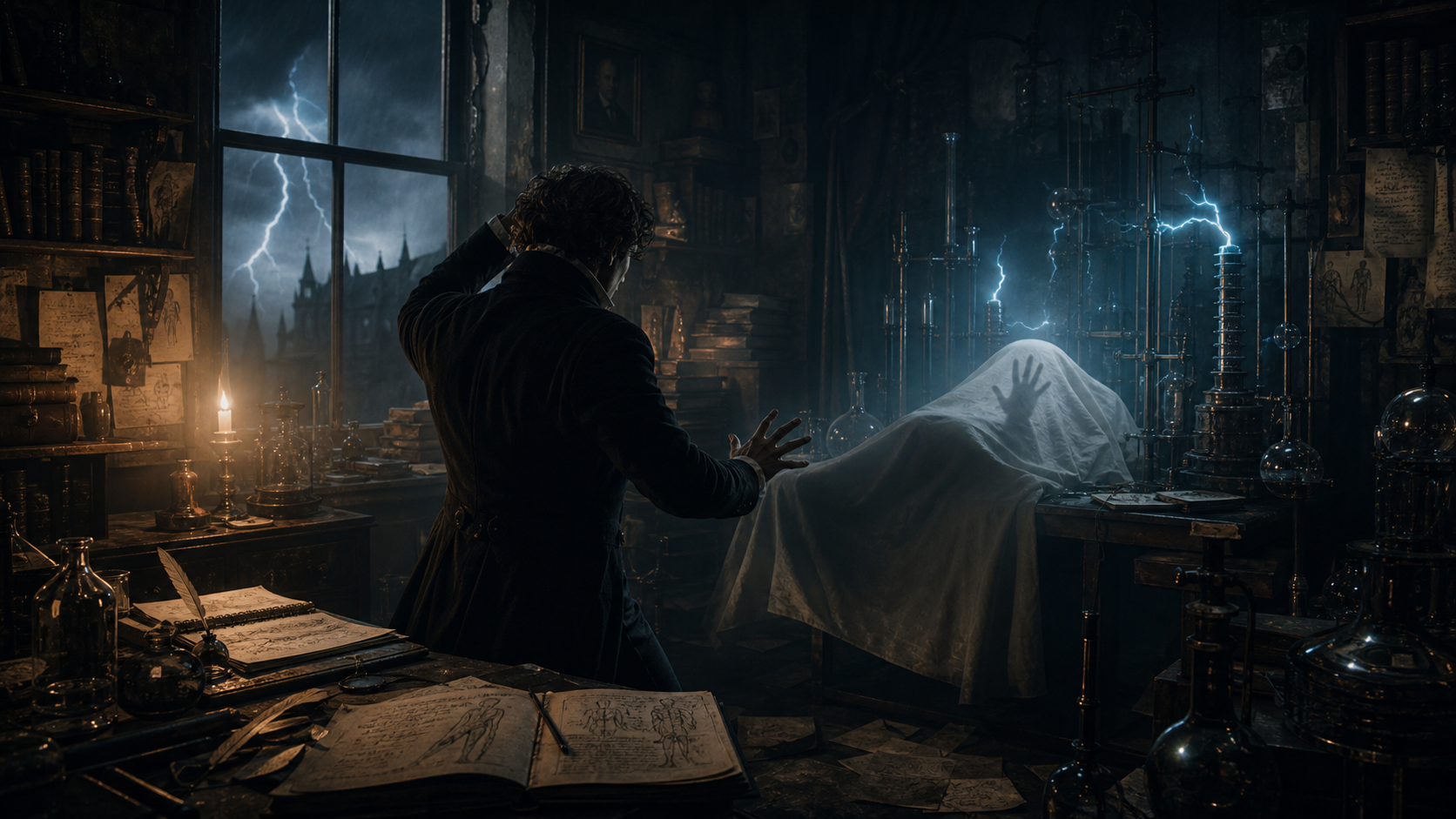
3. The creation and Victor's first failure
Victor succeeds. On a dreary November night, the creature opens his eyes. The moment should be triumph, but Victor's response is horror. He sees the being he has assembled and immediately rejects him.
That is the novel's first decisive moral failure. Highlighter went brrrr on this page for me. Victor does not ask what the creature needs. He does not speak to him, teach him, protect him, or take responsibility. He runs away. The creature is left to enter the world like a newborn with an adult body, no language, no name, and no one to interpret him kindly.
Victor falls ill, and Henry Clerval nurses him back to health. The contrast is sharp. Henry cares for Victor with patience and affection, while Victor has refused that same care to the being he created. Shelley quietly measures human responsibility through these pairs: creation without nurture, friendship without secrecy, ambition without compassion.
The aftermath also shows how quickly Victor wants to return to ordinary life without naming what he has done. Henry's arrival brings letters, conversation, and human warmth back into the room. Victor clings to that comfort, but the creature is still somewhere outside, nameless and abandoned. The novel's horror is not only the animation scene; it is the moral gap between Victor's relief and the creature's total exposure.
Henry's care gives Victor a temporary way back into society. They walk, talk, study languages, and re-enter a world of friendship and culture. But Victor's recovery is not repair. He does not search for the creature. He does not confess to Henry. He accepts care while refusing to extend care to the life he has made.
Shelley therefore keeps sympathy for Victor under pressure. He is genuinely ill, but his illness also shields him from action. The reader can see both things at once: Victor is traumatized, and Victor is still responsible. That overlap is uncomfortable, but it is where the plot gets its force.
4. William's death and Justine's execution
Victor returns home after learning that his younger brother William has been murdered. Near Geneva, he sees the creature and instantly believes he knows the truth: the being he abandoned has killed William. Victor is terrified, but he remains silent.
Justine Moritz, a servant loved by the Frankenstein family, is accused of the murder because evidence has been planted on her. Victor knows the accusation is false, but he does not speak. His silence helps destroy an innocent woman. Justine confesses under religious pressure and is executed.
This section is crucial because Victor's guilt is no longer private. His secret has entered the social world and killed people who had no part in his experiment. Victor often describes himself as the most miserable person alive, but Shelley makes readers ask whether self-torment is the same as responsibility. Victor suffers, but he still protects himself.
Justine's death also widens the novel's critique beyond Victor and the creature. A legal system, a religious culture of confession, and a household's inability to resist public accusation all help condemn her. Victor is not the only cause, but he is the one person who knows enough to disrupt the machinery. His silence turns guilt into complicity. For students, this is one of the strongest sections for arguing that Frankenstein is interested in social consequences, not only private emotion.
William's murder also marks the creature's first clear moral fall. He encounters a child and hopes, briefly, that a young person might not share adult prejudice. But William's connection to the Frankenstein family turns the meeting into a symbolic confrontation with the creator's world. The creature's rage moves from general rejection to targeted revenge.
Planting the evidence on Justine makes that revenge more chilling. The creature does not merely strike Victor; he learns how human systems can be manipulated against the innocent. He has become intelligent enough to understand society and wounded enough to use that understanding destructively.
Victor, meanwhile, chooses silence because the truth sounds impossible and because confession would expose him. His fear is understandable, but it is not innocent. From this point on, his secrecy is no longer only a private flaw. It is a force that allows other people to die.
5. The creature tells his story
Victor meets the creature in the Alps, where the landscape is vast, cold, and morally charged. The creature demands to be heard. This is one of the novel's great reversals: the figure Victor calls a monster becomes a narrator with memory, feeling, argument, and eloquence.
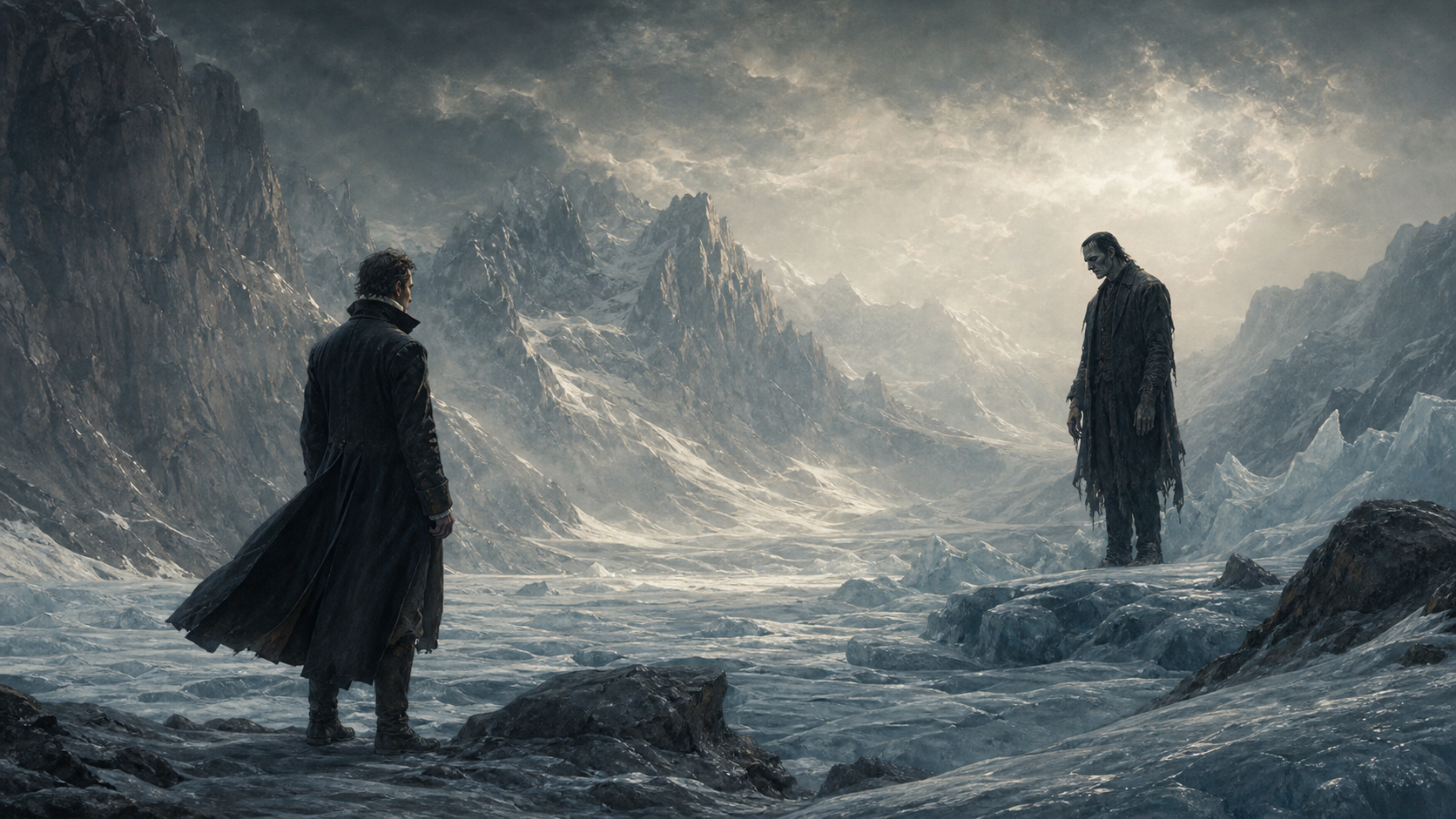
The creature explains how he woke alone and confused. He learned through pain: fire could warm him and burn him; food could satisfy hunger; human faces could recoil in fear. Eventually he hid near the De Lacey family and secretly observed them. From them he learned language, affection, poverty, history, and moral feeling.
The De Lacey episode is the emotional center of the novel. The creature becomes human through observation and reading. He reads Paradise Lost, Plutarch, and The Sorrows of Werter, and he begins to understand himself through stories of creation, virtue, sorrow, and exclusion. Yet the more human he becomes inwardly, the more painfully he recognizes that human society will not accept his outward form.
He tries to approach the blind father, hoping that someone who cannot see him might hear him first. This scene is quiet, but it hurts. For a moment, language seems to offer a path into human community. But when the rest of the family returns, they drive him away in fear. The creature's hope collapses. His rage is not born from simple evil. It grows from repeated rejection.
The creature's reading deepens this pain. Paradise Lost gives him a language for creation and exile, but it also gives him a devastating comparison. Adam had a creator who addressed him and placed him in a world; the creature has a creator who fled. Satan's bitterness also becomes available to him as a model of injured pride. Shelley is careful here: books educate the creature, but they do not automatically save him. They give him concepts large enough to understand the injustice of his condition.
The creature's education is gradual and bodily before it becomes intellectual. He first learns hunger, cold, fire, darkness, and shelter. Then he learns that human beings respond to his appearance before they know his intentions. Only after that does he begin to learn language by watching the De Laceys and listening to their conversations.
The family becomes his first school. Felix, Agatha, the blind father, and Safie teach him the emotional grammar of human life without knowing they are doing it. He sees care, labor, poverty, gratitude, sorrow, and affection. The more he learns, the less he can remain a blank monster. He becomes a mind capable of longing for the very community that will reject him.
That is why the failed meeting with De Lacey is so devastating. The creature tries to enter society through speech rather than force. For a moment, the blind father listens. The scene suggests that moral recognition might be possible if sight did not rush ahead of understanding. When the family returns and drives him away, the creature loses not only a refuge but a theory of hope.
By the time he speaks to Victor, the creature has an argument. He tells a story of attempted goodness answered by fear. Yet Shelley does not let that argument erase his crimes. His eloquence makes him more human, but it also makes his revenge more morally serious because he understands suffering and chooses to inflict it.
6. The demand for a companion
The creature tells Victor that he killed William and framed Justine, and he argues that Victor shares the blame because he made him and abandoned him. Then he asks for a female companion. If Victor creates another being like him, the creature promises to disappear with her into remote places, away from human society.
Victor is torn. The request has moral force because the creature is lonely through no fault of his own. But it also terrifies Victor. What if the second creature refuses the bargain? What if the two beings create a new race? What if Victor repeats his original mistake on a larger scale?
Victor begins the work, traveling to Britain and then to the Orkney Islands. His isolation returns. He is again a maker hidden from ordinary human bonds. But this time he cannot hide behind ignorance. He knows that creation is not a private act. It has consequences.
At the last moment, Victor destroys the unfinished female creature while the original creature watches. This decision seals the tragedy. The creature wanted companionship; Victor gives him another abandonment. The creature vows revenge, especially on Victor's wedding night.
This is not a simple scene of good judgment versus bad judgment. Victor has real reasons to fear a second creation, but the way he acts repeats the original pattern: he decides alone, explains nothing until too late, and leaves the creature with another absolute rejection. Shelley makes the reader sit inside the difficulty. Responsibility may require refusing to create again, but Victor's refusal still arrives without compassion, repair, or any alternative answer to the loneliness he caused.
Victor's journey to Britain looks, on the surface, like travel and study. He moves with Henry through a wider social world, but emotionally he is withdrawing again. The farther he travels, the more the second creation isolates him. By the time he reaches the Orkneys, he has returned to a version of the original laboratory: a remote space, a secret task, and a mind trapped between fear and compulsion.
The second experiment is ethically different from the first because Victor can no longer claim ignorance. He has heard the creature's account. He knows that the created being can suffer, reason, read, plead, and retaliate. He also knows that creation creates obligations that cannot be contained inside one room.
Destroying the female creature is therefore both understandable and devastating. Victor fears unleashing another life into misery or danger. But the creature sees only another refusal, another life denied, another promise broken by the maker who already abandoned him. That visual detail matters: the creature watches Victor tear apart the only future he had been offered.
After this, the plot becomes a chain of pursuit and consequence. Victor tries to dispose of the remains at sea, but guilt follows him back to shore. The destruction of the second creature does not end danger. It redirects danger toward the people Victor loves most.
7. Revenge spreads through the family
The creature kills Henry Clerval, Victor's closest friend. Victor is accused of the murder and falls into another severe illness. Again, the pattern repeats: Victor's secret creates death, and other people suffer while he collapses into guilt.
When Victor finally returns to Geneva, he marries Elizabeth despite knowing the creature's threat. Victor assumes the threat means the creature will kill him. This is another failure of imagination. He reads the warning through his own self-importance and does not fully protect Elizabeth.
The wedding night becomes the emotional consequence of Victor's entire story. The creature does not only punish Victor by attacking his body. He attacks the human bonds Victor still has. Shelley makes revenge relational: because Victor denied the creature family, the creature destroys Victor's family.
Victor's mistake before the wedding is especially revealing. He interprets the threat as if he himself must be the target, which means he still imagines the conflict as centered on his own suffering. Elizabeth becomes vulnerable because Victor does not fully tell her the truth and does not imagine that the creature's revenge might mirror the creature's own deprivation. The tragedy is not a sudden twist; it is the return of every silence Victor has chosen.
Henry's death is more than another loss. Henry represents a version of learning joined to sympathy, language, culture, and friendship. He loves knowledge without trying to dominate life. When he dies, Victor loses not only a friend but the clearest alternative to his own path.
The Irish accusation also echoes Justine's trial. Victor now stands near the position of the falsely accused, and the echo should force recognition. But Victor survives the accusation while Justine did not. That difference matters. The novel repeatedly shows that suffering is not distributed evenly, and that some people are protected by family, status, or chance while others are crushed.
Back in Geneva, Victor has opportunities to tell the truth. He can prepare Elizabeth, warn his father, or stop the wedding. Instead, he keeps the central facts buried. Elizabeth senses his distance and anxiety, but she cannot defend herself against a threat she has not been allowed to know.
On the wedding night, Victor arms himself and imagines a confrontation directed at his own body. The creature understands revenge more accurately than Victor understands protection. He attacks the bond Victor still has, not merely Victor's flesh. The result makes the entire plot feel circular: the creator who denied companionship loses companionship.

8. The ending and the final pursuitThis section contains spoilers.
Elizabeth is killed on the wedding night. Victor's father dies soon after from grief. Victor is left almost entirely alone, and he turns his life into pursuit. He follows the creature north, across cold and empty landscapes, until Walton's ship finds him.
Victor dies aboard Walton's ship, still urging Walton's men toward dangerous glory while also serving as the living proof of where such glory can lead. After Victor's death, the creature appears and mourns over him. This final scene complicates every simple reading of the creature as only a villain. He has committed terrible acts, but he also understands loss, remorse, and the emptiness of revenge.
The creature tells Walton that he will go north and die. Whether he truly does is left unseen. What matters is the emotional ending: creator and creature have destroyed each other, not because knowledge itself is evil, but because creation without responsibility becomes a form of violence.
Walton turns back. That choice is the novel's last moral contrast. He has heard Victor's story and chooses human life over the fantasy of heroic conquest. The ending does not erase tragedy, but it shows that a warning can still be heard.
Victor remains contradictory to the end. He warns Walton against ambition, yet he also urges Walton's men toward glory and continues to frame the creature as an enemy who must be pursued. He understands part of his failure, but he never fully escapes the imagination that produced it.
The creature's final appearance unsettles any easy victory. He does not come to celebrate. He mourns, speaks of remorse, and recognizes the emptiness of revenge. Killing Victor has not restored innocence, love, or belonging. It has only completed the ruin that began with abandonment.
Walton's return is therefore the novel's one surviving act of restraint. Victor is too late, the creature is too late, Elizabeth and Henry and Justine are already dead. But Walton is not too late. The final moral movement of the book depends on that difference: tragedy becomes useful only if someone changes course after hearing it.
Major Characters
Victor Frankenstein
Ambition without responsibility
Victor is intelligent, sensitive, and capable of love, but he separates knowledge from care. His tragedy is not that he creates life. It is that he refuses the duties that follow creation.
He often speaks like the greatest victim of the story, and in one sense he suffers deeply. But his suffering repeatedly becomes self-absorption. He feels guilt without turning it into timely confession, protection, or repair.
The creature
Rejected child, reader, and avenger
The creature begins as abandoned life. He learns language, sympathy, and moral judgment by watching others, which makes his rejection even more painful.
His later violence is real and unforgivable, but Shelley does not let readers treat him as naturally evil. He becomes monstrous through isolation, humiliation, and the absence of any loving social bond.
Robert Walton
Victor's mirror and the surviving listener
Walton frames the novel and mirrors Victor's desire for greatness. His Arctic expedition gives the story its warning shape.
Unlike Victor, Walton still has time to stop. His decision to turn back suggests that ambition can be corrected when someone listens before it is too late.
Elizabeth Lavenza
Domestic affection and the cost of Victor's secrecy
Elizabeth represents the world of attachment that Victor repeatedly abandons. She is loving, patient, and morally clear, but she is also left unprotected by Victor's silence.
Her death shows that Victor's private ambition is never only private. The people closest to him pay for what he refuses to confess.
Henry Clerval and Justine Moritz
Care, innocence, and collateral damage
Henry embodies friendship, imagination, and care. Justine embodies innocence destroyed by social judgment and Victor's silence.
Together, they show how the novel measures guilt. Victor's secret does not stay inside his mind. It spreads outward into the lives of people who trusted him.
Best Quotes
I ought to be thy Adam; but I am rather the fallen angel.
The creature's sentence compresses the novel's religious and moral argument. He should have been a cared-for creation, but abandonment has turned him into a figure of exile and revenge.
Learn from me, if not by my precepts, at least by my example.
Victor tells Walton to read his life as a warning. The line matters because Victor's story is not only confession; it is a cautionary case study in unchecked ambition.
If I cannot inspire love, I will cause fear.
The creature's turn toward violence begins as a response to exclusion. Shelley makes the line disturbing because it is both morally wrong and psychologically understandable.
Beware; for I am fearless, and therefore powerful.
Fearlessness here does not mean heroism. It means the creature has lost the ordinary attachments that might restrain him.
Major Themes
Creation
Creation Requires Care
Victor wants the glory of making life without the ongoing responsibility of nurturing it. The novel turns creation into an ethical problem, not only a scientific event.
Isolation
Loneliness Can Deform the Self
Both Victor and the creature become more dangerous as they become more isolated. Shelley presents social bonds as moral necessities, not sentimental extras.
Knowledge
Ambition Needs Limits
The novel does not simply reject science. It questions ambition that refuses humility, community, and consequence.
Justice
Society Creates Monsters Too
The creature is judged by appearance before he can speak. His violence is his own, but the society that rejects him helps produce the conditions for that violence.
Mary Shelley and the Birth of the Modern Monster
Mary Shelley was only a teenager when she began the story that became Frankenstein. The novel emerged from the intellectual and emotional world of Romanticism: questions about science, imagination, nature, death, revolution, and the limits of individual will.
The subtitle, The Modern Prometheus, points to the mythic scale of Victor's ambition. Like Prometheus, he reaches for a power associated with the gods. But Shelley makes the punishment intimate. Victor is not chained to a rock. He is bound to the being he refuses to love.
The novel is often called an early work of science fiction because it imagines artificial life through speculative science rather than pure magic. But it is also Gothic fiction, family tragedy, philosophical argument, and social critique. That mixture is why the creature has survived so many adaptations while the book itself still feels sharper than the myth people think they already know.
Why It Still Matters
Frankenstein remains modern because its central question has not disappeared. What does a creator owe to what they create? The question now belongs not only to laboratories, but also to technology, artificial intelligence, parenting, education, institutions, and every system that produces consequences beyond its maker's control.
The book's warning is not "do not discover." It is "do not abandon." Victor's sin is not curiosity alone. It is curiosity without care.
FAQ: Summary, Ending, and Themes
What is Frankenstein about?
Frankenstein is about Victor Frankenstein, a young scientist who creates a living being and then abandons him. The creature learns, suffers rejection, and turns to revenge, forcing Victor to face the consequences of creation without responsibility.
Is Frankenstein the monster or the scientist?
Frankenstein is the scientist's surname: Victor Frankenstein. The created being is usually called the creature, the monster, or Frankenstein's creature. The confusion is culturally common, but the novel makes the distinction important.
Why is the ending important?
The ending turns the story from revenge into warning. Victor's death and the creature's grief show that both creator and creation have been destroyed by abandonment, secrecy, and obsession.
Read Next
Read The Great Gatsby for another tragedy about self-invention, Dr. Jekyll and Mr. Hyde for a later Gothic double, and The Picture of Dorian Gray for a different story about beauty, secrecy, and moral consequence.
Adaptations
- 1931 film: creates the most famous visual myth of the creature, though it differs sharply from Shelley's novel.
- 1994 film: attempts a more text-conscious version of the story's ambition, grief, and revenge.
- Stage, radio, television, and comics: often shift the focus between horror spectacle, creator ethics, and the creature's loneliness.