A Doll's House — Nora Helmer and the Door That Changed Modern Drama
A detailed guide to Henrik Ibsen's three-act play about marriage, debt, performance, gender, law, and the cost of becoming a person.
Sua's Quick Take
A Doll's House is famous for the final door slam, but the play does not earn that sound by turning Nora into a slogan. It earns it by making the audience spend three acts inside a home where affection, money, law, religion, motherhood, and reputation all teach one woman to be charming instead of free.
Sua's one-line take: Nora does not leave because she suddenly becomes selfish. She leaves because Torvald's reaction teaches her that the marriage has never had room for her full moral life.
Source Note
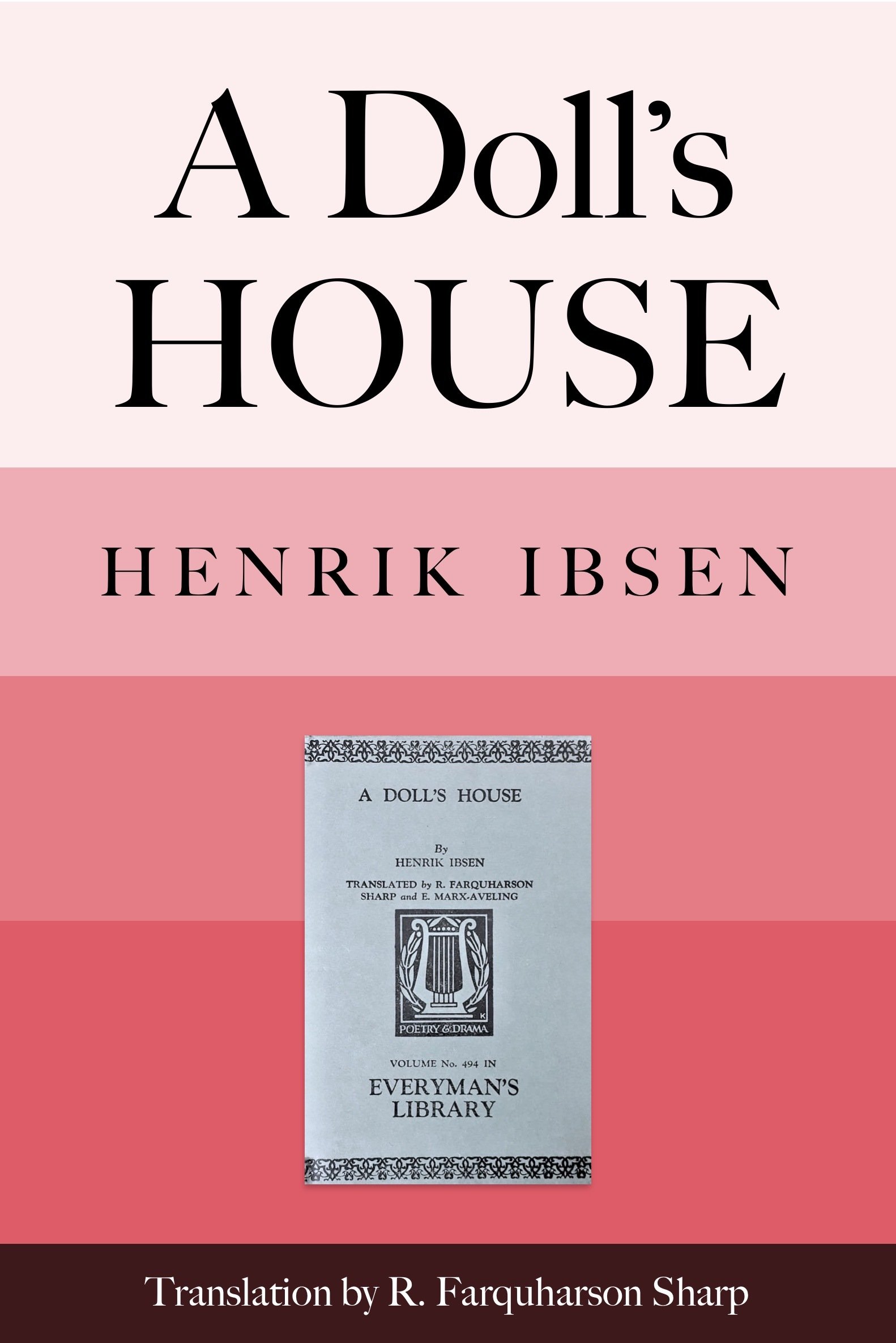
This guide is based on Project Gutenberg eBook #2542, A Doll's House: a play. The current Gutenberg page lists Henrik Ibsen as author, R. Farquharson Sharp as translator, English as the language, eBook release date March 1, 2001, last update February 26, 2026, and public-domain status in the United States. The article preserves the Gutenberg package cover image, cover.jpg, used as the page's representative image.
Ibsen's original Norwegian play, Et dukkehjem, premiered in Copenhagen in 1879. This English guide discusses Sharp's public-domain translation while noting where the dramatic structure, not only individual wording, carries Ibsen's argument.
What the Play Is Really About
Henrik Ibsen sets the whole action inside the Helmer drawing room. At first, that room looks secure: Christmas parcels, a stove, a piano, a tree, well-bound books, children nearby, servants moving through the hall, and a husband newly promoted at the bank. The room is comfortable and tasteful, but not extravagant. That detail matters. Ibsen is not exposing a grotesque household that no audience would recognize. He is exposing a respectable one.
Nora Helmer enters as if she belongs to domestic comedy. She hums, shops, hides macaroons, plays with money, and lets Torvald call her a lark, squirrel, skylark, spendthrift, and little singing-bird. Torvald's language sounds affectionate, but it repeatedly miniaturizes her. He loves the version of Nora who flatters his authority, depends on his judgment, and turns serious needs into playful requests.
The central secret is financial and legal. Years before the play begins, Torvald became dangerously ill. Nora borrowed money to fund the trip to Italy that saved his life, then secretly repaid the debt through copying work, needlework, and household economies. Because she could not easily borrow on her own authority, she forged her dying father's signature. The illegal act was also an act of care.
That contradiction drives the play. Torvald believes debt corrupts a home. Krogstad believes the law cares nothing about motive. Mrs. Linde believes truth is better than another concealment. Dr. Rank shows that polite households can carry fatal secrets. Nora believes, for most of the play, that love will produce a miracle when the truth appears. Ibsen's pressure comes from testing all those beliefs in one room.
Plot Summary
Act I: Christmas comfort and the hidden debt
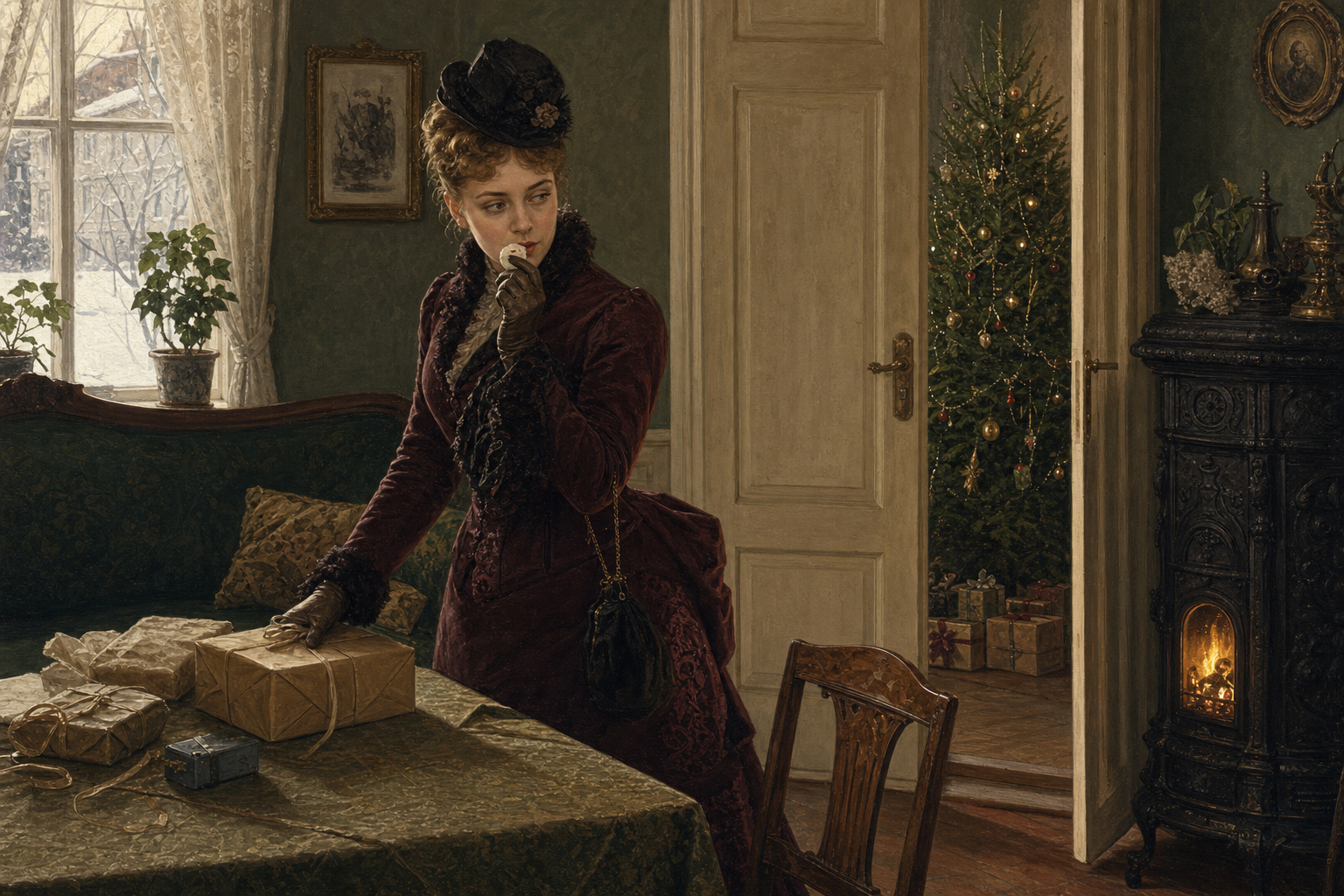
The play opens on Christmas Eve. Nora returns with parcels, pays the porter more than required, tells the maid to hide the Christmas tree, and secretly eats macaroons before Torvald comes in. The first image is festive, but it is already full of concealment. The tree must be hidden until it is dressed; the sweets must be hidden from Torvald; Nora's cheer has to cover more than one secret.
Torvald's first words define the marriage's emotional pattern. He asks whether his "little lark" is twittering and whether his "little squirrel" is bustling about. He then teases her about spending money, gives her cash, and lectures her against borrowing. The audience later discovers the irony: Torvald's health, income, and domestic confidence all rest on the very borrowing he condemns.
Torvald has just been appointed manager of the bank. To him, the promotion means stability, moral respectability, and a chance to control the household more comfortably. To Nora, it means relief because she can finally finish paying Krogstad. Her excitement is not childish greed. It is the excitement of someone who has been carrying adult risk while being spoken to as a child.
Mrs. Kristine Linde arrives after years away. She is a widow who married for duty, worked to support her mother and brothers, and now feels emptied by the loss of people who needed her. Nora first performs the role Torvald has trained into her: she talks about happiness, money, and children as if she is a sheltered wife. Then she confesses the loan.
That confession changes the whole act. Nora has not been merely coaxing money out of her husband. She has been keeping accounts, negotiating with a creditor, hiding labor, and protecting Torvald's masculine pride by letting him believe her father provided the money. She has also had to miss her father's final illness. The trip that saved Torvald cost Nora money, legality, grief, and years of secrecy.
Krogstad enters as the threat attached to that secret. He works at the bank and knows Torvald intends to dismiss him. He also knows Nora forged the signature on the bond. He pressures her to influence Torvald, not because he is purely evil, but because he has already been pushed to the social edge by his own past forgery. Ibsen makes Krogstad dangerous and understandable at the same time. He uses Nora cruelly, but his desperation belongs to the same reputation system that will later expose Torvald.
The act ends with Nora's fear turning inward. Torvald says morally corrupt parents poison their children. Nora, who committed forgery for love, begins to wonder whether she is dangerous to her own children. The plot is now more than blackmail. It has become a crisis in Nora's understanding of herself.
Act II: Tarantella, letterbox, and the panic of exposure
Act II begins with Nora trying to keep the house dressed for celebration while her mind runs toward disaster. The Christmas tree, now stripped and disheveled, mirrors her. What looked festive in Act I now shows the strain of being decorative under pressure.
Nora begs Torvald to keep Krogstad at the bank. Torvald refuses for several reasons, and each reason reveals him. He says Krogstad is morally tainted, but he also cannot bear the thought that bank employees might believe his wife influenced him. His public authority depends on private hierarchy. Even mercy must not look as if it came through Nora.
Dr. Rank deepens the play's atmosphere of hidden decay. He is dying from an inherited illness and moves through the Helmer home as a family friend who knows more than he says. Nora almost asks him for money, but he confesses that he loves her. The confession traps her. If she asks now, the request could exploit his feeling. Rank's scene shows how even tenderness becomes difficult in a house built on things left unsaid.
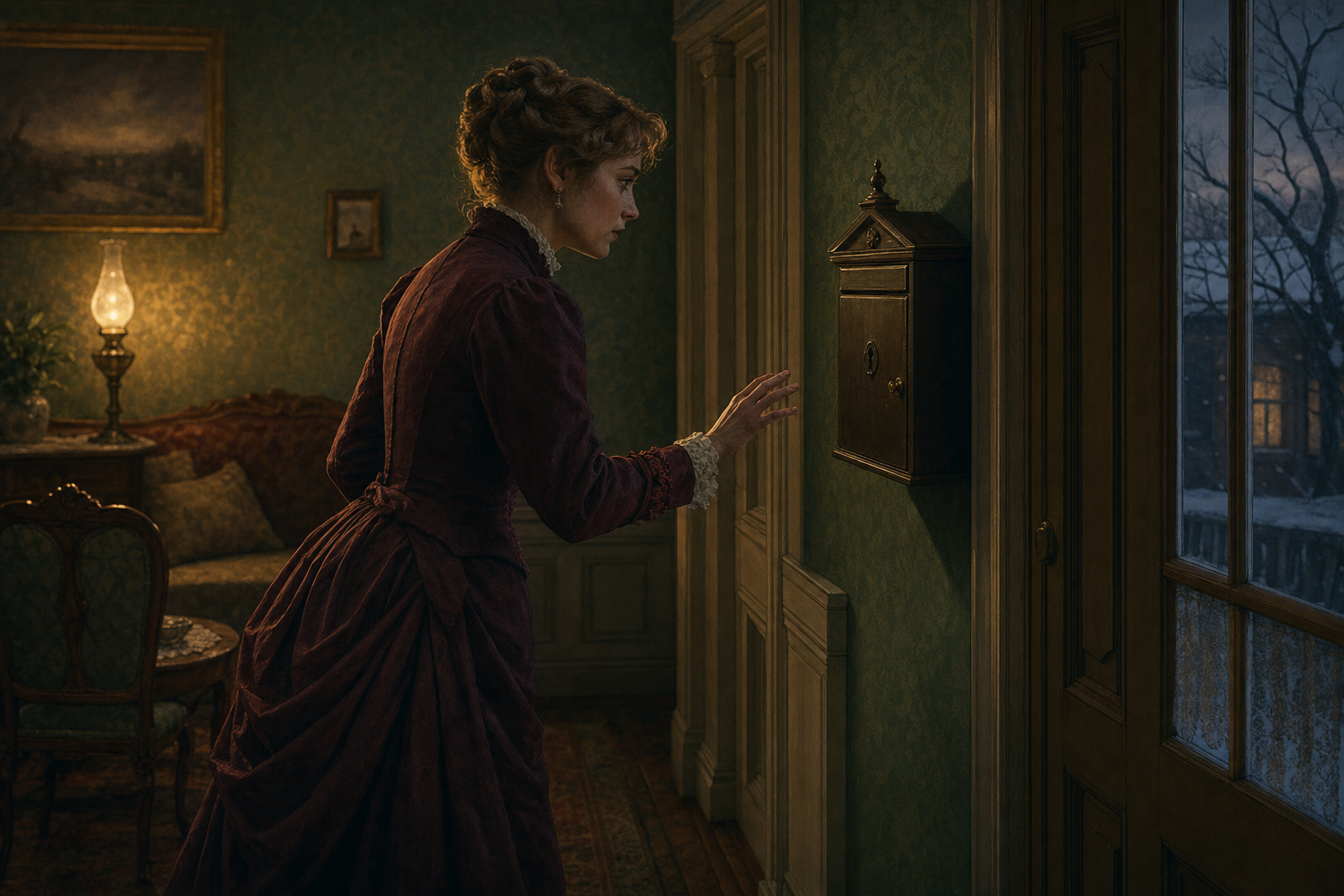
Krogstad returns and drops his letter into Torvald's locked letterbox. The object is ordinary, but it becomes the play's sharpest miniature of power. The truth is inside Nora's home. It is visible. It is only a few steps away. Yet she cannot reach it because Torvald holds the key.
Nora's response is theatrical. She throws herself into rehearsing the tarantella, pleading with Torvald to coach her and making the dance wild enough to occupy him. Torvald sees a charming woman who needs guidance. The audience sees panic converted into performance. Nora uses the very role that imprisons her as a temporary shield.
Mrs. Linde, meanwhile, understands that the crisis cannot be solved by another trick. She has known economic necessity without illusions. She also recognizes Krogstad as a person with a past, not only as Nora's creditor. Her search for him prepares the moral counterpoint of Act III: while Nora and Torvald's marriage collapses under truth, Mrs. Linde and Krogstad may rebuild because they choose truth.
Act II leaves Nora imagining the "wonderful thing": Torvald will read the letter, understand her sacrifice, take responsibility publicly, and prove that his love is larger than reputation. She fears that miracle because she believes he may sacrifice himself for her. The tragedy is that she overestimates his love while underestimating her own need to stop being protected.
Act III: Truth, reputation, and the end of the doll house
Act III begins away from Nora and Torvald. Mrs. Linde and Krogstad speak honestly about their shared past. Years earlier, she left him to marry a man who could support her family. Now she has no one to work for, and he has been hardened by disgrace. Their reunion is practical rather than romantic fantasy. They do not erase damage; they decide that two wounded adults may still help each other live truthfully.
Krogstad offers to retrieve the letter, but Mrs. Linde refuses. Her choice is ethically complicated. It keeps Nora in danger, but it also refuses to let the Helmer marriage survive by hiding its real terms. Mrs. Linde sees that Nora's secret has not only endangered the home; it has revealed the home.
After the party, Torvald returns full of desire and possessive fantasy. He likes watching Nora perform, likes imagining danger from which he could rescue her, and likes feeling that she belongs to him. Rank's black-cross cards interrupt the mood with a formal announcement of death. Then Torvald reads Krogstad's letter.
His reaction destroys Nora's dream of the wonderful thing. He does not ask why she borrowed, what she suffered, or how he was saved. He calls her a hypocrite, liar, criminal, and thoughtless woman. He worries that Krogstad may control him, that society may suspect him, and that his future may be ruined. In the crisis, Torvald does not protect Nora. He protects the image of Torvald.
Then a second letter arrives. Krogstad returns the bond, and Torvald instantly declares that they are saved. The reversal is more revealing than simple anger would be. He forgives Nora only after his own public danger disappears. He wants the old marriage restored, but with Nora even more dependent on his forgiveness. His language becomes protective again, yet that protection now sounds like possession.
The ending and the final doorThis section contains spoilers.
Nora changes clothes, sits Torvald down, and begins the first serious conversation of their marriage. The staging matters: after three acts of movement, hiding, dancing, and interruption, Nora demands stillness and speech. She says they have never tried to get to the bottom of anything. She tells him he has not loved her, only found it pleasant to be in love with her.
Her central metaphor gives the play its title. As a child, she was her father's doll-child. As a wife, she has been Torvald's doll-wife. The home has been a playroom where men arranged taste, opinion, pleasure, and moral instruction while Nora performed tricks. The insult is not only personal. It names a system that turns affection into ownership.
Torvald offers to educate her, but Nora rejects him as teacher. She says she must educate herself, stand alone, and discover whether the world is right or she is. When Torvald appeals to sacred duties as wife and mother, Nora answers that she has duties to herself and that before all else she is a reasonable human being.
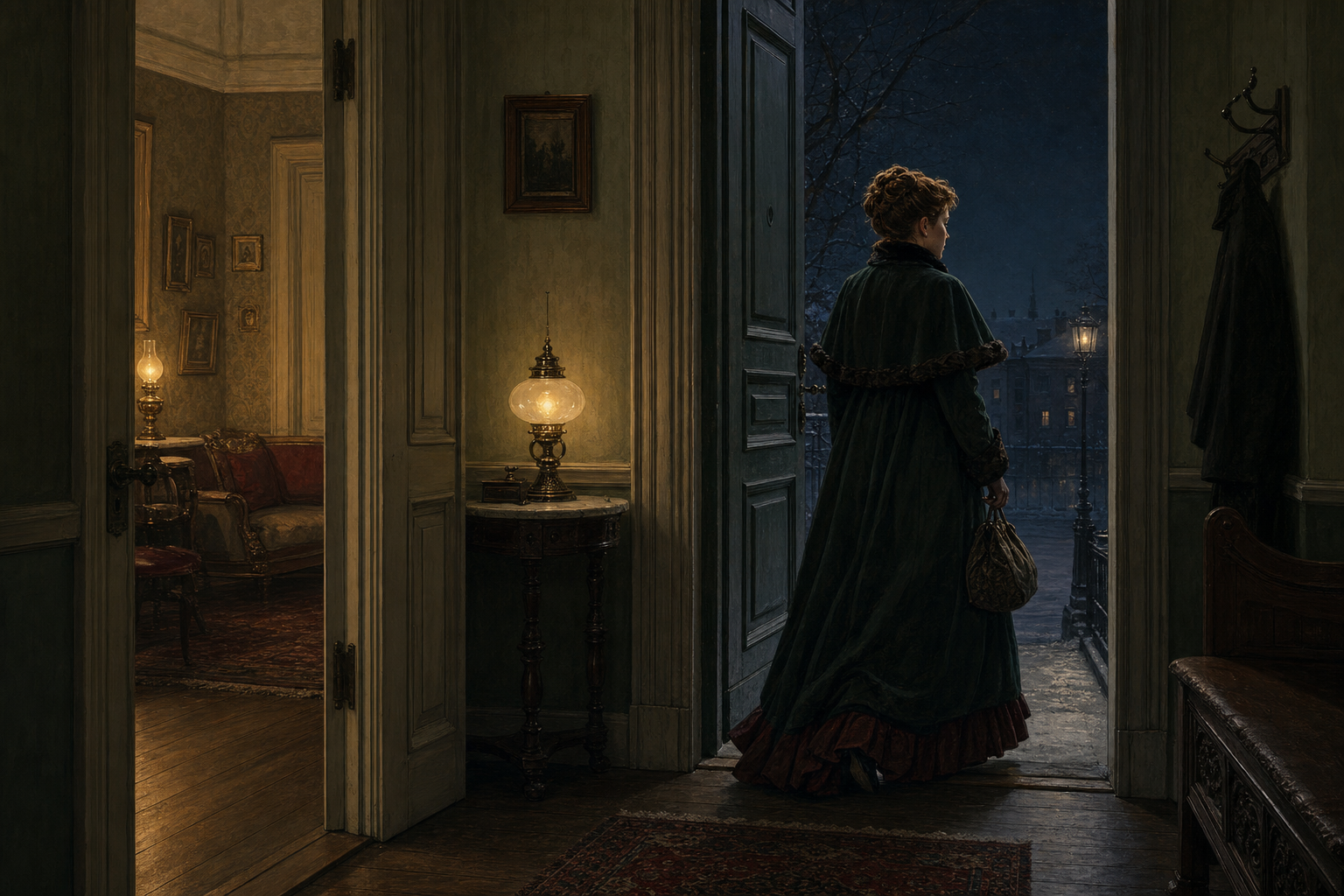
She leaves Torvald, the children, the house, and the marriage rings. The famous door slam is not an easy celebration. Nora walks into uncertainty. That is why the ending still shocks: Ibsen refuses to solve a false home by giving the audience a comfortable new home. The play ends with a question about whether real marriage would require both people to become changed enough for freedom on both sides.
Major Characters
Nora Helmer
wife, performer, debtor, and awakening self
Nora begins as the apparent child of the house: playful, flattering, secretive, and financially dependent. Ibsen then reveals that her playfulness hides years of calculation, illegal risk, grief over her father, and labor done at night while Torvald imagined her as delicate.
Her final transformation is intellectual as well as emotional. Nora does not leave because she already possesses complete wisdom. She leaves because the marriage has denied her the conditions for judgment, and she recognizes self-education as a moral duty before any honest return to wifehood or motherhood could be possible.
Torvald Helmer
husband, banker, and guardian of respectability
Torvald is tender when Nora performs the version of femininity he likes. His affection depends on hierarchy: he names, corrects, instructs, forgives, rewards, and imagines himself as the household's moral shelter.
His collapse after Krogstad's letter is the play's decisive revelation. The issue is not that Torvald becomes angry under stress. It is that his first instinct is reputation, not gratitude; control, not understanding. His "forgiveness" after the second letter proves how conditional his love has been.
Nils Krogstad
creditor, blackmailer, and damaged mirror
Krogstad threatens Nora and exploits her fear, but he is not a melodramatic villain. He has committed forgery too, and society's refusal to let him recover has made respectability feel like survival.
He mirrors Nora in dark form: both are tied to forged signatures, hidden motives, and reputational danger. His reunion with Mrs. Linde shows that moral recovery requires being seen as capable of change, not frozen forever as a public stain.
Mrs. Kristine Linde
working widow and truth-teller
Mrs. Linde has lived the adult life Nora has been shielded from: work, poverty, duty, compromise, and the exhaustion of usefulness. She can sound severe because she has no patience for decorative illusions.
By Act III she becomes the play's practical moral center. She chooses truth over comfort, not because truth is painless, but because concealment has already deformed the Helmer marriage. Her renewed bond with Krogstad also gives the play a counter-model: adults may join each other through need and honesty rather than performance.
Dr. Rank
dying friend and witness to hidden decay
Rank brings mortality into the drawing room. His inherited illness parallels the inherited moral assumptions that shape the Helmer home: fathers, reputations, debts, and social judgments all pass pressure into the next generation.
His love for Nora is sincere, but it also shows how unstable the house's silences are. The black-cross visiting cards turn etiquette into death notice, making a small social object carry a truth the room cannot comfortably speak.
The Helmer children and Anne-Marie
stakes of the domestic system
The children rarely direct the action, yet everyone uses them rhetorically. Torvald invokes motherhood to condemn Nora, and Nora fears she may morally harm them because she has accepted his language about corrupt mothers.
Anne-Marie quietly exposes the class underside of idealized motherhood. She left her own child to become Nora's nurse, proving that domestic purity depends on paid female labor and sacrifices the household prefers not to name.
Best Quotes
Is that my little lark twittering out there?
Torvald's pet name is charming and belittling at once. It turns Nora into a decorative sound inside his house rather than a full moral equal. The line also teaches the audience how to hear the marriage: domination will often arrive as sweetness.
No debt, no borrowing.
Torvald's sentence sounds like financial prudence, but the plot makes it dramatic irony. His health and household have already depended on Nora's hidden borrowing. The slogan exposes how clean principles can become false when they ignore the conditions that made survival possible.
The law cares nothing about motives.
Krogstad's line is frightening because it is technically accurate and morally incomplete. Nora's motive was sacrifice, but the law sees a forged signature. The play does not excuse forgery; it asks what happens when law has no space for unequal social conditions.
You have never loved me. You have only thought it pleasant to be in love with me.
This is one of Nora's sharpest distinctions. She separates love from the pleasure of possessing a pleasing image. Torvald enjoyed being the husband of a charming doll-wife; that is not the same as knowing her.
I have been your doll-wife.
Nora's phrase names the metaphor that has governed the whole play. The home was not simply unhappy; it was arranged as a toy world where she was handled, admired, and denied adulthood.
I have other duties just as sacred.
Torvald thinks sacred duty begins and ends with wifehood and motherhood. Nora's answer claims a moral life before role. The line is quiet, but it changes the ethical scale of the play.
It is a thing hundreds of thousands of women have done.
Nora says this after Torvald insists that no man would sacrifice honor for love. The answer expands her private story into social critique. Her life is not an isolated scandal; it belongs to a long history of women absorbing costs that respectable language refuses to count.
Major Themes
Marriage
Love Built on Performance
The Helmer marriage looks affectionate because Nora performs dependence and Torvald performs protection. Ibsen asks whether affection can count as love when equality, knowledge, and adult conversation are absent.
Money
Debt, Law, and Moral Contradiction
Nora's loan is illegal, but it saved Torvald's life. The play separates legal guilt from moral motive and shows how money structures gender power inside a supposedly private home.
House
Domestic Space as Stage Set
The drawing room is cozy, but it functions like a stage where everyone must play assigned roles. The macaroons, Christmas tree, letterbox, visiting cards, tarantella costume, bond, and door all become props with moral force.
Reputation
Respectability Is Not Morality
Torvald's public cleanliness collapses when scandal threatens him, while Krogstad, the disgraced man, proves capable of change. The play refuses to equate social approval with ethical capacity.
Selfhood
Education Before Reconciliation
Nora's final claim is not simple independence. It is the need to become capable of judgment before she can be wife, mother, or citizen in any honest way.
Ibsen and Modern Realism
When A Doll's House premiered in 1879, its ending shocked many audiences. The scandal was not only that Nora leaves her husband and children. It was that Ibsen made a middle-class home the site of serious moral drama and refused to resolve the conflict with obedience, forgiveness, death, or a sentimental embrace.
The play helped define modern realism. Instead of kings, mythic heroes, or historical spectacle, Ibsen gives us a living room, a bank job, a forged signature, a letterbox, and a marriage vocabulary that sounds loving until examined. The realism is theatrical but precise: ordinary objects reveal social structures.
Ibsen also changed what stage suspense could be. The central action is not a duel or battle; it is whether a husband will read a letter, whether a wife can delay him, and whether a room can survive the truth already placed inside it. Modern drama often works this way: small social mechanisms carry enormous moral pressure.
It is too thin to reduce the play to "freedom versus marriage." Ibsen was wary of being flattened into a single program, yet the play's feminist force is unavoidable. Nora's problem is not only Torvald as an individual man. It is a legal, economic, religious, and domestic system that has praised her as ideal woman while denying her adult personhood.
The play's performance history proves how unsettling that personhood was. Many later productions have emphasized different aspects of Nora's choice, and some adaptations have changed or softened the ending. For essays, the original structure matters: the final door is powerful because Ibsen withholds the reconciliation audiences had been trained to expect.
Why It Still Matters
The play remains modern because many relationships still reward performance over truth. A person may be praised for being easy, charming, grateful, supportive, or selfless while being quietly denied the space to think, choose, disagree, and become.
Nora's exit is not a simple instruction for every life. It is a dramatic test. What would have to be true for a home to deserve the name? What happens when protection becomes control? Can forgiveness matter if it begins only after danger to reputation disappears?
For students, A Doll's House is especially useful because every prop does analytical work. The macaroons show secret appetite; the Christmas tree reflects decorative domesticity under strain; the letterbox turns privacy into power; Rank's cards make polite paper announce death; the tarantella converts panic into performance; the door transforms a household object into a cultural symbol.
For modern readers, the play also asks how we talk about sacrifice. Torvald can imagine heroic sacrifice in theory, but he rejects the actual sacrifice Nora made because it damages his honor. That gap between romantic language and material behavior is one reason the play still feels painfully current.
FAQ: Summary, Ending, and Study Notes
What is A Doll's House about?
A Doll's House follows Nora Helmer, a married woman who secretly borrowed money and forged a signature to save her husband's life. When creditor Nils Krogstad threatens to reveal the forgery, Nora discovers that her marriage is built less on love than on performance, reputation, and unequal power.
Is A Doll's House public domain?
The Project Gutenberg edition used here is public domain in the United States. This guide is based on eBook #2542 and its current package text rather than on a modern copyrighted translation.
Why is the ending important?
The ending matters because Nora refuses the expected domestic reconciliation. Torvald wants to restore the marriage once the public danger has passed, but Nora recognizes that the deeper problem is her lack of education, equality, and selfhood. Her exit makes the audience confront the cost of a home built on dollhood.
Is the play only about women's freedom?
Women's freedom is central, but the play is more specific than a general independence message. It studies how law, money, reputation, religion, parenthood, and affectionate language cooperate inside one marriage. Nora's departure matters because every one of those systems has failed to treat her as a reasonable human being.
What should students focus on for AP Lit or SAT Reading?
Focus on dramatic irony, symbolic props, the two-letter structure, foil characters, and diction. Strong essays do not just say "Nora leaves." They explain how Ibsen prepares that decision through pet names, the hidden loan, Krogstad's legal pressure, Mrs. Linde's truth-telling, Torvald's reaction, and Nora's final shift from performance to judgment.
Read Next
Read Jane Eyre for another heroine who refuses love without self-respect, A Room with a View for social comedy about choosing an honest life, and The Awakening for a later work about marriage, selfhood, and the costs of female autonomy.
Adaptation note
- A Doll's House has many stage and screen versions, but the text itself remains the strongest source for essays because Ibsen's props, pacing, and dialogue carry the argument.
- Some productions change the ending. When writing for class, always specify whether you are discussing Ibsen's original ending or a later adaptation.