Crime and Punishment - Guilt Begins Before Punishment
Dostoevsky follows murder into fever, conscience, confession, and the possibility of moral rebirth.
Sua's Quick Take
Raskolnikov is punished by conscience long before the law finishes its work.
Crime and Punishment looks like a murder story, but Dostoevsky removes the usual mystery almost immediately. The reader knows who committed the crime. The deeper question is whether a person can turn murder into an idea and then survive the return of conscience.
What the Book Is Really About
Crime and Punishment was published in 1866 and is structured in six parts and an epilogue. The plot moves from poverty and theory, to murder, fever, suspicion, psychological investigation, Sonya's moral pressure, confession, legal punishment, and the possibility of spiritual rebirth.
Raskolnikov is a poor former student in St. Petersburg who believes that extraordinary individuals may step beyond ordinary morality for a higher purpose. He murders a pawnbroker partly to test that theory, but the crime does not produce liberation. It produces fever, paranoia, isolation, and a long struggle with confession.
The novel's power lies in the gap between theory and lived reality. Raskolnikov can justify murder in abstract terms, but he cannot control what the murder does to his body, his language, his relationships, or his conscience.
Plot Summary
1. St. Petersburg poverty and the extraordinary man theory
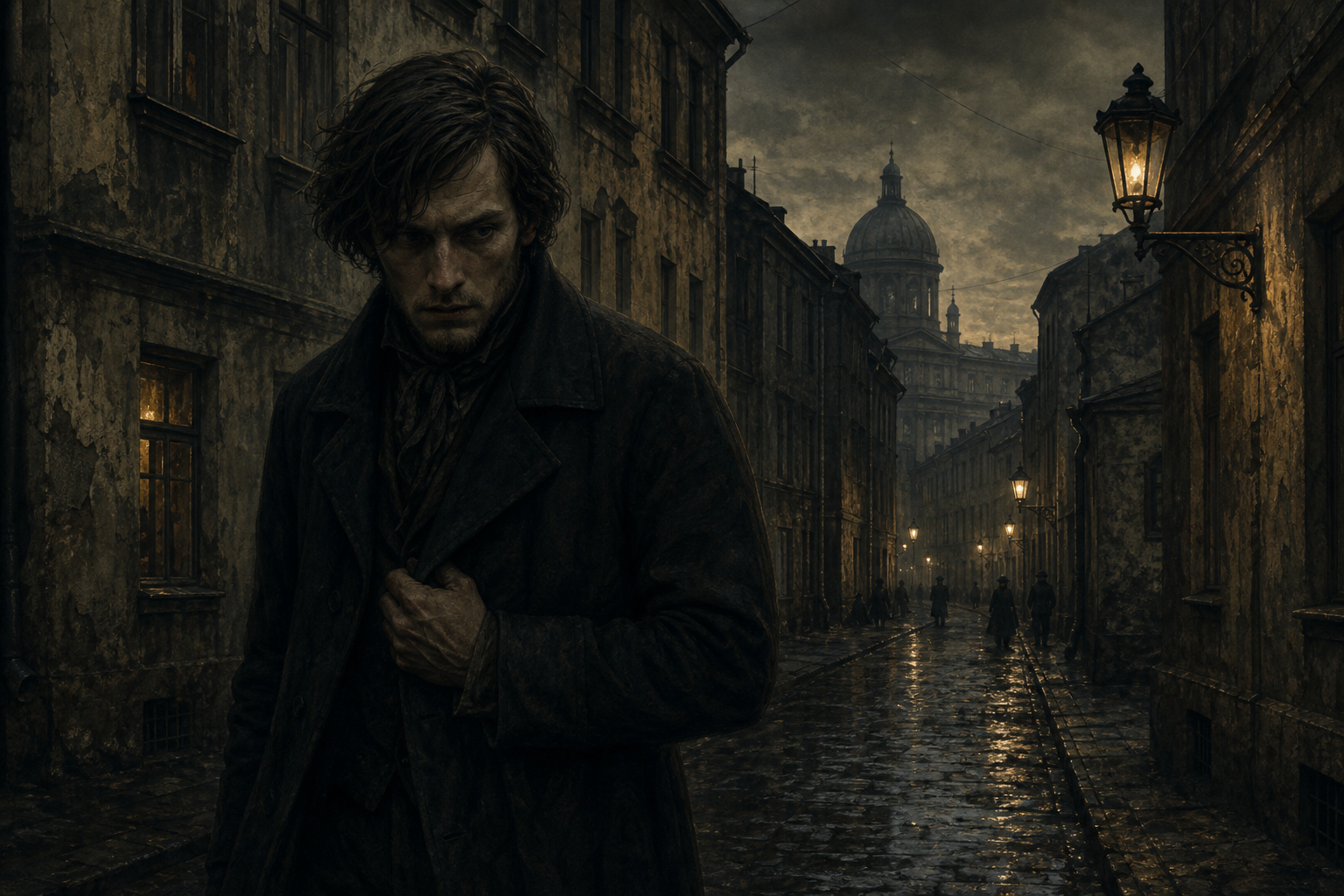
Raskolnikov lives in a cramped room in St. Petersburg, cut off from ordinary life by poverty, pride, and mental pressure. The city feels hot, crowded, dirty, and oppressive. Dostoevsky makes the urban environment mirror Raskolnikov's inner state: everything presses in.
The city is not just background. Its narrow rooms, staircases, taverns, heat, and noise make moral thought feel bodily. Raskolnikov's theory does not develop in a clean philosophical classroom. It ferments in hunger, shame, debt, and exhaustion.
He is obsessed with an idea. Some people, he believes, may be extraordinary enough to cross moral boundaries if doing so serves a larger historical purpose. He applies this theory to Alyona Ivanovna, a pawnbroker he sees as parasitic and useless. If he kills her and uses the money for good, he imagines, perhaps the act can be justified.
But the theory is never purely altruistic. Raskolnikov also wants to test himself. He wants to know whether he belongs among the extraordinary or among ordinary people who must obey. The murder is therefore not only a crime against another person. It is a cruel experiment on his own identity.
That is why the theory is so dangerous. It turns wounded pride into philosophy. Raskolnikov does not merely ask whether one evil act could lead to good results; he asks whether he is the kind of person allowed to stand above ordinary moral limits. The victim becomes material in a private test of greatness.
His meeting with Marmeladov introduces another moral world. Marmeladov is ruined by drink, and his daughter Sonya sacrifices herself to support the family. Raskolnikov feels pity, but pity alone does not save him from pride. He sees suffering everywhere, yet he still moves toward an act that treats human life as material for theory.
2. The pawnbroker murder and the second victim
Raskolnikov kills Alyona. The scene is not presented as a clean philosophical test. It is panicked, disordered, and morally ugly. The reality of murder immediately refuses the neatness of his theory.
Then Lizaveta enters unexpectedly. She is gentle, vulnerable, and innocent of the logic Raskolnikov has used to justify Alyona's death. He kills her too. This second murder is crucial because it destroys the fantasy that the crime can be rationally limited. Violence exceeds the boundaries of the idea that produced it.
Lizaveta's death is the first complete collapse of the theory. Raskolnikov may have rehearsed arguments about Alyona, but Lizaveta cannot be made to fit them. Her presence exposes the lie that murder can stay inside neat categories. Once violence begins, it creates consequences the thinker cannot control.
After the murder, Raskolnikov cannot even use the stolen goods meaningfully. He hides them. The supposed practical purpose collapses almost at once. The crime was never truly about redistributing wealth; it was about proving a theory and testing the self.
This is where the novel begins punishing him. Not through police, but through disorientation. He returns from the scene physically alive but psychologically divided. He has crossed the boundary he imagined, but what he finds on the other side is not greatness. It is contamination.
3. Fever, suspicion, and the body of guilt
After the crime, Raskolnikov falls into feverish instability. He sleeps, wakes, wanders, speaks strangely, and reacts too intensely to ordinary events. Guilt becomes bodily. It appears as heat, faintness, irritability, compulsive speech, and paranoia.
His contradictions are revealing. One part of him wants to escape punishment and preserve the theory. Another part moves compulsively toward exposure because isolation has become unbearable. Long before he confesses, his body and behavior are already trying to confess for him.
Razumikhin, his loyal friend, becomes an important contrast. Razumikhin is poor too, but he remains connected to people. He works, helps, cares, and builds relationships. Raskolnikov isolates himself inside theory; Razumikhin stays in the world of practical human responsibility.
Raskolnikov's mother and sister Dunya arrive, bringing family pressure into the plot. Dunya is considering marriage to Luzhin, a calculating man who wants gratitude and control. Raskolnikov hates the arrangement, partly because he sees Dunya's sacrifice and partly because his own inability to help his family humiliates him.
Luzhin becomes another version of selfish rationality. He does not murder, but he treats marriage as an arrangement that will place a woman beneath him. Dostoevsky uses him to show that cold calculation can be morally ugly even without spectacular crime.
Dunya's refusal of Luzhin also matters for Raskolnikov's moral education. She rejects a life built on domination disguised as practicality. Her courage challenges her brother's assumption that people can be used for larger purposes, whether those purposes are economic, social, or theoretical.
4. Porfiry and the psychological investigation
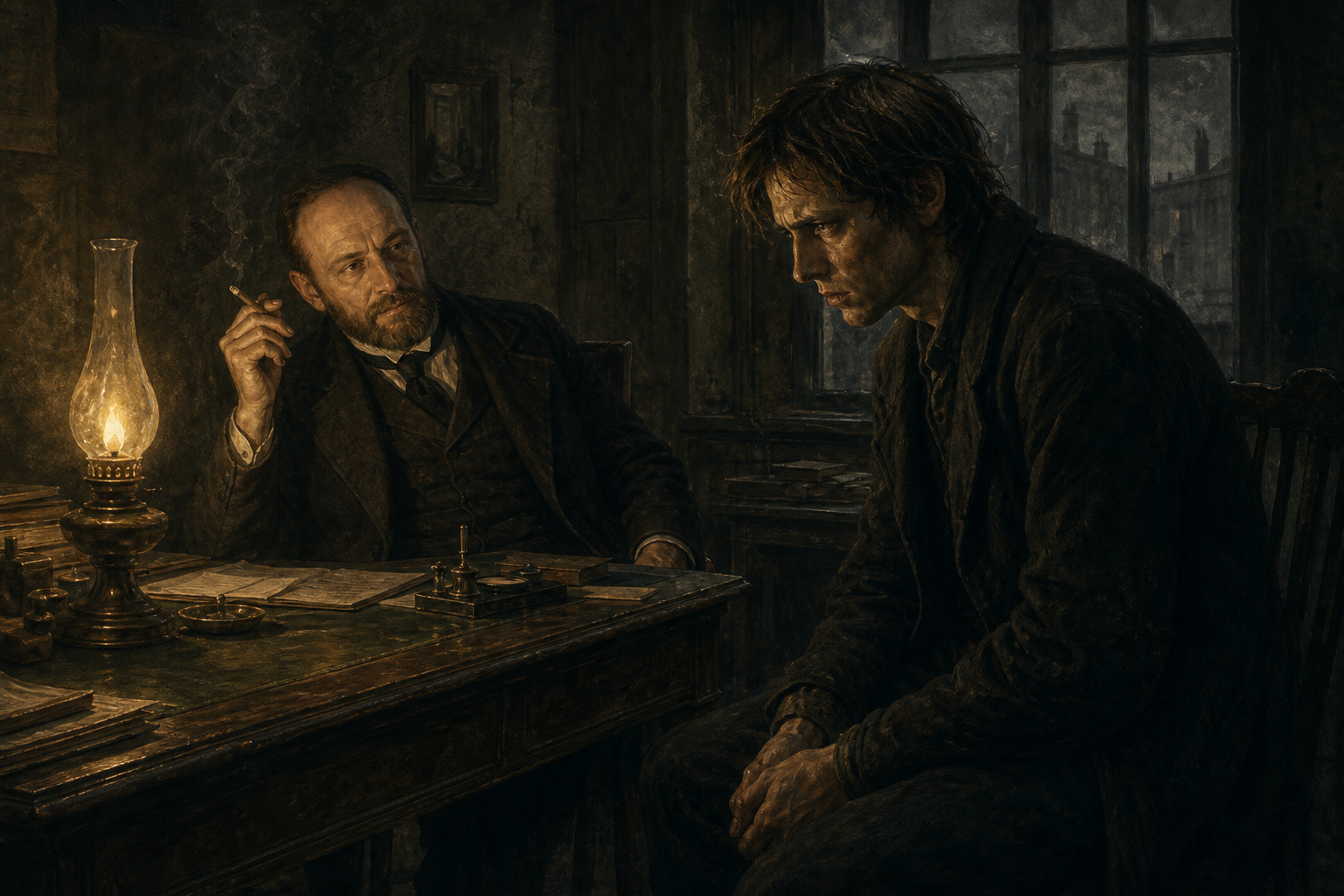
Porfiry Petrovich, the investigator, understands that the case is psychological. He knows of Raskolnikov's article about extraordinary people and begins pressing him through conversation rather than brute accusation.
Their scenes are tense because Porfiry rarely says everything directly. He circles, jokes, waits, and watches. Raskolnikov tries to maintain intellectual control, but his reactions betray him. The interrogation becomes a struggle between theory and conscience.
Porfiry's method matters. He sees that Raskolnikov is already imprisoned by guilt. Legal evidence is important, but the deeper pressure comes from Raskolnikov's inability to live with what he has done. Porfiry wants confession because confession would align external punishment with inward truth.
This makes the novel an unusual detective story. The reader knows who committed the murder almost from the beginning, so suspense does not come from identifying the criminal. It comes from watching whether the criminal's mind can survive the story it has told about itself.
For close reading, these scenes are essential. The suspense is not whether Porfiry is clever enough to catch Raskolnikov. The suspense is whether Raskolnikov can continue performing innocence while his mind and body keep revealing guilt.
5. Sonya and the possibility of confession
Sonya is socially degraded but morally central. She has sacrificed herself for her family, and she carries suffering without turning it into contempt for others. Raskolnikov is drawn to her because she can hear the truth without turning away.
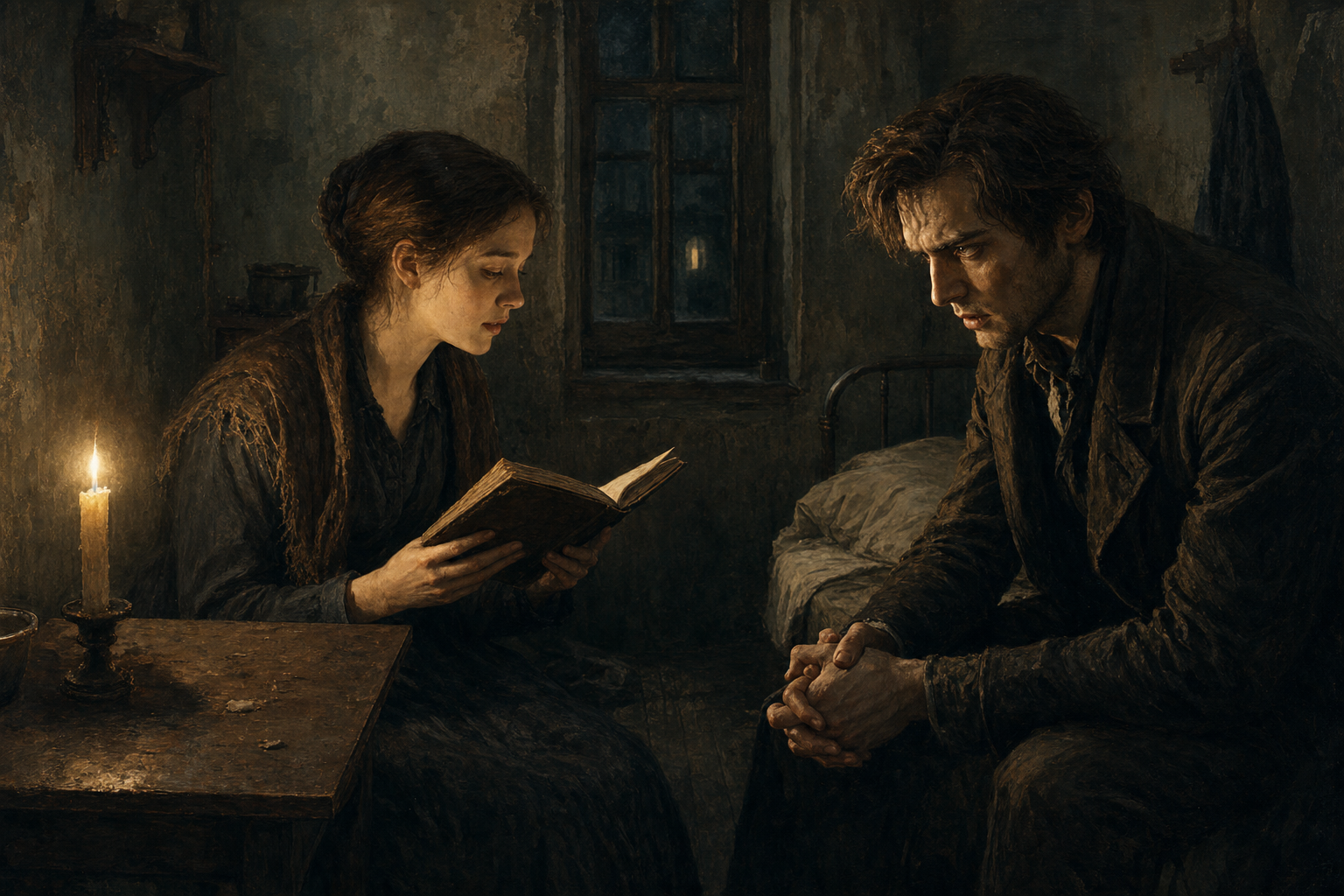
When Sonya reads the Lazarus passage, the scene becomes symbolic. Resurrection is not offered as easy comfort. It suggests that new life is possible only through an encounter with death, truth, and humiliation. Raskolnikov wants rebirth, but he resists the path that leads to it.
Raskolnikov confesses to Sonya. The confession does not instantly redeem him. He still argues, resists, and clings to the language of theory. But Sonya becomes the witness who refuses to let him separate crime from responsibility.
Sonya's answer is not abstract debate. She responds with grief, presence, faith, and moral insistence. She does not defeat the extraordinary man theory in a philosophical contest; she makes Raskolnikov stand before another human being who sees both his guilt and his possibility of return.
She tells him to confess publicly. That demand is severe. Love, in Sonya's form, is not permission to hide. It is the courage to accompany someone toward truth. She does not save Raskolnikov by excusing him; she stands beside him while insisting that he name what he has done.
6. Svidrigailov as a dark double
Svidrigailov is one of the novel's darkest mirrors for Raskolnikov. He moves through the world with cynicism, appetite, and moral fatigue. He knows guilt, but he does not move toward confession in the way Raskolnikov eventually can.
His obsession with Dunya shows the predatory form of desire. Dunya's resistance is important because she protects her dignity under pressure. Her strength contrasts with Raskolnikov's unstable theories and with Svidrigailov's moral emptiness.
Svidrigailov's end suggests what happens when guilt is not transformed into confession or relationship. He is not simply a villain outside Raskolnikov's story. He is a possible future: intelligence without moral rebirth, freedom without love, guilt without repentance.
7. The final pressure toward confession
Porfiry eventually urges Raskolnikov toward surrender. He knows enough, but he also understands that Raskolnikov needs confession for more than legal reasons. The law can sentence him; only truth can begin to change him.
Raskolnikov still hesitates. He is torn between shame over the crime and shame that he failed to become the extraordinary man of his theory. That confusion is one of Dostoevsky's most painful insights. Raskolnikov does not immediately repent because he still partly measures himself by the very theory that ruined him.
Sonya remains near him. She does not argue him into goodness. She bears witness, pressures him toward honesty, and offers a form of love that refuses evasion. Her presence makes confession possible without making it easy.
Raskolnikov finally moves toward public acknowledgment. His act of confession is not the completion of redemption. It is the first step away from isolation and self-deception.
The legal plot can end with confession, but the moral plot cannot. Dostoevsky separates punishment from renewal so that redemption never feels automatic. Raskolnikov must still learn how to live after the collapse of the identity that justified the crime.
Svidrigailov's end sharpens this pressure. He is another figure of transgression, but unlike Raskolnikov he moves toward emptiness rather than confession. His scenes with Dunya expose a world where desire has become predatory and moral limits have nearly disappeared. By placing him near Raskolnikov's final decision, Dostoevsky shows a possible destination for a life that refuses genuine repentance.
Dunya's courage and Sonya's endurance become two different moral counterforces. Dunya resists domination directly; Sonya bears suffering and calls another person toward truth. Neither woman is merely a device for Raskolnikov's development, though both affect him deeply. They reveal forms of strength his theory cannot explain.
The final movement toward confession is therefore not caused by one argument. It is produced by accumulated pressure: Porfiry's insight, Sonya's witness, Dunya's danger, Svidrigailov's darkness, family love, bodily illness, and the failure of the stolen goods to mean anything. The theory has no living world left to stand on.
This accumulation is why the novel feels morally exhaustive. Dostoevsky does not let Raskolnikov hide inside any single explanation. Poverty matters, but it does not excuse murder. Theory matters, but it cannot contain guilt. Pride matters, but it cannot defeat the need for human relation. By the time he confesses, every route away from truth has become more painful than truth itself.
The confession is therefore both defeat and beginning. Raskolnikov loses the fantasy of superiority, but he gains the possibility of re-entering a human world where love, suffering, and responsibility can be named without disguise.
This is why the ending cannot be read as simple punishment. Prison matters, but the deeper movement is from isolation toward relation. Raskolnikov's future remains difficult, yet the lie that made him alone has finally begun to break open.
8. Ending and final meaningThis section contains spoilers.
Raskolnikov is sentenced to Siberian penal servitude. Sonya follows him. At first, even punishment does not produce full repentance. He accepts the legal result before he fully accepts the moral meaning of his crime.
That delay is essential. Dostoevsky does not treat confession as instant transformation. Raskolnikov must live inside punishment, suffering, and Sonya's continued love before a new beginning becomes possible.
The epilogue is sometimes debated because its hope arrives quietly after so much psychological darkness. But its point is not that suffering magically purifies. The point is that Raskolnikov's recovery begins when he stops standing apart from humanity and begins to receive love, guilt, and responsibility as real.
Major Characters
Rodion Raskolnikov
former student who tries to justify murder through theory
Raskolnikov is poor, proud, isolated, and intellectually intense. His extraordinary man theory gives philosophical shape to his resentment and ambition. He wants to prove that he can cross moral boundaries and remain above ordinary guilt.
His body proves otherwise. Fever, paranoia, compulsive speech, and attraction to Sonya all reveal that conscience survives theory. His arc is not from innocence to guilt, but from rationalized guilt toward the possibility of confession.
Sonya Marmeladova
suffering witness and moral center
Sonya lives under social humiliation, yet she remains capable of compassion. She hears Raskolnikov's confession without abandoning him, but she also refuses to let him hide behind ideas.
Her love is demanding. She does not erase guilt; she insists that Raskolnikov confess and suffer truthfully. Through Sonya, the novel connects mercy with responsibility.
Porfiry Petrovich
investigator of conscience as much as crime
Porfiry is patient, ironic, and psychologically acute. He understands that Raskolnikov's theory and reactions matter as much as external evidence.
His pressure turns investigation into moral drama. He wants Raskolnikov to confess because confession would make the inner truth visible to the law.
Dunya
Raskolnikov's sister and a figure of dignity
Dunya is willing to sacrifice for her family, but she is not weak. She rejects Luzhin when his selfishness becomes clear and resists Svidrigailov's coercion.
She shows a form of strength Raskolnikov lacks: the ability to endure pressure without turning other people into tools for an idea.
Svidrigailov
dark double of guilt without rebirth
Svidrigailov reflects a possible path for Raskolnikov: intelligence, transgression, and guilt without confession. He is morally exhausted rather than morally transformed.
His end contrasts with Raskolnikov's. Without Sonya's witness and without a movement toward truth, guilt closes inward rather than opening toward renewal.
Best Quotes
I am a louse.
This line captures Raskolnikov's collapse from imagined greatness into self-disgust. He wanted to test whether he was extraordinary, but after the crime he confronts humiliation rather than superiority.
I wanted to murder, for my own sake.
This confession strips away the humanitarian mask of his theory. Raskolnikov spoke of usefulness and justice, but the deepest motive was self-testing.
Suffering is a great thing.
In Dostoevsky, suffering is not simple punishment. It can become the path by which a person stops evading truth. The danger is romanticizing pain; the power is seeing it as a passage toward responsibility.
Major Themes
Guilt
Guilt before legal punishment
Raskolnikov's punishment begins in fever, paranoia, isolation, and compulsive speech long before sentencing.
Theory
The collapse of the extraordinary man theory
Abstract arguments fail when confronted with real bodies, innocent victims, and the persistence of conscience.
Poverty
Poverty and moral pressure
Poverty shapes choices and desperation, but Dostoevsky refuses to make it a simple excuse for moral violence.
Confession
Confession and rebirth
Confession is not information transfer. It is the act of accepting guilt in one's own name and reentering human relation.
Dostoevsky and the Psychological Novel
Dostoevsky is interested in the failure of purely rational accounts of human life. Raskolnikov turns murder into an idea, but his body, dreams, speech, and relationships keep contradicting that idea. The novel is philosophical, but it is also intensely physical.
The social context matters as well. Urban poverty, radical theories, family obligation, and social humiliation create pressure around Raskolnikov. Yet the novel does not reduce crime to environment. It keeps asking what responsibility means under pressure.
Dostoevsky's genius is that readers are made to feel revulsion and pity at the same time. Raskolnikov is guilty, but he is not flat. The novel forces readers to remain near a mind that is both morally wrong and painfully human.
Why It Still Matters
The novel remains urgent because people still justify harm through abstractions: efficiency, greatness, history, ideology, necessity, or the supposed good of the many. Raskolnikov's failure shows what happens when a human being becomes a category inside someone else's theory.
It also remains powerful as a study of self-deception. Raskolnikov claims lofty motives, but his own confession reveals a private hunger for proof. Dostoevsky exposes how easily moral language can hide ego.
For AP Lit, SAT Reading, IB English, and essays, the novel rewards tracking psychological stages: theory, crime, fever, interrogation, confession to Sonya, public surrender, and the delayed opening of rebirth.
Frequently Asked Questions
What is Crime and Punishment about?
It is about Raskolnikov, a poor former student who murders a pawnbroker to test a theory of extraordinary people, then suffers through guilt, suspicion, confession, and punishment. The real plot is psychological and moral, not merely criminal.
What is Raskolnikov's extraordinary man theory?
He believes certain extraordinary individuals may transgress ordinary moral law for a higher purpose. The murder tests whether he is such a person. The novel shows the theory collapsing under guilt and human reality.
Why is Sonya important?
Sonya is the moral witness who hears Raskolnikov's confession and insists he accept responsibility. She offers compassion, but not escape. Her love demands truth.
Is the ending a complete redemption?
Not exactly. The ending suggests the beginning of moral rebirth, not a finished transformation. Raskolnikov must pass through punishment, suffering, and relationship before renewal becomes possible.
Read Next
- The Brothers Karamazov: guilt, faith, family, and moral responsibility on a larger scale.
- Dr. Jekyll and Mr. Hyde: another story about theory, divided selfhood, and moral evasion.
- Les Misérables: law, crime, mercy, and social redemption in a broader historical canvas.
Adaptations
- Russian film and television adaptations: often emphasize psychological pressure and urban atmosphere.
- Stage adaptations: compress the conflict into Porfiry, Sonya, and Raskolnikov's confrontations.
- Audiobooks: useful for following long interior pressure and moral argument.