The Brothers Karamazov Study Guide - AP Lit, SAT Reading, Close Reading, and Essay Practice
A practical guide for AP English Literature, SAT Reading, IB English, and school essays, with key passages, literary devices, practice questions, and essay-ready thesis work.
This study guide is for students who need to discuss The Brothers Karamazov with textual evidence. If you want the full plot explanation first, start with the main article.
Who This Guide Is For
This guide is for AP English Literature, SAT Reading, IB English, and high school or college students who need to write about Dostoyevsky's novel with evidence. The goal is not to memorize the murder plot. The goal is to explain how Dostoyevsky turns family conflict into questions about moral responsibility, faith, doubt, freedom, psychology, and storytelling.
By the end, you should be able to:
- explain why Dmitri can be morally guilty without being the murderer
- use short quotations about self-deception, active love, freedom, and responsibility
- discuss Ivan's rebellion and Grand Inquisitor parable without reducing them to a slogan
- connect Alyosha's faith to action, memory, and community
- answer SAT-style questions about inference, function, tone, diction, and structure
1. Quick Review
- Original title: The Brothers Karamazov
- Author: Fyodor Dostoyevsky
- Published: serialized 1879-1880; book publication 1880
- Source used here: Project Gutenberg ebook #28054, Constance Garnett translation
- Main settings: a provincial Russian town, Fyodor's house, the monastery, Grushenka's circle, the courtroom
- Central conflict: Fyodor Pavlovich is murdered, Dmitri is convicted, and the family must confront guilt beyond legal fact
- Core themes: faith, doubt, free will, active love, family corruption, sensuality, resentment, responsibility
- Common exam angles: Grand Inquisitor, Ivan and Smerdyakov, Zosima's teaching, Dmitri's trial, Alyosha and the schoolboys
One-sentence summary:
A corrupt father is murdered, but Dostoyevsky uses the trial of Dmitri Karamazov to examine whether guilt belongs only to the person who acts or also to the people, ideas, and failures that make action possible.
2. Exam Plot Structure
Exposition
Fyodor Pavlovich Karamazov is introduced as a grotesque father whose selfishness has damaged every family bond. His sons Dmitri, Ivan, and Alyosha return to the same moral center from very different directions: passion, intellect, and faith.
Rising Action
The monastery meeting fails, Dmitri's money dispute and rivalry with Fyodor intensify, Ivan develops his rebellion against innocent suffering, and Smerdyakov quietly gathers the family's resentments and theories into a plan.
Philosophical Center
Ivan's Grand Inquisitor poem asks whether human beings can bear freedom. Zosima's teaching answers from another direction: responsibility must become active love, not abstract sympathy.
Crisis
Fyodor is murdered. Dmitri's threats, debts, jealousy, and movements make him look guilty, but Smerdyakov later confesses to Ivan. Ivan must face the possibility that his ideas helped another man act.
Trial and Resolution
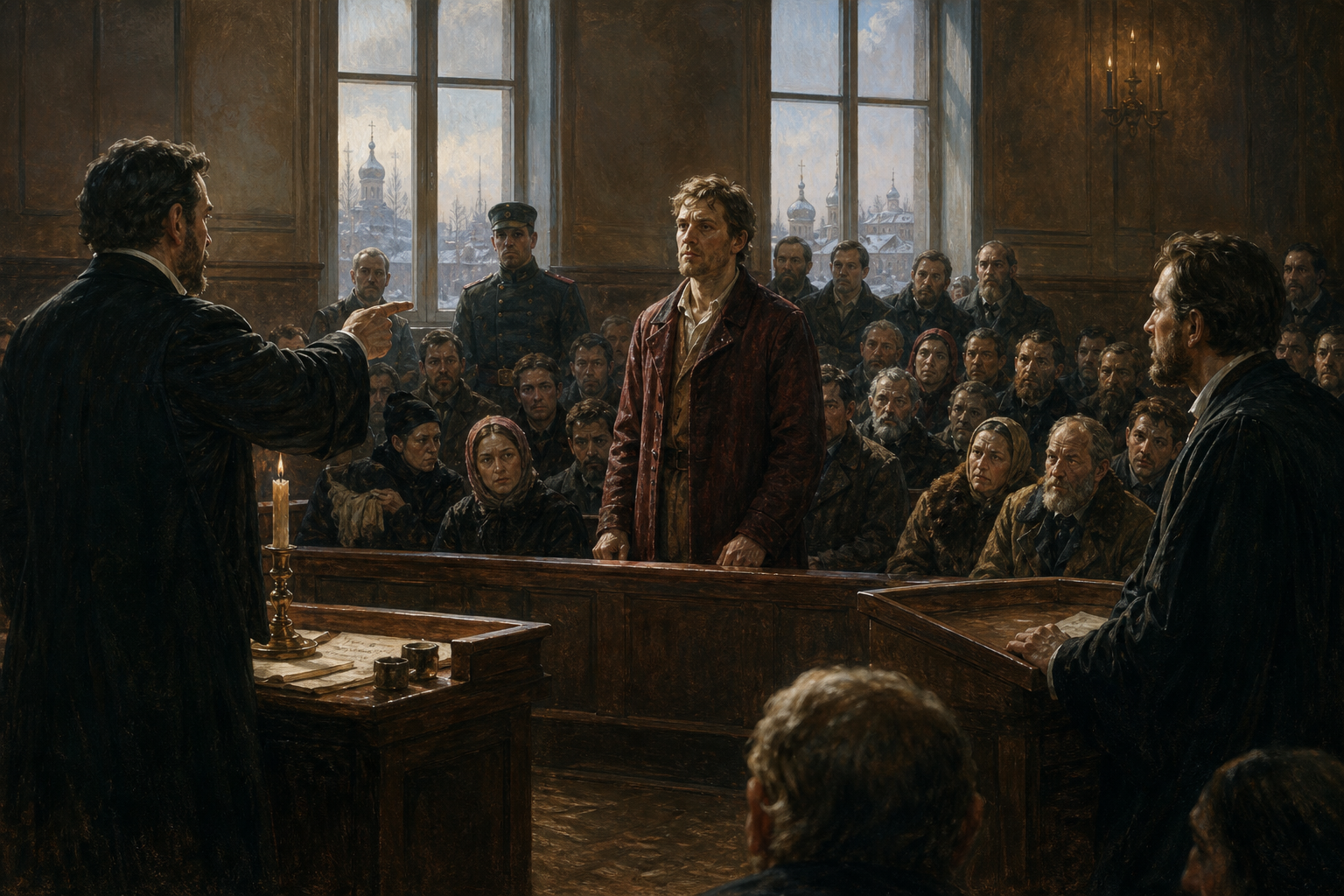
Dmitri is convicted. Ivan breaks down. Smerdyakov dies by suicide. Alyosha's final scene with the schoolboys shifts the novel from legal judgment to memory, kindness, and communal responsibility.
Exam point: do not write only "faith beats doubt" or "Dmitri is innocent." Stronger essays explain how Dostoyevsky separates legal proof, psychological motive, philosophical influence, and spiritual responsibility.
3. Key Original Passages for Close Reading
These passages are not decorative quotations. Each one can support a paragraph about diction, syntax, speaker, argument, and theme. In The Brothers Karamazov, short lines often carry several pressures at once: a character's immediate emotion, a philosophical position, and the novel's wider argument about responsibility.
Read each passage in three moves. First, place it in the scene: who speaks, to whom, and under what pressure. Second, mark the charged words: "lie," "secret," "freedom," "love," "responsible," "heart." Third, turn the observation into a claim about how Dostoyevsky creates meaning. A strong AP or IB paragraph does not simply identify a theme. It explains how the wording makes the theme difficult.
For SAT-style reading, pay attention to function. A passage may warn, accuse, test, seduce, confess, or reframe a scene. For essay writing, connect the local language to a larger conflict: Ivan versus Alyosha, Dmitri's performance versus truth, Zosima's doctrine of shared responsibility, or Smerdyakov's conversion of theory into action.
Passage 1: Don't lie to yourself
Above all, don’t lie to yourself.
Context: Zosima speaks about confession, self-knowledge, and the danger of making false stories about one's own motives.
Close reading: The phrase "above all" makes self-deception the first spiritual danger. The warning is simple, but in the novel it becomes complex because nearly every major character has a preferred lie about himself or herself.
Essay use: Use this line for essays about self-deception, confession, and why moral failure begins before public action.
Passage 2: The secret of man's being
For the secret of man’s being is not only to live but to have something to live for.
Context: The Grand Inquisitor argues that human beings need meaning, not merely survival. He uses that insight to justify control.
Close reading: The contrast between "to live" and "to have something to live for" turns physical survival into an incomplete answer. The line is persuasive because it names a real human need even while the Inquisitor uses it manipulatively.
Essay use: Use it to discuss freedom, authority, religion, and why Ivan's parable is more psychologically serious than a simple attack on faith.
Passage 3: Love in action
Love in action is a harsh and dreadful thing compared with love in dreams.
Context: Zosima distinguishes imagined goodness from the difficult practice of loving actual people.
Close reading: The adjectives "harsh" and "dreadful" strip love of sentimental softness. Dostoyevsky makes real love demanding because it must endure irritation, delay, humiliation, and repeated failure.
Essay use: Use this line for Alyosha, Zosima, Grushenka's onion story, and the final schoolboy scene.
Passage 4: Responsible for all
Every one of us is undoubtedly responsible for all men and everything on earth.
Context: Zosima's teaching expands responsibility beyond narrow legal guilt.
Close reading: "Every one," "all men," and "everything" create radical breadth. The sentence refuses the comfort of thinking that guilt belongs only to the person who can be convicted.
Essay use: Use it to connect Dmitri's trial, Ivan's indirect guilt, Smerdyakov's hidden action, and Alyosha's communal ethic.
Passage 5: Beauty as battlefield
God and the devil are fighting there and the battlefield is the heart of man.
Context: Dmitri speaks about beauty, desire, and inner division.
Close reading: The battlefield metaphor turns private desire into moral conflict. Dmitri's language is excessive, but the excess is revealing: he experiences himself as divided, not simply wicked.
Essay use: Use this passage for Dmitri's sensuality, the novel's psychology of divided will, and the link between religious vocabulary and bodily desire.
Passage 6: Everything is lawful
Yes, if you like, “everything is lawful” since the word has been said.
Context: The idea associated with Ivan is repeated and tested after the murder. It becomes dangerous because Smerdyakov treats it as practical permission.
Close reading: The phrase "since the word has been said" makes language consequential. Ideas do not stay abstract once spoken into a wounded household.
Essay use: Use it for Ivan, Smerdyakov, philosophical influence, and the difference between thinking a possibility and enabling an action.
Passage 7: A good memory
You must know that there is nothing higher and stronger and more wholesome and good for life in the future than some good memory.
Context: Alyosha speaks to the schoolboys after Ilyusha's funeral.
Close reading: The piling up of "higher," "stronger," "wholesome," and "good" gives memory ethical force. The ending turns remembrance into a practice that can shape future action.
Essay use: Use it for the ending, childhood, communal healing, and Alyosha's alternative to both legal punishment and abstract argument.
4. Close Reading Procedure
Close reading The Brothers Karamazov means refusing to separate plot from argument. A murder clue may also be a moral test. A philosophical speech may also be a character action. A religious teaching may become visible later in a child's funeral, a servant's resentment, or a brother's breakdown.
Step 1: Identify the speaker's pressure
Ask what the speaker wants in the moment. Ivan wants moral clarity but also distance from vulnerability. Dmitri wants to confess and perform at the same time. Zosima wants listeners to move from ideas to active responsibility. Smerdyakov wants recognition and revenge without open exposure.
Step 2: Separate legal guilt from moral responsibility
The novel makes this distinction constantly. Dmitri is legally convicted for a murder he likely did not commit. Ivan is not legally guilty, but he is spiritually implicated by the way Smerdyakov receives his ideas. Zosima's teaching pushes responsibility even wider, toward the atmosphere people create around one another.
Step 3: Mark abstract nouns and concrete consequences
Words such as "freedom," "love," "responsibility," "faith," and "lawful" sound abstract. Dostoyevsky tests them through concrete scenes: a father with money in an envelope, a servant listening outside the moral family circle, a public courtroom, a grieving child, a remembered kindness.
Step 4: Track reversals
Many scenes reverse first impressions. Grushenka moves from seductress to grieving soul. Dmitri moves from obvious suspect to spiritually serious innocent. Ivan moves from superior analyst to tormented participant. Alyosha moves from protected novice to active witness in the world.
Worked example: "Love in action"
The line "Love in action is a harsh and dreadful thing compared with love in dreams" appears in a spiritual context, but it is not vague piety. The contrast between "action" and "dreams" creates an ethical test: imaginary love flatters the self, while active love costs time, pride, patience, and comfort.
That gives you a paragraph claim:
Through Zosima's contrast between dreamed love and active love, Dostoyevsky defines goodness as a difficult practice rather than a feeling, preparing readers to see Alyosha's final work with the schoolboys as the novel's real answer to Ivan's despair.
5. Why Literary Devices Matter
In The Brothers Karamazov, literary devices matter because Dostoyevsky makes thought dramatic. People do not merely hold beliefs; they speak them, distort them, overhear them, act on them, and suffer from them.
Polyphonic dialogue: competing voices without easy closure
Ivan, Zosima, Dmitri, Alyosha, Smerdyakov, the lawyers, and even the schoolboys all bring different moral languages. The novel does not flatten them into one lecture. Use polyphony to show how Dostoyevsky lets arguments collide inside scenes.
Embedded parable: the Grand Inquisitor
Ivan's poem interrupts the family plot but clarifies it. The Inquisitor's claim that people fear freedom helps explain why characters seek money, authority, passion, or theory to escape responsibility.
Courtroom rhetoric: narrative as persuasion
The trial turns evidence into competing stories. The prosecutor and defense attorney both interpret Dmitri's life, but both are tempted by performance. Use courtroom rhetoric to discuss the instability of public truth.
Foil structure: the three brothers
Dmitri, Ivan, and Alyosha are not simple body, mind, and spirit labels, but they do illuminate one another. Dmitri exposes desire, Ivan exposes intellectual rebellion, and Alyosha exposes active love under pressure.
Motif of money: material fact and moral symbol
The disputed inheritance, the envelope, debts, gifts, and humiliating loans make money both plot engine and moral test. Money in the novel measures power, shame, dependence, and fantasy.
Diction of illness and laceration
Characters speak of wounds, fever, nerves, and lacerations. This language turns spiritual crisis into bodily experience, especially in Dmitri's frenzy, Ivan's collapse, and the family's contagious disorder.
Children as moral evidence
Ivan's rebellion depends on children's suffering, and the ending turns toward Ilyusha and the boys. Children are not sentimental decoration; they test adult theories by exposing what those theories cost.
Doubling and hidden kinship
Smerdyakov mirrors the Karamazovs from below. As the unrecognized son and servant, he shows what the family refuses to acknowledge. Doubling helps connect inheritance, resentment, and indirect guilt.
6. Turning Character Analysis into Essay Language
Character analysis should connect role, pressure, device, and theme. Do not write that Ivan "represents doubt" and stop. Explain how his doubt is created by compassion for suffering, how the Grand Inquisitor dramatizes it, and how Smerdyakov's action forces Ivan to face the consequences of speech.
Dmitri Karamazov
misread suspect and passionate penitent
Essay sentence: Dmitri's reckless sensuality makes him legally vulnerable, but Dostoyevsky separates the appearance of guilt from the fact of murder to test how well public judgment can read the soul.
Ivan Karamazov
rebellious intellect and indirect participant
Essay sentence: Ivan's protest against innocent suffering is morally serious, yet his collapse shows that abstract rebellion cannot escape responsibility for how ideas are received and used.
Alyosha Karamazov
active love and moral witness
Essay sentence: Alyosha answers the novel's violence not by winning an argument but by converting faith into attentive action toward wounded people.
Smerdyakov
resentful double and hidden actor
Essay sentence: Smerdyakov turns the Karamazov family's unacknowledged shame into action, exposing the danger of treating some lives as peripheral.
7. Thesis Builder for Major Themes
Faith
Active Love
Weak thesis: Alyosha is religious.
Strong thesis: Dostoyevsky presents faith as active love, showing through Alyosha that belief becomes meaningful only when it enters humiliating, ordinary, and painful relationships.
Doubt
Ivan's Rebellion
Weak thesis: Ivan does not believe in God.
Strong thesis: Ivan's rebellion gains force because it begins in outrage over innocent suffering, but the novel also shows the insufficiency of protest without responsibility.
Law
Trial and Truth
Weak thesis: The trial is unfair.
Strong thesis: The trial exposes the gap between persuasive narrative and moral truth, convicting Dmitri through a story that is plausible but incomplete.
Family
Inherited Disorder
Weak thesis: The Karamazovs are dysfunctional.
Strong thesis: The Karamazov family transmits appetite, humiliation, and resentment across class and bloodlines, making the murder a family catastrophe before it is a legal case.
8. SAT Reading Sample
These are SAT-style practice questions, not official College Board questions. Each question is tied to a specific scene, passage, or recurring device from the work.
Question 1
Zosima's warning "don't lie to yourself" most directly introduces the novel's concern with:
- A. military discipline
- B. rural poverty
- C. self-deception as the beginning of moral disorder
- D. comic exaggeration as harmless entertainment
Answer: C. Zosima treats inner falsehood as spiritually dangerous because it lets people justify pride, resentment, and cruelty before those motives become public actions. A and B are not the focus of the line, and D misses how comedy often reveals corruption in the novel.
Question 2
In the Grand Inquisitor passage, the distinction between living and having "something to live for" mainly suggests that human beings:
- A. require meaning as well as survival
- B. prefer legal trials to private confession
- C. are happiest when isolated from others
- D. should avoid all forms of authority
Answer: A. The Inquisitor's argument depends on the claim that survival alone is not enough; people need a purpose that organizes life. B, C, and D do not match the psychological point of the passage.
Question 3
The phrase "love in action" contrasts most strongly with:
- A. inherited money
- B. public rumor
- C. courtroom procedure
- D. idealized love that costs nothing in practice
Answer: D. Zosima contrasts real love with love in dreams, which allows a person to imagine virtue without enduring difficult people. The other choices name important plot elements but not the direct contrast in the line.
Question 4
The Grand Inquisitor's accusation against Christ centers on the idea that freedom is:
- A. a minor political issue
- B. too heavy for many people to bear
- C. identical to wealth
- D. easily protected by courts
Answer: B. The Inquisitor argues that people surrender freedom because they want bread, miracle, and authority. A trivializes the argument, while C and D shift away from the spiritual and psychological claim.
Question 5
Dmitri's legal vulnerability comes chiefly from the fact that he:
- A. speaks no Russian
- B. has no connection to Fyodor
- C. has repeatedly displayed the motives and emotions of violence
- D. refuses to love Grushenka
Answer: C. Dmitri's threats, jealousy, debt, and public frenzy make him look like the murderer even if he did not commit the act. A and B are false, and D reverses his central passion.
Question 6
Smerdyakov's role most complicates Ivan's ideas because Smerdyakov:
- A. treats abstract permission as practical license
- B. proves Ivan never thinks seriously
- C. replaces Alyosha as the monastery novice
- D. has no interest in the Karamazov family
Answer: A. Smerdyakov hears Ivan's speculation about morality and converts it into action. B ignores Ivan's seriousness, C invents a role, and D contradicts Smerdyakov's hidden kinship and resentment.
Question 7
The trial section mainly shows that public judgment can be:
- A. mathematically exact
- B. free from emotion
- C. unrelated to character
- D. shaped by compelling but incomplete stories
Answer: D. The lawyers create persuasive narratives from evidence, but those narratives do not necessarily reach the full truth. A and B are contradicted by the theatrical courtroom, and C ignores how Dmitri's character influences the verdict.
Question 8
Ivan's rebellion is morally powerful because it begins with:
- A. envy of Dmitri's inheritance
- B. boredom with provincial society
- C. outrage over innocent suffering
- D. admiration for Fyodor's behavior
Answer: C. Ivan's refusal of harmony is rooted in stories of suffering children. A and B understate the ethical seriousness of his protest, and D is the opposite of his attitude toward his father.
Question 9
Alyosha's final speech to the boys emphasizes:
- A. memory as a force that can shape future goodness
- B. the need to forget grief immediately
- C. legal revenge against the town
- D. Ivan's victory over Zosima
Answer: A. Alyosha asks the boys to preserve a good memory of Ilyusha and of their shared love. B contradicts the scene, C invents revenge, and D misreads the ending's moral direction.
Question 10
The money motif in the novel functions as:
- A. a neutral accounting detail only
- B. proof that no character cares about status
- C. a measure of shame, power, rivalry, and dependence
- D. a symbol that appears only in the courtroom
Answer: C. Debts, envelopes, inheritance, and gifts repeatedly turn money into an emotional and moral force. A is too narrow, B is false, and D ignores earlier plot sections.
Question 11
The best description of Alyosha's heroism is that he:
- A. practices attention and active love in damaged relationships
- B. defeats every opponent through legal argument
- C. avoids all contact with family conflict
- D. proves Ivan unintelligent
Answer: A. Alyosha enters conflict, listens, forgives, and helps form community. B gives him the wrong method, C is false, and D reduces Ivan's serious role.
Question 12
The phrase "battlefield is the heart of man" uses metaphor to present human nature as:
- A. free of contradiction
- B. divided by inner moral conflict
- C. determined only by courtroom evidence
- D. uninterested in beauty
Answer: B. Dmitri's metaphor turns desire and conscience into an inner battle. A and D contradict the line, and C belongs to the legal plot rather than the metaphor's meaning.
Question 13
Zosima's idea that everyone is responsible for all chiefly challenges:
- A. narrow definitions of guilt
- B. the existence of family resemblance
- C. the value of reading
- D. the usefulness of setting
Answer: A. Zosima expands responsibility beyond the person who can be legally blamed. B, C, and D may matter elsewhere, but they do not name the ethical challenge.
Question 14
Grushenka's "onion" story is important because it shows:
- A. Fyodor is secretly generous
- B. Dmitri never changes his mind
- C. Ivan has no moral imagination
- D. a tiny act of mercy can carry spiritual weight
Answer: D. The story values a small good deed because it reveals the possibility of mercy inside a damaged life. A, B, and C do not fit the story's function.
Question 15
The monastery scandal after Zosima's death tests Alyosha by:
- A. giving him immediate worldly success
- B. making visible signs of holiness uncertain
- C. proving Zosima taught nothing
- D. removing him from all human contact
Answer: B. The decay of Zosima's body disappoints expectations of miracle and forces Alyosha's faith away from spectacle. A, C, and D misread the episode.
Question 16
The three brothers are best read as:
- A. identical versions of the same personality
- B. unrelated comic figures
- C. contrasting responses to desire, thought, and faith
- D. minor witnesses to Smerdyakov's story
Answer: C. Dmitri, Ivan, and Alyosha illuminate one another through passion, intellect, and active faith. A erases contrast, B trivializes them, and D reduces the main structure.
Question 17
Ivan's breakdown after Smerdyakov's confession suggests that:
- A. ideas can return as personal judgment
- B. guilt disappears when evidence is hidden
- C. public success cures moral anxiety
- D. Alyosha caused the murder
Answer: A. Ivan is tormented because his words may have helped another person act. B and C contradict the collapse, and D is unsupported.
Question 18
The schoolboy subplot contributes to the whole novel by:
- A. distracting from every major theme
- B. turning questions of cruelty, memory, and forgiveness into a smaller community
- C. proving adults are morally irrelevant
- D. replacing the trial with comedy
Answer: B. Ilyusha and the boys echo the novel's larger concerns on a more intimate scale. A and D dismiss its importance, and C overstates the contrast with adults.
Question 19
The most accurate interpretation of Dmitri's conviction is that:
- A. Smerdyakov's confession has no effect on Ivan
- B. all evidence is irrelevant
- C. Dmitri has no moral flaws
- D. the verdict is emotionally plausible but factually incomplete
Answer: D. The court's story fits Dmitri's public behavior, but it misses the hidden murderer. A goes too far, B ignores Dmitri's faults, and C contradicts Ivan's crisis.
Question 20
The ending's emphasis on a "good memory" most strongly supports which theme?
- A. revenge is the highest form of justice
- B. childhood grief should be ignored
- C. shared remembrance can become ethical formation
- D. freedom is impossible in every circumstance
Answer: C. Alyosha asks the boys to let memory shape how they live with one another. A, B, and D do not match the hopeful but disciplined ending.
9. AP Lit Essay Questions
Use these AP Lit-style practice questions to turn a specific scene into a thesis, outline, and evidence-based commentary.
Essay Question 1
Analyze how the failed monastery meeting introduces the central conflicts of the novel. Discuss how comedy, humiliation, and spiritual authority collide in that scene.
Essay Question 2
Dmitri is innocent of the murder but not innocent in a broader moral sense. Explain how Dostoyevsky separates legal guilt from emotional, spiritual, or social guilt.
Essay Question 3
Ivan's rebellion against innocent suffering is one of the novel's most serious arguments. Analyze how Dostoyevsky gives that rebellion moral force while also testing its limits.
Essay Question 4
The Grand Inquisitor claims that human beings cannot bear freedom. Analyze how the parable develops the novel's larger concern with authority, conscience, and responsibility.
Essay Question 5
Zosima teaches that active love is harder than love in dreams. Explain how this teaching is tested through Alyosha, Grushenka, or the schoolboy subplot.
Essay Question 6
Smerdyakov occupies a marginal position in the Karamazov household. Analyze how his hidden kinship and resentment shape the novel's treatment of class, family, and responsibility.
Essay Question 7
Money in the novel is never merely financial. Analyze how inheritance, debt, gifts, or the envelope of cash reveal shame, power, and desire.
Essay Question 8
Choose one female character, such as Grushenka or Katerina Ivanovna. Analyze how Dostoyevsky presents pride, vulnerability, and agency through her role in the family crisis.
Essay Question 9
Analyze how the trial turns character into evidence. What does the courtroom reveal about storytelling, performance, and the limits of public judgment?
Essay Question 10
Compare Ivan and Alyosha as responses to suffering. How does the novel stage the difference between protest, compassion, faith, and action?
Essay Question 11
Dmitri often speaks in exaggerated, theatrical language. Analyze how this style both reveals and obscures his moral seriousness.
Essay Question 12
Discuss the role of children in the novel. How do stories of suffering children and the Ilyusha subplot test adult beliefs?
Essay Question 13
Analyze the motif of self-deception. Choose two characters and explain how private lies shape public consequences.
Essay Question 14
How does Dostoyevsky use doubling or hidden kinship in the relationship between Smerdyakov and the Karamazov brothers?
Essay Question 15
Analyze the ending with Alyosha and the schoolboys. Why does the novel close with memory and community rather than with the courtroom verdict alone?
Essay Question 16
Choose one scene of confession or near-confession. Explain how speech becomes a test of responsibility in that moment.
Essay Question 17
Discuss how Dostoyevsky uses religious language outside formal religious settings. How do terms such as sin, devil, miracle, or salvation enter family and legal conflicts?
Essay Question 18
The novel is often described as polyphonic. Analyze how Dostoyevsky lets competing voices remain powerful without reducing the work to a single lecture.
Essay Question 19
Analyze Ivan's responsibility for Smerdyakov's crime. How does the novel distinguish between causing, permitting, influencing, and refusing to know?
Essay Question 20
Explain how The Brothers Karamazov turns a murder mystery into a philosophical and spiritual investigation. Use at least two plotlines beyond the crime itself.
10. Model Thesis Bank
Use these as models, then adapt them to the exact question.
- Dostoyevsky uses the monastery meeting to expose the Karamazov family's moral disorder before the murder, showing that scandal begins as humiliation long before it becomes crime.
- Dmitri's conviction is tragic because the court correctly reads his violent passions but incorrectly turns those passions into proof of murder.
- Ivan's rebellion gains authority from compassion for innocent suffering, yet the novel questions whether refusal alone can become a livable ethic.
- The Grand Inquisitor parable dramatizes the terror of freedom by imagining authority as a comfort people may desire more than truth.
- Through Zosima and Alyosha, Dostoyevsky defines love as difficult action rather than ideal feeling.
- Smerdyakov's hidden kinship reveals how the Karamazov household produces resentment by denying responsibility for those it exploits.
- Money functions as moral pressure in the novel, turning inheritance, debt, and gifts into signs of shame and domination.
- Grushenka's movement from wounded performance to mercy complicates the men's fantasies about her and reveals her moral agency.
- The trial shows that public narratives can be emotionally convincing while still missing hidden truth.
- Ivan and Alyosha offer contrasting responses to suffering: one refuses unjust harmony, while the other tries to answer pain through presence and action.
- Dmitri's theatrical speech makes him appear unreliable, but it also exposes a conscience struggling to name its own divided desires.
- The suffering of children gives the novel its sharpest moral test because it refuses abstract explanations that ignore concrete pain.
- Self-deception in the novel allows characters to experience themselves as victims while participating in the injury of others.
- Smerdyakov doubles the brothers from below, acting out the family's unacknowledged violence and resentment.
- The final schoolboy scene replaces the courtroom's failed certainty with a fragile community formed through shared memory.
- Confession in the novel matters because speech either accepts responsibility or turns guilt into another performance.
- Dostoyevsky brings religious language into domestic and legal scenes to show that spiritual conflict is embedded in ordinary life.
- The novel's polyphony lets Ivan, Zosima, Dmitri, and Alyosha speak with real force, making moral judgment active rather than automatic.
- Ivan's guilt lies not in physical action but in his refusal to see how ideas, contempt, and silence can authorize another person's crime.
- The Brothers Karamazov transforms murder mystery into spiritual investigation by making the question of who killed Fyodor inseparable from the question of how everyone has failed one another.
11. Academic Vocabulary for Essays
- polyphony: a novelistic structure with multiple strong voices and worldviews
- theodicy: an argument about divine justice in a world containing suffering
- free will: the capacity and burden of moral choice
- active love: love practiced through concrete action rather than admired in fantasy
- self-deception: lying to oneself about motive, guilt, or desire
- indirect responsibility: moral involvement without direct physical action
- parable: a story that carries ethical or spiritual meaning
- rhetoric: persuasive language, especially in speeches or trials
- motif: a recurring image, object, phrase, or situation
- foil: a character who clarifies another through contrast
- resentment: anger shaped by humiliation and perceived exclusion
- legal guilt: guilt established by a court or evidence standard
- moral guilt: responsibility grounded in motive, influence, neglect, or participation
- confession: speech that reveals guilt, desire, or truth under pressure
- spiritual crisis: a conflict over meaning, faith, sin, or salvation
- characterization: how a writer creates personality, motive, and change
- embedded narrative: a story placed inside another story
- psychological realism: detailed representation of inner conflict
- ambiguity: meaningful uncertainty that resists a single answer
- communal memory: shared remembrance that shapes future conduct