The Brothers Karamazov — Faith, Doubt, and a Family on Trial
A detailed guide to Dostoyevsky's final novel: the Karamazov brothers, the murder accusation, Ivan's rebellion, Alyosha's faith, and the question of moral responsibility.

Sua's Quick Take
The Brothers Karamazov begins like a messy inheritance fight and ends as one of literature's deepest trials of conscience. The murder mystery matters, but the real question is harsher: when a family, a town, and a culture all help make a catastrophe possible, who gets to call himself innocent?
What the Book Is Really About
Fyodor Dostoyevsky's final novel follows the Karamazov family: Fyodor Pavlovich, a vulgar and greedy father, and his sons Dmitri, Ivan, Alyosha, and the illegitimate servant Smerdyakov. On the surface, the plot turns on money, sexual jealousy, and a murder accusation. Underneath, the book asks whether human beings can live without God, whether freedom is a gift or a burden, and whether love can become concrete action rather than a dream.
The Project Gutenberg source used here is the public-domain Constance Garnett English translation, released as ebook #28054. The translation preserves the novel's argument-driven texture: scenes often begin as social comedy, tip into spiritual crisis, and end with someone exposed before a question he cannot escape.
Plot Summary
1. The Karamazov household is already a moral crime scene
The novel opens with Fyodor Pavlovich Karamazov, a father so careless and grotesque that his household feels broken before the central crime happens. He marries twice, neglects his children, consumes money and women with the same appetite, and turns family life into a public spectacle. The sons grow up scattered, each carrying a different response to the father they share.
Dmitri, the eldest, is passionate, sensual, proud, generous, and reckless. He believes Fyodor has cheated him out of inheritance money, and that financial grievance soon mixes with a more dangerous rivalry: both father and son desire Grushenka. Ivan, the intellectual son, approaches the family with cold analysis and spiritual anguish. He doubts providence, hates cruelty, and cannot accept a universe in which innocent suffering is folded into divine harmony. Alyosha, the youngest legitimate son, is attached to the monastery and to the elder Zosima. He is gentle without being naive; his faith is tested precisely because he must keep walking into other people's ugliness.
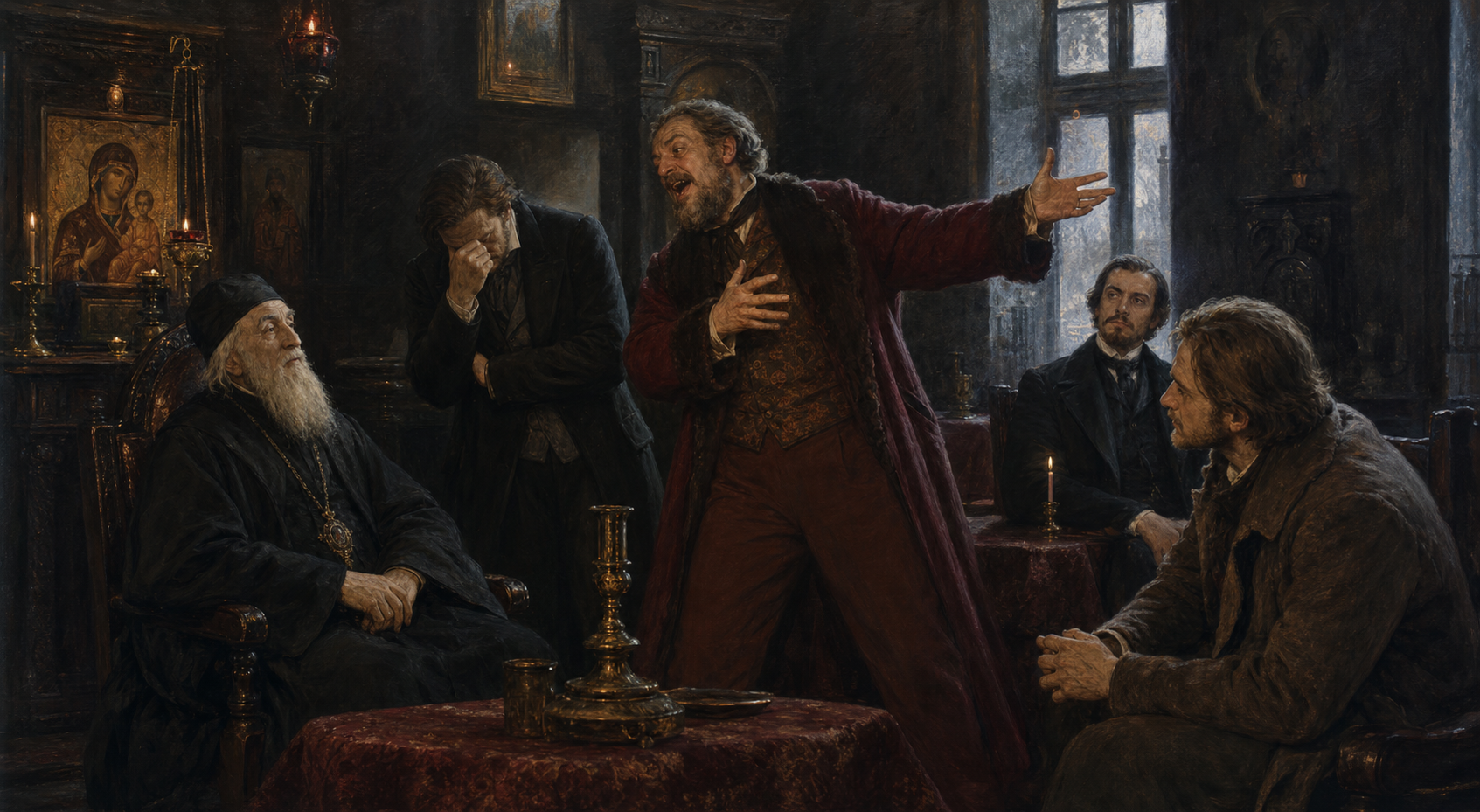
The family arrives at the monastery for a meeting meant to settle Dmitri's dispute with Fyodor. It fails almost immediately. Fyodor performs buffoonery, Dmitri arrives in fury, Ivan watches with inward distance, and Alyosha suffers because the people he loves cannot stop humiliating one another. Zosima's calm presence does not solve the conflict. Instead, it reveals how deep the conflict is.
2. Desire, money, and humiliation tighten around Dmitri
Dmitri's life becomes a storm of debt, love, resentment, and theatrical self-accusation. He is engaged to Katerina Ivanovna, but he is obsessed with Grushenka, a woman whose own history of humiliation has made her proud, wounded, and unpredictable. Katerina's relation to Dmitri is not simple devotion. She has saved his honor before, and that memory binds love to pride. Grushenka is not merely a temptress. She is a person who has learned to defend herself by controlling the men who want her.
Fyodor's house becomes the stage for an inheritance and romantic war. Dmitri believes money owed to him is hidden there. Fyodor waits for Grushenka and keeps cash ready to impress her. Smerdyakov, the epileptic servant widely understood to be Fyodor's illegitimate son, watches everything. He absorbs Ivan's ideas, resents his position, and learns how other people's words can become permission.
This is the brilliance of the plot: by the time Fyodor is murdered, Dmitri looks guilty because he has loudly imagined the crime. He has threatened his father, fought for money, stalked Grushenka, and behaved as if impulse were destiny. Yet Dostoyevsky keeps separating moral guilt from legal guilt. Dmitri is guilty of many things before the murder; whether he committed the murder is a different question.
3. Ivan's rebellion turns the family story into a philosophical crisis
Ivan's central conflict is not simple atheism. He is wounded by the suffering of children and revolted by any theory that asks him to accept innocent pain as part of a beautiful design. In his conversations with Alyosha, he refuses the universe not because he enjoys unbelief, but because he cannot morally reconcile himself to it.
His poem of the Grand Inquisitor gives the novel one of its most famous internal dramas. Christ returns to earth during the Spanish Inquisition, and the Grand Inquisitor arrests him. The Inquisitor's accusation is terrifying: Christ gave humanity freedom, but human beings cannot bear freedom. They want bread, miracle, authority, and relief from moral choice. The Inquisitor claims the church has corrected Christ's work by giving people certainty instead of freedom.
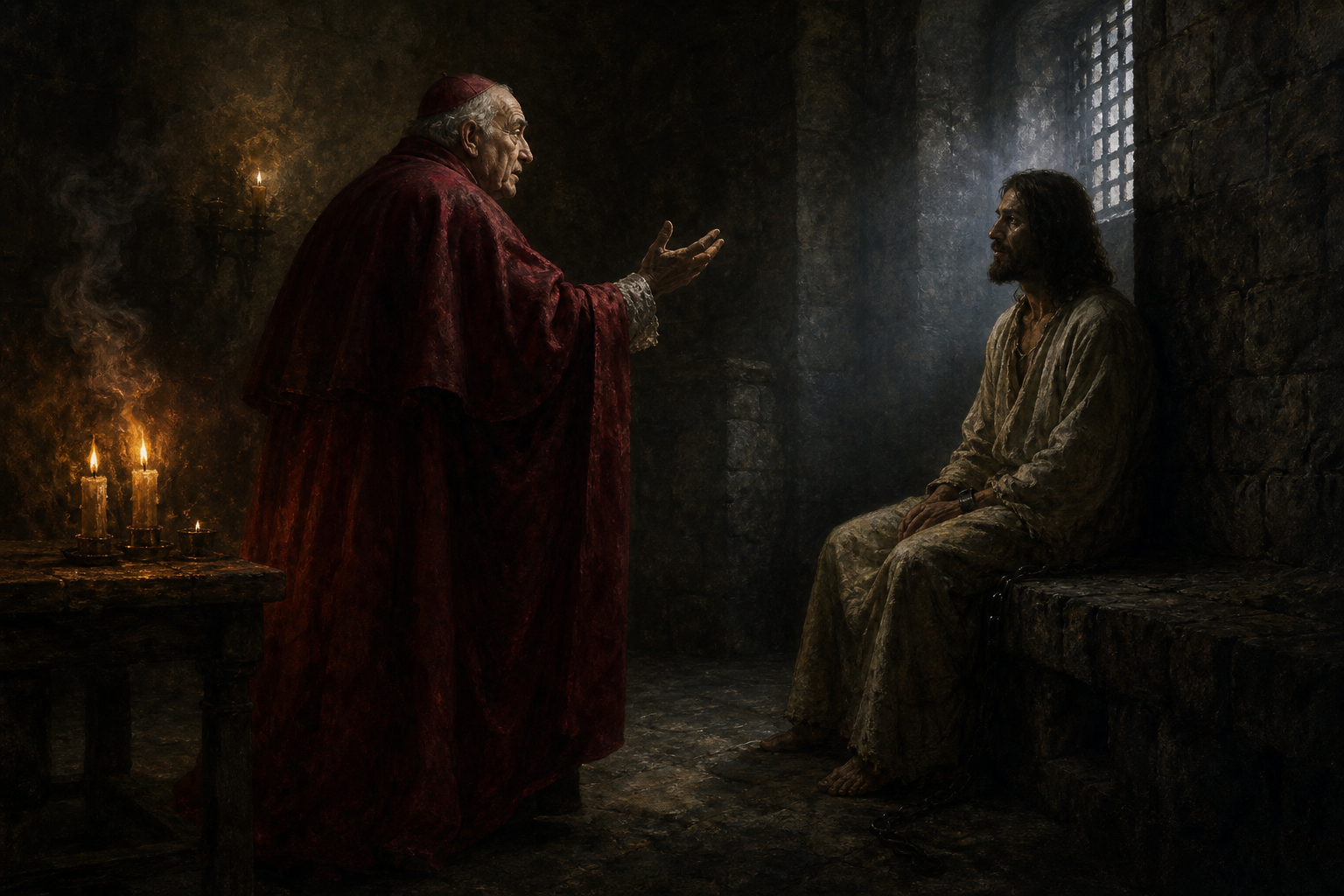
The parable matters because it is not just an argument against religion. It is an argument about politics, authority, psychology, and the fear of responsibility. Ivan can diagnose oppression brilliantly, but he cannot turn his diagnosis into love. Alyosha answers not with a proof, but with a kiss, echoing the silent Christ in the parable. The gesture does not refute Ivan logically. It shows another way of existing.
4. Zosima's teaching and Alyosha's fall from easy faith
Elder Zosima teaches responsibility, active love, humility, and the refusal of self-deception. His holiness is not presented as decorative piety. He insists that spiritual life must become action toward actual people, especially difficult people. He also teaches that each person is bound to all others, a claim that becomes crucial once the murder plot unfolds.
Yet Alyosha's faith is not left untouched. After Zosima dies, his body decays quickly, disappointing those who expected a miraculous sign. The monastery world turns petty; rivals use the odor as evidence against Zosima's sanctity. Alyosha is shaken because his faith has been attached, partly, to visible reassurance.
The turning point comes through Grushenka. Alyosha expects temptation or mockery, but he finds grief, vulnerability, and a sudden act of compassion. Grushenka's small "onion" story, about one tiny good deed that might save a soul, gives Alyosha a different form of faith. Not miracle, not prestige, not spiritual spectacle: a concrete act of mercy.
5. Murder, evidence, and the wrong shape of truth
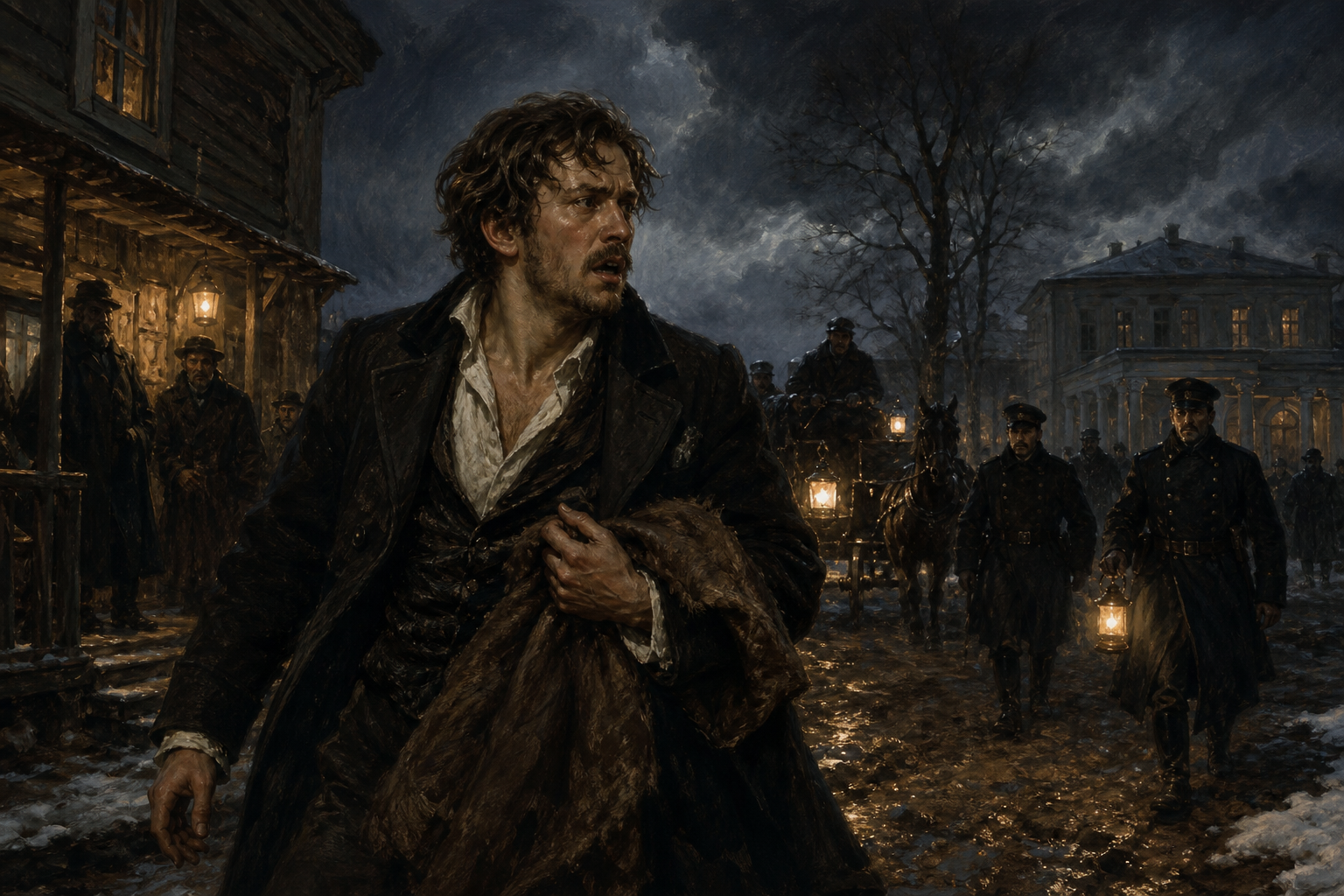
Fyodor Pavlovich is murdered, and everything points toward Dmitri. He has been desperate for money, he has threatened his father, he has appeared near the scene, and he has fled into a wild night with Grushenka. The legal case becomes a machine that turns character evidence into murder evidence. Dmitri's worst traits make him easy to convict.
Smerdyakov later tells Ivan that he committed the murder. The confession is devastating because it implicates Ivan in a different way. Ivan did not swing the weapon, but Smerdyakov claims Ivan's ideas helped clear the path. Ivan had spoken as if everything might be permitted without immortality; Smerdyakov converted philosophical possibility into criminal permission.
This does not make Ivan legally guilty. It makes him spiritually unable to hide behind abstraction. Ideas in this novel do not remain in books or conversations. They pass into servants' rooms, family grudges, courtrooms, and bodies.
6. The trial, the verdict, and the endingThis section contains spoilers.
Dmitri's trial becomes a public drama about Russia, masculinity, passion, psychology, and storytelling. The prosecution turns Dmitri's character into a chain of motive. The defense argues that the same evidence can be read differently, and that a passionate man can imagine violence without committing it. The spectators are not neutral. They want a story that satisfies their appetite for scandal.
Dmitri is convicted. The verdict is legally wrong if Smerdyakov's confession is true, but it is emotionally plausible to the court because Dmitri has lived so noisily near guilt. Dostoyevsky makes the reader sit with that discomfort. Dmitri is innocent of the murder and guilty of much else; the court can punish him for the wrong act while still touching something real in him.
Ivan collapses under the pressure of guilt, hallucination, and moral self-division. Smerdyakov kills himself, removing the clearest path to exoneration. Alyosha remains with the living, especially the schoolboys connected to Ilyusha, the sick child whose suffering creates one of the novel's tenderest counterplots.
The ending does not close with the courtroom but with Alyosha and the boys after Ilyusha's funeral. Alyosha asks them to remember love, kindness, and shared responsibility. That final movement matters. After a novel full of fathers who fail sons, brothers who wound brothers, and adults who turn ideas into weapons, the last hope is a community of memory formed around a child.
Major Characters
Dmitri Karamazov
passion, honor, and misread guilt
Dmitri is impulsive, sensual, and often self-destructive, but he also has a fierce hunger for honor. He can behave disgracefully and then condemn himself with theatrical sincerity. That mixture makes him both morally guilty and legally vulnerable.
His arc matters because Dostoyevsky asks readers to distinguish the guilt of desire from the guilt of action. Dmitri looks like a murderer because he has lived in the emotional neighborhood of murder, yet the novel keeps asking whether a court can read a soul accurately.
Ivan Karamazov
intellect, rebellion, and indirect responsibility
Ivan is the novel's most powerful thinker. His rebellion against innocent suffering is morally serious, not shallow skepticism. He refuses cheap harmony because he cannot accept a world purchased at the cost of children.
His tragedy is that thought cannot remain untouched by life. Smerdyakov's crime forces Ivan to face the possibility that ideas spoken in abstraction can become permission in another person's hands.
Alyosha Karamazov
active love under pressure
Alyosha is not a passive saint. He moves between monastery, family conflict, romantic humiliation, schoolboy cruelty, and public grief. His faith is tested by disappointment and by the pain of other people.
His strength is attention. He listens, absorbs, forgives, and returns. In a novel where many characters speak brilliantly but wound deeply, Alyosha's care becomes a form of interpretation.
Fyodor Pavlovich Karamazov
grotesque fatherhood and spiritual disorder
Fyodor is comic, obscene, selfish, and more dangerous than he first appears. He turns fatherhood into neglect and money into humiliation. He is not only a victim of murder; he is one cause of the moral climate that makes murder imaginable.
The novel does not ask readers to pity him easily. It asks them to notice how a corrupt center deforms everyone orbiting it.
Smerdyakov
resentment, servitude, and acted-out theory
Smerdyakov is quiet, watchful, humiliated, and deeply resentful. As the suspected illegitimate son, he belongs to the Karamazov family and is denied full recognition by it.
He is essential because he turns subtext into action. He listens to Ivan, studies everyone's weaknesses, and commits the hidden act that the louder characters seem to have prepared.
Grushenka and Katerina Ivanovna
wounded pride and competing forms of love
Grushenka and Katerina are often pulled into the men's drama, but both are more than objects of rivalry. Grushenka's apparent playfulness hides old humiliation and a capacity for sudden mercy. Katerina's sacrifice for Dmitri is tangled with pride, debt, and self-image.
Together they show how love in the novel can become generosity, domination, revenge, or self-sacrifice depending on whether it sees the other person clearly.
Best Quotes
Above all, don’t lie to yourself.
Zosima's warning cuts through the whole novel. Nearly every major character has a private story that protects the ego: Dmitri's noble passion, Ivan's clean abstraction, Katerina's sacrificial pride, Fyodor's comic shamelessness. Self-deception is dangerous because it lets a person feel injured while injuring others.
For the secret of man’s being is not only to live but to have something to live for.
The Grand Inquisitor uses this claim to argue that human beings need meaning more than bare survival. The line is powerful because both Ivan and Alyosha would agree that people need a reason to live; they differ over whether freedom and love can carry that burden.
Love in action is a harsh and dreadful thing compared with love in dreams.
This is one of the novel's clearest definitions of active love. Dream-love is flattering because it imagines sacrifice from a safe distance. Active love is harder because it requires patience with actual people, including boredom, insult, failure, and repetition.
God and the devil are fighting there and the battlefield is the heart of man.
Dmitri's sentence turns psychology into spiritual combat. The novel's battles are not only in courtrooms or inheritance disputes; they take place inside divided hearts that want purity and degradation at the same time.
Major Themes
Faith
Faith After Scandal
Alyosha's faith is not protected from ugliness. It survives the monastery scandal, family violence, and children's suffering by becoming active attention rather than easy certainty.
Doubt
Rebellion Against Innocent Suffering
Ivan's protest is one of the strongest moral arguments in the novel. His doubt begins in compassion for victims, especially children, which makes it harder to dismiss as pride alone.
Freedom
The Burden of Choice
The Grand Inquisitor claims people would trade freedom for bread and certainty. Dostoyevsky makes that claim frightening because it is psychologically plausible.
Guilt
Legal Guilt and Moral Responsibility
Dmitri's trial separates evidence from truth. Ivan's crisis separates action from influence. Zosima's teaching pushes responsibility beyond the narrow question of who physically committed the crime.
Family
Fathers, Sons, and Inheritance
The Karamazov family passes down more than money. It transmits neglect, appetite, resentment, shame, and spiritual hunger.
Dostoyevsky's Final Novel and Russian Context
Dostoyevsky published The Brothers Karamazov in 1879-1880, near the end of his life. It gathers many of his lifelong concerns: crime, confession, faith, socialism, Western rationalism, Russian religious identity, humiliation, and the psychology of freedom. The novel is large because Dostoyevsky refuses to keep those questions separate.
The Russian setting matters. The monastery, the provincial court, the servants' quarters, the schoolboys, and the salons all belong to one moral ecosystem. Ideas travel across class lines, but not equally. Ivan can treat a theory as a tormenting intellectual possibility; Smerdyakov can hear it as a license. That asymmetry is one reason the novel still feels politically alive.
The book also belongs to the tradition of the philosophical novel. Characters do not simply represent positions, but they do argue from the pressure of their lives. Ivan's doubt is inseparable from his sensitivity to cruelty. Zosima's teaching comes from spiritual practice and memory. Dmitri's language of sin comes from a body that cannot stop wanting.
Why It Still Matters
The novel lasts because it understands how modern people argue. We separate legal responsibility from moral atmosphere. We treat ideas as harmless until someone acts on them. We demand freedom and then become frightened by its weight. We want love, but prefer it in forms that flatter our self-image.
Sua's one-line take: The Brothers Karamazov is hard because it will not let anyone hide in a single explanation. Faith can become sentimental, doubt can become cruel, passion can become noble, law can miss truth, and a small act of love can matter more than a perfect theory.
FAQ: Summary, Ending, and Study Questions
What is The Brothers Karamazov about?
The Brothers Karamazov is about a corrupt father, his sons, and a murder accusation that exposes deeper questions about faith, doubt, desire, guilt, and responsibility. Dmitri is accused of killing Fyodor Pavlovich, but the novel is just as interested in Ivan's ideas, Alyosha's faith, Smerdyakov's resentment, and the moral atmosphere that surrounds the crime.
Who actually kills Fyodor Pavlovich?
Smerdyakov confesses to Ivan that he killed Fyodor Pavlovich. Dmitri is convicted because the evidence and his own violent behavior make him look guilty. The gap between legal verdict and moral truth is one of the novel's central tensions.
Why is the Grand Inquisitor chapter important?
The Grand Inquisitor chapter concentrates Ivan's argument about freedom, religion, authority, and human weakness. It asks whether people truly want freedom, or whether they would rather surrender it for security, bread, and certainty. Alyosha's response shows that Dostoyevsky does not answer Ivan with a simple lecture.
Is Alyosha the hero of the novel?
Yes, though he is an unusual hero. Alyosha does not defeat evil through power or argument. He carries Zosima's teaching into ordinary relationships, especially with the schoolboys at the end. His heroism is active love under pressure.
Read Next
Read Crime and Punishment for Dostoyevsky's earlier exploration of crime, confession, and moral theory; Anna Karenina for another Russian novel about family, desire, and society; and King Lear for a family tragedy where inheritance and failed fatherhood become catastrophic.
Adaptations
- 1958 film: a condensed Hollywood version focused on family melodrama and Dmitri's passion.
- 1969 Soviet film trilogy: a fuller adaptation that gives more room to the philosophical and courtroom material.
- Stage and radio adaptations: often center on the Grand Inquisitor, the trial, or the three brothers as competing spiritual types.