Guia de estudio de Frankenstein - AP Lit, SAT Reading, lectura atenta y practica de ensayo
Guia practica para AP English Literature, SAT Reading, IB English y ensayos escolares, con pasajes clave, recursos literarios, preguntas y tesis listas para trabajar.
Esta guia de estudio se traduce a partir del original en ingles y puede refinarse con el tiempo.
Esta guia esta hecha para estudiantes que necesitan hablar de Frankenstein con evidencia textual. Si quieres primero la explicacion completa de la trama, empieza con el articulo principal.
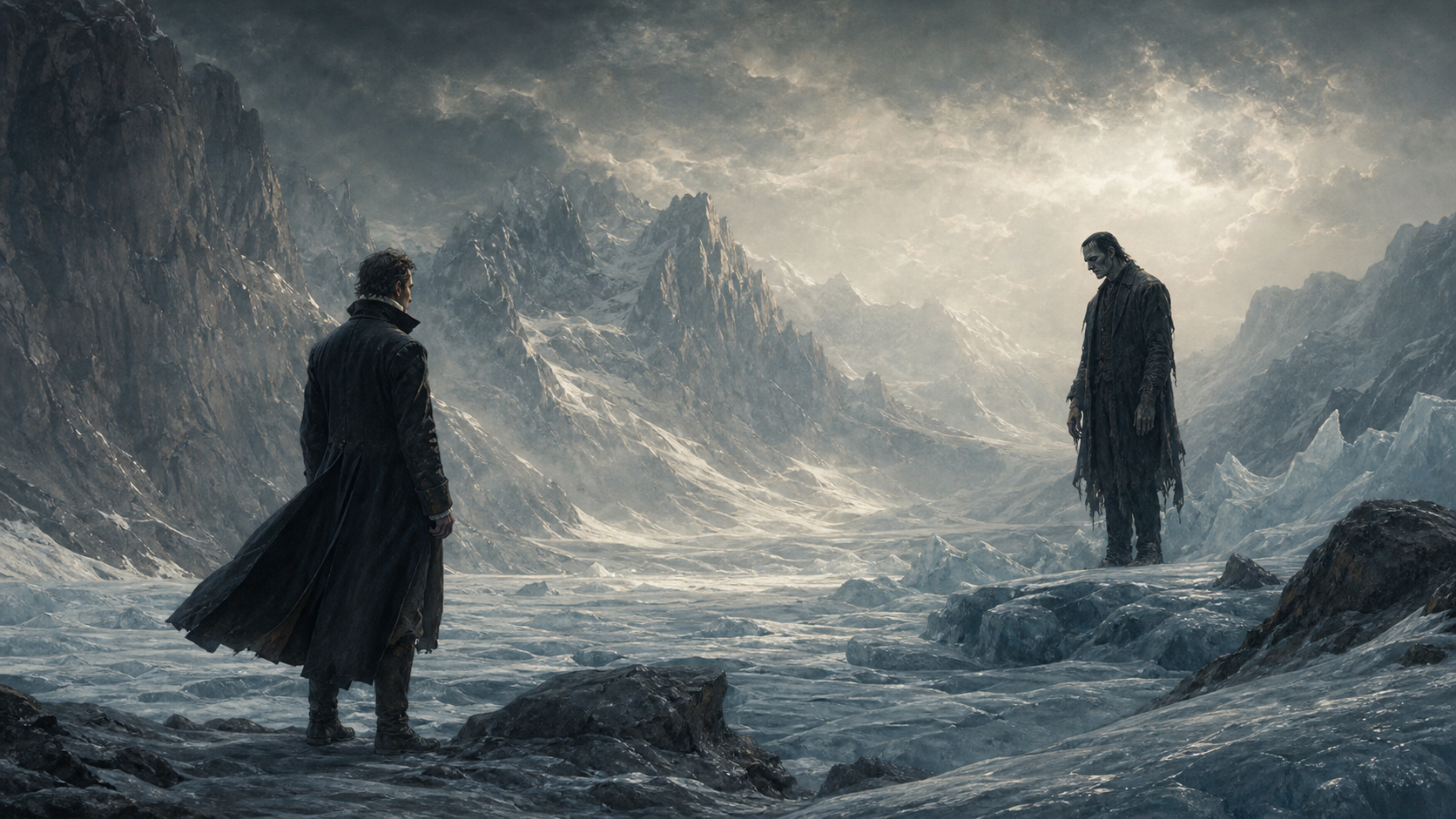
Para quien es esta guia
Esta guia es para estudiantes de AP English Literature, SAT Reading, IB English y cursos de secundaria o universidad que deben escribir sobre Frankenstein con evidencia. El objetivo no es memorizar la venganza de la criatura, sino explicar como Shelley construye significado mediante narracion enmarcada, ambiente gotico, paisaje romantico, alusion, diccion y contraste moral.
Al terminar, deberias poder:
- explicar por que Victor y Walton se reflejan
- usar citas breves sobre creacion, rechazo y venganza
- discutir a la criatura como victima y agente moral
- construir tesis defendibles sobre responsabilidad, aislamiento y ambicion
- responder preguntas estilo SAT sobre inferencia, funcion, tono y eleccion de palabras
1. Quick Review
- Original title: Frankenstein; Or, The Modern Prometheus
- Author: Mary Wollstonecraft Shelley
- Published: 1818; revised edition 1831
- Main settings: Geneva, Ingolstadt, the Alps, the Orkneys, Ireland, the Arctic
- Narrators: Walton, Victor Frankenstein, and the creature
- Central conflict: Victor creates life, abandons it, and is pursued by the consequences
- Core themes: creation and responsibility, isolation, ambition, appearance and judgment, revenge, education
- Common exam angles: frame narration, the Prometheus allusion, the creature's education, sublime nature, Victor's unreliable self-presentation
One-sentence summary:
Victor Frankenstein creates a living being and rejects him, turning scientific ambition into a tragedy about responsibility, loneliness, and revenge.
2. Estructura de trama para examenes
Exposicion
Las cartas articas de Walton introducen el patron central: un hombre solitario busca gloria mediante descubrimiento peligroso. Victor es rescatado del hielo y cuenta su historia como advertencia.
Desarrollo
Victor se obsesiona con poderes naturales ocultos, estudia en Ingolstadt, crea la criatura y la abandona. William muere, Justine es ejecutada y el experimento privado se vuelve sufrimiento publico.
Relato de la criatura
La criatura cuenta su propia historia. Aprende lenguaje y simpatia observando a los De Lacey, lee libros importantes e intenta entrar en la sociedad. El rechazo convierte su dolor en ira.
Climax
Victor destruye la companera femenina que habia empezado a crear. La criatura promete venganza y el conflicto pasa de peticion a castigo.
Descenso
Henry y Elizabeth son asesinados. La familia de Victor se derrumba, y el convierte su vida en persecucion.
Resolucion
Victor muere en el barco de Walton. La criatura lo llora y anuncia su propia muerte futura. Walton vuelve atras, eligiendo la vida humana antes que la gloria peligrosa.
Punto de examen: no escribas simplemente que la novela dice "la ciencia es mala". Una tesis mas fuerte: Shelley critica la ambicion cuando separa creacion y cuidado.
3. Pasajes originales clave para close reading
Estos pasajes no son solo citas memorables. Cada uno funciona como un punto de práctica para close reading: situación, hablante, dicción, sintaxis, imagen, tono y tema deben leerse juntos. En AP Lit, SAT Reading, IB English y ensayos escolares, una cita breve solo sirve si puedes explicar cómo sus palabras cambian el sentido de la escena y de la obra completa.
Lee cada pasaje en tres pasos. Primero, ubica la situación literal. Segundo, marca palabras o imágenes cargadas de sentido. Tercero, convierte esa observación en una afirmación defendible. El objetivo es pasar de quotation a commentary sin quedarse en resumen de trama.
Las notas de Context, Close reading y Essay use mantienen los términos de práctica en inglés porque el examen y el ensayo se escriben en inglés. La explicación en español te ayuda a entender qué función cumple cada línea y cómo usarla como evidencia.
Passage 1: Learn from me
Learn from me, if not by my precepts, at least by my example, how dangerous is the acquirement of knowledge.
Contexto: Victor turns his life story into a warning for Walton.
Close reading: Instructional diction makes narration ethically charged; suffering becomes evidence.
Uso en ensayo: Use it for frame narration, ambition, and knowledge versus wisdom.
Passage 2: Life and death appeared to me ideal bounds
Life and death appeared to me ideal bounds, which I should first break through, and pour a torrent of light into our dark world.
Contexto: Victor imagines creating life.
Close reading: Boundary and light imagery make discovery sound heroic while exposing hubris.
Uso en ensayo: Use it to critique ambition before responsibility.
Passage 3: a new species would bless me
A new species would bless me as its creator and source; many happy and excellent natures would owe their being to me.
Contexto: Victor imagines future beings praising him.
Close reading: The future-tense fantasy centers Victor’s glory before care.
Uso en ensayo: Use it for creation, pride, and ethical blindness.
Passage 4: Adam and fallen angel
I ought to be thy Adam; but I am rather the fallen angel, whom thou drivest from joy for no misdeed.
Contexto: The creature confronts Victor in the Alps.
Close reading: Biblical allusion gives him a language for innocence and exclusion.
Uso en ensayo: Use it for allusion, creature voice, and responsibility.
Passage 5: love and fear
If I cannot inspire love, I will cause fear; and chiefly towards you my arch-enemy, because my creator, do I swear inextinguishable hatred.
Contexto: The creature turns rejection into revenge.
Close reading: Balanced syntax makes violence a terrible substitute for denied affection.
Uso en ensayo: Use it to discuss sympathy without excusing revenge.
Passage 6: a hell within me
I, like the arch-fiend, bore a hell within me; and finding myself unsympathised with, wished to tear up the trees.
Contexto: The creature describes rejection’s aftermath.
Close reading: Allusion and inward imagery make monstrosity psychological before physical action.
Uso en ensayo: Use it for isolation, allusion, and destructive agency.
Passage 7: returning to England
I am returning to England. I have lost my hopes of utility and glory; I have lost my friend.
Contexto: Walton turns back from the Arctic quest.
Close reading: Plain syntax turns renunciation into the frame’s ethical answer to Victor.
Uso en ensayo: Use it for endings, restraint, and Walton as foil.
4. Procedimiento de Close Reading
Hacer close reading de Frankenstein significa preguntar quién cuenta la historia, quién escucha y qué responsabilidad intenta reclamar o evitar el hablante. Shelley construye la novela mediante narraciones encajadas: Walton escribe a su hermana, Victor advierte a Walton y la creature argumenta su caso ante Victor. Cada pasaje tiene hablante, audiencia y presión moral.
Paso 1: Identifica narrador y audiencia
Antes de interpretar una línea, pregunta quién habla y por qué. La advertencia de Victor a Walton no es consejo neutral; es el intento de un moribundo de convertir fracaso en instrucción. El discurso alpino de la creature no es solo queja; es un argumento dirigido al creador que la abandonó.
Paso 2: Coloca el pasaje en la cadena de responsabilidad
Ubica la escena dentro de la secuencia de ambición, creación, abandono, educación, rechazo, venganza y reconocimiento tardío. Esto evita que un párrafo diga solo "Victor is ambitious" o "the creature is lonely". La pregunta es qué responsabilidad se ha creado y quién la rechaza o acepta.
Paso 3: Marca palabras de creación, parentesco y juicio
Palabras como "creator", "source", "Adam", "fallen angel", "wretch", "daemon", "father", "friend" y "glory" cargan peso moral. Explica si la dicción crea parentesco, lo niega, juzga la apariencia o expone el deseo de Victor por reconocimiento.
Paso 4: Sigue allusion y autointerpretación
El subtítulo Prometheus, el lenguaje de Adam y fallen angel de la creature y la esperanza de renovación cercana a Lazarus dan a los personajes historias heredadas para su dolor. No te limites a nombrar la allusion. Pregunta qué papel quiere ocupar el hablante dentro de esa historia y si la novela lo confirma o lo complica.
Paso 5: Lee el setting como escala moral
Ingolstadt comprime el experimento secreto; los Alps agrandan la confrontación; las Orkneys aíslan la elección ética; el Arctic convierte la ambición en extremo congelado. Los settings de Frankenstein suelen volver visibles los estados interiores en una escala mayor.
Paso 6: Convierte observación en claim
Termina con una claim que nombre el recurso, el efecto local y el significado mayor. Evita "This shows science is bad". Una claim más fuerte explica cómo Shelley critica la creación cuando la ambición se separa del cuidado.
Ejemplo trabajado: el "torrent of light" de Victor
Cuando Victor dice: "Life and death appeared to me ideal bounds, which I should first break through, and pour a torrent of light into our dark world", la situación literal es su fantasía antes de la creación. La dicción de límites hace que vida y muerte parezcan fronteras que él tiene derecho a cruzar. La imagery de luz hace que el descubrimiento suene heroico, pero el verbo "pour" sugiere exceso antes de que aparezca la responsabilidad.
Eso produce una claim de párrafo:
Mediante imagery de límites y luz, Shelley hace que la ambición de Victor suene grandiosa antes de exponer su ceguera ética, mostrando que su verdadero fracaso no es la curiosidad misma, sino el deseo de crear sin cuidado.
5. Por qué importan los Literary Devices
En Frankenstein, los literary devices importan porque la novela pide al lector juzgar historias contadas por hablantes heridos, ambiciosos y defensivos. Los recursos ayudan a explicar no solo qué ocurre, sino cómo Shelley convierte la creación en una pregunta sobre responsabilidad.
Frame narration: una ambición advirtiendo a otra
Las cartas de Walton rodean la historia de Victor, de modo que la tragedia de Victor se convierte en prueba para otro explorador ambicioso. Usa frame narration para argumentar que contar una historia puede volverse advertencia ética cuando el oyente cambia de rumbo.
Light and boundary imagery: descubrimiento antes del cuidado
El lenguaje de Victor sobre "torrent of light" e "ideal bounds" hace que la creación suene liberadora antes de que la novela revele su costo. Usa esta imagery para ensayos que distingan conocimiento de sabiduría.
Prometheus allusion: poder creativo prohibido
El subtítulo conecta a Victor con un mito de poder robado y castigo. No significa que la invención sea automáticamente mala. Enmarca la creación como éticamente peligrosa cuando el creador busca gloria sin aceptar consecuencia.
Paradise Lost allusion: Adam y fallen angel
La creature dice que "ought to be" Adam, pero se siente como el fallen angel. Esa allusion le da lenguaje para inocencia y furia. Úsala para discutir simpatía sin borrar su violencia posterior.
Diction of naming: wretch, daemon, creature
Los nombres que Victor usa para el ser suelen deshumanizarlo antes de que el lector oiga su historia. Esta dicción sostiene ensayos sobre apariencia, prejuicio y la manera en que el lenguaje puede crear distancia moral.
Sublime setting: Alps, Orkneys y Arctic
Los Alps hacen que la confrontación entre creador y creación parezca moralmente vasta; las Orkneys aíslan la elección de Victor; el Arctic convierte la ambición en vacío casi mortal. Usa lo sublime para conectar paisaje con escala ética.
Foils: Walton, Clerval y Victor
Walton refleja el deseo de gloria de Victor, mientras Clerval une aprendizaje con amistad y cuidado. Los foils ayudan a mostrar que Shelley no está contra el conocimiento; está contra la ambición que se separa de las obligaciones humanas.
Irony: el creador se vuelve destructor
Victor sueña con que una nueva especie lo bendiga, pero su primer acto es abandono. Esta ironía es central para el ensayo porque expone la brecha entre gloria imaginada y responsabilidad real.
Balanced syntax: love and fear
La línea de la creature "If I cannot inspire love, I will cause fear" convierte afecto negado en venganza mediante estructura balanceada. Usa la sintaxis para explicar su agencia: el sufrimiento ayuda a entender su violencia, pero no la excusa.
6. Convertir análisis de personajes en lenguaje de ensayo
El análisis de personajes no es una lista de rasgos. Un personaje importa porque carga presión: deseo, miedo, regla social, conflicto moral, autoengaño o cambio. Un ensayo fuerte conecta personaje, técnica y tema.
Antes de escribir, usa cuatro preguntas:
- Role: ¿qué función cumple el personaje?
- Pressure: ¿qué deseo, miedo o regla lo presiona?
- Device: ¿cómo lo presenta el autor?
- Essay sentence: ¿qué claim puede sostener?
Victor functions as a creator who refuses responsibility, and Shelley's frame narration reveals how ambition becomes destructive when it rejects care.
Las tarjetas siguientes convierten notas de personaje en claims listos para desarrollar con evidencia textual.
Victor Frankenstein
creador, transgresor y testigo moral poco fiable
Victor busca conocimiento pero rechaza el cuidado. Su lenguaje convierte a menudo la responsabilidad en sufrimiento.
Frase de ensayo: La tragedia de Victor no esta en el descubrimiento mismo, sino en su intento de separar creacion, crianza y confesion.
La criatura
creacion rechazada y acusador moral
La criatura es victima y tambien agresor. Aprende simpatia, pero elige la venganza tras rechazos repetidos.
Frase de ensayo: Shelley vuelve moralmente compleja a la criatura al mostrar que su violencia es elegida, pero no nace en el vacio.
Robert Walton
ambicion que aun puede volver atras
Walton refleja a Victor, pero sobrevive porque escucha.
Frase de ensayo: La decision de Walton de volver da a la novela un contraste final entre ambicion destructiva y limite responsable.
Elizabeth Lavenza
amor domestico amenazado por el secreto
Elizabeth representa afecto y obligacion humana ordinaria.
Frase de ensayo: El destino de Elizabeth muestra que el secreto privado de Victor produce catastrofe familiar y publica.
Henry Clerval
amistad, imaginacion y cuidado
Henry es el contraste de Victor porque une aprendizaje y sentimiento humano.
Frase de ensayo: El cuidado de Clerval hacia Victor resalta el fracaso de Victor al no cuidar a su propia creacion.
7. Constructor de tesis para temas principales
Creacion
Responsabilidad
Tesis debil: Victor crea un monstruo.
Tesis fuerte: Shelley presenta la creacion como acto etico, mostrando que el mayor fracaso de Victor no es hacer vida sino abandonarla.
Ambicion
Conocimiento y limites
Tesis debil: La ciencia es mala.
Tesis fuerte: A traves de Victor y Walton, Shelley advierte contra la ambicion que persigue gloria ignorando comunidad, humildad y consecuencia.
Aislamiento
Soledad
Tesis debil: La criatura esta sola.
Tesis fuerte: El aislamiento de la criatura revela que la identidad se forma mediante reconocimiento, lenguaje y pertenencia social.
Voz
Narracion
Tesis debil: La novela tiene muchos narradores.
Tesis fuerte: La narracion en capas de Shelley dificulta el juicio moral al permitir que Victor, Walton y la criatura enmarquen el sufrimiento en sus propios terminos.
8. SAT Reading Sample
Estas son preguntas de práctica estilo SAT, no preguntas oficiales de College Board. Cada una se basa en una escena, pasaje o recurso recurrente de la obra.
Question 1
Victor's warning to Walton suggests knowledge is dangerous when it is:
- A. shared through letters
- B. connected to family memories
- C. pursued without responsibility or human connection
- D. studied abroad
Answer: C. Victor does not condemn knowledge itself; he warns Walton about discovery pursued past human limits and obligations. A, B, and D mention details around the frame but not the ethical danger in Victor's warning.
Question 2
In "ideal bounds," "bounds" most nearly means:
- A. limits
- B. decorations
- C. promises
- D. rewards
Answer: A. Victor is imagining life and death as limits he can break through. B, C, and D do not fit the boundary image that makes his ambition sound transgressive.
Question 3
"A new species would bless me" reveals Victor's:
- A. fear of fame
- B. ordinary medical interest
- C. commitment to family duty
- D. desire to be adored as creator
Answer: D. The imagined blessing centers Victor's glory as creator before he considers care for the being he will make. A and B understate the ambition, and C says the opposite of his isolation from family duty.
Question 4
The creature's Adam allusion functions to:
- A. prove legal innocence
- B. frame abandonment as broken creator-creation bond
- C. make the Alps peaceful
- D. show he has no language
Answer: B. By comparing himself to Adam, the creature argues that Victor has violated a creator's duty to his creation. A shifts to law, C ignores the confrontation, and D contradicts the creature's learned eloquence.
Question 5
Victor's first response after animation supports the claim that his central failure is:
- A. lack of intelligence
- B. excessive patience
- C. abandonment rather than discovery alone
- D. obedience to professors
Answer: C. The key failure is that Victor flees from the being he has made, turning creation into neglect. A reduces the issue to intellect, B reverses his impatience, and D misses the ethical break after animation.
Question 6
The De Lacey episode shows the creature:
- A. cannot learn
- B. wants wealth above all
- C. controls society
- D. develops sympathy and language before rejection
Answer: D. Watching the De Laceys teaches the creature language, care, and social feeling before rejection hardens him. A denies his education, and B and C invent motives or power he does not have.
Question 7
Victor's silence during Justine's trial is best understood as:
- A. guilt becoming another form of violence
- B. proof of innocence
- C. comic misunderstanding
- D. Walton's failure
Answer: A. Victor's private knowledge does not save Justine, so his silence lets his experiment harm an innocent person through the legal system. B mistakes his guilt for innocence, C trivializes the scene, and D belongs to the frame plot.
Question 8
The Arctic setting at the end symbolizes:
- A. domestic comfort
- B. social popularity
- C. isolation and ambition at an extreme
- D. religious certainty
Answer: C. The Arctic turns ambition into a frozen limit, isolating Victor, the creature, and Walton at the edge of survival. A and B contradict the setting, and D is not the frame's main symbolic work.
Question 9
Walton's return home shows that:
- A. all exploration is foolish
- B. Victor's warning has been heard
- C. the creature controls the ship
- D. Elizabeth is unrelated
Answer: B. Walton turns back where Victor did not, making the frame a test of whether a listener can learn from another man's tragedy. A overgeneralizes, C invents control, and D ignores the family losses that shape the warning.
Question 10
"If I cannot inspire love, I will cause fear" marks a shift from:
- A. education to farming
- B. science to comedy
- C. ambition to success
- D. longing for affection to chosen revenge
Answer: D. The balanced line turns denied love into deliberate intimidation, showing the creature's movement from appeal to revenge. A and B are unrelated, and C wrongly turns the threat into triumph.
Question 11
Which evidence best supports dehumanization?
- A. Victor calling the creature "wretch" or "daemon"
- B. Clerval studying languages
- C. Walton dating letters
- D. Elizabeth waiting
Answer: A. Victor's labels deny the creature personhood before readers hear the creature's own narrative. B, C, and D may matter elsewhere, but they do not show dehumanizing diction.
Question 12
The Prometheus subtitle connects Victor to:
- A. a comic traveler
- B. a neutral narrator
- C. forbidden creative power and punishment
- D. a caretaker
Answer: C. Prometheus evokes transgressive creative power and the suffering that follows. A and B do not fit the mythic frame, and D makes Victor more responsible than his actions show.
Question 13
The creature's books help Shelley show:
- A. his inability to speak
- B. his moral and emotional development
- C. his lack of memory
- D. his total innocence
Answer: B. The books give the creature language, history, comparison, and moral imagination, making rejection more tragic. A and C deny his learning, and D overstates innocence after his revenge begins.
Question 14
Victor's narration is unreliable because it:
- A. reports no events
- B. belongs to the creature
- C. avoids emotion
- D. mixes confession with self-defense
Answer: D. Victor warns Walton and confesses failure, but he also frames himself as uniquely suffering and often avoids full responsibility. A is false, B assigns narration to the wrong speaker, and C misses the emotional intensity of his account.
Question 15
The Alps scenes connect nature with:
- A. moral scale and sublime confrontation
- B. school routine
- C. commerce
- D. comic relief
Answer: A. The Alpine landscape enlarges the confrontation between creator and creature, making their moral conflict feel vast. B, C, and D do not fit the sublime setting.
Question 16
Henry Clerval serves as Victor's foil because he:
- A. rejects friendship
- B. commits the crime
- C. connects learning with care
- D. narrates the frame
Answer: C. Clerval's learning is tied to friendship, language, and human sympathy, which contrasts Victor's isolating ambition. A and B reverse his role, and D belongs to Walton.
Question 17
"Fallen angel" suggests the creature sees himself as:
- A. Victor's chemistry teacher
- B. unable to read
- C. a successful explorer
- D. excluded from an intended place
Answer: D. The phrase lets the creature describe himself as cast out from a role he believes should have included love and belonging. A gives him the wrong role, B contradicts his education, and C imports Walton's explorer identity.
Question 18
Shelley's critique of ambition is best stated as:
- A. all curiosity is immoral
- B. ambition is dangerous when separated from responsibility
- C. knowledge never changes anyone
- D. exploration always succeeds
Answer: B. Victor and Walton show that curiosity becomes dangerous when it ignores human obligation, not that all inquiry is wrong. A is too broad, and C and D contradict the plot.
Question 19
The frame narrative functions by:
- A. making Victor's tragedy a test for another ambitious listener
- B. silencing the creature
- C. removing Walton
- D. proving Victor objective
Answer: A. Walton hears Victor's warning and must decide whether to repeat or resist the same pursuit of glory. B is false because the creature speaks, C erases the frame, and D ignores Victor's self-defense.
Question 20
The final ship scene emphasizes:
- A. comic closure
- B. victory for science
- C. the cost of abandonment for creator and creation
- D. Elizabeth's authority
Answer: C. Victor dies after pursuing the being he abandoned, and the creature mourns the creator who rejected him. A and B misread the ending's grief, and D names a character who is already dead.
9. AP Lit Essay Questions
Usa estos prompts para practicar cómo construir un argumento literario defendible desde escenas específicas, no solo desde resumen de trama.
Essay Question 1
Walton’s letters frame Victor’s confession before readers meet Victor directly. Analyze how Shelley uses frame narration to turn one man’s tragedy into a warning for another ambitious listener. Include one detail from Walton and one from Victor.
Essay Question 2
Victor’s ambition begins as intellectual aspiration but becomes a refusal of responsibility. Explain how this shift shapes the novel’s central conflict. Use two scenes that show discovery and avoidance.
Essay Question 3
The creature’s education changes him from a silent body into a reader, speaker, and moral interpreter. Analyze how this education changes the reader’s judgment of him. Include one De Lacey episode detail.
Essay Question 4
The Prometheus allusion appears in the novel’s title and moral design. Analyze how Shelley uses the myth to frame creation as transgression, gift, punishment, or responsibility. Use evidence from Victor’s experiment and its aftermath.
Essay Question 5
Creation in the novel is not condemned simply because it is unnatural; it is condemned because it is abandoned. Analyze how Shelley presents creation as an ethical responsibility. Include Victor’s first reaction to the creature.
Essay Question 6
Isolation shapes both Victor and the creature, but it affects them differently. Compare how isolation turns private suffering into public harm. Use one scene for each character.
Essay Question 7
Gothic settings such as laboratories, mountains, storms, and Arctic ice do more than create mood. Analyze how one or two settings externalize secrecy, guilt, fear, or pursuit.
Essay Question 8
Nature and the sublime sometimes console Victor and sometimes expose his limits. Analyze how Shelley uses landscape to measure human ambition against forces larger than the self.
Essay Question 9
Victor’s silence during Justine’s trial is one of the novel’s central ethical failures. Analyze how secrecy becomes another form of violence. Include one consequence for Victor and one for an innocent person.
Essay Question 10
The De Lacey episode briefly imagines sympathy before rejection returns. Analyze how this episode complicates the creature’s role as both victim and future aggressor.
Essay Question 11
The creature’s revenge is understandable in motive but destructive in action. Analyze how Shelley creates sympathy without excusing violence. Use two moments from the creature’s narrative.
Essay Question 12
Victor’s narration is confession, warning, and self-defense at once. Analyze how his storytelling shapes the reader’s judgment. Include one moment where his language seems self-protective.
Essay Question 13
Walton mirrors Victor, but he also makes a different final choice. Analyze how Walton’s role changes the meaning of Victor’s warning. Use the frame ending as evidence.
Essay Question 14
Choose a secondary character, such as Elizabeth, Justine, Clerval, or William. Explain how that character reveals the human cost of Victor’s private ambition.
Essay Question 15
The creature reads texts such as Paradise Lost and uses them to understand himself. Analyze how allusion gives him a language for identity, grievance, and judgment.
Essay Question 16
The novel distinguishes knowledge from wisdom. Analyze how Victor can discover the secret of life while failing to understand care, limits, and consequence.
Essay Question 17
Appearance shapes moral judgment throughout the novel. Explain how Shelley critiques a society that sees the creature’s body before hearing his speech.
Essay Question 18
Choose a morally flawed character for whom Shelley still creates sympathy. Analyze how the novel asks readers to hold compassion and judgment together.
Essay Question 19
The ending leaves Victor dead, Walton changed, and the creature speaking over a future disappearance. Analyze how this ending revises Victor’s warning about ambition.
Essay Question 20
Analyze how Frankenstein critiques creation without care. Your answer should connect the animation scene, the creature’s abandonment, and the final consequences of that abandonment.
10. Model Thesis Bank
Use these as models, then adapt them to the exact question.
- Shelley uses Walton's frame narrative to show that Victor's tragedy can become a warning only if another ambitious man chooses to listen.
- Victor's desire to break the bounds of life and death becomes tragic because it separates discovery from responsibility.
- The creature's education makes him morally legible, forcing readers to judge both his violence and the rejection that shaped it.
- The Prometheus allusion presents Victor's experiment as a modern act of transgression whose punishment is intimate rather than cosmic.
- Shelley presents creation as an ethical act by making abandonment, not animation, Victor's decisive failure.
- Isolation transforms both Victor and the creature, turning private suffering into public harm.
- Gothic settings externalize Victor's secrecy, guilt, and fear of what he has made.
- The sublime landscapes of the Alps and Arctic measure human ambition against forces larger than the self.
- Victor's silence during Justine's trial shows that guilt without confession can become another form of harm.
- The De Lacey episode proves that the creature's monstrosity is socially produced as well as personally chosen.
- Shelley makes revenge destructive by showing that it gives the creature power while emptying him of hope.
- Victor's narration is compelling but self-protective, turning confession into a form of self-dramatization.
- Walton mirrors Victor's ambition but avoids Victor's fate by accepting limits.
- Elizabeth's death shows that Victor's private ambition destroys the domestic world he claims to value.
- The creature's biblical allusions transform him from silent object into a reader capable of judging his creator.
- The novel distinguishes knowledge from wisdom by showing that Victor can discover life without understanding care.
- Shelley critiques a society that judges by appearance before allowing speech.
- The creature's moral complexity lies in the gap between the sympathy he deserves and the violence he chooses.
- Walton's return home turns Victor's tragedy into a final argument for responsible restraint.
- Frankenstein warns that creation without care produces not mastery, but abandonment returned as judgment.
11. Vocabulario academico para ensayos
- frame narrative: estructura en la que un relato contiene otro
- transgression: cruce de un limite moral, natural o social
- sublime: grandeza abrumadora que produce asombro, miedo o escala moral
- allusion: referencia indirecta a otro texto, mito o tradicion
- dehumanization: tratar a una persona como menos que humana
- moral agency: capacidad de elegir y ser responsable
- alienation: separacion de sociedad, afecto o autocomprension
- hubris: orgullo excesivo que lleva a la caida
- ethical responsibility: deber creado por las propias acciones o poder
- unreliable narration: narracion moldeada por sesgo, autodefensa o perspectiva limitada
- foil: personaje que resalta a otro por contraste
- Gothic: modo literario de miedo, secreto, oscuridad y perturbacion psicologica
- Romanticism: movimiento que enfatiza imaginacion, naturaleza, emocion y experiencia individual
- vengeance: venganza perseguida como justicia pero capaz de producir mas dano
- nurture: cuidado, educacion y apoyo social necesarios para el desarrollo
- marginalization: exclusion del reconocimiento o la pertenencia social
- self-fashioning: construccion deliberada de identidad
- consequence: resultado o costo de una accion
- pathos: apelacion emocional, especialmente mediante sufrimiento
- critique: argumento que expone limites, fallas o contradicciones