A Room with a View - A View Is Also a Choice
Forster turns a Florence holiday into a sharp comedy about self-deception, class, desire, and emotional truth.
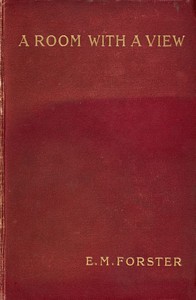
Sua's Quick Take
A Room with a View looks like a light love story, but Forster is really asking whether a person can stop lying about what she wants.
The "view" in the title is not only scenery. It is the ability to look beyond social correctness and see life, desire, and other people more honestly.
What the Book Is Really About
E. M. Forster's A Room with a View was published in 1908. It follows Lucy Honeychurch, a young Englishwoman traveling in Florence with her cousin and chaperone Charlotte Bartlett. In Italy, Lucy encounters George Emerson and his unconventional father. In England, she becomes engaged to the refined Cecil Vyse, only to discover that refinement can become another kind of confinement.
The novel has two broad movements. The first is set in Florence and the surrounding Italian landscape, where Lucy's senses begin to open. The second returns to England, where social expectation, family life, and self-deception try to contain what Italy awakened.
Forster's comedy is gentle but precise. The novel satirizes English tourists who travel abroad without leaving their class assumptions behind. It also studies a private moral problem: Lucy keeps trying to call her feelings by safer names. Her real conflict is not simply George versus Cecil. It is truth versus self-deception.
Plot Summary
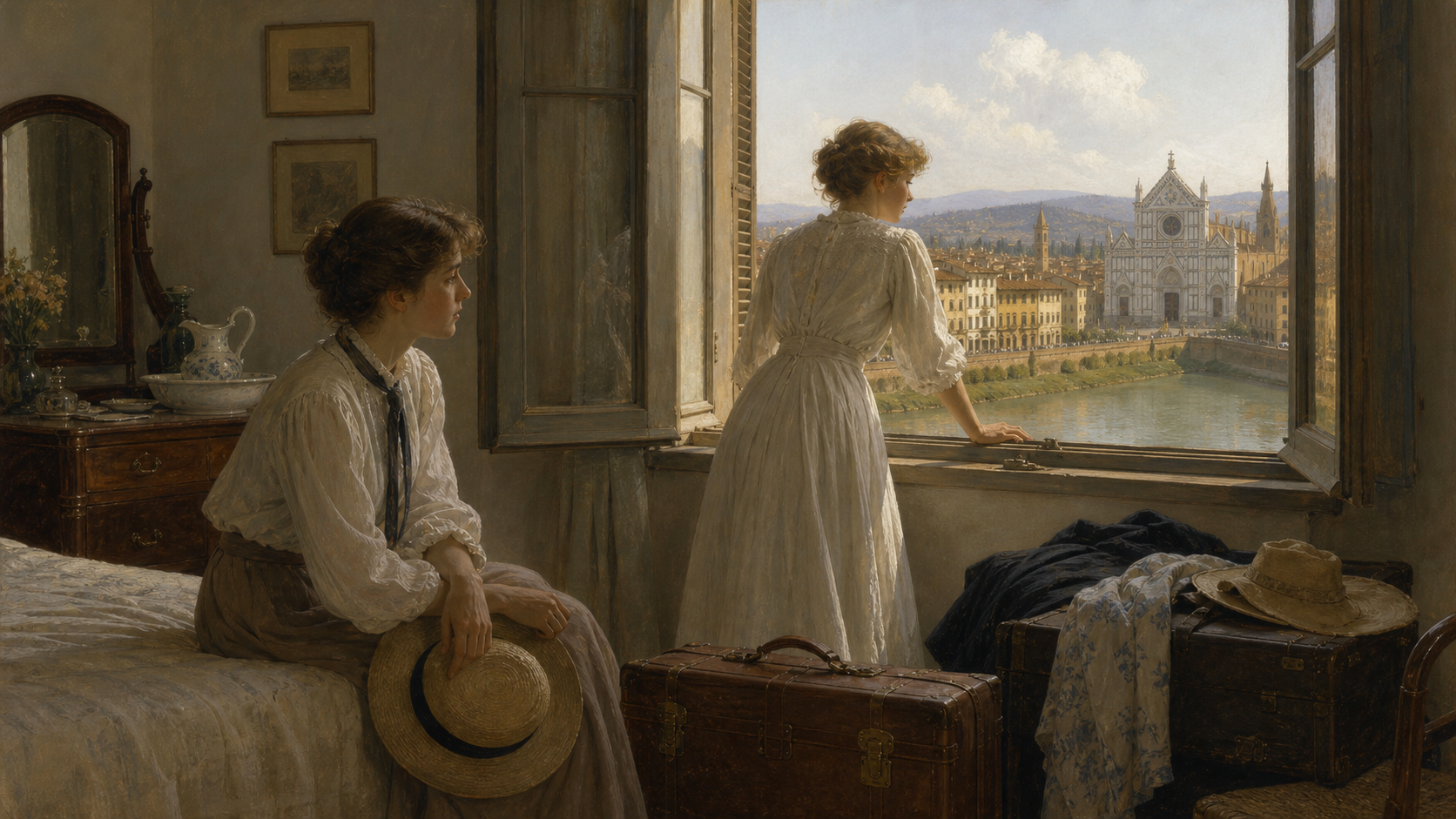
1. Florence begins with a room that has no view
Lucy Honeychurch arrives in Florence with Charlotte Bartlett, her older cousin and chaperone. They expected rooms with a view, but the Pension Bertolini gives them rooms without one. The complaint sounds small, almost comic, yet it opens the novel's central symbol. A view is not only a pleasant landscape; it is a way of seeing more widely.
The pension is full of English travelers who have brought England with them. They discuss manners, propriety, class, and one another's behavior while standing inside a foreign city filled with art, sunlight, religion, and public life. Forster's satire begins here. Travel does not automatically make people freer. Many of the tourists carry their social cages across borders.
George Emerson and his father immediately disturb the atmosphere. Mr. Emerson offers to exchange rooms because he and George have the view Lucy and Charlotte wanted. The offer is direct and generous, but Charlotte worries about obligation, impropriety, and how the gesture will look. The Emersons are kind, yet they are socially awkward because they do not wrap kindness in the expected codes.
Lucy is both unsettled and drawn to them. George is quiet, intense, and unhappy. Mr. Emerson is blunt, humane, and impatient with false politeness. They contrast with the more polished figures around Lucy. Forster does not make them perfectly graceful; he makes their awkwardness a kind of truth.
Florence begins to work on Lucy. She encounters churches, streets, music, paintings, and unfamiliar emotional directness. Her piano playing is especially important. In speech, Lucy is often obedient and evasive. In music, she reveals force, feeling, and freedom. Forster suggests that Lucy's real self is already present, but not yet admitted in language.
Santa Croce and the city's public spaces also matter because Lucy is forced out of controlled tourism. She gets lost, meets people outside the expected script, and begins to feel the difference between living art and merely consuming it as culture. Italy becomes a place where feeling breaks through English arrangement.
The opening also establishes Lucy between two languages. One is the language of propriety: obligation, tact, reputation, and correct distance. The other is the language of life: need, feeling, music, sunlight, and directness. Lucy has been trained in the first, but her temperament keeps answering the second. The plot will keep returning to this tension until she can speak truthfully in her own voice.
2. Violence, rescue, and the first shock of emotional truth
In the Piazza della Signoria, Lucy witnesses a stabbing. The sudden violence shocks her, and George helps her afterward. This scene pushes the novel beyond polite tourism. Florence is no longer only art, views, and guidebooks. It is a place where life and death appear without social editing.
George throws away the photographs Lucy dropped because they are stained. The action is strange but symbolically important. He does not preserve the pretty tourist image when reality has marked it. Lucy cannot easily decide whether he is rude, kind, intense, or frightening. That uncertainty is part of his power in the novel. He resists the categories she has been trained to use.
Charlotte becomes anxious about the intimacy between Lucy and George. She wants to protect Lucy, but protection often becomes control. Charlotte's first instinct is not to ask what Lucy feels, but to ask what the situation might mean socially. Her fear is not absurd in her world. A young woman's reputation can be damaged by appearance as much as by fact. Still, her caution keeps Lucy from honest self-knowledge.
The countryside excursion intensifies everything. In a field outside Florence, George kisses Lucy. The scene is beautiful, sudden, and emotionally disruptive. It is not simply a romantic high point. It is the moment Lucy's body and feeling move faster than her social language can manage. She is attracted to George, but to admit that would require admitting that her carefully arranged self is incomplete.
Charlotte intervenes, and Lucy leaves Italy. On the surface, this solves the problem. The embarrassing event can be treated as a mistake, a youthful disturbance, an Italian excess. But the reader understands that Lucy has not escaped anything. She has only changed the name of the conflict. George becomes something she tries not to remember, precisely because he is connected to a truth she is not ready to speak.

3. England restores order, and Cecil Vyse offers a respectable cage
Back in England, Lucy returns to Windy Corner, her family home. The atmosphere is affectionate, comfortable, and recognizably English. Her mother is loving, her brother Freddy is lively, and the domestic setting offers safety after Italy's emotional disturbance. But Forster makes this safety double-edged. It can comfort Lucy, and it can help her hide.
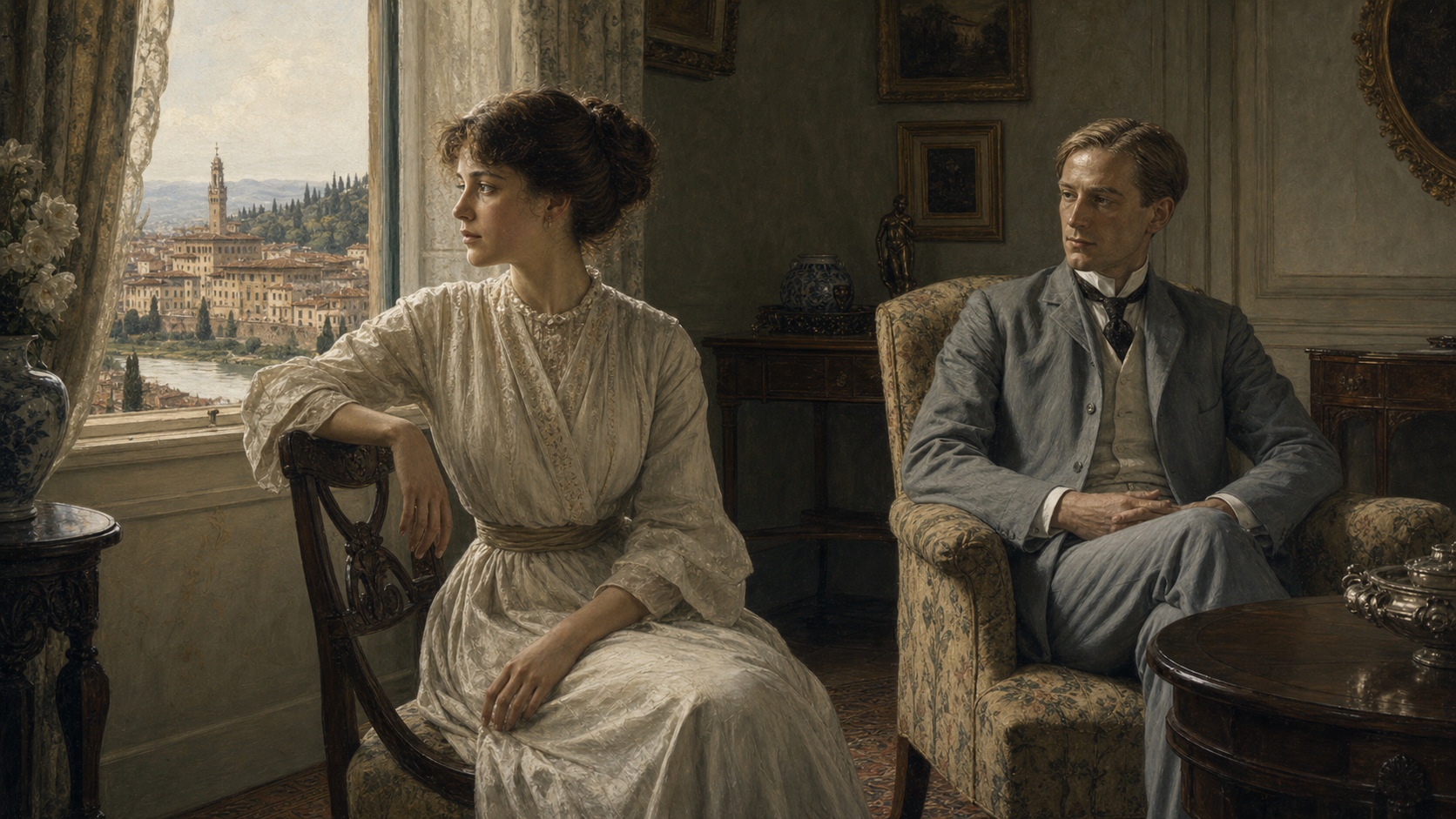
Cecil Vyse becomes Lucy's fiance. Cecil is refined, cultivated, intellectual, and socially appropriate. He has taste. He knows how to speak about art and manners. Yet his elegance has a cold quality. He tends to view Lucy as an object to be admired and improved rather than as a living person with unruly desires.
Lucy's engagement to Cecil is therefore not pure love. It is also self-protection. Cecil represents a life that can explain her away from George. He is the kind of man her world can understand. He offers order after confusion, form after feeling. That makes him attractive not because he is right for her, but because he allows her to avoid the question Italy raised.
Forster is careful with Cecil. He is not a melodramatic villain. He is often ridiculous, but not evil. His problem is abstraction. He loves Lucy as an aesthetic idea. He admires her freshness, but wants to frame it. He appreciates music and culture, but he does not easily join ordinary life. He looks down on Freddy, on the Honeychurch household's looseness, and on the less polished forms of vitality around him.
The Emersons re-enter Lucy's English world through an irony Cecil helps create. He encourages their move into the neighborhood partly out of playful superiority, not realizing that he is bringing George back into Lucy's life. The plot uses coincidence, but the coincidence feels morally pointed: what Lucy has tried to suppress returns through the very social world she trusted to protect her.
George's presence unsettles the English setting. Freddy likes him. George participates in physical, spontaneous life in a way Cecil cannot. The famous bathing episode, with its rough freedom and comic energy, contrasts sharply with Cecil's stiffness. Forster links truth to bodies, laughter, nature, and direct experience, while falsehood often appears in over-managed speech.
4. Lucy breaks with Cecil but still lies about George
As George returns, Lucy's self-deception becomes harder to sustain. George tells her that Cecil does not truly see her. His criticism is blunt, but it is not merely jealous. Cecil treats Lucy like something to arrange, not someone to encounter. George's words hurt because they name what Lucy has already begun to feel.
Lucy rejects George, but rejection does not equal clarity. She tells herself that George is impossible, that the situation is improper, that she must protect order. Yet every reason avoids the central fact: she is moved by him. Forster is interested in the grammar of evasion. Lucy can speak many sentences that sound reasonable while still avoiding the truth.
Her lies are layered. She wants to say that Florence is over, that George's kiss was merely improper, that Cecil's unsuitability has nothing to do with George, and that a trip to Greece would solve the problem. Each statement contains a little truth, which makes the larger falsehood harder to expose. Lucy is not ignorant of her feeling; she is intelligent enough to rename it.
Her break with Cecil is a major step. She sees that he has been patronizing not only her but her family and her way of life. He wants Lucy as a beautiful possession within his cultivated world. She realizes that to marry him would be to become less alive. The engagement ends, and Cecil, to his credit, partially understands the justice of her decision. He is wounded, but he is not entirely blind.
Still, Lucy tries to separate the breakup from George. She wants to say that she rejects Cecil only because Cecil is wrong, not because George is right. This distinction matters. She has left one falsehood but not yet accepted the positive truth of her desire. She remains trapped in a second, subtler lie.
Cecil and George are not simply bad choice and good choice. Cecil offers safety, polish, and approval, but that safety makes Lucy smaller. George offers emotional risk, but the risk forces her toward greater honesty. Forster turns romance into a question of perception: with whom does Lucy become more truthful about herself?
Charlotte remains a complicated figure in this process. She appears to guard propriety and restrain Lucy, yet the later plot hints that she may understand more than she says. Her interference may not be only repression; it may also contain a distorted wish for Lucy to reach a freedom Charlotte herself never had. Forster leaves her morally ambiguous in a productive way.
5. Mr. Emerson names the truth Lucy cannot say
Mr. Emerson becomes the novel's crucial moral voice near the end. He is not socially elegant, but he has emotional honesty. He sees that Lucy is not merely confused; she is lying to herself. His intervention matters because it shifts the conflict from romance to truth. The question is not simply whether Lucy will choose George. The question is whether she will stop calling fear by respectable names.
In conversation with Mr. Emerson, Lucy is forced to face what she has hidden. She does not love Cecil. She has not forgotten George. Her plan to leave for Greece is another form of avoidance. She keeps trying to move geographically in order to avoid moving morally. Mr. Emerson's directness breaks through the polite evasions that have protected her.
The scene is powerful because it does not make love a decorative emotion. Love becomes connected to truthfulness. Forster suggests that a person who lies about love may also deform her whole relation to life. Lucy's problem is not that she has chosen the wrong man in a narrow romantic sense. Her problem is that she has allowed social fear to teach her how to misname herself.
Once Lucy admits the truth, the plot can resolve. But the admission is not painless. She has to accept that her earlier behavior hurt people, that her family may not approve, and that Charlotte's role remains tangled. Freedom in the novel is not a clean escape from consequences. It is the decision to live without the central lie.
6. The final room restores the view
The ending returns Lucy and George to Florence, in a room with a view. The structure is elegant. At the beginning, Lucy wanted a room with a view but could not fully claim the larger life it symbolized. At the end, she has the view because she has chosen it. The physical room becomes the outward sign of an inward transformation.
The ending is romantic, but Forster does not erase all discomfort. Lucy's family has been hurt. Social approval is uncertain. Charlotte's motives remain complex. The marriage to George is not presented as entry into a world with no conflict. Instead, it is a truer world because it is less built on denial.
The title therefore gathers the whole novel. A room is a social position, an emotional habit, a class interior, a script for living. A view is the possibility of looking beyond that script. Lucy's growth is the movement from receiving rooms assigned by others to choosing the view she can actually live with.
The return to Florence also changes the meaning of travel. At the beginning, Lucy was a tourist being shown culture by guides, cousins, and conventions. At the end, she inhabits the place as part of her own chosen life. The view is no longer a commodity promised by a pension; it is the outward form of a decision she has finally made.
7. Ending and final meaningThis section contains spoilers.
Lucy breaks with Cecil, admits her love for George, marries him, and returns with him to Florence. The final room with a view reverses the opening complaint and turns it into a symbol of chosen freedom.
The ending is not only about getting the right lover. It is about Lucy escaping the self-deception that made the wrong life seem respectable. The view is emotional honesty, not just scenery.
Major Characters
Lucy Honeychurch
a young woman learning to stop lying to herself
Lucy is polite, musical, impressionable, and more passionate than her social training allows. Her real self appears first in music and instinct before she can admit it in words.
Her growth is not simply choosing George. It is learning to recognize when propriety has become self-deception.
George Emerson
direct feeling and emotional truth
George is awkward, intense, and often melancholy. He lacks Cecil's polish, but he sees Lucy as a living person rather than an aesthetic object.
His importance lies in the pressure he places on Lucy's false explanations. He represents a life less filtered by social performance.
Cecil Vyse
refinement as confinement
Cecil is cultivated and intelligent, but he treats Lucy like something to frame and improve. His love is real in its way, yet abstract and patronizing.
He is not evil. He is limited by a refined self-consciousness that cannot fully join ordinary life.
Charlotte Bartlett
chaperone, censor, and ambiguous helper
Charlotte represents propriety and reputation. She protects Lucy, but that protection often becomes emotional control.
Her later ambiguity matters. She may also carry a hidden wish that Lucy will choose the freedom Charlotte could not claim.
Mr. Emerson
plain-speaking moral witness
Mr. Emerson is socially awkward but morally direct. He names Lucy's self-deception when more polished people only preserve appearances.
He helps the novel connect love with truth rather than mere romance.
Best Quotes
She promised us south rooms with a view close together, instead of which here are north rooms, looking into a courtyard, and a long way apart.
The title phrase is the novel's central image: a view is a wider emotional and moral horizon, not only scenery.
Let yourself go. Pull out from the depths those thoughts that you do not understand, and spread them out in the sunlight and know the meaning of them.
Forster's comedy keeps returning to truth. Lucy's problem is not lack of feeling, but the refusal to name it honestly.
You are inclined to get muddled, if I may judge from last night. Let yourself go.
The muddle is the mess created when emotion, convention, and fear are forced into polite language.
Light and beauty enveloped her. She had fallen on to a little open terrace, which was covered with violets from end to end.
Italy becomes the space where Lucy's senses open and English social scripts begin to loosen.
It so happened that Lucy, who found daily life rather chaotic, entered a more solid world when she opened the piano.
Lucy's piano playing reveals an emotional freedom she cannot yet speak in ordinary conversation.
Major Themes
Truth
Self-Deception
The main conflict is not simply George versus Cecil. Lucy's deepest struggle is whether she can stop lying to herself about what she feels.
View
The Symbol of the View
The view represents widened perception. Lucy begins by wanting a literal view and ends by choosing a freer way of seeing and living.
Class
Manners and Social Control
English propriety can protect people, but it can also suppress truth. Forster's satire exposes the emotional cost of excessive politeness.
Body
Feeling, Music, and Nature
Music, landscape, kissing, bathing, and physical spontaneity all challenge the over-managed world of social form.
E. M. Forster and the Context
E. M. Forster often wrote about the conflict between personal connection and social convention. A Room with a View is one of his brightest novels, but its lightness should not be mistaken for shallowness. Under the comedy is a serious critique of class, gender, tourism, and emotional dishonesty.
The novel belongs to a period when upper-middle-class English travel to Italy carried cultural prestige. Forster uses that setting ironically. The English tourists admire art and scenery, but they often resist the emotional freedom the foreign landscape makes possible. Lucy's real journey is therefore inward. She does not become free because she travels; she becomes free when she stops using social language to hide from herself.
Why It Still Matters
The novel remains modern because people still confuse the respectable choice with the truthful one. Cecil is not obviously monstrous; that is why he matters. He is the wrong choice disguised as refinement, safety, and taste. Lucy's story speaks to anyone who has ever tried to make a life decision sound reasonable while knowing, somewhere underneath, that it is false.
Forster does not recommend mere impulse. He recommends honesty. The room with a view is not a fantasy of easy freedom. It is the result of admitting what fear, politeness, and self-protection have tried to conceal.
Frequently Asked Questions
What is A Room with a View about?
It is about Lucy Honeychurch, who meets George Emerson in Florence, returns to England, becomes engaged to Cecil Vyse, and gradually realizes that she has been lying to herself about love, freedom, and the life she wants.
What does the title mean?
The title begins as a literal hotel-room complaint, but it becomes a symbol of wider perception. A view means the ability to see beyond social convention and choose a more truthful life.
Is Cecil Vyse a villain?
No. Cecil is refined, patronizing, and wrong for Lucy, but he is not a simple villain. His problem is that he treats Lucy as an aesthetic object rather than a full person.
Read Next
- Pride and Prejudice: marriage, judgment, manners, and social reading
- Middlemarch: marriage, vocation, and the social consequences of misreading
- Jane Eyre: moral autonomy and the self-respecting heroine
- Howards End: Forster's broader treatment of class, connection, and culture
Adaptations
- 1985 film: acclaimed adaptation with strong visual use of Florence and Edwardian England
- BBC radio versions: useful for hearing Forster's dialogue and social comedy
- Audiobook editions: good for tracking irony, pacing, and Lucy's changing self-understanding