Moby-Dick - Obsession, Authority, and the White Whale
Melville turns a whaling voyage into a vast meditation on obsession, fate, labor, and interpretation.
Sua's Quick Take
Moby-Dick is not only about hunting a whale. It is about what happens when one man's wound becomes the meaning system for everyone around him.
The novel begins as a sea voyage and expands into labor history, theology, science, myth, comedy, tragedy, and symbolic obsession. Ahab wants one meaning for the white whale. Ishmael's narration keeps showing that the world resists one meaning.
What the Book Is Really About
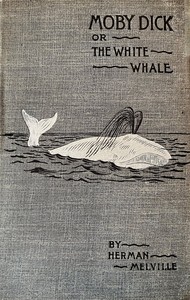
Herman Melville's Moby-Dick; Or, The Whale was published in 1851. It follows Ishmael, a restless narrator who joins the whaling ship Pequod, befriends Queequeg, and witnesses Captain Ahab turn a commercial whaling voyage into a private war against the white whale that maimed him.
The novel has 135 chapters and an epilogue, so it should not be read as a simple action plot. A useful structure is: Ishmael's decision to go to sea; his friendship with Queequeg; the Pequod's departure; Ahab's revelation of his true purpose; the whaling labor and digressive whale chapters; encounters with other ships; Queequeg's coffin; and the final chase.
The book's strange form is part of its meaning. Melville interrupts the voyage with taxonomy, sermons, stage-like speeches, comic scenes, industrial detail, and philosophical speculation. These do not merely decorate the plot. They show how human beings try to classify, interpret, and master a vast world that exceeds them.
Plot Summary
1. Ishmael goes to sea and meets Queequeg
Ishmael begins by turning toward the sea when life on land feels suffocating. The decision is emotional and existential. He goes to sea not only for work, but to escape a mood of deadness and to enter a world larger than himself.
In New Bedford, he meets Queequeg, a harpooner whose appearance and customs first frighten him. Their shared room becomes one of the novel's most important early scenes because fear gives way to recognition. Ishmael discovers courage, dignity, and kindness in the person he initially misread.
Their friendship matters because the Pequod will later become a community pulled toward destruction by Ahab. Before that happens, Melville gives readers a different model of relation: trust across difference. Ishmael's openness to Queequeg contrasts with Ahab's closed obsession.
The two men sign onto the Pequod, a whaling ship that already feels ominous. The owners speak in a mixture of religion and commerce. The ship itself seems old, decorated, and haunted by violence. Ahab is absent at first, which makes his presence feel like something waiting below the surface.
The sermon before departure also prepares the novel's moral atmosphere. The story of Jonah makes the sea feel like a place of judgment as well as labor. Melville places Ishmael's voyage inside a biblical and existential frame before the Pequod even leaves harbor.
Ishmael's early openness matters. He begins with fear and prejudice toward Queequeg, then changes through contact and trust. This flexibility will contrast sharply with Ahab, who becomes more rigid as the voyage continues. Ishmael learns from strangeness; Ahab turns strangeness into an enemy.
The early chapters also teach the reader how to read the novel. Melville does not rush to the whale because he wants the voyage to feel inhabited before it becomes tragic. Inns, sermons, contracts, jokes, fears, and strange first impressions all create a human scale. Ahab's later obsession is frightening partly because it invades this ordinary world and bends it toward one purpose.

2. The Pequod and the world of whaling labor
Once the Pequod sails, the novel enters the working world of whaling. Melville describes watches, boats, harpoons, lines, cutting-in, try-works, oil, weather, and the hierarchy of shipboard labor. These details can feel digressive, but they are central to the novel's scale.
Whaling is dangerous industrial work. The sea is not a romantic background; it is a workplace where bodies, tools, animals, capital, and death meet. Melville makes readers feel the material reality beneath the symbolic drama.
The ship is also a social world. Officers, harpooners, sailors, and laborers from different backgrounds form a floating community. Starbuck is cautious and morally serious. Stubb survives danger through humor. Flask is blunt and practical. Queequeg, Tashtego, and Daggoo show the global reach of the whaling industry.
The key question becomes: what is the Pequod for? Commercially, it is a whaling vessel. Under Ahab, it becomes an instrument of private revenge. The tragedy begins when a shared workplace is captured by one man's symbolic obsession.
The whale chapters are part of that question. Ishmael tries to classify whales through books, pictures, anatomy, and maritime experience. Yet the more he explains, the more the whale exceeds explanation. Knowledge expands the mystery instead of closing it.
Melville also shows the physical and economic reality of whaling. The men risk death for oil, profit, and wages. Their labor is communal and skillful, but it is also tied to extraction and commerce. Ahab's obsession hijacks a world that is already dangerous.
This is why the so-called digressions matter. The chapters on whale species, paintings, measurements, blubber, rope, and oil are not random interruptions. They show that the whale can be approached through science, art, industry, myth, and bodily danger, but no approach completely owns it. Ishmael's mind keeps multiplying perspectives. Ahab's mind keeps subtracting them.
3. Ahab appears and names the true mission
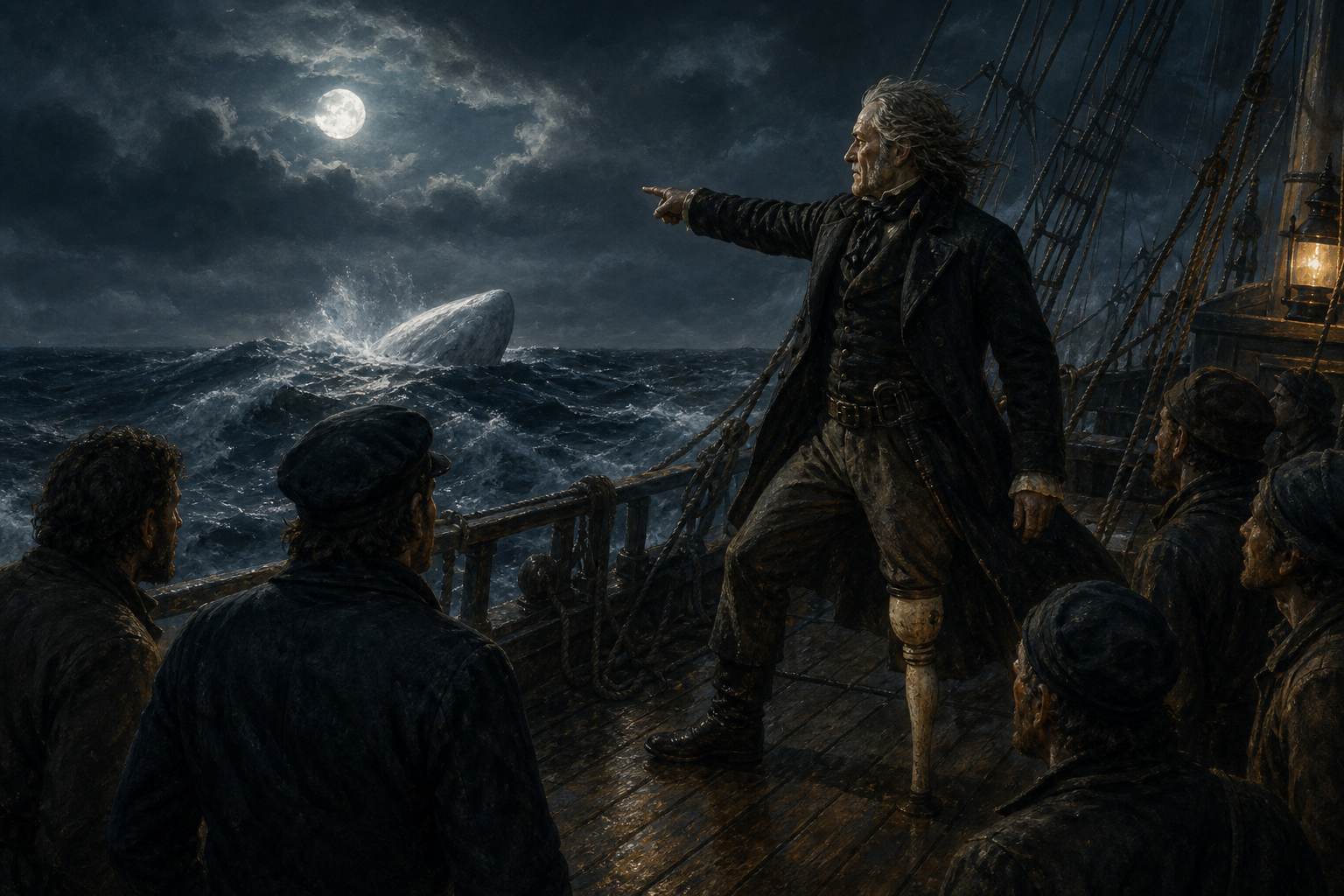
Ahab finally appears on deck, marked by the loss of his leg and by an intensity that separates him from ordinary command. He is charismatic, theatrical, wounded, and dangerous. The crew senses that he is more than a captain performing routine authority.
He nails a gold coin to the mast and promises it to whoever first sights Moby Dick. This scene converts the crew's attention into Ahab's mission. Money, spectacle, danger, and obedience fuse into one ritual. Ahab does not merely order the crew; he seduces their imaginations.
For Ahab, Moby Dick is not just a whale. The whale becomes the visible mask of invisible evil, fate, pain, and resistance. Ahab projects metaphysical meaning onto the animal. His wound becomes a theory of the universe.
Starbuck objects. He sees revenge against a whale as irrational and impious. Yet he cannot stop Ahab. This is crucial: the novel is not only about a tyrannical captain. It is also about the weakness of those who know better but fail to act.
Ahab's power is rhetorical as much as official. He speaks with such intensity that the crew begins to feel his private wound as a shared destiny. He does not merely command labor; he captures imagination.
This is why his leadership is so dangerous. A captain's authority already matters at sea, where survival depends on command. When that authority is fused with obsession, the entire ship becomes vulnerable to one man's interpretation.
Starbuck's resistance remains morally important even though it fails. He is not foolish; he understands that the ship has been hired to gather oil, not to enact a metaphysical vendetta. But his conscience stays trapped inside obedience. Melville makes that weakness painful. Ahab needs charisma, but he also needs the silence of people who can see danger and still submit to it.
4. The white whale and the problem of meaning
As the voyage continues, the Pequod meets other ships. These encounters function like warnings, mirrors, and fragments of information. Some ships have seen Moby Dick. Some carry injury or grief. Ahab reads almost everything as a clue leading to the whale.
This is how obsession works in the novel. Ahab does not simply desire revenge; he reorganizes reality around it. Other people's stories become useful only insofar as they point toward his goal. The world narrows as his will intensifies.
The famous whiteness of the whale is deliberately unstable. White can suggest purity, blankness, terror, divinity, death, or the absence of meaning. Ishmael reflects on these possibilities without reducing them to one answer. Ahab, by contrast, insists on one answer: the whale must mean the evil he needs it to mean.
That contrast between Ishmael and Ahab is central. Ishmael catalogs, wonders, contradicts himself, and leaves meaning open. Ahab interprets absolutely. The novel's tragedy grows from the violence of one closed interpretation imposed on a living world.
The other ships repeatedly offer alternate meanings. Some carry commercial news, some grief, some warnings, some ordinary maritime business. Ahab mostly ignores everything except information about Moby Dick. Other people's losses become clues for his pursuit.
This narrowing is the psychology of obsession. The world still contains many stories, but Ahab recognizes only the story that feeds his wound. The Pequod becomes more isolated not only geographically, but interpretively.
The meetings with other vessels also widen the moral field of the book. The ocean is full of people doing work, suffering loss, looking for profit, grieving sons, fearing accidents, and trying to survive. Ahab could recognize that his pain is one pain among many. Instead, he treats every encounter as a sign addressed to him. The result is a terrible form of ego: even another ship's tragedy becomes material for his own quest.
5. Queequeg's coffin and the pressure of fate
When Queequeg falls seriously ill, he has a coffin made. He prepares for death with calm dignity. Then he recovers, and the coffin is kept aboard. This object becomes one of the novel's great symbols.
The coffin compresses death and survival into one thing. It is built for burial but will later become a life buoy. Melville's world is full of such reversals: tools change meaning, omens mislead, and objects refuse to stay inside one category.
Starbuck's conflict deepens as well. He understands that Ahab's pursuit is wrong and dangerous. At one point, he imagines stopping him, but he cannot bring himself to act. His moral hesitation becomes part of the disaster.
Ishmael continues to observe. His narration moves between practical detail and cosmic speculation, between comedy and dread. He survives partly because he never becomes trapped inside Ahab's single meaning. He remains a witness rather than a convert.
Queequeg's coffin also preserves the emotional value of the early friendship. The object that later saves Ishmael is tied to the man he first learned to trust across fear and difference. Human connection survives in symbolic form even when the ship's community fails.
As the voyage darkens, nature grows larger than every human system aboard the ship. Experience, tools, hierarchy, and courage all matter, but the sea can overwhelm them. Melville's ocean is not sentimental; it is vast, beautiful, indifferent, and resistant to human mastery.
This section of the novel also tests Ishmael's role as narrator. He does not prevent catastrophe, and he is not an uncomplicated hero. His strength is attention. He notices labor, language, objects, bodies, jokes, omens, and fear. In a book dominated by Ahab's will, Ishmael's attentive uncertainty becomes a counterforce.
6. The final chase
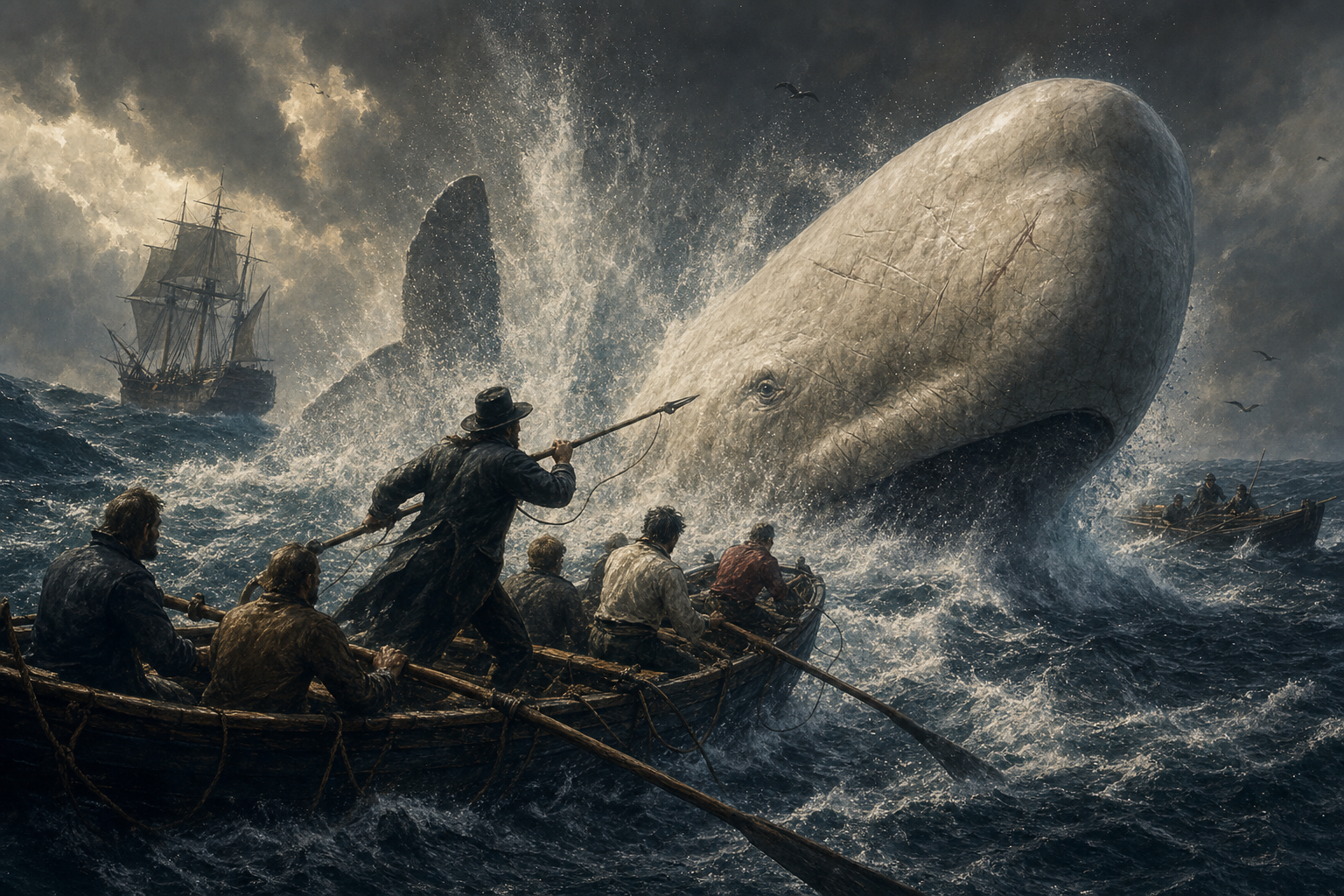
The Pequod finally encounters Moby Dick, and the final chase unfolds over several days. Ahab drives the boats toward the whale with a force that ignores warning, fatigue, and loss. The crew follows because the ship's authority structure has been absorbed into his obsession.
Moby Dick resists all human interpretation. To Ahab, the whale is the enemy. To the novel, the whale remains larger: animal, symbol, blankness, nature, fate, and the limit of human control. The whale does not confirm Ahab's meaning; it destroys the world built around that meaning.
The final chase makes the ethical stakes visible. Ahab's private wound becomes collective catastrophe. Sailors who did not lose a leg to Moby Dick die because their captain cannot distinguish personal revenge from universal truth.
The Pequod's destruction feels both mythic and brutally material. Wood breaks, bodies fall, boats splinter, and the sea closes over human ambition. Melville refuses to give Ahab's death a clean heroic triumph.
The final chase is terrifying because Ahab's will remains powerful even when reality has turned against him. His language is magnificent, but it cannot command the whale or the sea. Human speech reaches its highest pitch just before it fails.
The crew's fate makes the ethical point concrete. Ahab's wound might have been his own tragedy, but his authority turns it into everyone's disaster. The ship goes down because one man's meaning has become institutional purpose.
The last chase also reveals the difference between courage and obsession. The sailors are brave; the labor is skillful; the danger is real. But courage under a destructive purpose does not become wisdom. Melville lets the chase feel grand, then lets its grandeur collapse into waste. Ahab can inspire action, but he cannot justify the cost.
7. Ending and final meaningThis section contains spoilers.
Ahab dies in the final pursuit, and the Pequod sinks. Nearly everyone is lost. The ending is devastating because the whole ship has been made to serve one man's interpretation of his wound.
Ishmael alone survives, floating on Queequeg's coffin. The object made for death becomes the condition of narration. Without that coffin, there is no survivor to tell the story.
Moby Dick remains unexplained. Ahab believed the whale embodied evil, but the novel never fully endorses that reading. The whale outlasts the human meanings cast onto it. The sea closes over the ship, and Ishmael's voice remains as testimony.
The ending leaves silence rather than victory. Human labor, language, obsession, and authority burn intensely for a time, but the ocean absorbs them. Ishmael survives to speak from the edge of that silence.
Ahab's death is not simple martyrdom. It is the end of a man bound completely to his own interpretation. He dies still speaking revenge, and the novel lets that language sound grand and horrifying at once.
Ishmael's survival changes the genre of the story. This is not a conqueror's account. It is testimony from a catastrophe. He remains to tell what obsession did to a ship, a crew, and a world of meanings.
That is why the ending is so unsettling for study and discussion. The novel does not simply say that ambition is bad or that nature is stronger than human beings. It asks what happens when language, pain, charisma, labor, religion, and interpretation all gather around a single destructive idea. Ishmael survives because the story must be told from outside that idea.
Major Characters
Ishmael
survivor, witness, and open interpreter
Ishmael is narrator, participant, and observer. He joins the whaling world, befriends Queequeg, and records the Pequod's voyage with curiosity that ranges from practical detail to metaphysical speculation.
His importance lies in openness. Unlike Ahab, he does not force one meaning onto the whale or the world. He survives as the voice that can hold uncertainty.
Captain Ahab
wounded authority turned obsession
Ahab is powerful, eloquent, and terrifying. Moby Dick has maimed him, and he turns that injury into a cosmic mission. His authority transforms the Pequod from workplace into revenge machine.
His tragedy is interpretive. He makes his wound the key to the universe and compels others to live inside that meaning. His greatness and danger are inseparable.
Queequeg
friendship, courage, and the coffin symbol
Queequeg begins as a feared stranger and becomes Ishmael's closest companion. His courage and generosity challenge Ishmael's assumptions and ground the novel in human connection.
His coffin is one of the book's central symbols. Made for death, it becomes Ishmael's means of survival, turning mortality into the condition of storytelling.
Starbuck
conscience unable to stop authority
Starbuck sees that Ahab's revenge is wrong. He values duty, religion, prudence, and the commercial purpose of the voyage.
His failure is the failure of conscience without decisive action. He knows enough to resist, but not enough to save the ship.
Moby Dick
white whale and limit of human interpretation
Moby Dick is a whale, but also a symbolic field onto which humans project fear, evil, divinity, blankness, and fate. The whale does not explain itself.
Ahab needs the whale to mean one thing. Ishmael's narration shows that the whale exceeds every single meaning imposed on it.
Best Quotes
Call me Ishmael.
This opening line begins the novel as testimony. Ishmael's name matters because he is the one who survives to tell what happened after everyone else disappears.
Ahab is for ever Ahab.
The line captures Ahab's self-fixity. He imagines himself as unchangeable, and that refusal of change becomes part of his doom.
From hell's heart I stab at thee.
Ahab's final language is magnificent and horrifying. Even at the edge of death, he turns existence into revenge speech.
Major Themes
Obsession
Obsession and authority
Ahab's private injury becomes collective fate because he possesses command. The novel studies how obsession scales through power.
Meaning
The danger of interpretation
The white whale contains many meanings. Ahab's tragedy is his insistence that it must mean only one thing.
Labor
Whaling labor and capitalism
The Pequod is a workplace. Melville grounds symbolic drama in dangerous industrial labor and global commerce.
Survival
Death, survival, and narration
Queequeg's coffin saving Ishmael turns death into the vehicle of story. Survival becomes the burden of testimony.
Herman Melville and the American Context
Melville combines firsthand maritime knowledge with scripture, Shakespearean drama, scientific taxonomy, comic digression, and philosophical speculation. The novel's hybrid form is the point: no single genre can contain the whale.
Nineteenth-century whaling was dangerous global labor tied to oil, capital, and imperial routes. The Pequod is not only a symbolic vessel. It is a workplace where bodies risk death for profit before Ahab converts that labor into private revenge.
The novel is central to American literature because it turns expansion, work, nature, and individual will into tragedy. Ahab's heroic energy becomes destructive when it refuses limits.
Why It Still Matters
Today, Moby-Dick reads powerfully as a study of obsession and leadership. A leader who turns personal injury into institutional purpose can destroy everyone under his command.
The novel also speaks to interpretation. People often make the world confirm their wounds, fears, or theories. Ahab is extreme, but his error is recognizable: he treats one meaning as absolute.
For AP Lit, SAT Reading, IB English, and essays, compare Ishmael's open narration with Ahab's closed symbolism. That contrast is one of the strongest ways to write about the novel's form and theme.
Frequently Asked Questions
What is Moby-Dick about?
It follows Ishmael aboard the whaling ship Pequod as Captain Ahab turns the voyage into a pursuit of the white whale Moby Dick. The plot is about whaling, but also obsession, authority, labor, symbolism, and the limits of interpretation.
What does the white whale symbolize?
It cannot be reduced to one meaning. For Ahab it represents evil and injury. For the novel, it also suggests nature, blankness, divinity, fate, terror, and the failure of human interpretation.
Why is Ahab tragic?
Ahab is tragic because his strength becomes fixation. He transforms personal suffering into a universal mission and drags an entire crew into that interpretation.
Why are there so many whale chapters?
The whale chapters show the human desire to classify and master the unknown. They also slow the plot in order to expand the novel's intellectual scale.
Read Next
- The Old Man and the Sea: sea, hunting, endurance, and human limits in compressed form.
- Crime and Punishment: another study of a mind trapped by a theory.
- Dr. Jekyll and Mr. Hyde: divided selfhood and the danger of trying to command inner darkness.
Adaptations
- 1956 film: turns Ahab and the whale chase into classic adventure tragedy.
- Audiobooks: useful for hearing Ishmael's rhythms and digressions.
- Stage and radio adaptations: often focus on Ahab's speeches and the ship as a doomed community.