The King in Yellow - Chambers' Forbidden Book of Carcosa
A story-by-story guide to Robert W. Chambers' 1895 weird-fiction collection: the cursed play, the Yellow Sign, Carcosa, doomed artists, and the quieter Paris tales that follow.
Sua's Quick Take
The King in Yellow is not a novel about one plot. It is a collection built around a dangerous idea: art can enter the mind like a disease, and once you have seen the right symbol or read the wrong second act, ordinary reality no longer feels secure.
What makes Chambers' book still unsettling is its restraint. He does not explain the cursed play, Carcosa, or the Yellow Sign in a neat mythology. He gives you fragments, infected narrators, beautiful rooms, Paris studios, ruined romances, and enough blank space for dread to keep working after the page ends.
What the Book Is Really About
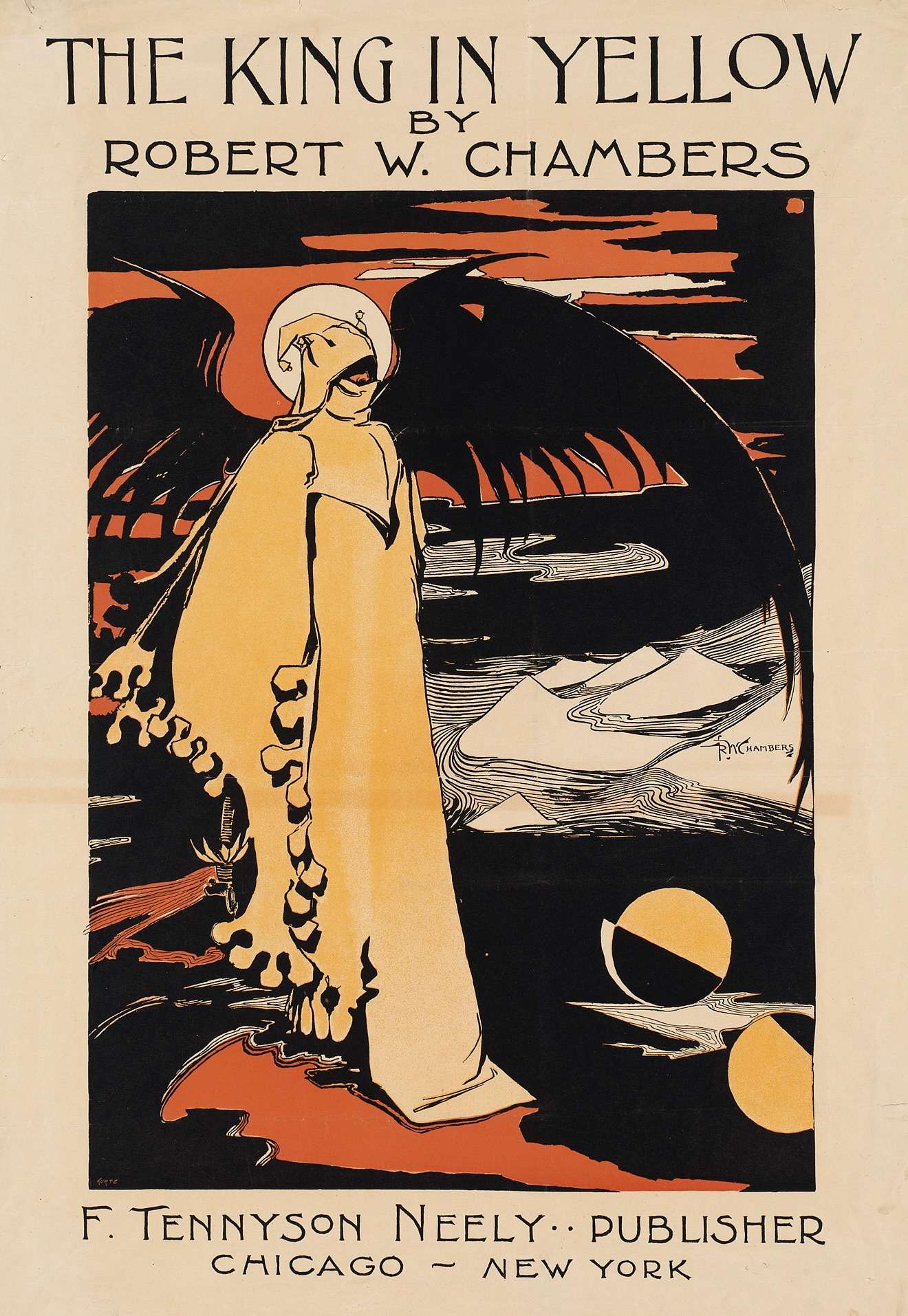
Robert W. Chambers published The King in Yellow in 1895. The collection contains ten stories. The first four are the famous "Yellow Mythos" pieces: "The Repairer of Reputations," "The Mask," "In the Court of the Dragon," and "The Yellow Sign." These stories refer to an imaginary play also called The King in Yellow. The play is beautiful, poisonous, and apparently unbearable after its first act.
The remaining stories move away from explicit supernatural horror. "The Demoiselle d'Ys" is a time-slip romance in Brittany. "The Prophets' Paradise" is a sequence of dreamlike prose miniatures. The last four Paris stories focus on artists, students, love, poverty, war, and disappointment. That shift can surprise modern horror readers, but it matters. Chambers is not only inventing a cursed-book myth. He is also asking what happens when aesthetic longing meets fragile human lives.
The book's strongest pattern is contamination. A phrase, a sign, a melody, a costume, a mask, or a book changes the pressure in a scene. People who think they are rational begin to interpret the world through Carcosa. People who think they are simply in love discover that art, jealousy, and self-deception have been wearing masks all along.
Story-by-Story Summary
1. "The Repairer of Reputations"
The collection opens in an alternate New York of 1920, imagined from Chambers' 1890s. The United States has become orderly, militarized, nationalistic, and proud of its new architecture. The most shocking invention is the Government Lethal Chamber on Washington Square, a state-sponsored place for legal suicide. This cool civic description is part of the horror. The world looks rational, modern, and clean, but the moral atmosphere is already disturbed.
The narrator, Hildred Castaigne, has recently left Dr. Archer's care after a head injury and a period of confinement for supposed insanity. Hildred insists that his mind is sound. His narration quickly proves otherwise. He has read the forbidden play The King in Yellow, and the book has reorganized his imagination. Carcosa, the Pallid Mask, Hastur, the Hyades, and the Lake of Hali have become more real to him than ordinary social life.
Hildred visits Mr. Wilde, a grotesque recluse who calls himself a "repairer of reputations." Wilde keeps files, secrets, and delusions of political influence. Together they imagine a vast imperial succession connected to the Yellow Sign. Hildred believes that his cousin Louis Castaigne stands between him and a hidden crown. Louis is engaged to Constance Hawberk, and Hildred's jealousy turns political fantasy into danger.
The plot works because Hildred's private delusion is mixed with a public dystopia that is itself unpleasantly plausible. The Lethal Chamber is treated as civic progress. The nation speaks of order and self-preservation. Hildred's madness therefore feels like an exaggerated version of the culture around him, not a separate illness sealed inside one man.
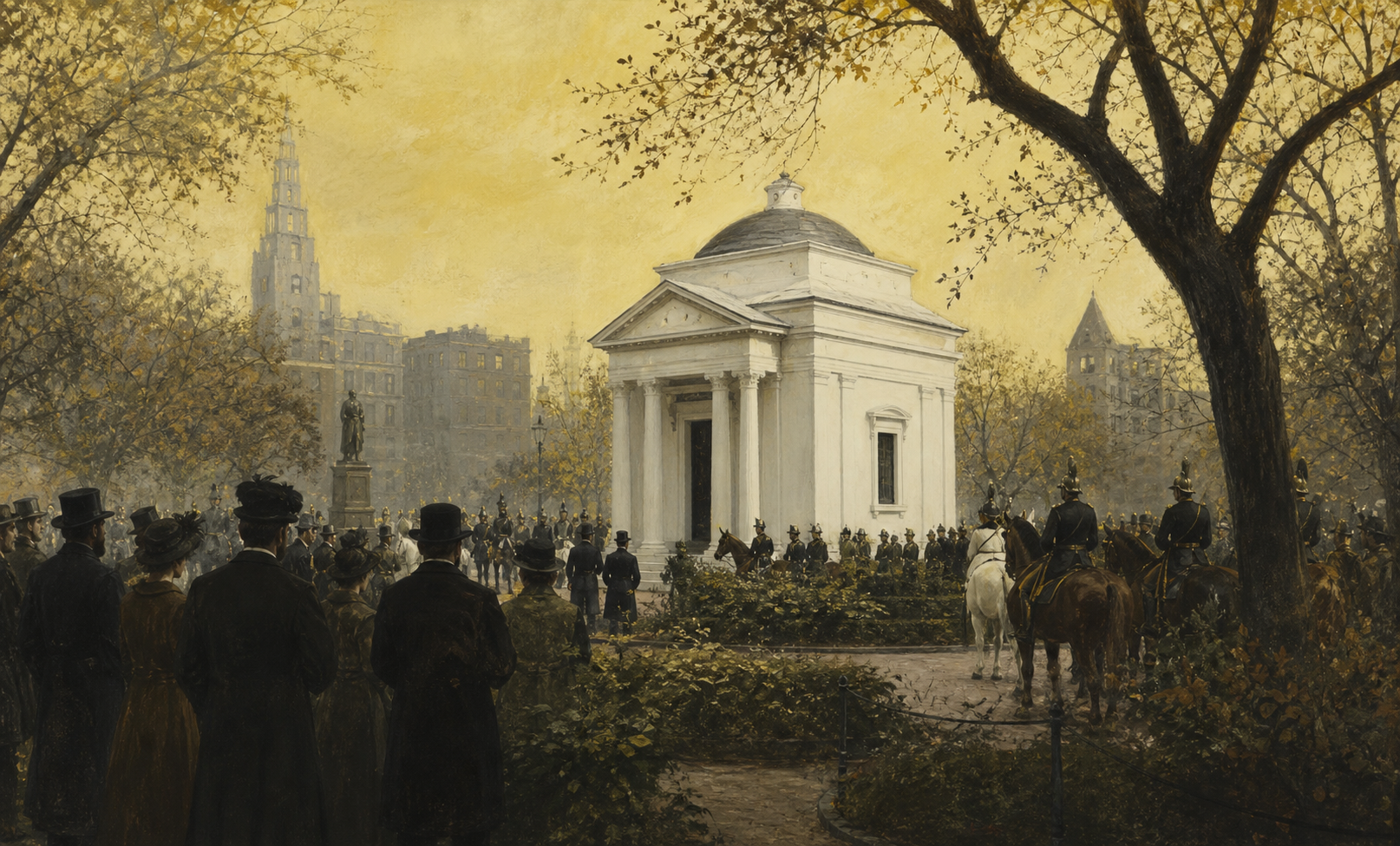
In the ending, Hildred confronts Louis and demands that he renounce the crown. He also reveals, or believes he reveals, that Dr. Archer has been murdered. Violence spreads through his imagined court. Vance, another figure in the plot, rushes into the Lethal Chamber. Hildred returns to Wilde's room, dresses himself in a robe embroidered with the Yellow Sign, and crowns himself king. But Wilde is found dead, Hildred is seized, and the imperial fantasy collapses into restraint, blood, and screaming.
The story never lets us rest on one explanation. Hildred is clearly delusional, yet the forbidden play has clearly done something to him. The horror lies in that overlap: psychological breakdown, political nightmare, and supernatural suggestion all wearing the same mask.
2. "The Mask"
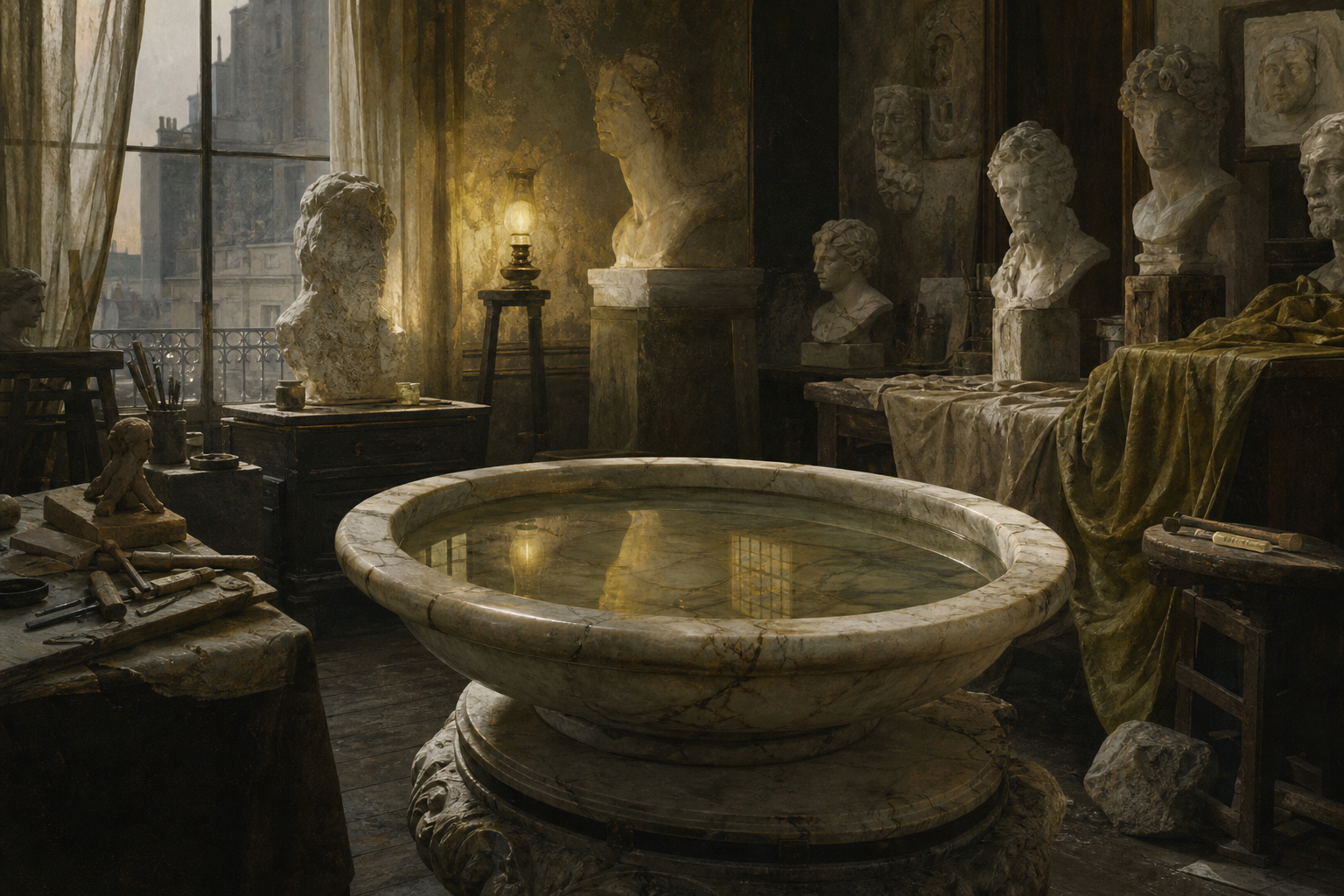
"The Mask" moves from political nightmare to artistic and emotional tragedy. Boris Yvain, a sculptor, has discovered a strange chemical solution that can turn living things into marble. The premise could be pure scientific horror, but Chambers frames it through love, friendship, and self-deception.
The narrator Alec loves Genevieve, who is engaged to Boris. Alec tries to bury his feelings under loyalty. Boris, Genevieve, Alec, and Jack Scott live in a world of studios, sculpture, illness, and artistic experiment. The dangerous fluid in Boris' basin becomes a physical version of the story's emotional problem: living feeling can become beautiful, cold, and fixed.
The forbidden play enters again. Alec finds The King in Yellow and feels its effect. Around the same time, Genevieve's fever makes her confess that she loves Alec. Boris is wounded but noble. Alec is ashamed. The "mask" of the title is not only the legendary Pallid Mask. It is also Alec's habit of pretending to himself that desire can be perfectly hidden.
The ending is gentler than the opening story but still uncanny. Marble creatures prove not to be permanently dead; they can return to life. Genevieve revives, and Boris' sacrifice gives the story a strange grace. Even so, Chambers has already shown how art can freeze life into a beautiful form while human love remains painfully unstable.
3. "In the Court of the Dragon"
"In the Court of the Dragon" is one of the collection's purest nightmare structures. The narrator attends vespers at the Church of St. Barnabe in Paris after reading The King in Yellow. The church should be a place of calm, but the organ music becomes sinister. The narrator senses that something is being hunted inside the music.
He sees a pale organist whose look seems full of hatred. He tries to reason the fear away. The church is modern, well lit, and rational; surely there is no medieval horror hiding in the organ loft. Yet the story keeps undoing those reassurances. The figure appears again, and the narrator's ordinary Paris begins to slide toward another plane.
The pursuit continues into the Court of the Dragon, the passage where the narrator lives. The space becomes a trap: gates, archways, blackness, closed doors, and the advancing figure. Then the story snaps back. The narrator has apparently slept through the sermon. But the escape is not complete, because the spiritual pursuit has been real at another level.
The ending opens onto Carcosa. The church dissolves in dazzling light; black stars hang in the heavens; the lake of Hali chills the narrator's face. The story is frightening because it treats reading as a wound in perception. After the play, even sacred architecture and ordinary music can become entrances.
4. "The Yellow Sign"
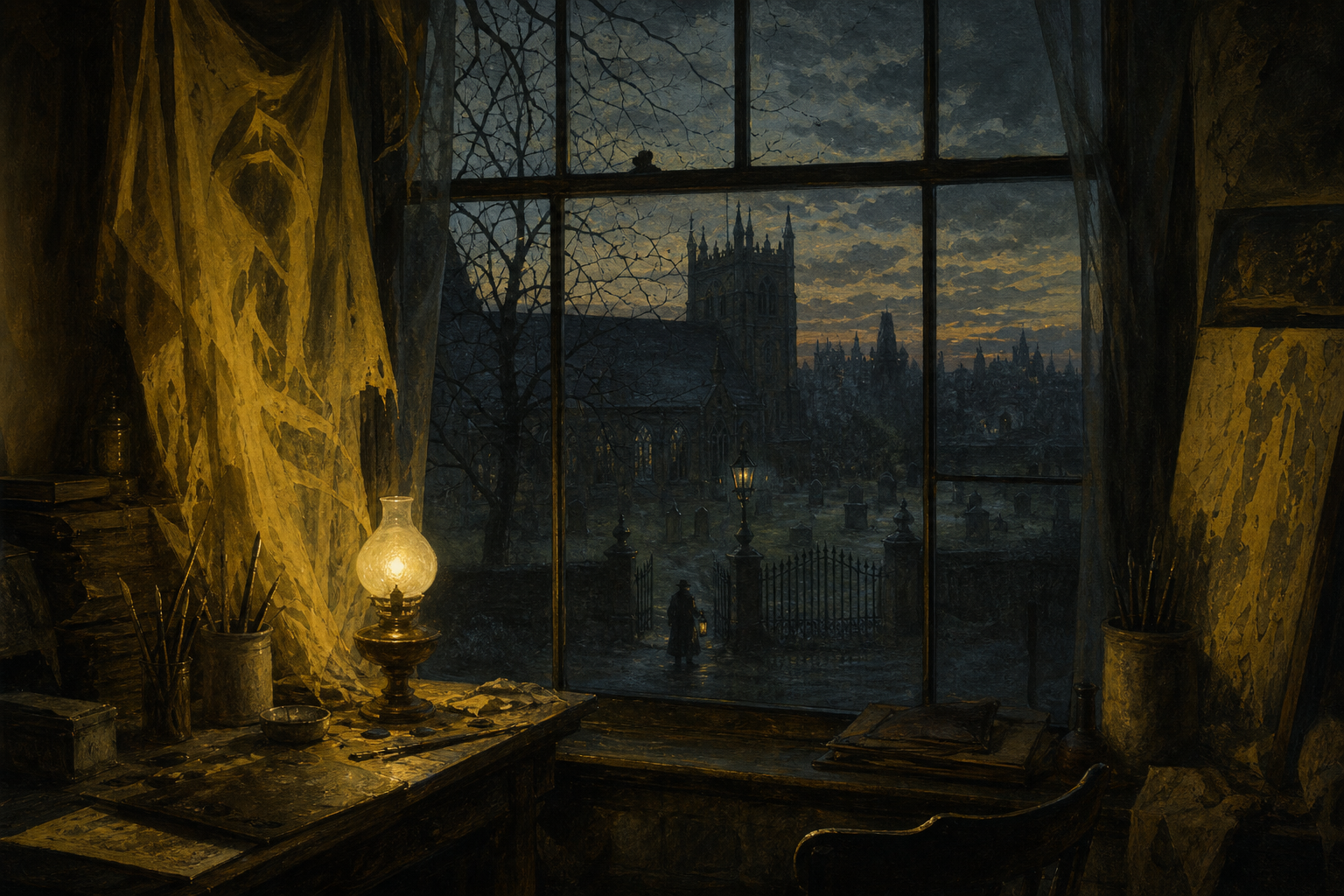
"The Yellow Sign" is the best-known story in the collection and the clearest statement of the cursed-symbol pattern. The narrator, an artist named Jack Scott, watches an unpleasant churchyard watchman from his studio window. His model Tessie also dreams of a hearse. Their ordinary working relationship becomes charged with desire, dread, and superstition.
Tessie gives the artist a black onyx clasp marked with a symbol she found. It is not Arabic, Chinese, or any human script. It is the Yellow Sign. The artist later finds the forbidden book in his rooms. Tessie opens it to the second part, and the damage is done. He reads it too. The two begin to speak of the King, the Pallid Mask, Hastur, Cassilda, and the Hyades as if these names now belong to their own lives.
The horror of the story is domestic and intimate. The sign is not an abstract emblem in a distant kingdom; it is pinned under the artist's lapel. The hearse comes to the door. The watchman enters despite bolts and locks. The cursed play and the cursed object turn a studio romance into a deathbed confession.
The ending leaves the narrator dying and Tessie dead. He refuses sensational public explanation and frames his last words through confession. The story's deepest fear is not merely that the sign kills. It is that some knowledge arrives too late to unread, unsee, or unwear.
5. "The Demoiselle d'Ys"
This story shifts to Brittany and medieval romance. Philip, an American, becomes lost while hunting and meets the Demoiselle d'Ys, a young falconer whose household seems to belong to another time. The tale uses courtly manners, falconry, hospitality, and delicate attraction rather than direct Yellow Mythos horror.
The uncanny element is temporal. Philip appears to cross into the past, fall in love, and then return to the present with evidence that makes the encounter both impossible and emotionally real. The story's sadness comes from distance: love appears, but the time in which it could survive is already gone.
6. "The Prophets' Paradise"
"The Prophets' Paradise" is not a conventional plot story. It is a sequence of short, symbolic pieces with titles such as "The Prophet's Paradise," "The Maker of Moons," and other dreamlike fragments. The section reads like a prose interlude about desire, illusion, artifice, and impossible promises.
Its function in the collection is tonal. After the cursed-book stories and the time-slip romance, Chambers gives us a set of miniature masks. The reader is asked to move by association rather than by plot: prophecy, paradise, beauty, failure, and theatrical language become part of the same atmosphere.
7. "The Street of the Four Winds"
The Paris stories begin with a quieter tale about Severn, an artist, and a stray cat that leads him into another room and another life. The story is modest compared with "The Yellow Sign," but it keeps the collection's interest in thresholds. A street, a door, a window, or an animal can move a lonely artist toward hidden feeling.
The tale's emotional center is poverty and tenderness. Chambers is less interested here in cosmic terror than in the fragile links between bohemian artists, abandoned people, and the small accidents that reveal them to one another.
8. "The Street of the First Shell"
This story takes place during the Franco-Prussian War and the siege of Paris. It follows the American art-student world under pressure from hunger, danger, and shelling. The title refers to the first shell that reaches the street, turning artistic youth into historical vulnerability.
The story matters because it grounds the collection's aesthetic world in real violence. Earlier stories fear imagined plays and supernatural symbols. Here, a shell is not symbolic at first; it is war entering the street. Chambers uses the artist milieu again, but the pressure comes from history.
9. "The Street of Our Lady of the Fields"
This long Paris story focuses on students, studios, courtship, ambition, and emotional education. It is full of social detail: art classes, neighborhood habits, friendships, flirtations, and the difficult difference between romantic fantasy and durable devotion.
Placed late in the collection, the story makes the book feel wider than horror. Chambers keeps returning to young artists because they are trained to turn life into images. Sometimes that power produces beauty; sometimes it produces evasion. In this story, the question becomes how to live when art and love do not arrange themselves into a perfect pose.
10. "Rue Barree"
"Rue Barree" closes the book in a lighter but still bittersweet Parisian register. It returns to bohemian life, conversation, attraction, and the awkward comedy of desire. The supernatural machinery has nearly disappeared, but the collection's central word, "mask," still matters. People continue to perform, misunderstand, and protect themselves.
The final effect of the collection is unusual. Chambers begins with cursed art and ends with social comedy and melancholy realism. That makes The King in Yellow feel less like a single mythology manual and more like a gallery: some rooms are nightmare chambers, some are love stories, and all of them ask what art does to the people who live too close to it.
Major Characters and Forces
Hildred Castaigne
Unreliable narrator and self-crowned heir
Hildred is the collection's most disturbing speaker because he is lucid in style and broken in judgment. He reads civic order, family rivalry, personal jealousy, and imperial fantasy through the same delusional system.
His story is not only private insanity. Chambers makes Hildred's alternate America cold, authoritarian, and obsessed with order, so his madness becomes a dark mirror of public modernity.
Mr. Wilde
The repairer of reputations
Wilde is a grotesque keeper of secrets who feeds Hildred's fantasy of succession. He represents the social hunger to control reputation, files, gossip, and hidden leverage.
Whether he is a mastermind or another deluded parasite is part of the story's unease. He gives Hildred's madness a bureaucratic shape, making fantasy look like a dossier.
Alec, Boris, and Genevieve
Art, loyalty, and the mask of self-deception
In "The Mask," the central triangle turns supernatural experiment into emotional pressure. Boris can turn life into marble; Alec turns desire into silence; Genevieve's fever turns hidden love into speech.
Their story shows Chambers' softer but still dangerous idea of art: beauty can preserve, conceal, and paralyze feeling until crisis makes the hidden truth visible.
The pursued narrator of the Dragon
Reader whose perception has been wounded
The narrator of "In the Court of the Dragon" is not given a large social world. He is almost a pure consciousness under pursuit.
His importance lies in how quickly reading becomes perception. Music, church space, light, and architecture all become signs that the world has been invaded by Carcosa.
Jack Scott and Tessie
The artist and model caught by the Yellow Sign
"The Yellow Sign" makes the cursed mythology intimate. Jack and Tessie are not rulers or prophets; they are an artist and a model whose studio becomes a trap.
Tessie's found clasp shows how the myth enters ordinary life through objects, gifts, flirtation, curiosity, and dreams. The sign is terrifying because it travels so quietly.
Best Quotes
Strange is the night where black stars rise, And strange moons circle through the skies.
This line from Cassilda's Song gives the collection its cosmic weather. Chambers does not explain Carcosa; he lets images of black stars, strange moons, and impossible skies create a geography of dread.
The very banality and innocence of the first act only allowed the blow to fall afterward with more awful effect.
This is one of the clearest descriptions of the forbidden play's method. The terror is delayed. The first act seems harmless, which makes the second act feel like a violation of trust.
STRANGER: I wear no mask.
The fragment matters because it turns identity into horror. In a world where everyone has laid aside disguise, the figure who wears "no mask" becomes more frightening than any masked villain.
Have you found the Yellow Sign?
The question is frightening because it sounds both intimate and official, like a password, a diagnosis, and a summons. Repetition makes it feel less like information than infection.
Major Themes
Art
Art as Contagion
The cursed play is beautiful, but beauty does not make it safe. Chambers imagines art as something that can bypass judgment and alter perception before a reader understands what has happened.
Mask
Identity and Self-Deception
Masks appear as theatrical objects, emotional habits, and social performances. Hildred masks madness as destiny; Alec masks desire as loyalty; artists mask life as composition.
Sign
Symbols That Act on People
The Yellow Sign is not explained as a simple code. It works because characters respond to it before they can interpret it. The sign has power as recognition, threat, and invitation.
City
Modern Streets and Ancient Dread
New York and Paris are modern, social, and mapped, yet they keep opening into Carcosa, Hali, and nightmare courts. Chambers makes the modern city porous.
Chambers, Weird Fiction, and Carcosa
Chambers did not invent the name Carcosa; Ambrose Bierce had used it earlier. But Chambers transformed Carcosa into a literary atmosphere: a place made of quotation, theater, ruined royalty, black stars, and half-understood names. Later weird fiction and cosmic horror would borrow that method of suggesting a vast mythology through fragments rather than explaining every rule.
The book is also deeply 1890s in its anxieties. It worries about decadent art, unstable nerves, urban modernity, suicide, reputation, bohemian life, and the thin line between cultivated taste and moral danger. Its artists and students live near beauty, but beauty is rarely innocent.
For modern readers, the first four stories are usually the main attraction because they point toward H. P. Lovecraft and later cosmic horror. Still, the Paris stories should not be dismissed as filler. They show the social and emotional world that the horror stories distort. Chambers' cursed art is frightening because his ordinary art world already depends on pose, longing, and fragile self-command.
Why It Still Matters
The book lasts because it understands viral culture before modern media. A play circulates; governments ban it; readers whisper about the second act; symbols detach from context and become dangerous. That logic feels familiar in an age of memes, conspiracy systems, and media that changes how people interpret reality.
It also remains useful for studying unreliable narration. Hildred is not simply wrong; he builds a complete interpretive system. The reader has to ask where delusion ends and the story's supernatural premise begins. That uncertainty is the engine of weird fiction.
Most importantly, The King in Yellow trusts suggestion. It does not hand us a map of Carcosa. It lets us glimpse enough to feel that a map would be unsafe.
FAQ: Stories, Symbols, and Reading Order
Is The King in Yellow a novel or a short-story collection?
It is a short-story collection. The first four stories are connected by the imaginary play The King in Yellow, Carcosa, the Pallid Mask, and the Yellow Sign. The later stories are looser Paris and romance pieces, though they continue the book's interest in art, performance, desire, and illusion.
What is the Yellow Sign?
The Yellow Sign is a mysterious symbol associated with the cursed play and the King in Yellow. Chambers never fully explains its grammar or origin. That lack of explanation is the point: the sign works as recognition and contamination before it works as information.
Do I need to read all ten stories?
For the horror mythology, read the first four stories carefully. To understand Chambers' full design, read all ten. The later stories show the artistic and emotional world behind the horror: studios, students, courtship, war, and the habit of turning life into aesthetic pose.
Why is Carcosa important?
Carcosa is less a setting than a pressure on reality. Its black stars, strange moons, Lake of Hali, Hyades, Hastur, and Pallid Mask create the sense of an older, stranger order touching modern life through art.
Read Next
Read Ambrose Bierce's "An Inhabitant of Carcosa" to see an earlier use of Carcosa, then H. P. Lovecraft's "The Call of Cthulhu" for a later model of fragmentary cosmic horror. For another nineteenth-century cursed-text atmosphere, pair Chambers with Oscar Wilde's The Picture of Dorian Gray.
Adaptation and influence notes
- The first four stories shaped later weird-fiction mythmaking by showing how a few repeated names can imply a vast hidden world.
- The book influenced later horror games, comics, television, and tabletop role-playing through the Yellow Sign and Carcosa imagery.
- Adaptations vary widely because Chambers leaves the play itself mostly unseen; every version must decide how much of the forbidden text to reveal.