Adventures of Huckleberry Finn - The River, Freedom, and America's Hardest Conscience
A detailed guide to Mark Twain's river novel about satire, slavery, friendship, lies, and the moral education Huck receives from Jim.
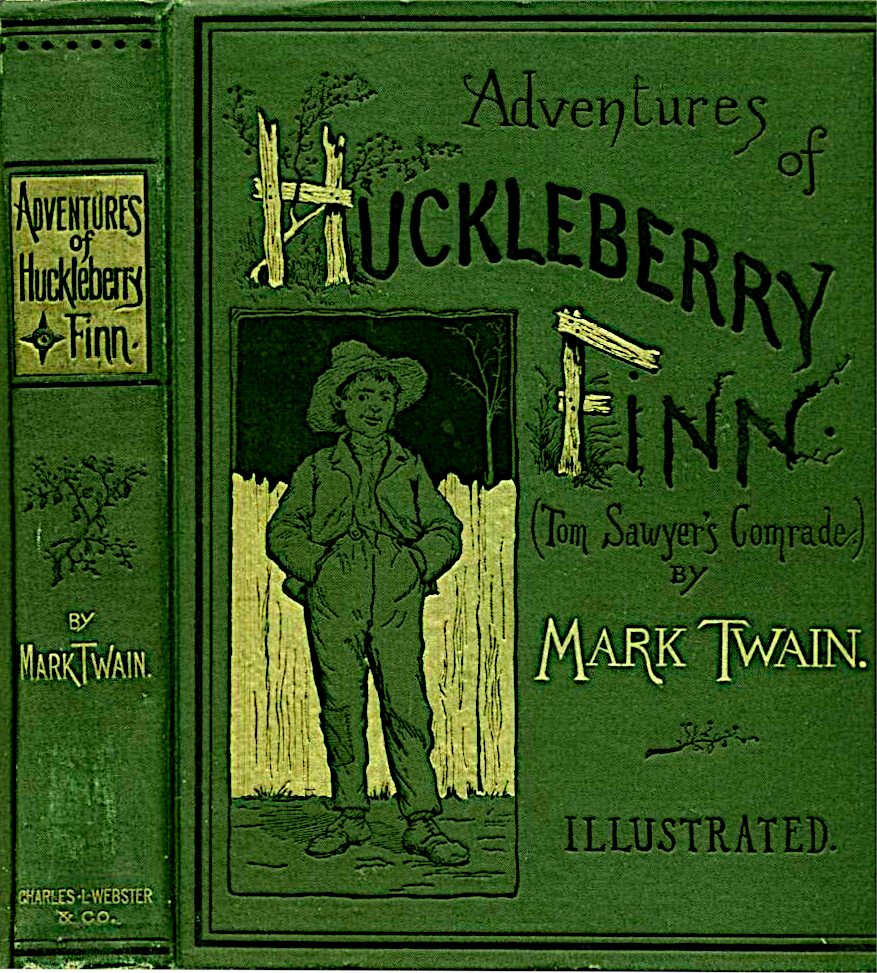
Sua's Quick Take
Adventures of Huckleberry Finn is easy to misremember as a boys' adventure on a raft. Up close, it is much harder: a comic, painful, brilliant novel about a child whose society teaches him the wrong conscience, and an enslaved man whose humanity exposes that society's moral failure.
A Responsible Reading Note
This novel uses racial slurs and period dialect because it is set in the slaveholding world of the antebellum Mississippi Valley. A serious reading should not flatten that language into nostalgia, comedy, or "old-fashioned" charm. Twain's satire attacks hypocrisy, cruelty, sentimental violence, and the moral education that makes white characters treat slavery as normal.
At the same time, the book is not simple. Jim is more humane, loyal, and emotionally mature than nearly everyone around him, but the narration still comes through Huck's limited and prejudiced child voice. The result is a novel that demands context. It should be taught with slavery, Reconstruction-era memory, racial language, banned-book debates, and the difference between representing racism and reproducing it.
What the Book Is Really About
The plot begins as Huck running away from civilization, but the real story is Huck learning that the moral rules he has inherited may be morally corrupt. In his world, law, church teaching, family respectability, and town gossip all tell him that helping Jim escape slavery is wrong. The deepest drama is that Huck's "bad" choice is often the ethical one.
The Mississippi River seems to promise freedom, but the river is never pure escape. It carries Huck and Jim away from one danger and toward another. It gives them quiet nights, shared labor, and moments of trust, yet it also brings fog, steamboats, con men, mobs, feuds, and the terrifying fact that slaveholding society exists on both banks.
That is why the novel remains central to American literature. Twain turns comedy into moral pressure. The jokes make social rules look ridiculous; the adventure plot keeps moving; then suddenly a scene asks whether a society's "good people" can be trusted when their goodness depends on denying another person's freedom.
Plot Summary
1. Huck is "sivilized," then trapped by Pap
The novel continues Huck Finn's story after The Adventures of Tom Sawyer. Huck has money, guardians, and a chance to become respectable, but respectability feels like a tight costume. Widow Douglas tries to house, teach, and "sivilize" him. Miss Watson adds religious discipline. Huck does not hate them exactly; he just feels that their world is made of rules that do not fit his body or mind.
This opening matters because Twain immediately makes "civilization" unstable. The respectable adults teach prayer, manners, property, and obedience, but they also live inside a society where Miss Watson can own Jim. Huck sees contradictions without having the adult vocabulary to name them. He notices hypocrisy as a physical discomfort before he can turn it into argument.
Tom Sawyer's gang deepens the satire. Tom borrows adventure ideas from books and turns them into playacting. The boys talk about robbery, ransom, and murder with comic ignorance. Huck goes along, but the scene quietly introduces one of the novel's major contrasts: Tom loves stories that imitate adventure; Huck will soon face real danger, real poverty, and real moral choice.
Pap Finn returns and makes that danger immediate. Pap is violent, alcoholic, racist, resentful, and obsessed with controlling Huck's money. He attacks education because a literate child threatens his authority. He attacks Black civic participation because even the smallest sign of racial equality enrages him. Through Pap, Twain shows one ugly root of white supremacy: the desire to feel superior when one has failed at nearly everything else.
Pap kidnaps Huck and locks him in a cabin across the river. For a while Huck enjoys the release from school and manners, but the freedom is false. Pap's violence grows, and Huck realizes he may be killed. Huck stages his own murder with practical brilliance: he kills a pig, spreads blood, hides evidence, and escapes by canoe. This fake death is the first major break in the plot. Huck leaves the town's social identity behind and becomes a boy presumed dead.
That escape also defines the kind of intelligence Huck has. He is not formally educated, but he can read mud, blood, footprints, river current, adult suspicion, and the timing of pursuit. Twain gives him a survival literacy that school has not taught. This matters for the whole novel because Huck's best thinking usually happens under pressure, through observation and improvisation, rather than through the moral vocabulary adults hand him.
The scene also darkens the idea of home. Huck has to become "dead" in order to become safe. A father should protect a child; Pap turns fatherhood into confinement and threat. A legal guardian should create stability; Huck's legal world repeatedly fails him. By the time he reaches the river, the novel has already made escape feel both necessary and incomplete.
2. Jackson's Island and the discovery of Jim
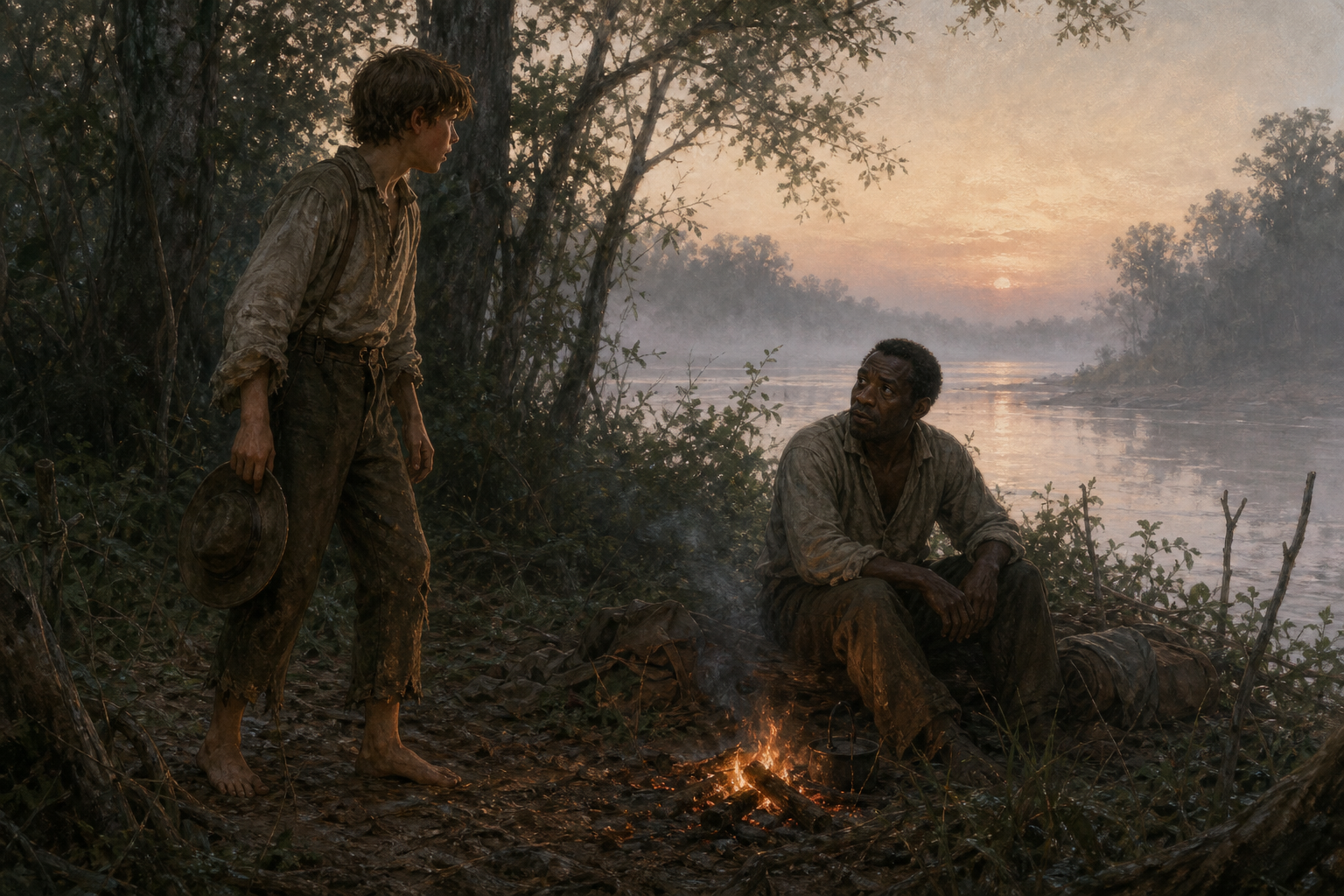
Huck hides on Jackson's Island, close enough to watch the town search for his body and far enough to taste independence. The island is one of the novel's early freedom spaces. Huck fishes, sleeps, explores, and enjoys the pleasure of not being watched. Yet the island is not empty. He soon discovers Jim, Miss Watson's enslaved man, who has run away after hearing that she might sell him down the river.
This meeting changes the novel. Huck first reacts with the assumptions his society has taught him, but practical companionship begins immediately. Huck and Jim share food, shelter, fear, and information. They are both runaways, but not in the same way. Huck runs from abuse and unwanted control; Jim runs from enslavement, family separation, and the legal machinery that treats him as property.
The difference matters. Huck can disguise himself, tell stories, move through white society, and eventually be absorbed back into family structures. Jim is hunted by law, economy, and racial violence. Twain's achievement is partly that he lets the child narrator slowly feel this difference before he can fully explain it.
Huck goes to town dressed as a girl to gather information. The scene is comic, but its function is serious. Huck learns that people suspect Jim of murdering him, which means Jim's attempt to save himself has already been turned by white imagination into criminal threat. Huck returns to the island, warns Jim, and the two flee on a raft. From this point, the raft becomes the novel's most important space: fragile, temporary, exposed, and still more humane than the towns on shore.
The island chapters also begin the novel's pattern of protective silence. When Huck and Jim find a floating house with a dead man inside, Jim recognizes more than he tells Huck. He shields Huck from the knowledge that the body is Pap's. This is not the same kind of lie the con men will later practice. Jim's silence protects a child from shock; the duke and king's lies exploit grief. Twain is already teaching readers to ask what a story or concealment does to another person.
3. The raft, the river, and the first moral tests
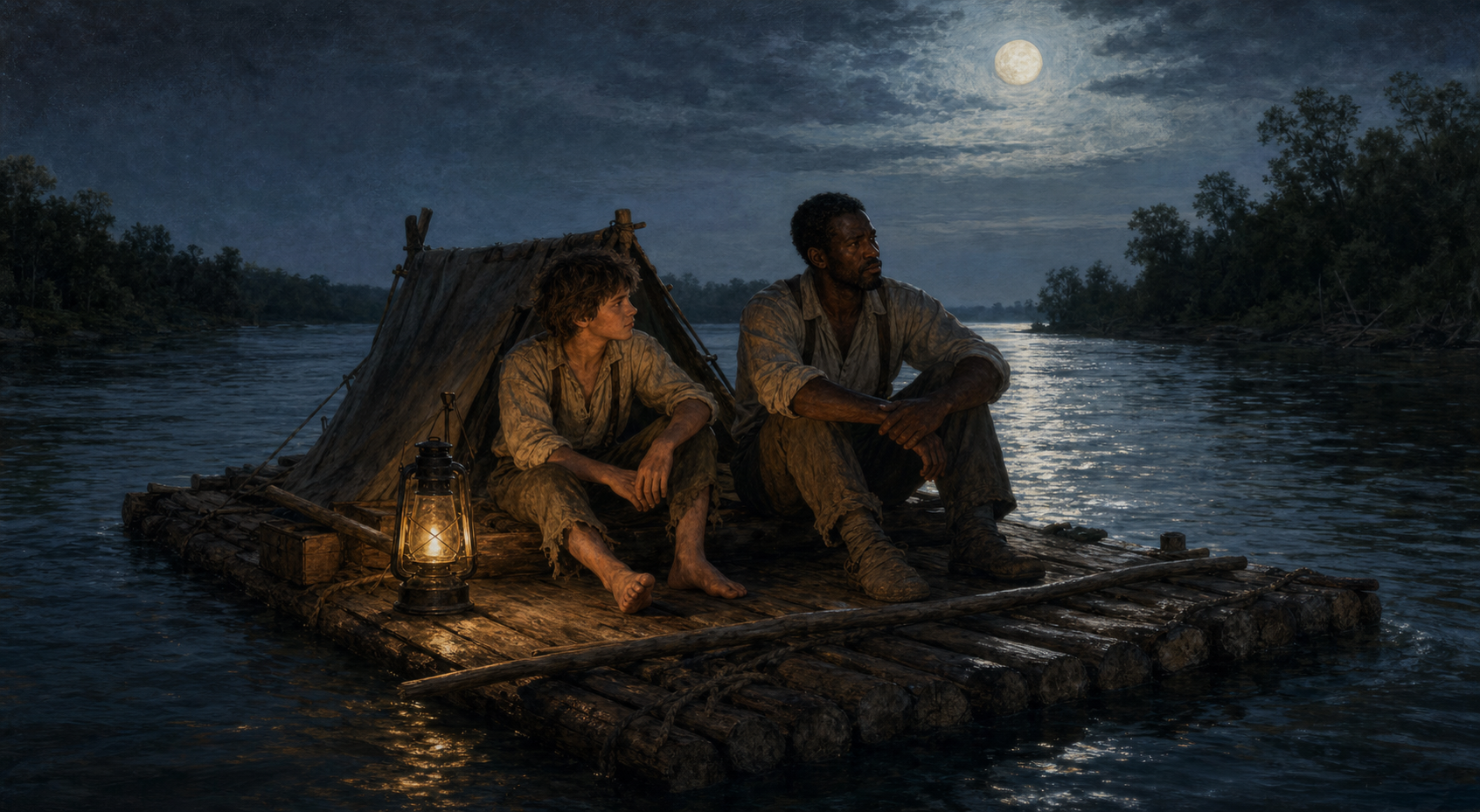
The middle movement of the novel is built around river travel. Huck and Jim float at night and hide by day. They pass towns, storms, wrecks, towheads, and steamboats. The river gives the book its rhythm: drift, danger, improvisation, rest, then danger again.
On the raft, Huck experiences a form of life that feels freer than the cramped places on shore. The raft requires cooperation. It rewards practical kindness. It makes social rank temporarily less important than whether two people can keep each other alive. Huck learns Jim's habits, fears, stories, and hopes, and Jim becomes a protective adult presence in Huck's life.
Yet Huck's inherited conscience keeps returning. When Jim talks about reaching the free states and buying or rescuing his family, Huck is disturbed because he has been taught to think of Jim's freedom as theft. The reader sees the horror of that training: Huck's moral discomfort comes not when he harms Jim, but when he helps him.
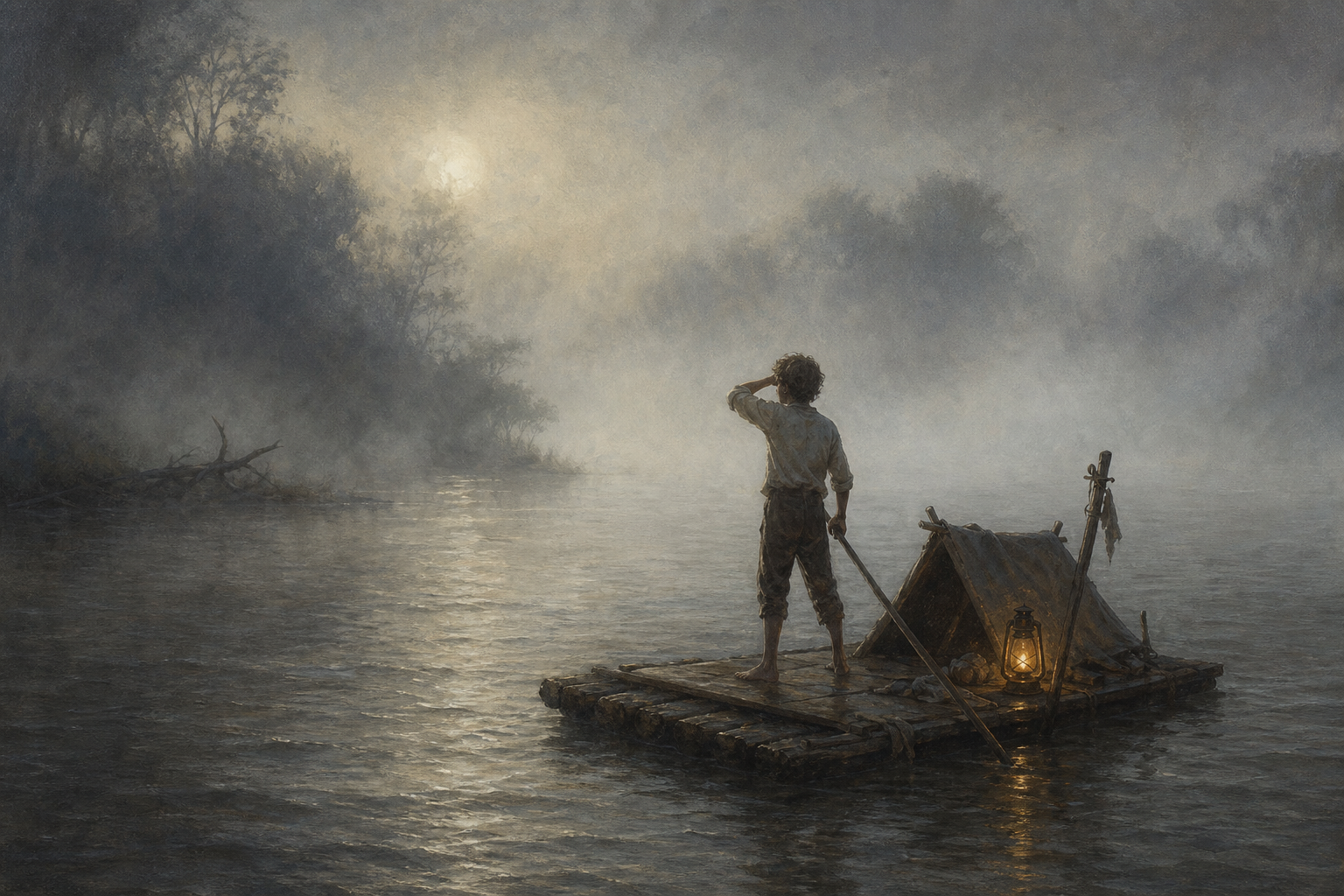
The fog episode turns this moral education into action. Huck and Jim are separated in dense fog, and Jim spends the night terrified that Huck has drowned. When Huck returns, he tries to trick Jim by saying the whole thing was a dream. Jim interprets the wreckage on the raft and realizes Huck has lied. More importantly, he tells Huck that the lie made him feel ashamed and hurt after all his worry.
Huck's apology is one of the novel's most important early turns. He has to humble himself before a person his society has taught him to consider beneath him. Twain does not pretend this erases Huck's racism. Instead, the scene shows a crack in the false moral order: Huck's personal experience of Jim's love challenges what he has been told Jim is worth.
The pressure sharpens as Cairo approaches. Jim's excitement about freedom and family makes Huck nervous, which is exactly the point. Jim's hope is morally obvious to the reader, but Huck has been trained to experience it as wrongdoing. The novel therefore turns a simple geographical goal into an ethical test. Reaching Cairo would not only change Jim's legal situation; it would force Huck to decide whether he believes the law's claim over Jim more than Jim's claim to himself.
When men on the river seem ready to search for runaways, Huck lies to protect Jim. He does not yet have a mature theory of justice, but his body and imagination move toward protection before his conscience catches up. Twain makes moral growth uneven: Huck often acts better than he can explain.
4. Cairo is missed, and the shore grows dangerous
Huck and Jim hope to reach Cairo, Illinois, where the Ohio River would lead toward free territory. Missing Cairo is therefore not just a navigational mistake. It is the loss of a possible route into legal freedom. Fog, accident, and the river's confusing movement turn geography into fate.
The raft is then smashed by a steamboat, separating Huck and Jim. Huck makes his way ashore and enters the Grangerford household, a wealthy family locked in a long feud with the Shepherdsons. At first the Grangerfords seem refined: they have a large house, poetry, family pride, and polished manners. But their refinement hides senseless violence. They cannot even clearly explain the cause of the feud they continue to honor.
Twain uses the Grangerford chapters to attack romantic codes of honor. The same culture that claims gentility produces dead boys, armed churchgoers, and inherited hatred. Huck admires the house and the family before the violence erupts, which makes the critique sharper. The problem is not that cruelty always looks crude. Sometimes it wears good clothes and speaks politely.
The death of Buck Grangerford shocks Huck. It is one of the moments when the adventure plot stops feeling playful. Huck cannot turn the scene into a joke or a clever escape. He hides in a tree and watches a world of adult honor destroy a child. When Jim reappears with the repaired raft, the river again becomes refuge, but the reader knows by now that refuge is temporary.
The Grangerford episode also revises Huck's eye for beauty. He genuinely admires the house, the furniture, the poetry, and the family's style. The point is not that Huck is foolish for admiring them. The point is that beauty and violence can live in the same social form. Twain refuses the easy idea that brutality always looks rough. Sometimes it has polished rooms, sentimental art, and churchgoing habits.
5. The duke and the king expose fraud as social theater
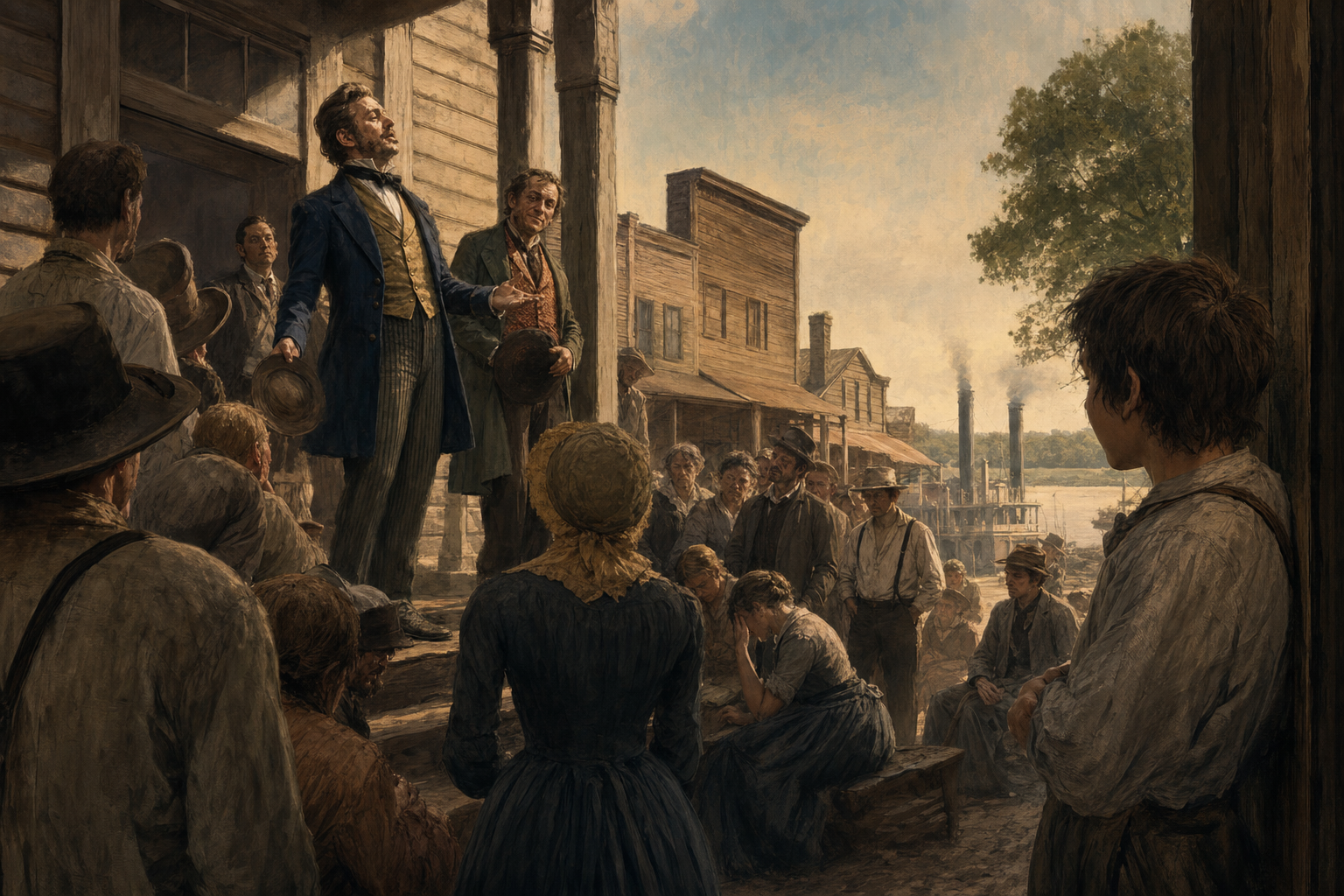
Huck and Jim take two con men onto the raft: a younger man who claims to be a duke and an older man who claims to be a king. Huck quickly sees through them, but he also understands that arguing may be more trouble than silence. The duke and the king turn lying into a profession, and their scams reveal how easily communities can be manipulated by performance.
Their frauds vary in style. They stage bad theater, sell fake lectures, exploit religious feeling, and eventually impersonate the dead brothers of Peter Wilks in order to steal an inheritance from grieving nieces. These episodes can be very funny, but the comedy is acidic. The con men succeed because people want a story that confirms what they hope to believe.
Huck's moral growth becomes clearer during the Wilks episode. He sees Mary Jane Wilks and her sisters being deceived and decides to expose the fraud. This is not the same as his decision about Jim, but it prepares for it. Huck begins to act against lies even when truth creates risk for him. He is still a liar himself, but his lying increasingly serves protection rather than exploitation.
The con men are successful because they understand audiences. At camp meetings they sell repentance. In towns they sell scandal disguised as theater. In the Wilks household they sell family feeling. Twain's satire is not only that two bad men lie; it is that communities often complete the lie by wanting the performance to be true. Huck's growing disgust with them becomes a training ground for his later refusal to let another human being be sold for convenience.
The duke and king also make Jim more vulnerable. Because Jim has to hide during daylight, he is repeatedly treated as an object to be disguised, explained, or moved around. The con men eventually sell him for reward money after printing handbills about him. This betrayal forces the novel toward its central crisis: Huck must decide whether Jim is a friend to rescue or property to return.
6. Huck's conscience turns against his society
When Jim is sold to the Phelps farm, Huck feels trapped between what he has been taught and what he knows from experience. He writes a letter to Miss Watson telling her where Jim is. By the values of his society, this should be the righteous act. Huck has returned "property," obeyed law, and protected his reputation.
Then memory interrupts doctrine. Huck remembers Jim on the raft: Jim keeping watch, calling him "honey," worrying for him in the fog, and showing him care again and again. The abstract category of property breaks against the concrete reality of a person who has loved him.
Huck decides to tear up the letter and accept damnation rather than betray Jim. The famous line is powerful because Huck still thinks he is choosing wrong. Twain's satire is devastating here: a society has trained a child so badly that his moral breakthrough feels to him like sin.
This is the novel's clearest ethical center. It does not make Huck fully enlightened. He remains limited, inconsistent, and shaped by racist assumptions. But in the decisive moment, he chooses loyalty to Jim over the official morality of slavery. That choice is why the novel remains so important for AP Lit and American literature courses: it dramatizes conscience as a struggle against inherited values, not simply obedience to them.
The decision comes through memory rather than doctrine. Huck does not reason from a clean philosophical principle. He remembers Jim in weather, darkness, fear, relief, and care. That makes the scene emotionally persuasive and intellectually disturbing. The novel suggests that conscience may need to be reeducated by relationship when public morality has been corrupted.
7. Tom Sawyer's return and the troubling ending
The ending begins when Huck reaches the Phelps farm and is mistaken for Tom Sawyer. Tom arrives soon afterward and agrees to help "free" Jim, but the situation becomes morally ugly. Tom already knows that Miss Watson has died and freed Jim in her will. He keeps that information secret because he wants an elaborate adventure.
This is where many readers become frustrated with the novel, and they should. Tom turns Jim's captivity into a game full of unnecessary obstacles, secret messages, fake prison customs, snakes, rats, and theatrical plans. Huck, who has just made a profound moral decision, is pulled back into Tom's storybook imagination. Jim, meanwhile, is forced to endure danger and humiliation for a performance that Tom knows is unnecessary.
8. Ending explainedThis section contains spoilers.
The escape ends with Tom wounded. Jim gives up his chance to keep running in order to help Tom get medical care, proving his moral generosity once more. After the truth comes out, Jim is legally free because of Miss Watson's will. Huck also learns that Pap is dead, which means he is no longer under his father's direct threat.
The ending does not solve the novel's ethical problems cleanly. Jim receives freedom, but only after being manipulated by boys and endangered by adults. Tom treats the whole affair as romance and entertainment. Huck refuses Aunt Sally's plan to adopt and "sivilize" him, deciding that he will light out for the Territory instead.
That final escape impulse is both comic and sad. Huck wants to avoid being trapped by another household, but the reader knows that running west cannot by itself answer the questions the novel has raised. The river has taught Huck something real, but America is still full of shores.
This unresolved quality is one reason the ending remains debated. Some readers feel that Tom's elaborate game weakens the moral power Huck gained in the letter scene. Others argue that the discomfort is the point: Jim's freedom can still be delayed by white play, even when the law no longer requires it. Either way, the ending should not be treated as a tidy rescue. Jim is free, Huck is no longer under Pap's direct threat, and Tom survives, but the novel leaves behind a harder question: what good is private loyalty if the surrounding culture can turn another person's freedom into entertainment?
Major Characters
Huck Finn
child narrator with a damaged conscience
Huck is practical, funny, observant, and deeply shaped by neglect. He distrusts formal morality because many respectable adults around him are hypocritical or cruel.
His growth is not a clean conversion from prejudice to modern enlightenment. It is a more uncomfortable process: lived friendship with Jim slowly defeats some of the false moral lessons Huck has inherited.
Jim
enslaved man seeking freedom and family
Jim runs because he fears being sold away from his family. On the raft, he becomes Huck's protector, companion, teacher, and moral counterweight.
The novel gives Jim dignity, tenderness, fear, humor, and grief, even though Huck's narration sometimes limits what readers can see. A careful reading keeps Jim's freedom and family at the center, not just Huck's growth.
Tom Sawyer
romance-reader who turns ethics into play
Tom loves adventure conventions and theatrical plans. Early in the book this is comic; at the end it becomes morally disturbing.
His elaborate "rescue" of Jim exposes the danger of treating other people's suffering as material for stories. Tom's imagination has style, but not enough responsibility.
Pap Finn
abuse, racism, and failed white authority
Pap embodies a violent form of freedom: he rejects school, law, work, and care, but demands power over Huck and resents anyone else's dignity.
His scenes show that Twain's satire is not only aimed at polite hypocrisy. It also exposes the raw brutality underneath claims of racial and paternal authority.
The duke and the king
fraud as performance
These con men survive by reading what crowds want to believe. They are comic because they are absurd, but dangerous because their lies produce real harm.
Through them, Twain expands the book's critique from slavery to a wider American talent for salesmanship, spectacle, and sentimental self-deception.
The Grangerfords
gentility hiding inherited violence
The Grangerfords seem refined, educated, and hospitable, but their family feud turns honor into child-killing violence.
They show that civilization can be decorative rather than moral. Their house is beautiful; their code is rotten.
Best Quotes
You feel mighty free and easy and comfortable on a raft.
The raft is the novel's strongest image of temporary freedom. It is not paradise, but it creates a space where Huck and Jim can live by care, cooperation, and practical trust rather than town law.
You can’t pray a lie—I found that out.
This sentence prepares Huck's great moral decision. Prayer does not work for him when it requires betrayal. Twain makes spiritual truth depend on honesty rather than public respectability.
All right, then, I’ll go to hell.
Huck believes he is choosing damnation, but the reader understands that he is rejecting a corrupt social conscience. The irony is severe: the world has taught him to call mercy a sin.
Human beings can be awful cruel to one another.
The line comes after public humiliation and mob pleasure. It widens the novel beyond one friendship, showing Twain's interest in crowds, cruelty, entertainment, and moral cowardice.
Major Themes
Conscience
Inherited Morality Can Be Wrong
Huck's conscience has been trained by a slaveholding society. The novel's key test is whether lived loyalty to Jim can defeat rules that call injustice righteous.
Freedom
The River Is Refuge, Not Escape
The raft offers breathing room, but the shore keeps returning. Freedom in the novel is physical, legal, emotional, and social, and Jim's need for freedom is far more urgent than Huck's desire for independence.
Satire
Comedy Exposes Cruel Systems
Twain uses jokes, hoaxes, dialect, and absurdity to reveal the foolishness of feud culture, religious hypocrisy, romantic adventure, mob behavior, and slavery's moral logic.
Storytelling
Lies Can Protect or Exploit
Huck lies to survive and sometimes to protect others. The duke and king lie to steal. Tom lies to create theatrical adventure. The novel keeps asking what stories do to real people.
Twain, Slavery, and American Satire
Mark Twain published the book in the 1880s, but the story looks back to the pre-Civil War world of slavery along the Mississippi River. That time gap matters. Twain was writing after emancipation, during an era when the United States was still arguing over race, memory, citizenship, and whose version of the past would become national common sense.
The novel's satire often works by letting white society condemn itself. Pap's racism is obviously grotesque, but polite society is not innocent. Miss Watson can teach religion while owning Jim. Churchgoers can carry guns into a feud. Families can call themselves honorable while training children into inherited violence. Fraudulent performers can succeed because audiences want sentimental stories more than truth.
The book is also a dialect novel. Twain tries to distinguish regional voices, class positions, and racialized speech patterns. Modern readers should handle that feature carefully. Dialect is part of the book's realism and satire, but it also sits inside a literary history that often mocked Black speech. Responsible reading asks what the voice accomplishes, what limits it creates, and how Jim's moral intelligence exceeds the stereotypes available to Huck's language.
Why It Still Matters
The novel lasts because Huck's problem is still recognizable: what if everything around you says the wrong thing is right? Huck does not reach ethical clarity by memorizing a rule. He reaches it by remembering a person.
That makes the book valuable for students, but also uncomfortable. It asks readers to separate law from justice, manners from morality, and official virtue from actual care. It also asks readers to notice when satire is sharp enough to wound the thing it attacks and when historical language still hurts readers now.
When I closed the book, the river did not feel like an escape route. It felt like a moving classroom, teaching Huck that a conscience can be socially approved and still be false.
FAQ: Summary, Ending, and Context
What is Adventures of Huckleberry Finn about?
It follows Huck Finn, a runaway white boy, and Jim, an enslaved man seeking freedom, as they travel by raft down the Mississippi River. The adventure plot becomes a satire of slavery, racism, family violence, fraud, religious hypocrisy, and the moral confusion of a society that calls injustice lawful.
Why is Jim so important?
Jim is not only a companion in Huck's adventure. He is the emotional and ethical center of the book. His love for his family, care for Huck, fear of capture, and repeated acts of loyalty expose the cruelty of the society that treats him as property.
Why is the ending controversial?
Tom Sawyer turns Jim's escape into a game even though he knows Jim has already been freed in Miss Watson's will. Many readers find the ending frustrating because it delays Jim's freedom for comic performance. That discomfort is part of why the ending remains so debated.
How should readers handle the novel's racist language?
The language should be named, contextualized, and discussed rather than normalized. The book represents a racist society and often satirizes that society's moral logic, but classrooms and readers still need care because repeated slurs can cause real harm.
Read Next
Read The Adventures of Tom Sawyer to see the lighter comic world Huck grows out of, Uncle Tom's Cabin for a different nineteenth-century anti-slavery literary landmark, and The Great Gatsby for another American novel about illusion, social performance, and moral failure.
Adaptations
- 1939 film: an early Hollywood version that softens much of the novel's satire.
- 1960 film: emphasizes river adventure and family viewing.
- 1993 film: brings more attention to Huck and Jim's relationship while still simplifying the book's racial and satirical complexity.
- Stage, radio, and school adaptations: often reveal what a culture wants to emphasize or avoid about the novel.