The Enchanted April - Wistaria, Sunshine, and the Courage to Rest
A detailed guide to Elizabeth von Arnim's comedy of renewal, marriage, solitude, friendship, and the small Italian castle that changes four unhappy women.
Sua's Quick Take
The Enchanted April looks like a holiday novel, but Elizabeth von Arnim is doing something more exact: she asks what happens when exhausted people are removed from the roles that have made them small.
San Salvatore does not magically erase selfishness, loneliness, vanity, or unhappy marriage. It gives the characters enough beauty, quiet, and unoccupied time to notice what those habits have cost them.
What the Book Is Really About
The novel begins in London rain and ends in Italian light. That movement sounds simple, yet the book is not only a contrast between bad weather and good weather. It is a study of emotional climate. Mrs. Lotty Wilkins is ignored by a handsome, self-important husband. Rose Arbuthnot has buried a painful marriage under religious duty and parish work. Lady Caroline Dester, known as Scrap, is tired of being desired. Mrs. Fisher is trapped in memories of eminent Victorian men and the authority those memories give her.
All four women answer the same advertisement for a "small mediaeval Italian Castle" to be let for April. At first, San Salvatore is a practical arrangement: shared rent, shared servants, shared escape. Once they arrive, the castle becomes a testing ground. Can rest become ethical? Can solitude make a person kinder rather than more self-protective? Can beauty expose the difference between love and possession?
Von Arnim's comedy is gentle on the surface and ruthless underneath. The joke is often that the characters think they want to be left alone, respected, obeyed, or admired, when what they need is to stop defending the selves that London taught them to perform.
That is why the book works as more than a travel fantasy. San Salvatore is lovely, but the plot is not "women go somewhere pretty and become happy." Each woman carries a social identity that has become too tight: wife, saint, beauty, relic. April gives those identities a month of pressure-free air, then asks whether the characters can return to relationship without returning to the old diminishment.
Plot Summary
1. Rain, The Times, and the advertisement for April
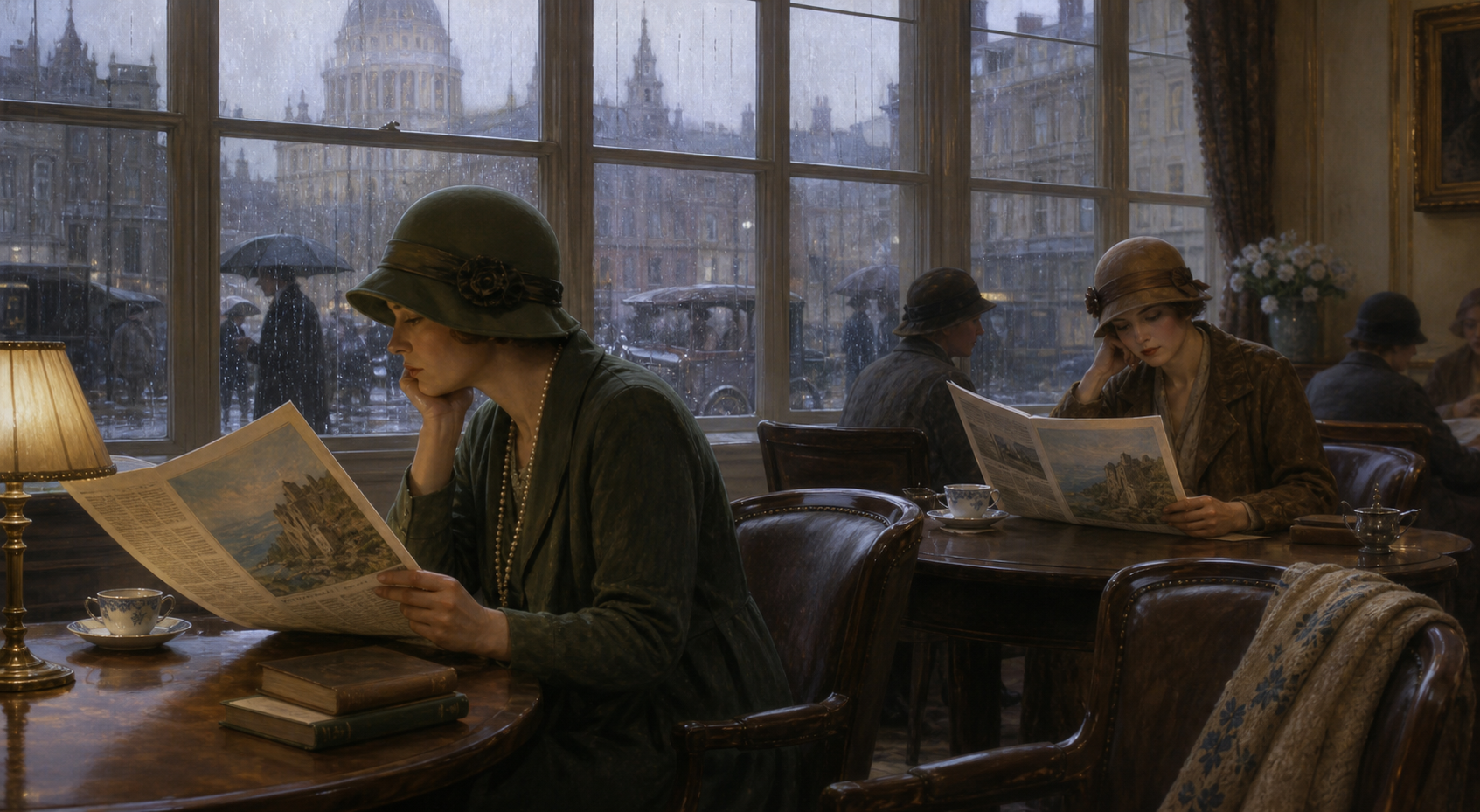
The book opens in a London Women's Club on a miserable February afternoon. Lotty Wilkins has come down from Hampstead to shop, eat lunch, and endure another ordinary day. In The Times, she sees an advertisement addressed to people who appreciate wistaria and sunshine: a small medieval Italian castle on the Mediterranean is available for the month of April.
The advertisement feels as if it has found her by name. Lotty is not rich, not admired, and not listened to. Her husband Mellersh is a solicitor who believes in thrift, appearances, and his own good sense. Lotty has learned to be apologetic before she even speaks. Yet the advertisement awakens an image so vivid that it cuts through habit. She sees herself and another woman under trailing wisteria, with old grey walls behind them.
The other woman is Rose Arbuthnot, whom Lotty knows only by sight from church. Rose is dutiful, charitable, and sad. She organizes poor children, keeps her respectable house, and tries to convert emotional disappointment into religious endurance. Her husband Frederick writes popular memoirs about morally scandalous women; Rose lives partly on the money those books bring in and partly in spiritual protest against them.
Lotty asks Rose whether she is reading about the castle and the wistaria. This is the first miracle of the novel, and it is not supernatural. A shy woman speaks. A dutiful woman listens. The escape begins because someone names a shared longing aloud.
The opening also sets up von Arnim's comic method. Ordinary details are funny because they reveal whole systems: Mellersh's fish preferences, Lotty's savings, Rose's church work, and the club's uncomfortable respectability all show how small routines can become moral weather. Before Italy appears, the novel has already made London feel like a place where women are asked to become useful, quiet, and nearly invisible.
2. Sharing the cost, screening strangers, and leaving husbands behind
Lotty and Rose cannot afford San Salvatore alone, so they advertise for two more women to share the rent. Their attempt to arrange freedom is comic because they are inexperienced in freedom. They must write letters, meet applicants, calculate expenses, keep husbands from taking over the decision, and persuade themselves that one month of happiness is not morally suspicious.
The two women who join them are almost opposites. Lady Caroline Dester is young, beautiful, aristocratic, and exhausted by attention. Men and women alike want something from her beauty, and she longs to be anonymous for once. Mrs. Fisher is elderly, respectable, and very conscious of having known important men in the past. She brings a stick, a store of memories, and a habit of silent judgment.
These four do not begin as friends. Lotty hopes for joy, Rose hopes for rest, Scrap hopes for privacy, and Mrs. Fisher hopes for authority with a view. The castle party is therefore unstable from the start. San Salvatore is not a sisterhood retreat in any sentimental sense; it is four forms of loneliness placed inside the same April.
The journey itself begins to reduce England's power. Mellersh, Frederick, the vicar, charity committees, social fatigue, and London rain recede by train and distance. The women arrive at night, confused by language, luggage, stairs, and darkness. Their first Italian impressions are not smooth luxury but disorientation. That matters because the book does not make transformation instant. It begins with the body being moved into a new world before the mind knows what to do with it.
The hiring process also matters for class. The women can pursue rest because they have some money, servants, letters, and social access, even if none of them feels fully free. Von Arnim does not ignore that privilege; she turns it into part of the comedy. They are escaping constraint, but they are still arranging escape through rent, references, meals, luggage, and the etiquette of who gets which room.
3. San Salvatore and the first morning of enchantment
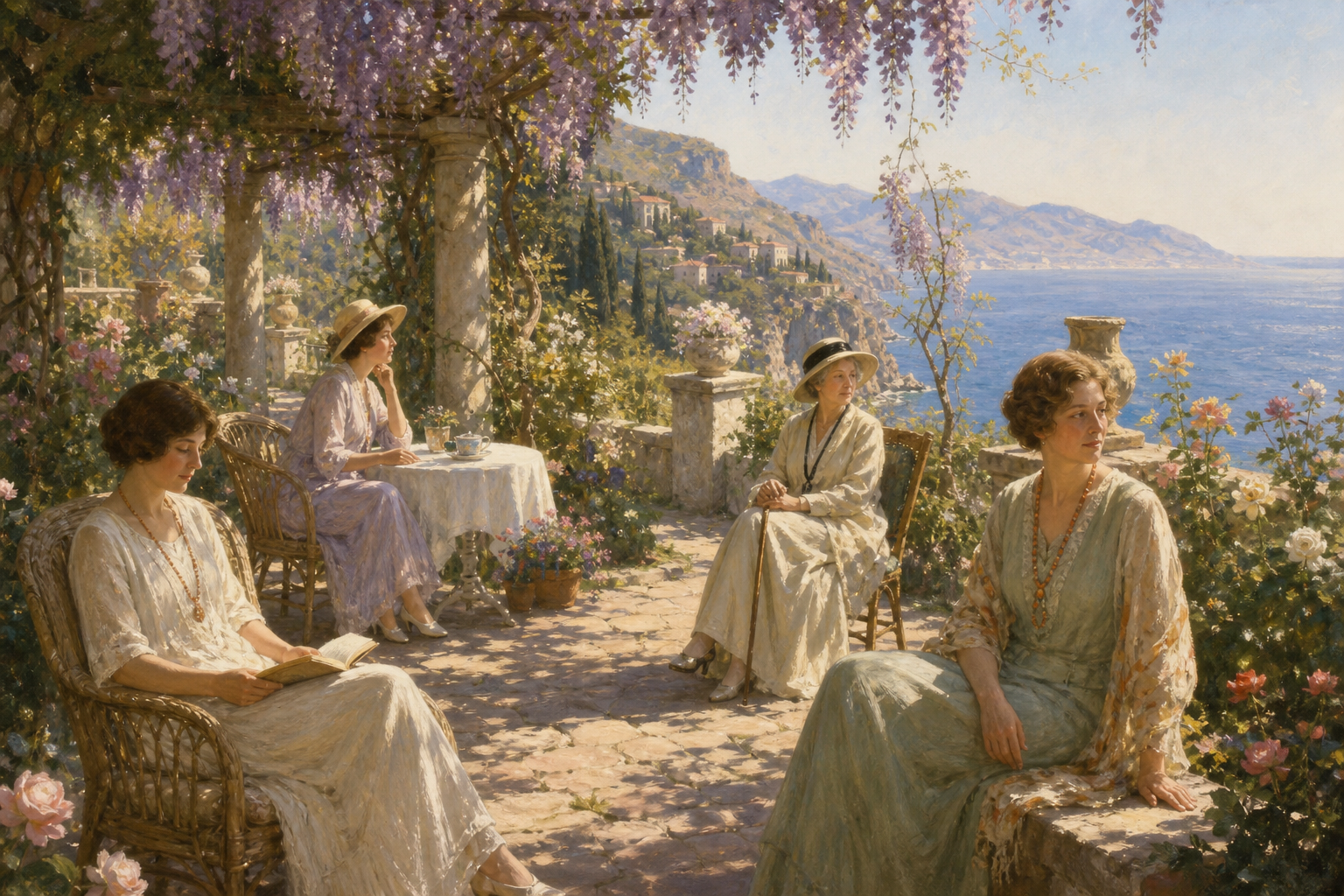
The first morning at San Salvatore changes the scale of reality. Lotty wakes in a bed without Mellersh, in a room that gives her space, air, flowers, and a sense of bodily freedom she has not had for years. Outside are gardens, sea, sun, and wisteria. Worries that seemed solid in Hampstead dissolve into color and light.
Rose also feels the effect, but more cautiously. Her religious discipline has taught her to suspect self-indulgence, yet San Salvatore makes her feel how tired she is. She begins to understand that service without love can become a hiding place. Her distance from Frederick is not solved by simply leaving England, but in Italy she can finally feel the ache she has been managing under duty.
Mrs. Fisher tries to claim the house through precedence. She wants the best sitting place, the right to remember, and the quiet respect owed to age. Yet the castle does not fully obey her categories. The servants, the garden, the other women, and especially Lotty's strange directness all resist the old order she carries with her.
Scrap wants to retreat behind beauty. She is used to being looked at and wants a month in which no one wants, touches, praises, or pursues her. San Salvatore first appears to give her that. But the garden also makes isolation less satisfying. Beauty has protected her; now beauty begins to open her.
The first morning is therefore not one conversion but four separate openings. Lotty receives the place immediately, Rose receives it guiltily, Scrap receives it as privacy, and Mrs. Fisher receives it as property to organize. The same landscape produces different reactions because each woman arrives with a different injury. A useful reading tracks not simply that the castle "changes them," but which part of the castle touches which defense.

4. Four women, four defenses
The middle of the novel is built from small shifts rather than melodramatic events. Lotty is the first to trust the enchantment. She stops being merely apologetic and begins to see people generously before they have earned it. Her optimism can look foolish, but von Arnim makes it a form of perception. Lotty often sees what people might become if fear loosened.
Rose's conflict is quieter. She has made a religion out of endurance, but her endurance has become lonely and dry. At San Salvatore she has no poor children to organize, no parish rhythm to hide in, and no Frederick nearby to pray over from a distance. The absence leaves room for desire, hurt, and the possibility that forgiveness may require speech rather than self-erasure.
Scrap's defense is detachment. She is beautiful enough to make people ridiculous, and she knows it. Her coldness is a survival tool. Yet she is also bored by the identity that beauty has forced on her. In the garden she begins to experience herself as more than an object of attention. Her late movement toward Mr. Briggs matters because it is not a conquest scene; it is the first time her beauty does not have to be armor.
Mrs. Fisher's defense is memory. Her past with famous writers and cultivated men lets her organize the present as decline. She can dismiss the younger women because she has the dead behind her. But San Salvatore is intensely present-tense. Flowers bloom now, meals happen now, awkward kindness happens now. The April air asks even Mrs. Fisher whether authority is worth the price of being unreachable.
This middle movement is intentionally domestic. There are no duels, betrayals, or great public scenes. Instead, von Arnim makes chairs, bedrooms, lunches, walks, letters, and silences carry the plot. That is part of the book's argument: emotional life is not repaired only by decisive declarations. It is often changed by the repeated experience of not being watched, ordered, used, or admired in the old way.
5. Mellersh arrives, and Lotty's marriage changes shape
Lotty eventually invites Mellersh to San Salvatore. This could ruin everything. Mellersh is practical, suspicious, and accustomed to defining Lotty by her usefulness. When he arrives, however, the castle begins working on him too. Comfort, food, beauty, and Lotty's new unafraid happiness confuse his old certainty.
Von Arnim does not pretend Mellersh becomes a saint. His transformation is comic and partial. He discovers that it is pleasant to be pleased, that Lotty is attractive when not crushed by his judgment, and that authority is less enjoyable than admiration freely given. His softening exposes the novel's marital argument: some husbands behave badly because systems of marriage reward small tyrannies; change begins when the wife no longer collaborates with her own shrinking.
Lotty's love is important because it is not revenge. She does not use San Salvatore to humiliate Mellersh. She sees that he too has been deformed by the role he plays. That generosity is risky, and the novel knows it, but it also shows why Lotty is the book's moral center. She believes people can be better before they can prove it.
Mellersh's visit also keeps the novel from becoming a simple women-only refuge. The old world walks into the castle wearing good manners and confident opinions. If April can only work while husbands are absent, its power would be fragile. Mellersh's comic thaw tests whether Lotty's new confidence can meet marital authority without shrinking back into apology.
6. Frederick, Rose, and the danger of loving an image
Rose's husband Frederick arrives later and with more complicated motives. He is drawn partly by curiosity, partly by the rumor of Lady Caroline, and partly by a marriage he has let go cold. Rose has long treated Frederick as a spiritual problem rather than a living partner. Frederick has treated Rose as a domestic fact rather than a beloved person.
The comedy around Frederick and Scrap is sharp because it reveals how easily desire attaches itself to surfaces. Frederick's interest in Lady Caroline embarrasses Rose, but it also forces the marriage out of its frozen politeness. Rose cannot continue being only long-suffering. Frederick cannot continue being only clever and absent. San Salvatore exposes the evasions both have relied on.
The reconciliation between Rose and Frederick is not as simple as sunshine curing sin. It depends on seeing. Rose must see that her righteous distance has protected her from risk as well as from pain. Frederick must see that his wife's tenderness is not an automatic possession. The Italian April makes their reunion possible because it makes the old English arrangement feel impossible.
Frederick's attraction to Scrap is uncomfortable for a reason. It shows that beauty can become another escape from truth, just as duty and memory can. Rose's marriage cannot be healed by ignoring Frederick's vanity or by pretending her own moral distance has been pure. The castle's gift is exposure: people see the evasions they have been calling personality.
7. The ending and what April changesThis section contains spoilers.
By the end of April, San Salvatore has rearranged nearly every relationship. Lotty and Mellersh are newly affectionate. Rose and Frederick recover the possibility of mutual love. Scrap becomes less defended and more open to Mr. Briggs, the castle's owner. Mrs. Fisher, though still herself, is softened into a less lonely relation to the present.
The ending is deliberately bright, but it is not empty wish fulfillment. The novel has prepared its brightness by showing how each defense weakens: Lotty stops apologizing, Rose stops hiding behind sanctity, Scrap stops treating every admirer as a threat, and Mrs. Fisher starts wanting the living more than the dead. The pairings at the end can feel idealized, but they are thematically earned because the book has made receptivity itself the central moral action.
Von Arnim's point is that beauty and leisure have moral force when they free people from defensive habits. The castle does not replace London forever. The characters must return to ordinary life. What changes is that they have learned another version of themselves is possible.
The "enchantment" is therefore not escape from reality. It is a temporary clearing in which reality can be seen without the fog of resentment, duty, vanity, and fatigue.
Major Characters
Lotty Wilkins
visionary, neglected wife, and agent of renewal
Lotty begins as a shy woman almost erased by thrift, marriage, and social invisibility. The advertisement wakes a courage that looks irrational only because her old life has taught her to apologize for wanting anything.
Her gift is imaginative charity. She sees San Salvatore before it exists for her, then sees better selves in Mellersh, Rose, Scrap, and Mrs. Fisher before they are ready to inhabit them.
Rose Arbuthnot
dutiful wife learning to desire honestly
Rose is kind, religious, and disciplined, but her goodness has become a shelter from pain. Her husband Frederick's work and emotional absence have driven her into service that is morally serious but personally desolate.
In Italy she learns that forgiveness cannot mean self-cancellation. Her renewal depends on admitting loneliness, anger, and love instead of converting all feeling into duty.
Lady Caroline Dester / Scrap
beauty exhausted by being wanted
Scrap is young, aristocratic, and famously beautiful. Her coolness is not mere vanity; it is a defense against a world that turns her into an object of appetite and admiration.
San Salvatore gives her the rare chance to be unperformed. Her movement toward openness suggests that being loved without being consumed may make beauty less isolating.
Mrs. Fisher
authority, memory, and Victorian afterlife
Mrs. Fisher lives among memories of great men and uses the past as a court of appeal against the present. Her stick, chair, and reminiscences give her control when intimacy feels risky.
The novel does not mock age itself; it mocks the refusal to live now. Mrs. Fisher softens when April makes the present more compelling than prestige.
Mellersh Wilkins, Frederick Arbuthnot, and Mr. Briggs
men tested by the castle's atmosphere
Mellersh exposes the comedy of marital authority, Frederick exposes the damage of clever absence, and Mr. Briggs offers a less possessive relation to San Salvatore and to Scrap.
The men are not the center of the novel, but their arrivals test whether the women's renewal can survive contact with the old world.
Best Quotes
It began in a Woman's Club in London on a February afternoon--an uncomfortable club, and a miserable afternoon.
The opening sentence makes weather, place, and mood do structural work. London is not just rainy; it is cramped, social, and spiritually airless.
To Those who Appreciate Wistaria and Sunshine. Small mediaeval Italian Castle on the shores of the Mediterranean to be Let Furnished for the month of April.
The advertisement is both plot device and temptation. Its capitalized, practical language accidentally offers the exact poetry Lotty and Rose need.
I do choose, and I do make it, and it isn't.
Lotty answers Rose's idea that heaven can be made at home. The line is comic, plain, and devastating: it exposes the cruelty of telling unhappy women that domestic misery is only a failure of attitude.
I'm sure it's wrong to go on being good for too long, till one gets miserable.
This is one of Lotty's most radical sentences. Von Arnim separates real goodness from self-erasing obedience, especially the kind expected of wives and respectable women.
Why couldn't two unhappy people refresh each other on their way through this dusty business of life by a little talk--real, natural talk, about what they felt, what they would have liked, what they still tried to hope?
The question turns conversation into rescue. It shows why Lotty's first act of speech matters: the novel begins renewal not with travel, but with one person refusing to keep longing private.
Nothing further was to be expected of them; while of the living, what might one not still expect?
Mrs. Fisher's late realization quietly reverses her whole life strategy. The dead great men gave her status, but the living can still surprise, need, forgive, and love.
Beauty made you love, and love made you beautiful.
Near the end, the novel's whole theory of enchantment condenses into one sentence. Beauty is not a decorative reward; it starts a cycle of perception, affection, and transformation.
Major Themes
Rest
Rest as Moral Recovery
The novel treats rest not as laziness but as a condition for truth. When the women stop serving, performing, and defending themselves, they can finally hear what their lives have been saying.
Place
San Salvatore as Transforming Setting
The castle is a setting with agency: light, gardens, rooms, meals, sea air, and distance from England all reshape perception. Place becomes a form of argument.
Marriage
Marriage Beyond Possession
Lotty and Rose show two damaged marriages: one narrowed by authority, the other by distance and moral disappointment. April does not erase harm, but it makes mutual seeing possible again.
Beauty
Beauty Against Defensive Selves
Beauty in the novel is dangerous because it disarms. Scrap's beauty isolates her, but San Salvatore's beauty asks the characters to love without grasping.
Class
Leisure, Money, and Access
The holiday depends on rent, servants, letters, and social privilege. Von Arnim lets that privilege remain visible while still arguing that rest can reveal truths ordinary respectability hides.
Speech
Talk as the First Escape
Lotty and Rose begin to change before they reach Italy because Lotty speaks honestly. The novel treats plain, natural talk as an antidote to roles that keep people classified and silent.
Elizabeth von Arnim and the Comedy of Renewal
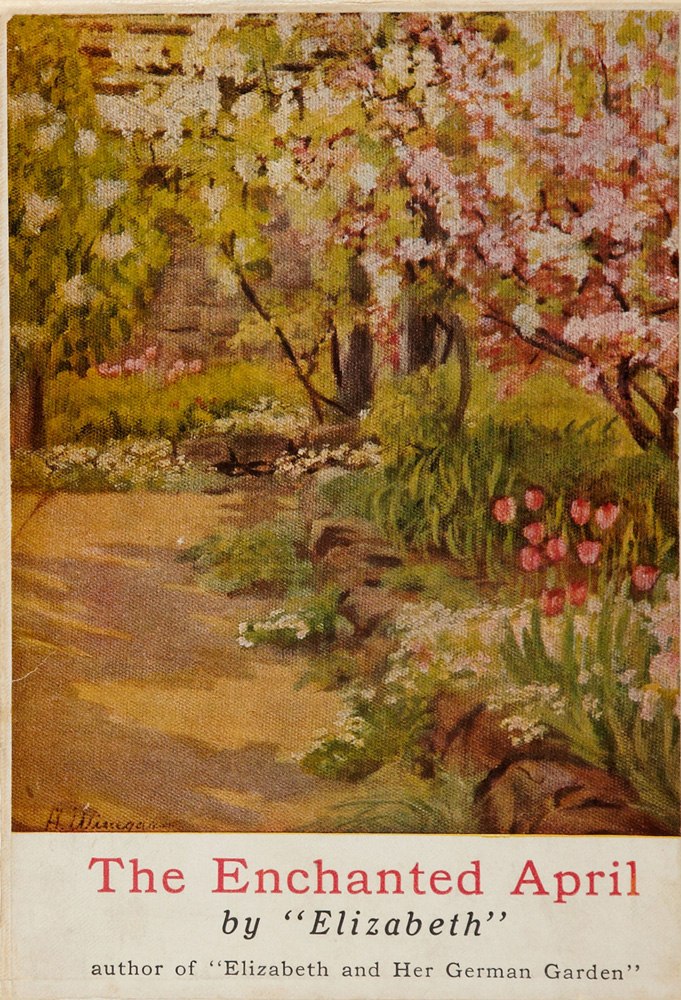
Elizabeth von Arnim published The Enchanted April in 1922, after a career already associated with gardens, irony, domestic observation, and women's inner lives. The cover in the Project Gutenberg package still names the author as "Elizabeth," a reminder of the public persona attached to Elizabeth and Her German Garden.
The novel belongs to the post-World War I moment without becoming a war novel. Its weariness is social and emotional: marriages have gone stale, public roles have hardened, and people confuse endurance with virtue. The Italian setting lets von Arnim write a restorative fantasy while keeping her satirical eye on money, class, gender, and self-deception.
That balance is why the book still reads freshly. It believes in happiness, but not in cheap cheerfulness. Happiness arrives through attention, humility, altered habits, and the willingness to stop calling deprivation goodness.
The book is also a useful companion to other early twentieth-century novels about social performance. Where The Great Gatsby makes spectacle glitter and then curdle, The Enchanted April makes charm restorative but not mindless. Where a darker modernist novel might expose the emptiness of old roles and stop there, von Arnim asks what gentler form of life might become possible after exposure.
Why It Still Matters
Modern readers still understand the longing that begins the book: the fantasy that one month away might restore the self that routine has buried. The novel is not only about travel. It is about what becomes visible when the noise of obligation is interrupted.
It is especially useful for literary study because its surface charm hides complex craft. Setting, irony, free indirect style, social comedy, gender roles, and symbolic imagery all work together. A strong essay can analyze San Salvatore as a character-like force, Lotty as comic prophet, Scrap as a critique of objectification, or Mrs. Fisher as the past resisting renewal.
When I closed the book, the line I kept was not "go to Italy." It was: make enough room in a life for love to become visible again.
That makes the novel sharper than its reputation as comfort reading can suggest. It asks whether people sometimes call themselves dutiful, refined, practical, or detached because those words sound better than lonely, frightened, proud, or tired. April does not excuse those evasions. It makes them harder to keep.
FAQ: Summary, Ending, and Study Notes
What is The Enchanted April about?
The Enchanted April follows four women who rent San Salvatore, a small Italian castle, for the month of April. Lotty Wilkins, Rose Arbuthnot, Lady Caroline Dester, and Mrs. Fisher arrive with different kinds of unhappiness, and the beauty and quiet of the castle change how they understand marriage, solitude, friendship, and love.
Is The Enchanted April public domain?
The Project Gutenberg edition of The Enchanted April is public domain in the United States. This guide is based on Project Gutenberg eBook #16389, using the original English text and the cover image included in the Gutenberg package.
Why is the ending important?
The ending matters because it shows renewal spreading beyond the women alone. Mellersh and Frederick also change, but the novel's deeper point is that the women have stopped accepting cramped versions of themselves. April's enchantment is temporary; the new perception it creates can travel home.
Is the novel just escapist?
It is escapist in the best literary sense: it creates a temporary elsewhere where ordinary life can be judged more clearly. But it is not an argument that money, travel, or sunshine solve everything. The comedy works because San Salvatore exposes the habits that London normalized.
What should students focus on in an essay?
The strongest essays usually connect setting to character change. Track how London rain, the advertisement, bedrooms, gardens, meals, and the final white flowers turn emotional states into visible images. Then connect those images to marriage, gender, class, beauty, or the difference between solitude and isolation.
Read Next
Read A Room with a View for another comedy about Italy and self-knowledge, The Blue Castle for a late-blooming heroine who escapes fear, and Pride and Prejudice for a sharper marriage comedy about perception and social roles.
Adaptation note
- Enchanted April (1991) is the best-known screen adaptation, useful for comparing how visual media renders San Salvatore's garden, Lotty's warmth, and the ensemble's emotional thaw.
- The novel also pairs well with travel-and-renewal stories where place does not solve life but changes what people can admit about it.