Dracula - The Vampire, the Archive, and the Hunt Through the Dark
A detailed guide to Bram Stoker's Gothic classic about blood, belief, modern records, and the group that learns how to read a monster's trail.

Sua's Quick Take
Honestly, Dracula is scarier when you stop treating it as only a vampire story. It is a novel about what people do when reality becomes unbelievable: they write, compare, type, listen, trust, and turn scattered fear into an archive strong enough to hunt the thing causing it.
What the Book Is Really About
Bram Stoker's Dracula is the vampire novel that taught modern popular culture much of its vampire grammar: the aristocratic count, the castle, the coffin, the bite at the throat, the fear of daylight, the power of blood, the protective force of garlic, crosses, and sacred objects. But the original novel is less simple than the myth it created.
The book is made of documents: Jonathan Harker's journal, Mina Harker's diary and typescripts, Lucy Westenra's letters, Dr. Seward's phonograph diary, telegrams, newspaper clippings, ship logs, legal papers, and memoranda. That structure matters. No single narrator understands the whole threat. Each person records a fragment, and only when Mina organizes those fragments can the group understand Dracula's pattern.
So the central conflict is not just humans versus vampire. It is darkness versus record, superstition versus narrow skepticism, ancient predation versus modern coordination, and private terror versus shared testimony. Dracula is powerful because he isolates people. The group becomes powerful when it stops being isolated.
Plot Summary
1. Jonathan Harker enters Castle Dracula
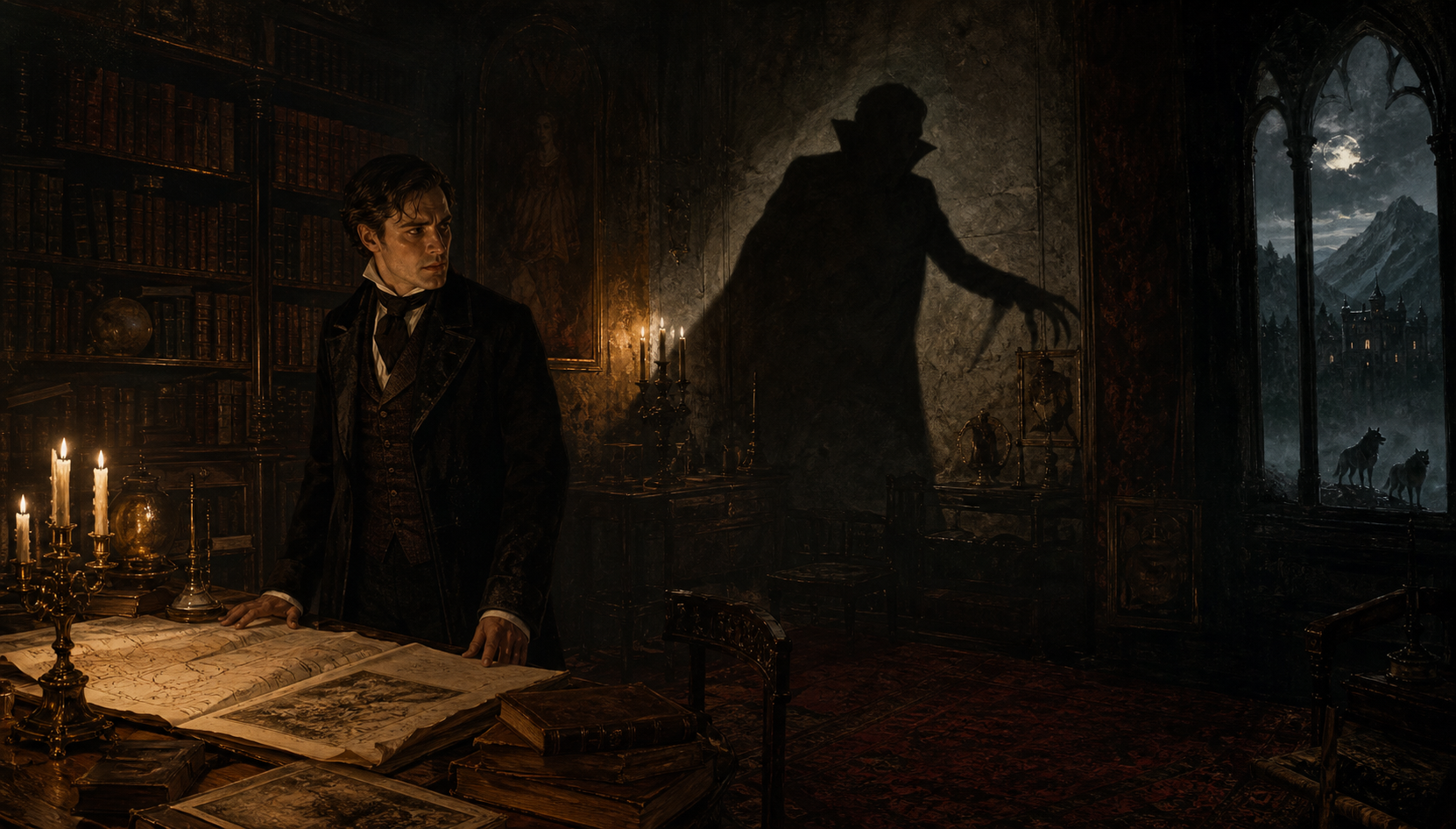
The novel begins with Jonathan Harker, a young English solicitor's clerk, traveling through Eastern Europe to assist Count Dracula with a London real-estate purchase. Harker's early journal sounds practical: trains, hotels, food, maps, languages, business arrangements. That practicality is important because Stoker lets the ordinary world remain visible as the Gothic world opens beneath it.
The farther Harker travels toward the Carpathians, the more local warnings gather around him. The innkeepers at Bistritz grow frightened at Dracula's name. An old woman begs him not to go and gives him a crucifix. Harker treats much of this as superstition, but the reader can feel that his English confidence is already out of scale with the place he is entering.
The journey to the castle is one of the novel's great threshold sequences. The coach travels through darkness, wolves howl, the driver behaves mysteriously, and blue flames appear over the ground. Harker is still trying to record the experience like a rational observer, but the record itself begins to strain under what he cannot explain.
Count Dracula receives him with formal courtesy. At first, the Count appears to be an eccentric foreign nobleman who wants help learning English manners. He has studied English books, newspapers, directories, law, and society. He wants to blend into London. Yet the wish to blend in is not innocent. Dracula does not want to become harmlessly English; he wants to enter England without being recognized as a stranger and without losing mastery.
Harker slowly notices the wrongness beneath the hospitality. Dracula has no reflection in a mirror. He appears without servants, yet meals are prepared. His hands are strange, his teeth sharp, his pallor unnatural. The castle is rich but airless, a house of locked doors and missing exits. The guest becomes a prisoner.
The horror deepens because Dracula uses manners as a trap. He makes Harker write letters with future dates, effectively scheduling the appearance of normal communication after Harker may already be dead. He controls what Harker can say to the outside world. The civilized forms of correspondence, hospitality, and legal business become tools of captivity.
Harker explores the castle and sees Dracula sleeping in a box of earth. He also encounters three vampire women whose approach is both erotic and deadly. Dracula interrupts them, not out of mercy, but because Harker still belongs to him. The scene shows how vampiric power in the novel works through desire as well as fear. Dracula does not merely attack bodies; he rearranges the victim's will, perception, and boundaries.
By the end of the castle section, Harker knows he must escape or die. His journal becomes an attempt to preserve sanity, evidence, and farewell at once. He is not a heroic vampire hunter yet. He is a trapped witness who writes because writing is the only form of control left.
2. Whitby, Lucy, and the arrival of Dracula in England
The narrative then shifts to England and to the friendship between Mina Murray and Lucy Westenra. The tonal change is striking. Letters about marriage, friendship, proposals, and seaside life replace the claustrophobic castle. Lucy is loved by three men: Arthur Holmwood, Dr. John Seward, and Quincey Morris. She accepts Arthur, while Seward and Quincey remain devoted friends.
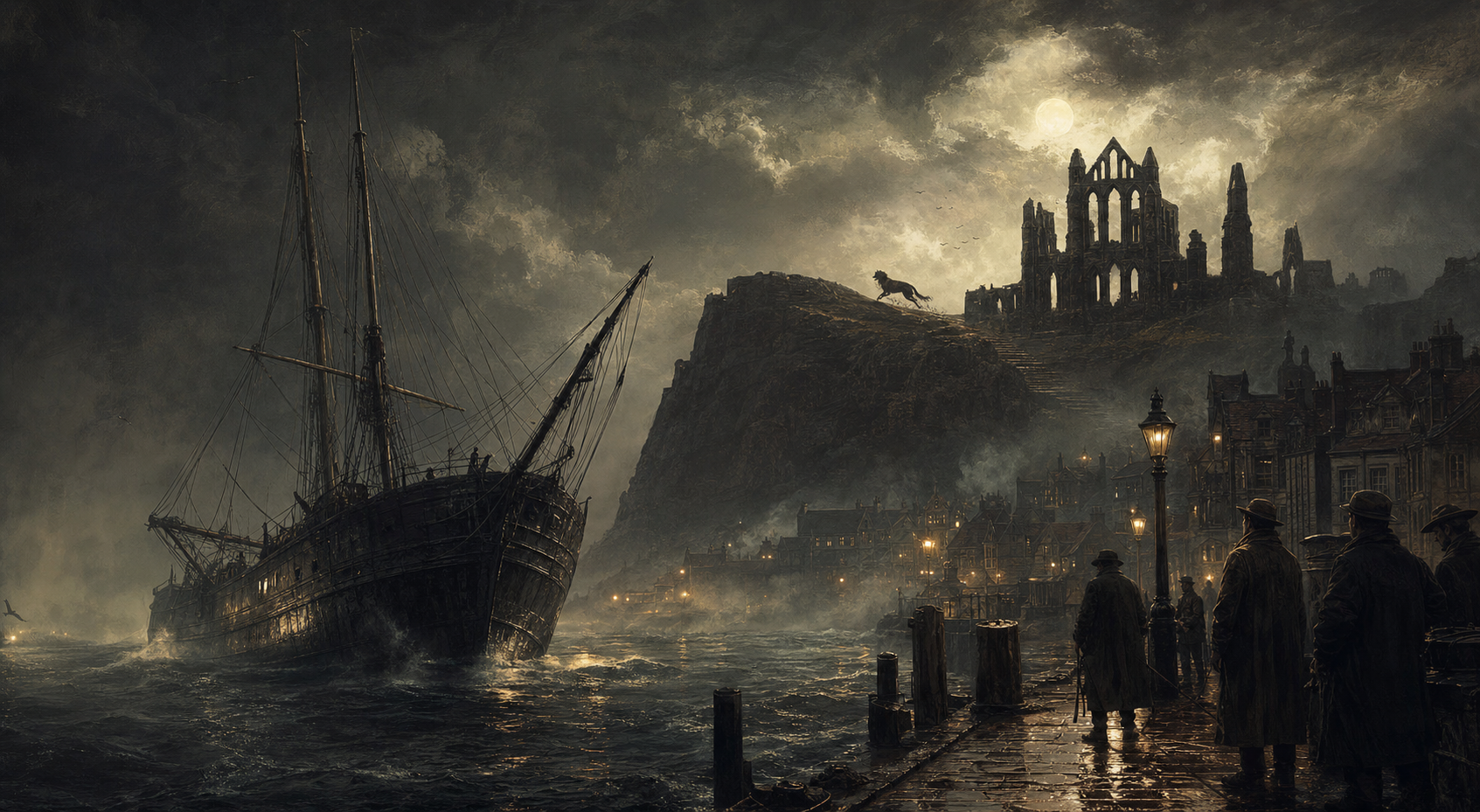
But the Gothic has already crossed the sea. In Whitby, Mina worries over Jonathan's silence while Lucy begins sleepwalking. The graveyard, cliff, abbey ruins, and sea fog create an English Gothic setting. Stoker does not leave horror in a distant castle. He imports it into a recognizable English coastal town.
The ship Demeter brings Dracula to England. Its arrival is staged through newspaper report and ship log, which gives the episode a documentary feeling. The ship reaches Whitby in a storm with its captain dead at the wheel and a large black dog leaping ashore. The log reveals that the crew disappeared one by one during the voyage, haunted by something hidden aboard.
The Demeter episode is easy to underestimate, but it is crucial. Dracula is not a local monster trapped in old-world folklore. He is a mobile threat who can travel through modern shipping, cargo, paperwork, and ports. He brings boxes of Transylvanian earth with him, making his homeland portable.
After Dracula arrives, Lucy's condition worsens. Mina finds her near the graveyard, pale and dazed, with small wounds at her throat. At first, Lucy's decline looks like illness, nervous weakness, or sleepwalking. Dr. Seward cannot explain it. He calls in his old teacher, Abraham Van Helsing, whose strength lies in being both learned and intellectually flexible.
The repeated blood transfusions are among the novel's strangest and most revealing scenes. Arthur, Seward, Van Helsing, and Quincey all give blood to Lucy. Their blood is framed as devotion, but it also makes the body a site of intimacy, medical experiment, male rivalry, and spiritual danger. Stoker's handling of blood is never just biological.
Van Helsing uses garlic and sacred objects, but his precautions fail when Mrs. Westenra unknowingly removes them and a wolf breaks into the room. Lucy dies. Yet death does not end the threat. Children begin reporting the "Bloofer Lady," and Van Helsing realizes that Lucy has become one of the Un-Dead.
3. Lucy's tomb and the demand to believe
The tomb sequence forces the characters to accept what they most want to deny. Arthur and Seward loved Lucy as a living woman. Van Helsing asks them to see that the thing wearing Lucy's face is no longer the Lucy they mourn. The emotional violence of that demand is the point.
Stoker makes belief difficult. Seward is a doctor and a rational observer. He does not want to abandon evidence. Van Helsing does not ask him to abandon evidence either; he asks him to expand what can count as evidence when the facts outrun conventional explanation. The novel's argument is not "science is useless." It is that science becomes weak when it refuses to look at facts that do not fit its current categories.
Lucy as vampire is terrifying because she is familiar and corrupted at once. She carries the memory of sweetness and the behavior of predation. The group must separate sentimental memory from present danger. Arthur's role in releasing her into "true death" is brutal, but the scene is written as an act of terrible mercy within the novel's moral universe.
This section changes the plot. Before Lucy's tomb, Dracula is a mystery and a threat. After Lucy's tomb, the group knows what they are fighting. They also know the cost of delay. Lucy's tragedy becomes the evidence that makes disbelief impossible.
4. Mina's archive and the making of the hunting party
Mina Harker becomes the novel's intellectual center. She types and organizes journals, letters, newspaper clippings, telegrams, ship records, and phonograph entries. Without her, the group has grief, suspicion, and scattered facts. With her, they have a chronological case file.
This is why Mina matters so much. She is not only the "good woman" praised by the men around her. She is the person who turns private documents into shared knowledge. Her typewriter is not decorative; it is one of the central weapons of the book.
The vampire hunt becomes investigative work. The group tracks Dracula's boxes of earth, his houses, his legal purchases, and his movements across London. The Count has supernatural powers, but he also needs material conditions: daylight shelter, transport, property, soil, servants, and routes. Once the group understands the rules, his power leaves traces.
Renfield's plot also becomes clearer here. Seward's patient has been collecting lives: flies, spiders, birds, and a desired cat. His obsession with consuming life mirrors Dracula's vampirism in miniature. Seward initially treats him as a psychiatric case, but Renfield is also a barometer for Dracula's presence. He shows how the desire to absorb life can look like madness, worship, appetite, and metaphysical hunger at once.
The group's weakness is that they sometimes confuse protection with exclusion. When the men decide Mina should be spared the terrible details, they mean well. But their decision removes the best organizer from the center of the investigation and leaves her more vulnerable. Stoker is not a modern feminist in a simple sense, but the novel repeatedly shows that Mina's exclusion is both morally patronizing and strategically foolish.
5. Mina's infection and the crisis of shared trust
Dracula attacks Mina in one of the novel's darkest scenes. Jonathan is rendered helpless, and Mina is forced into a blood exchange with the Count. The scene is violent, intimate, humiliating, and spiritually terrifying. Van Helsing later calls it a "Vampire's baptism of blood."
Mina feels contaminated. When a sacred wafer touches her forehead, it burns a red mark into her skin. That mark becomes a visible sign of her connection to Dracula, but it is also proof that she has not been lost. She is endangered, not erased.
This is the novel's hardest test of community. Mina asks the men to promise that they will kill her if she becomes a danger. Jonathan is nearly destroyed by the thought. The group must treat Mina as beloved, endangered, and still authoritative at the same time.
The infection also creates a tactical opening. Under hypnosis, Mina can sense elements of Dracula's movement: water, waves, travel. Her suffering becomes evidence without ceasing to be suffering. Stoker avoids making this clean or easy. Mina's usefulness does not cancel the horror done to her, but it does keep her inside the circle of action.
The chase now becomes urgent. Dracula flees England, returning toward Transylvania with his last box of earth. The group splits routes, using trains, boats, horses, maps, and Mina's hypnotic impressions. The plot reverses the opening movement. At first, Harker traveled alone into Dracula's territory and Dracula moved toward England. Now the hunters move back toward Dracula's castle, carrying English records and shared purpose into the place where Harker once had only fear.
6. What Dracula represents
Dracula is ancient, aristocratic, predatory, and strategic. He is a nobleman, a warlord, a parasite, a colonizer of bodies, and a student of modern systems. His terror lies partly in combination. He belongs to old Gothic darkness, but he learns train schedules, property law, shipping routes, language, and urban anonymity.
Blood is the center of his power. To drink blood is to take life; to force blood is to bind another person into his influence. The vampire bite is therefore not just an injury. It is a violation of bodily boundary, spiritual identity, and social relation.
Dracula also isolates. Harker is alone in the castle. Lucy is attacked in sleep and secrecy. Mina becomes endangered when the group withholds knowledge from her. Against that pattern, the novel offers collaboration. The hunters win not because one hero is stronger than Dracula, but because many partial witnesses finally trust one another enough to act.
The Count's limits matter too. He needs earth, darkness, invitation, and time. He can transform and command, but he cannot simply do anything anywhere. These rules are not technical trivia. They make the supernatural legible. A monster with conditions can be studied, tracked, and cornered.
7. The return to the Carpathians
The final pursuit takes the novel back to the landscape of the beginning. Dracula is no longer advancing into England; he is retreating toward his castle. His boxes of earth have been destroyed or purified, and his options have narrowed.
Van Helsing and Mina travel by land while the others follow different routes. The split pursuit mirrors the novel's form: no one person sees everything, but multiple lines of movement converge. Mina's hypnotic reports help interpret Dracula's route, and her presence makes the final chase morally urgent. They are not only trying to kill Dracula; they are trying to free Mina before the connection becomes permanent.
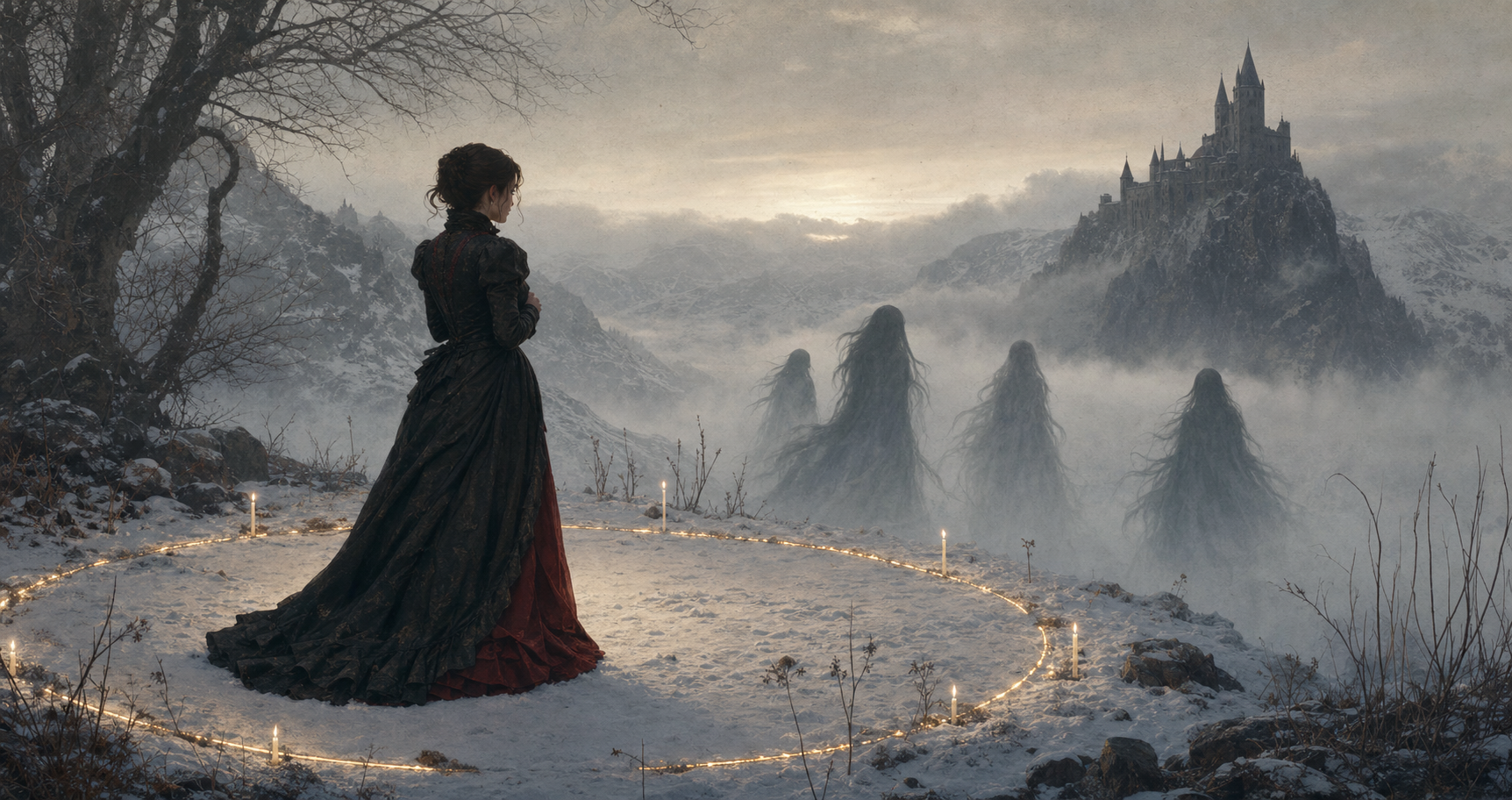
Near Castle Dracula, Van Helsing protects Mina within a sacred circle while the vampire women appear through snow and mist. The scene echoes Harker's earlier temptation by the three women, but the moral arrangement has changed. Mina is vulnerable, yet not alone. Van Helsing's knowledge, sacred ritual, and Mina's own endurance keep the boundary intact.
8. The ending and what it leaves behindThis section contains spoilers.
At sunset, the hunters reach the group carrying Dracula's box toward the castle. Jonathan attacks with his kukri knife while Quincey Morris strikes near the heart. Dracula's body crumbles into dust, and the mark on Mina's forehead disappears.
Quincey dies from his wounds. His death keeps the ending from becoming clean triumph. Lucy, Renfield, and Quincey are gone. The victory has cost lives. Yet Mina is released, and Dracula's chain of predation is broken.
The final note, set years later, shows Jonathan and Mina with a son named after Quincey. The surviving group looks back on the documents. Strikingly, they do not possess courtroom-perfect proof. What remains is a set of typescripts and shared testimony. That might seem weak, but it is also the novel's deepest claim. The truth of their experience survives because they recorded it together and trusted one another's records.
The ending therefore belongs to the archive as much as to the stake and knife. Dracula begins as a darkness no one can fully explain. He ends as a pattern made visible through documents, memory, sacrifice, and collective interpretation.
Major Characters
Count Dracula
Ancient predator inside modern systems
Dracula is an old aristocratic power who studies modern England carefully. He is not frightening only because he is supernatural. He is frightening because he can adapt: he uses real estate, shipping, language study, and urban anonymity.
His violence is possessive. Blood lets him feed, dominate, contaminate, and bind others to him. He turns intimacy into control and death into continued ownership.
Mina Harker
Compiler, strategist, and moral center
Mina turns scattered records into a usable archive. Her typing, organizing, and interpretive work make the hunt possible.
After Dracula attacks her, she remains both endangered and essential. The novel's strongest resistance comes from refusing to treat her only as a victim.
Jonathan Harker
Witness, captive, and returning hunter
Jonathan begins as a practical legal clerk and becomes the first witness to Dracula's true nature. His journal preserves a truth he can barely admit to himself.
By the end, he returns toward the castle not as a trapped guest but as a hunter trying to save Mina and finish the story that began with his captivity.
Lucy Westenra
Beloved victim and Gothic transformation
Lucy is warm, loved, and socially radiant before Dracula's attacks. Her decline turns private affection into communal crisis.
As the Un-Dead, she forces the group to confront the difference between memory and present danger. Her second death is one of the novel's most painful acts of mercy.
Van Helsing
Teacher of expanded evidence
Van Helsing combines medical training, folklore, faith, and intellectual humility. He asks the others not to abandon reason, but to keep reason open when the facts become strange.
His leadership matters because he can translate impossible events into rules the group can act on.
Seward, Arthur, Quincey, and Renfield
Observation, grief, sacrifice, and warning
Seward records and doubts; Arthur grieves and acts; Quincey gives the final sacrifice. Each man contributes a different kind of loyalty.
Renfield mirrors Dracula's hunger in miniature. His desire to consume lives shows the vampire logic before the group fully understands it.
Best Quotes
Listen to them--the children of the night. What music they make!
Dracula hears wolves as kinship and music. The line is chilling because it turns a human fear signal into pleasure, revealing how alien his emotional world is.
We are in Transylvania; and Transylvania is not England.
The sentence marks more than geography. It signals that English assumptions about law, reason, hospitality, and safety will not be enough in Dracula's world.
The blood is the life!
Renfield's repeated phrase compresses the novel's central symbol. Blood means life, appetite, control, contamination, and spiritual danger.
There are darknesses in life, and there are lights; you are one of the lights.
Van Helsing's praise of Mina is not only sentimental. Mina becomes one of the novel's lights because she makes truth visible through care, intelligence, and records.
We learn from failure, not from success!
The vampire hunt is built from mistakes. The group fails Lucy, misreads Renfield, excludes Mina, and then learns enough from those failures to change tactics.
Major Themes
Archive
Records Make Fear Legible
Journals, letters, logs, telegrams, and typescripts turn private terror into shared evidence. The novel's form is one of its weapons.
Blood
Life Becomes Control
Blood is never merely physical. It carries intimacy, contamination, inheritance, appetite, domination, sacrifice, and rescue.
Modernity
Ancient Evil Uses Modern Routes
Dracula is old, but he travels through shipping, property law, railways, newspapers, and urban networks. The modern world helps spread the Gothic threat before it helps defeat it.
Gender
Protection Can Become Exclusion
Mina's role exposes the danger of treating women as too pure or fragile for knowledge. The hunt succeeds when her intelligence returns to the center.
Bram Stoker and the Gothic at the End of the Century
Bram Stoker was an Irish writer and theater manager, and Dracula often feels theatrical: doors, thresholds, entrances, dramatic revelations, staged confrontations, and highly visual settings. Yet its structure is also modern and documentary. The novel's terror depends on both atmosphere and paperwork.
Published in 1897, the book belongs to a late-Victorian world preoccupied with science, empire, degeneration, sexuality, technology, and foreignness. Dracula can be read as an outside invader, but he also reveals anxieties already inside English modernity. He does not defeat modern systems from the outside; he studies them and uses them.
That is why the novel remains stronger than many simplified vampire retellings. The famous monster is there, but the deeper drama is epistemological: how do people know what is true when the truth first looks impossible?
Why It Still Matters
Dracula still works because it understands fear as an information problem. Something is happening. The witnesses do not have the same facts. The facts do not fit the available categories. Some people are tempted to protect others by withholding knowledge. The crisis worsens until records are shared.
That makes the novel unexpectedly modern. In an age of fragmented information, Dracula argues for careful documentation, cross-checking, trust, and collective interpretation. The monster thrives in secrecy. The archive makes him visible.
FAQ: Summary, Ending, and Symbols
What is Dracula about?
Dracula is about Count Dracula's attempt to move from Transylvania into England and prey on Lucy Westenra and Mina Harker. A group led by Van Helsing gathers documents and evidence, tracks Dracula's boxes of earth, and hunts him back toward his castle.
Why is Mina Harker important?
Mina is the novel's organizer of knowledge. She types, gathers, and arranges the documents that reveal Dracula's pattern. After Dracula attacks her, she also becomes a dangerous but crucial source of information through her connection to him.
What does blood symbolize in Dracula?
Blood symbolizes life, intimacy, contamination, domination, sacrifice, and spiritual danger. Dracula's bite is frightening because it is not only injury; it is a violation of bodily and moral boundaries.
Read Next
Read Frankenstein for another Gothic classic about creation and responsibility, Dr. Jekyll and Mr. Hyde for a later story of divided identity, and Carmilla for an earlier vampire narrative that helps place Stoker's novel in context.
Adaptations
- Nosferatu (1922): an unauthorized but historically crucial transformation of the Dracula story.
- Dracula (1931): helped define the aristocratic vampire image through Bela Lugosi's performance.
- Later film, television, comics, and games: often emphasize the Count's seduction and Gothic style more than the novel's documentary structure.