The Blue Castle — Valancy Stirling and the Courage to Live
A detailed guide to L. M. Montgomery's adult novel about fear, family control, self-invention, Muskoka freedom, and the difference between safety and life.
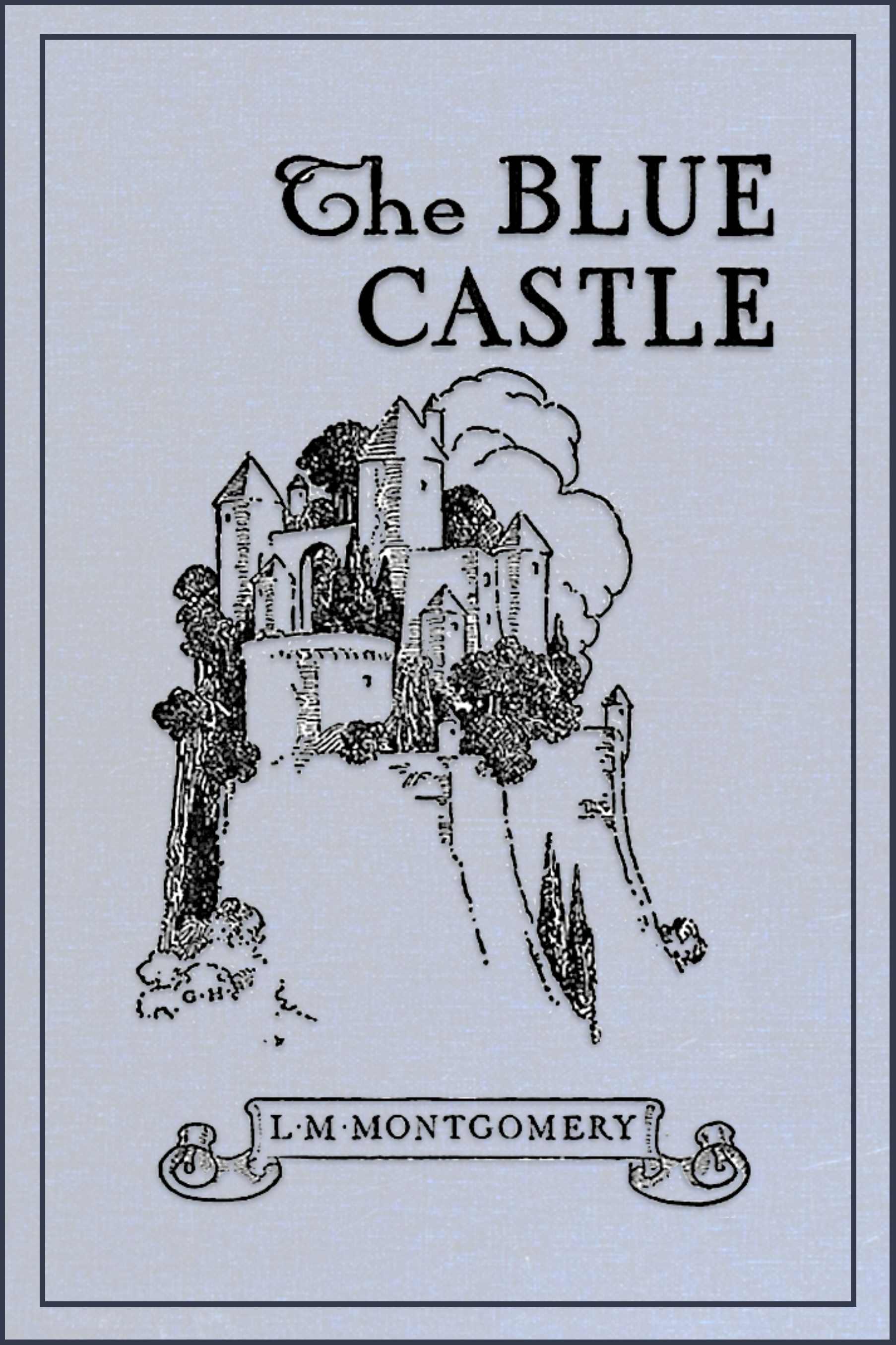
Sua's Quick Take
The Blue Castle begins with a woman who has never been allowed to want anything aloud. Then a medical letter tells Valancy Stirling she may have only a year left, and the whole novel asks a sharp question: if fear has been your real prison, what counts as escape?
What the Book Is Really About
L. M. Montgomery is best known for Anne of Green Gables, but The Blue Castle is darker, funnier, and more adult in its pressure points. Valancy is twenty-nine, unmarried, poor, and treated by the Stirling clan as a useful embarrassment. She is not physically locked up, yet her mother, cousins, aunts, uncles, and social rules have made her life feel smaller than a room.
The title names Valancy's private fantasy. In her mind, the Blue Castle is a beautiful imagined place where she is loved, brave, admired, and free. In real life she lives in a drab house on Elm Street in Deerwood, Ontario, where every preference is corrected and every pleasure is suspected. The novel's movement is not simply from spinsterhood to marriage. It is from internal exile to a life she can claim without apology.
Plot Summary
1. A rainy birthday and a life built on fear
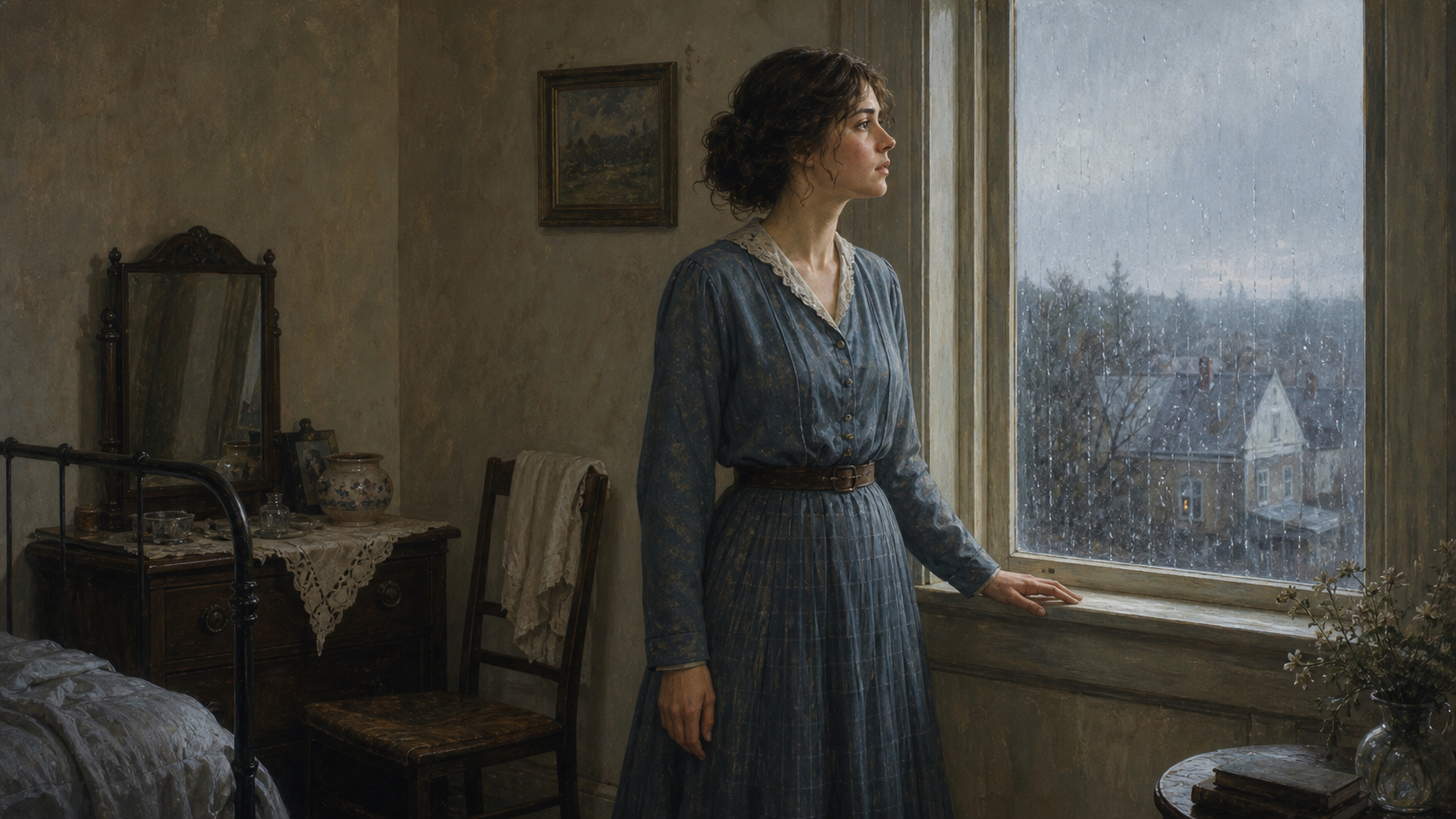
The novel opens on a rainy May morning. Valancy Stirling wakes up on her twenty-ninth birthday and realizes that nothing in her life has become what she once secretly hoped it might become. The rain has cancelled Aunt Wellington's picnic, which saves Valancy from another public comparison with her beautiful cousin Olive, but it cannot save her from the deeper fact: Deerwood already regards her as a hopeless old maid.
Valancy's home life is a system of small humiliations. Her mother, Mrs. Frederick Stirling, treats obedience as virtue. Cousin Stickles hovers with nervous sympathy that often becomes another form of control. The wider Stirling clan values propriety, money, reputation, and family authority more than tenderness. Valancy has been trained not to persist, not to contradict, not to make a scene, and not to want anything that might inconvenience the family.
That is why her fantasy of the Blue Castle matters. It is not childish decoration; it is psychic survival. In her Blue Castle she has rooms that are beautiful, lovers who choose her, and a self who is not mocked before she speaks. The fantasy is both escape and indictment. If the imagined castle feels more real than her real home, the real home has already failed her.
2. John Foster, Dr. Trent, and the letter that changes everything
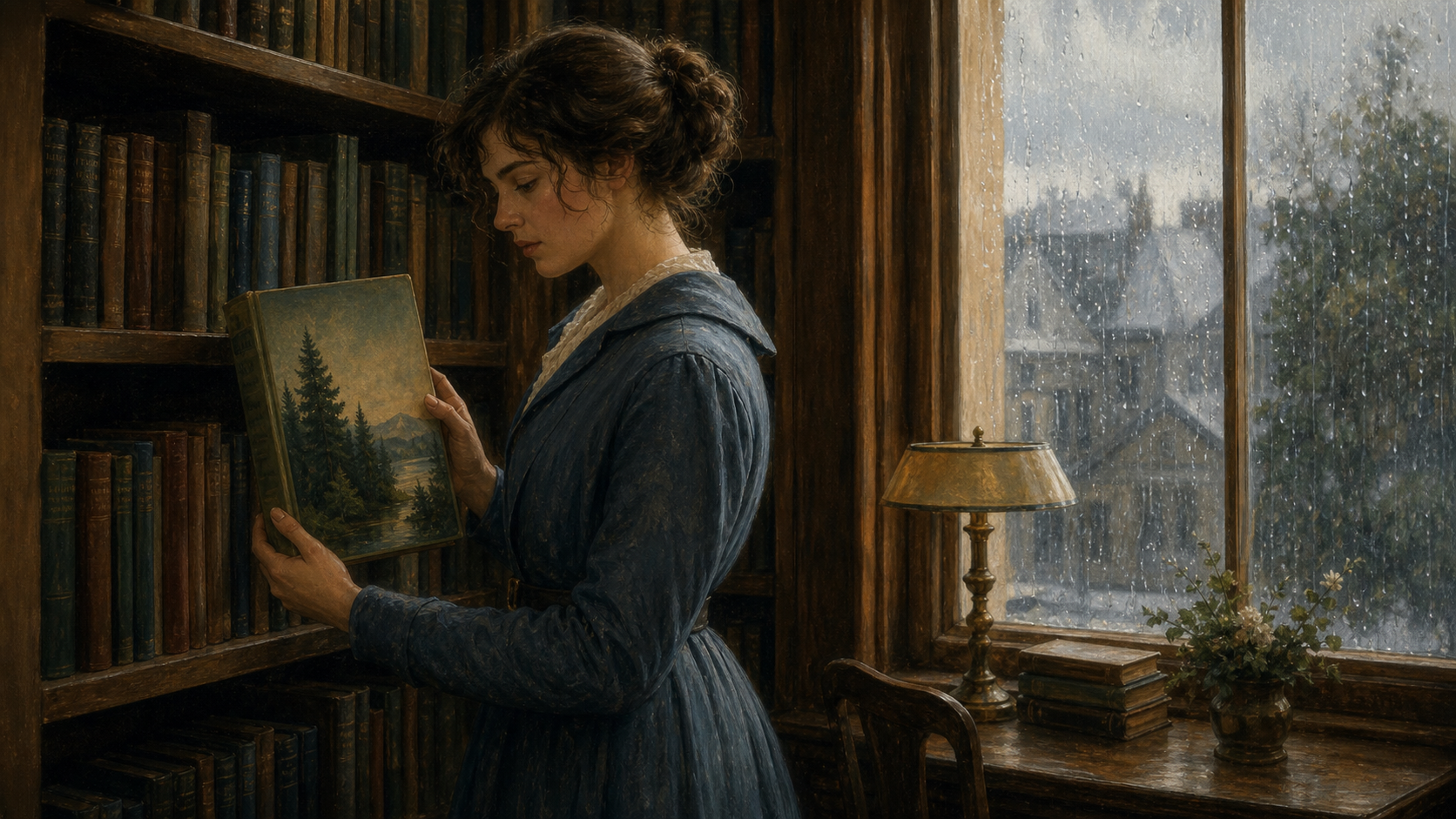
Valancy's one permitted delight is reading the nature books of John Foster. The family approves them because they are not novels, but Valancy receives them like secret invitations to a larger world. Foster's writing about woods, birds, wind, and hidden life gives her language for a freedom she has never touched.
Her body also begins to frighten her. She has pains around the heart, palpitations, dizziness, and shortness of breath. Because the Stirling family would turn illness into fuss, surveillance, and advice, Valancy secretly visits Dr. Trent. He examines her but is called away before speaking clearly. Later, a blunt letter arrives: she has a fatal heart condition, must avoid exertion and excitement, and may live a year, or may die at any moment.
The diagnosis is terrifying, but it also changes the moral weather. Valancy has spent nearly three decades obeying people who made her miserable. If she is going to die soon, their approval no longer has the same force. The letter does not make her reckless in a shallow way. It reveals how much of her life has been governed by fear rather than love.
3. Truth-telling at the Stirling table
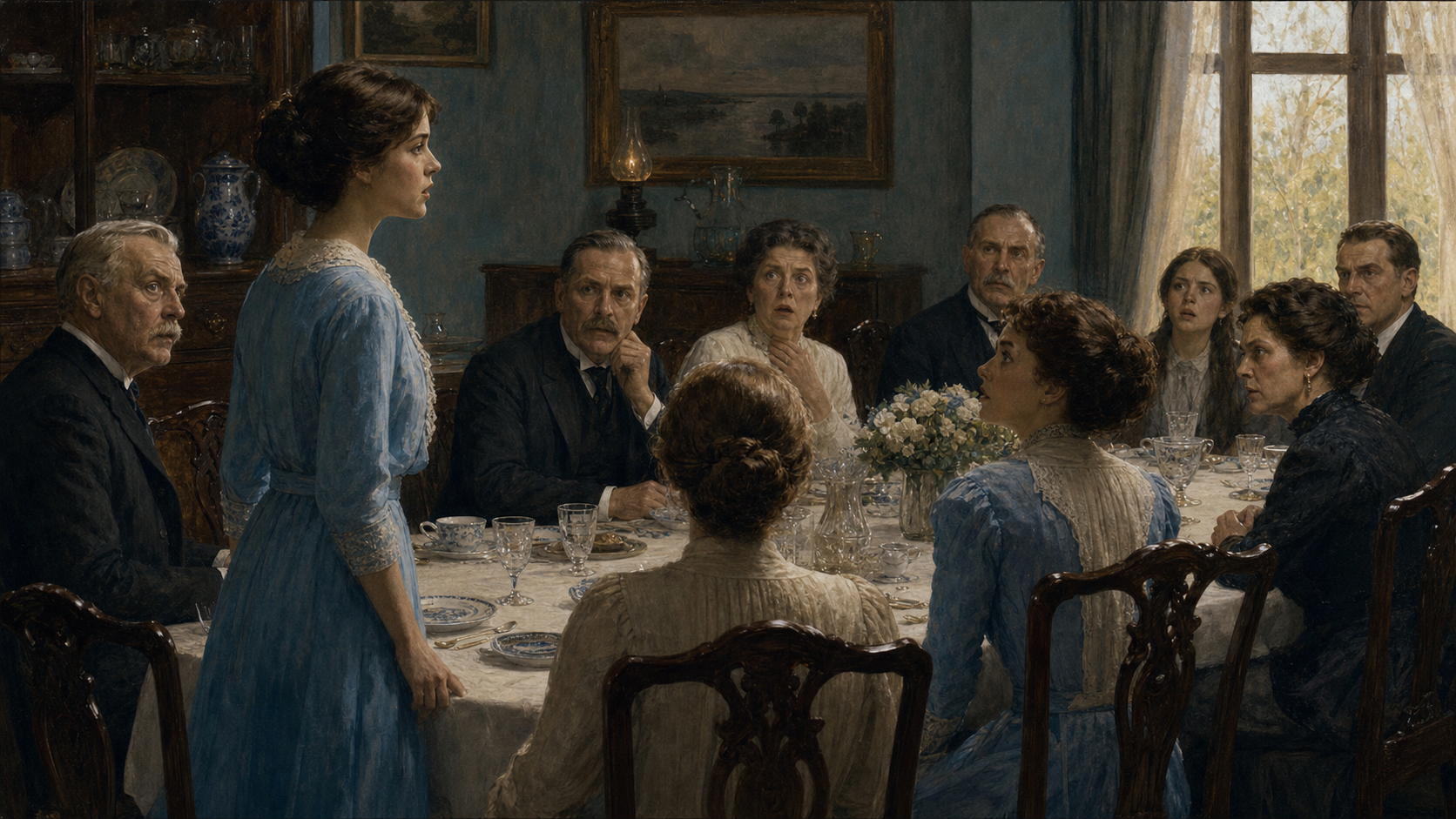
Valancy's first rebellion is speech. She begins telling the truth at family gatherings, and Montgomery turns the scenes into social comedy with real bite. Valancy does not suddenly become cruel. She simply stops protecting everyone else's comfort at the cost of her own silence.
The Stirlings are shocked because they have always mistaken compliance for character. When Valancy says what she thinks about Olive, Uncle Benjamin's jokes, family vanity, or her own lack of affection for their rituals, the clan treats honesty as scandal. In their world, the worst thing is not to be unkind; it is to make hidden unkindness visible.
These scenes matter because Valancy's freedom begins before romance. She does not need Barney Snaith to give her a self. She starts by withdrawing the automatic obedience that made the old system work. Her voice becomes the first door out of the house.
4. Cissy Gay, Roaring Abel, and the ethics of disgrace
The second major break comes through Cissy Gay. Cissy, once a delicate young woman in Deerwood's social circle, has been ruined by scandal, isolated, and left to die in the rough house of her father, Roaring Abel. The respectable community pities her in theory while avoiding the actual work of companionship.
Valancy decides to move into Abel's house, keep house for him, and nurse Cissy. This decision horrifies the Stirlings more than almost anything she has said. To them, Cissy's disgrace is contagious. To Valancy, Cissy is a human being who should not die alone.
This is one of the novel's strongest ethical turns. Valancy's rebellion is not only personal self-expression. It becomes care. She chooses a socially dangerous house because it contains a suffering person. In doing so, she discovers usefulness, friendship, bodily work, and a new kind of happiness. She can cook, clean, sit on the verandah, read aloud, and be needed. The world becomes larger because she has stopped asking respectable people for permission to be kind.
5. Barney Snaith and the island life
At Abel's, Valancy comes to know Barney Snaith, the local mystery man surrounded by absurd rumors. The Stirlings and Deerwood society imagine him as criminal, immoral, and dangerous. The actual Barney is independent, educated, funny, protective of Cissy, and uninterested in proving himself to people who have already decided he is disreputable.
After Cissy dies, Valancy asks Barney to marry her. She tells him about Dr. Trent's letter and admits that she wants to live her remaining time rather than return to Deerwood. Barney is careful to clarify that he is not romantically in love with her, but he respects her honesty and agrees. Their marriage begins as a practical, compassionate arrangement.
The island on Lake Mistawis becomes the real Blue Castle. Its cottage is small, but it gives Valancy sunrise, sunset, water, cats, work, conversation, and a home not ruled by relatives. Montgomery is very good at making domestic detail feel spiritual. A room where one can see both sunrise and sunset becomes more valuable than any fantasy palace because it belongs to Valancy's actual life.

6. Love, secrecy, and the real test of freedom
Valancy and Barney's companionship deepens. They talk, canoe, explore, keep house, and share a life that feels playful and equal. Valancy believes the time is temporary, so she does not demand conventional assurances. Barney, who has his own hidden history, also lives under a chosen name. The marriage becomes honest in daily practice while remaining surrounded by concealed facts.
The novel then tightens the plot through discovery and accident. Valancy learns that Barney is actually Bernard Redfern, the estranged son of a wealthy man and the writer behind the name John Foster. She also narrowly escapes death in a railway accident, which makes her doubt Dr. Trent's diagnosis. If she was healthy enough to survive such shock, perhaps the fatal letter was wrong.
7. The ending and what it changesThis section contains spoilers.
Valancy returns to Dr. Trent and learns the truth: he accidentally sent her the letter meant for another Miss Sterling. Valancy's condition was pseudo-angina, not fatal heart disease. The revelation should be pure relief, but it first feels like disaster. She believes she has trapped Barney into marriage under false pretenses.
She leaves the island, writes Barney a letter, returns the expensive pearls he gave her, and goes back to her mother's house. The old room feels worse because she now knows another life is possible. Her fear is no longer death but a future in which she has to live without the love and freedom she discovered.
Barney follows her. He explains that he does love her, that her supposed illness was not the only reason he married her, and that her love made him believe again in friendship and trust. The ending resolves the romantic plot, but its deeper satisfaction comes from Valancy's transformation. She returns to the Stirlings no longer as the old Doss, but as someone who has lived beyond their judgment. Marriage does not create her worth; it confirms the life she had already begun to choose.
Major Characters
Valancy Stirling
late-blooming heroine and truth-teller
Valancy begins as a woman trained into fear. Her family calls her Doss, manages her habits, belittles her looks, and treats her unmarried status as a family inconvenience. Yet her inward life remains vivid through the Blue Castle fantasy and John Foster's books.
Her growth is not a makeover plot. She becomes free by speaking truth, choosing care over respectability, and learning that she can build a real life before anyone else grants permission.
Barney Snaith / Bernard Redfern
outsider, naturalist, and hidden writer
Barney appears to Deerwood as a disreputable wanderer. In reality, he is intelligent, wounded, wealthy by birth, and deliberately withdrawn from a world that once made him cynical.
His secret identity as John Foster matters because Valancy has loved his mind before she knows his name. Their marriage works when both stop hiding behind protective stories.
Mrs. Frederick Stirling
domestic authority and social fear
Valancy's mother is not a melodramatic villain; she is more frightening because her control is ordinary. She polices food, letters, rooms, visits, clothing, illness, and reputation.
She represents a form of respectability that calls itself love while denying another person's adult selfhood.
Cissy Gay
disgraced woman and test of compassion
Cissy's story exposes Deerwood's moral hypocrisy. The same community that pities her refuses to visit, care, or risk contamination by association.
Through Cissy, Valancy discovers that freedom is not merely saying no to family. It is saying yes to someone whom respectable people have abandoned.
The Stirling clan
comic chorus of conformity
Uncle Benjamin, Uncle James, Aunt Wellington, Olive, Cousin Stickles, and the rest form a social chorus. Their manners are funny, but their collective pressure has real force.
Montgomery uses them to show how families can turn love, money, religion, and reputation into instruments of fear.
Best Quotes
If it had not rained on a certain May morning Valancy Stirling's whole life would have been entirely different.
The opening sentence turns weather into fate. Montgomery begins with a tiny accident, then shows how a cancelled picnic, a library visit, a doctor's appointment, and a letter can rearrange an entire life.
Fear is the original sin.
John Foster's sentence gives Valancy a moral vocabulary for her prison. The line matters because fear in the novel is not just an emotion; it is a social system.
Every one has a Blue Castle, I think.
Cissy's insight broadens the title. The Blue Castle is not only Valancy's private daydream. It is the human need for a place where the self can be loved without humiliation.
There are so many kinds of loveliness.
Barney's line helps revise Valancy's idea of beauty. The novel moves from social prettiness to a larger kind of loveliness: wild places, honest speech, chosen work, and mutual recognition.
Major Themes
Fear
Fear as a Social Prison
Valancy is controlled less by force than by dread: fear of scenes, criticism, poverty, illness, impropriety, and being unloved. The novel treats fear as the habit that lets oppressive systems keep working.
Freedom
Life Before Permission
Valancy's freedom begins when she stops waiting for approval. Her decisions are imperfect, but they are hers, and that ownership changes the meaning of every room she enters.
Care
Compassion Against Respectability
Cissy's illness exposes the emptiness of public morality without private care. Valancy's move to Abel's house is socially shocking because it is morally serious.
Nature
Muskoka as Real Enchantment
The island, lake, woods, birds, cats, and weather turn nature into more than scenery. Muskoka becomes the place where Valancy's imagined Blue Castle becomes ordinary, livable reality.
Montgomery and the Adult Fairy Tale
L. M. Montgomery published The Blue Castle in 1926, long after creating Anne Shirley. The novel still has Montgomery's gift for landscape, humor, and emotionally vivid inward life, but its heroine is not a child with a future ahead of her. Valancy is an adult who believes the future has already passed her by.
That makes the book an adult fairy tale with a satirical edge. There is a castle, but it is imaginary before it becomes a cottage. There is a prince, but he is also a rumored outcast and a hidden writer. There is a rescue, but Valancy begins it herself by telling the truth and walking out.
The Canadian setting matters. Deerwood's family networks, church respectability, class anxiety, and Muskoka wilderness create the novel's moral geography. The town shrinks Valancy; the lake enlarges her. Montgomery does not simply oppose society and nature, but she makes clear that some social worlds call imprisonment protection.
Why It Still Matters
Valancy's crisis still feels modern because many people are not trapped by dramatic villains. They are trapped by expectations, family scripts, money worries, politeness, health fear, and the terror of disappointing people who have never really seen them.
The book is comforting, but not because it says everything will magically improve. It says that a life can change when a person stops treating fear as wisdom. That is a sharper message than simple optimism.
It also remains useful for study because Montgomery combines romance, satire, illness plot, nature writing, and fairy-tale structure. A strong essay can analyze tone, setting, gender, class, irony, or the difference between fantasy and chosen reality.
FAQ: Summary, Ending, and Study Notes
What is The Blue Castle about?
The Blue Castle follows Valancy Stirling, a repressed twenty-nine-year-old woman in Deerwood, Ontario, who receives a mistaken diagnosis that she may have only a year to live. Believing death is near, she begins telling the truth, leaves her controlling family, cares for the dying Cissy Gay, marries Barney Snaith, and discovers that the life she imagined can become real.
Is The Blue Castle public domain?
The Project Gutenberg edition of The Blue Castle is public domain in the United States. This guide is based on Gutenberg eBook #67979, using Montgomery's original English text rather than any modern adaptation or translation.
Why is the ending important?
The ending reveals that Valancy's fatal diagnosis was a mistake, but the mistake still bought her a real year of life. The point is not that illness was good; it is that fear had been killing her before the letter arrived. Once Barney's love is confirmed, Valancy can live without needing death as an excuse for courage.
Read Next
Read Anne of Green Gables for Montgomery's childhood imagination, A Room with a View for another comedy about social rules and self-knowledge, and Jane Eyre for a more Gothic heroine's search for love without self-erasure.
Adaptation note
- The Blue Castle has not had the same screen afterlife as Anne of Green Gables, which makes the novel especially useful for students who want to argue from text rather than from a dominant adaptation.
- Its strongest media comparison is not a single film version but the broader pattern of late-blooming heroine stories: a woman stops asking permission and discovers that ordinary rooms can become radiant.