Alice's Adventures in Wonderland - The Child Who Keeps Asking
Logic, language, identity, and authority all loosen inside Carroll's dreamlike classic.
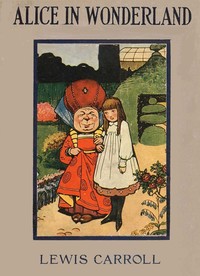
Sua's Quick Take
Alice's Adventures in Wonderland lasts because its nonsense is not random. Lewis Carroll gives a child permission to keep asking questions until the adult world begins to look like the more absurd place.
The book is light, quick, and playful on the surface, but it is built from serious problems: unstable identity, unreliable language, arbitrary authority, bad logic, schoolroom memory, and social rules that often punish curiosity more than confusion. Alice does not conquer Wonderland. She learns to notice when its rules do not deserve obedience.
What the Book Is Really About
Alice's Adventures in Wonderland is a Victorian nonsense fantasy first published in 1865. It is arranged in twelve short chapters: Alice falls down the rabbit hole, struggles with size changes, swims through a pool of tears, joins a caucus-race, meets the Caterpillar, enters the Duchess's chaotic house, talks with the Cheshire Cat, attends the Mad Tea-Party, reaches the Queen's garden, hears the Mock Turtle's story, and finally enters a courtroom where legal procedure has become nonsense.
That episodic shape matters. Alice is not a quest novel where the heroine defeats one central villain or retrieves one magical object. It is a sequence of encounters in which ordinary tools stop working. Size no longer fits space. Memory no longer guarantees identity. Grammar no longer guarantees sense. Manners no longer guarantee kindness. Law no longer guarantees justice.
The book's deeper movement is Alice's education in skepticism. She begins as a curious child trying to apply familiar rules. By the end, she can see that a rule is not automatically meaningful just because someone powerful says it loudly. That is why the novel remains useful for close reading: every comic episode also tests a system of meaning.
Plot Summary
1. The White Rabbit and the fall beneath ordinary life
Alice begins the book in boredom, sitting beside her sister and looking at a book without pictures or conversations. That first detail is important because Carroll immediately connects curiosity with story. Alice wants a world that speaks back to her. When she sees a White Rabbit in a waistcoat take a watch out of its pocket and worry about being late, the impossible enters ordinary life without explanation.
Alice follows almost before she thinks. The action is impulsive, but it is also the beginning of her role as the reader's stand-in. She does not wait for Wonderland to become reasonable. She moves toward mystery, and the novel rewards that curiosity by sending her down the rabbit hole.
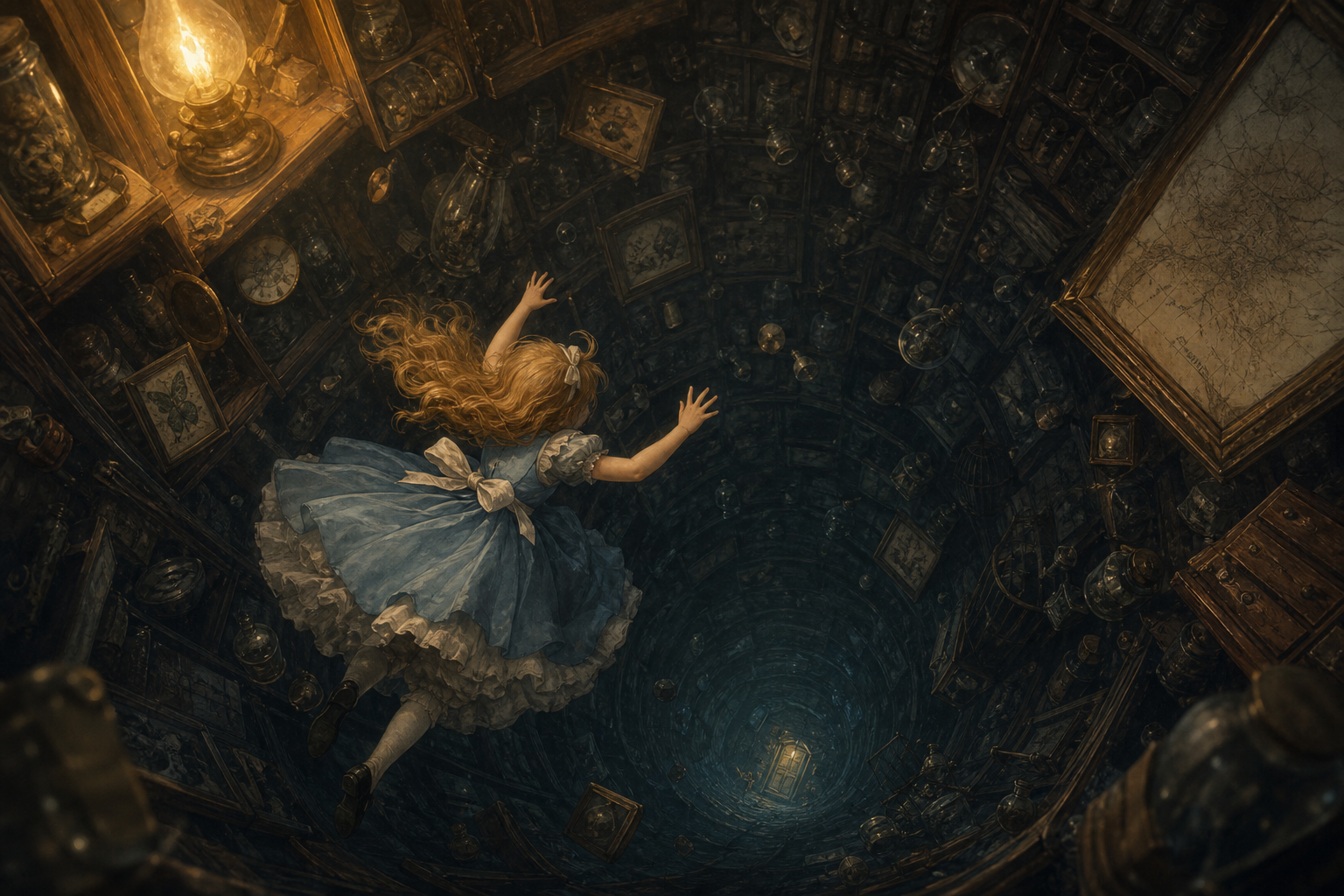
The fall is long enough for Alice to observe it. She passes shelves, maps, jars, and cupboards. She wonders how far she has fallen and whether she might come out on the other side of the earth. The scene is strange because danger has been slowed down into thought. Alice is falling, but she keeps interpreting. That is one of the book's central habits: fear, comedy, and analysis can occupy the same moment.
At the bottom, Alice finds a hallway of locked doors and one small door that opens onto a beautiful garden. The garden looks like a promised destination, but her body does not fit it. The key is on a table; the table is too high when she is small and the door is too small when she is large. A bottle and a cake seem to offer solutions, but every solution creates a new problem.
This opening establishes the whole logic of Wonderland. Alice can see what she wants, but access depends on unstable proportions. Rules exist, but they do not align with need. Objects solve one problem while causing another. The ordinary idea that effort plus intelligence will lead to progress is immediately complicated.
2. Size changes, tears, and the unstable self
After drinking from the bottle, Alice shrinks; after eating the cake, she grows. These changes are comic because they are exaggerated, but they also capture a child's unstable relation to the adult world. A child may feel too small to reach what matters, then suddenly too large for the space allowed. Alice remains Alice, yet the world keeps making her body feel wrong.
The size changes affect her sense of identity. Alice tries to test herself by reciting lessons and poems, but the words come out incorrectly. She wonders whether she has been changed into another child. Carroll makes identity practical before it becomes philosophical. Alice is not asking an abstract question in a quiet classroom. She is asking who she is because her body, memory, and knowledge no longer agree.
Her crying becomes a literal pool of tears. This is one of the novel's strongest dream images: emotion becomes environment. Alice does not merely feel overwhelmed; she must swim through the physical consequence of her own distress. The joke is gentle, but the idea is sharp. Feelings shape the world in which the child must move.
In the pool, Alice meets the Mouse and several other wet creatures. Their problem is simple: they need to get dry. Their solution is comic: the Mouse begins a "dry" historical lecture, as if the word dry in one context could produce dryness in another. The pun is funny, but it also shows how language can fail when it is treated mechanically.
The caucus-race continues that satire. The animals run in circles with no clear beginning or end, and everyone is declared a winner. At first, this sounds fair and cheerful. But the scene also empties procedure of meaning. A race without measurable direction cannot really decide anything. Carroll is already mocking systems that look official while producing no rational result.
Alice is not flawless here. She keeps mentioning her cat Dinah, which terrifies the other animals. Her politeness sometimes fails because she does not understand the social world around her. Still, she is attentive. She notices when a rule does not work, when a word does not mean what it should, and when a group ceremony hides confusion instead of solving it.
3. The Caterpillar, the mushroom, and the problem of saying "I"
The Caterpillar's question - who is Alice? - becomes one of the book's most important moments. In a realistic novel, the answer might be simple. In Wonderland, Alice cannot answer confidently because all the usual evidence has become unreliable. Her height changes, her memory falters, and her school knowledge no longer behaves.
The Caterpillar is not a comforting mentor. He is calm, slow, and irritating. He makes Alice explain herself without offering much help. That matters because Wonderland rarely gives Alice neat guidance. It gives her puzzles, interruptions, and tools she has to test for herself.
The mushroom becomes one of those tools. One side makes her taller; the other side makes her shorter. It does not restore a stable world, but it gives Alice a method of adjustment. She learns to experiment with scale rather than expect permanent certainty. In that sense, the episode quietly changes her competence. She still does not control Wonderland, but she becomes better at surviving its shifting conditions.
The pigeon episode deepens the question of identity. When Alice's neck grows long, a pigeon mistakes her for a serpent and accuses her of threatening eggs. Alice insists she is a little girl, but the pigeon reads her body according to fear. Identity is no longer only what Alice knows about herself. It is also what others think they see.
That tension is one reason the book still feels modern. Alice's selfhood depends on language, body, memory, and recognition, but none of them stays stable. The question "Who am I?" becomes a repeated negotiation rather than a settled fact.
4. The Duchess's house and the Cheshire Cat's direction
The Duchess's house is one of the book's most chaotic domestic spaces. Pepper fills the air, the cook throws dishes, the baby cries, and the Duchess speaks in harsh, moralizing tones. A home should be a place of order and care, but this one turns care into noise. Carroll makes the domestic world as strange as any fantasy kingdom.
The Duchess is important because she keeps forcing morals onto events. She sounds as if every situation must be converted into a lesson, but her lessons do not clarify anything. They decorate confusion. Carroll is mocking a familiar adult habit: using moral language as a performance of wisdom rather than as real understanding.
Alice takes the baby away from the Duchess's house, but the baby turns into a pig. The transformation is comic and disturbing at once. Alice has tried to rescue something vulnerable, but the object of care changes form. Even kindness cannot guarantee a stable result in Wonderland.
Then Alice meets the Cheshire Cat, one of the novel's most memorable figures. The Cat does not give normal directions. When Alice asks which way she ought to go, the Cat asks where she wants to get. That exchange is funny because it is so literal, but it is also serious. Direction only has meaning if a destination has meaning.
The Cat's grin remains after its body disappears. This image condenses the book's logic of unstable signs. A grin usually belongs to a face; here, expression outlasts the thing that should contain it. Meaning detaches from structure. Alice must keep learning that what appears obvious may not be secure.
5. The Mad Tea-Party and the exhaustion of failed conversation
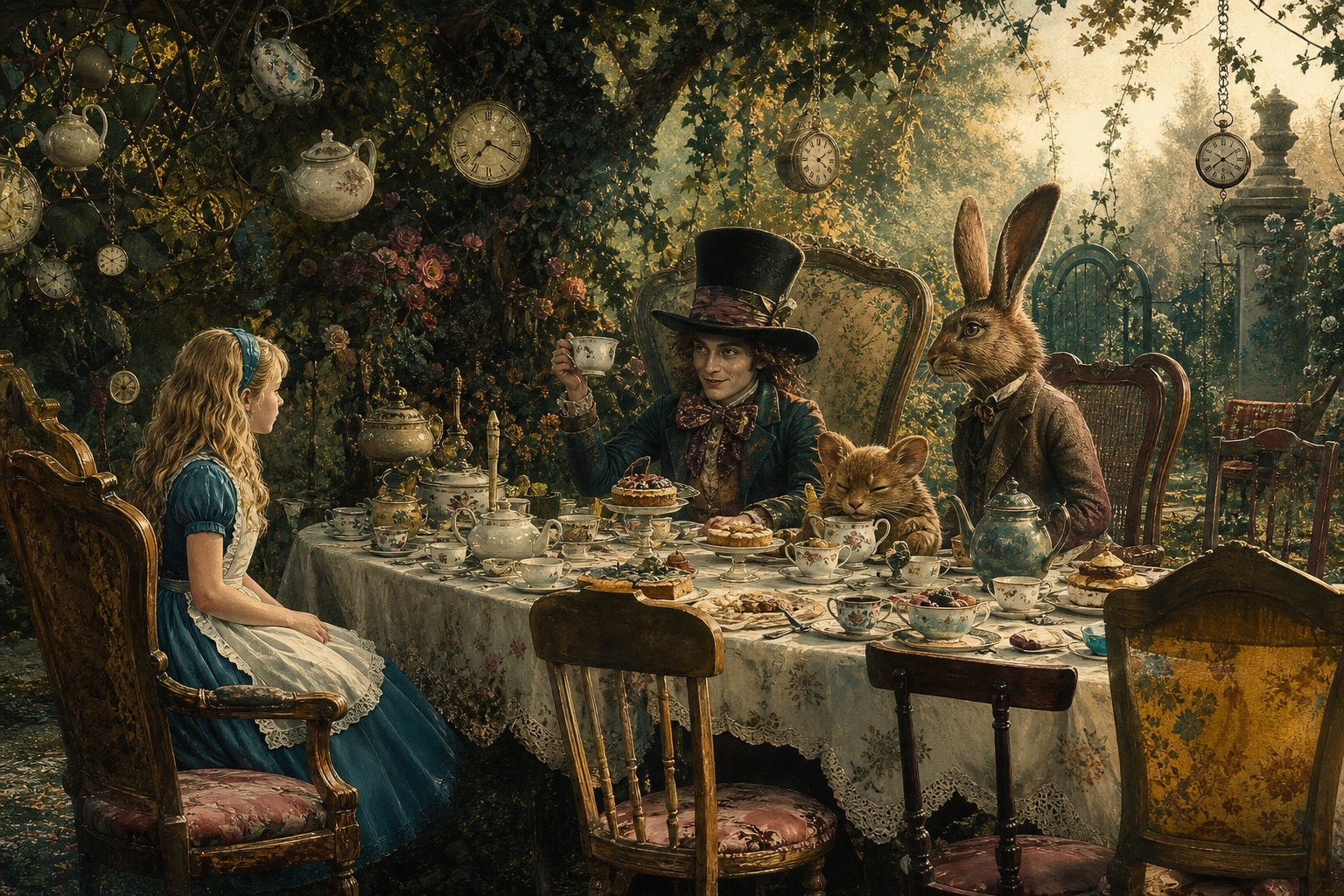
The tea party is one of the richest scenes in the novel because almost nothing "happens" in the ordinary plot sense, yet everything about language breaks down. Alice sits with the Hatter, the March Hare, and the Dormouse. They ask riddles, change topics, accuse Alice of rudeness, and refuse to accept responsibility for what their own words mean.
The scene is funny, but it is also exhausting. Alice is not simply missing a joke. She is trying to keep a stable relation between question and answer. The Hatter's famous riddle does not need an answer. The guests move around the table instead of cleaning up. Hospitality becomes exclusion. Manners become a weapon used by people who are themselves rude.
Time is central to the scene. The party is trapped at tea-time because the Hatter has quarreled with Time. Instead of moving through the day, the characters remain stuck in a social ritual that cannot end. Carroll turns time from a background condition into a character-like force. When time stops, conversation, etiquette, and daily order all become absurd.
The Dormouse's story adds another layer of nonsense. It sounds like a tale, but it keeps sliding into puns and impossibilities. Alice interrupts because she wants sense, and the others object because her demand for sense disrupts their game. This is one of the book's repeated conflicts: Alice often becomes rude only because the adults and near-adults around her have made reason impossible.
By leaving the tea party, Alice makes a small but important choice. She does not defeat the Hatter or solve the riddle. She simply refuses to remain in a conversation where words are being used against meaning. That refusal prepares her for the stronger resistance she will show in the trial.
6. The Queen's garden and the performance of power
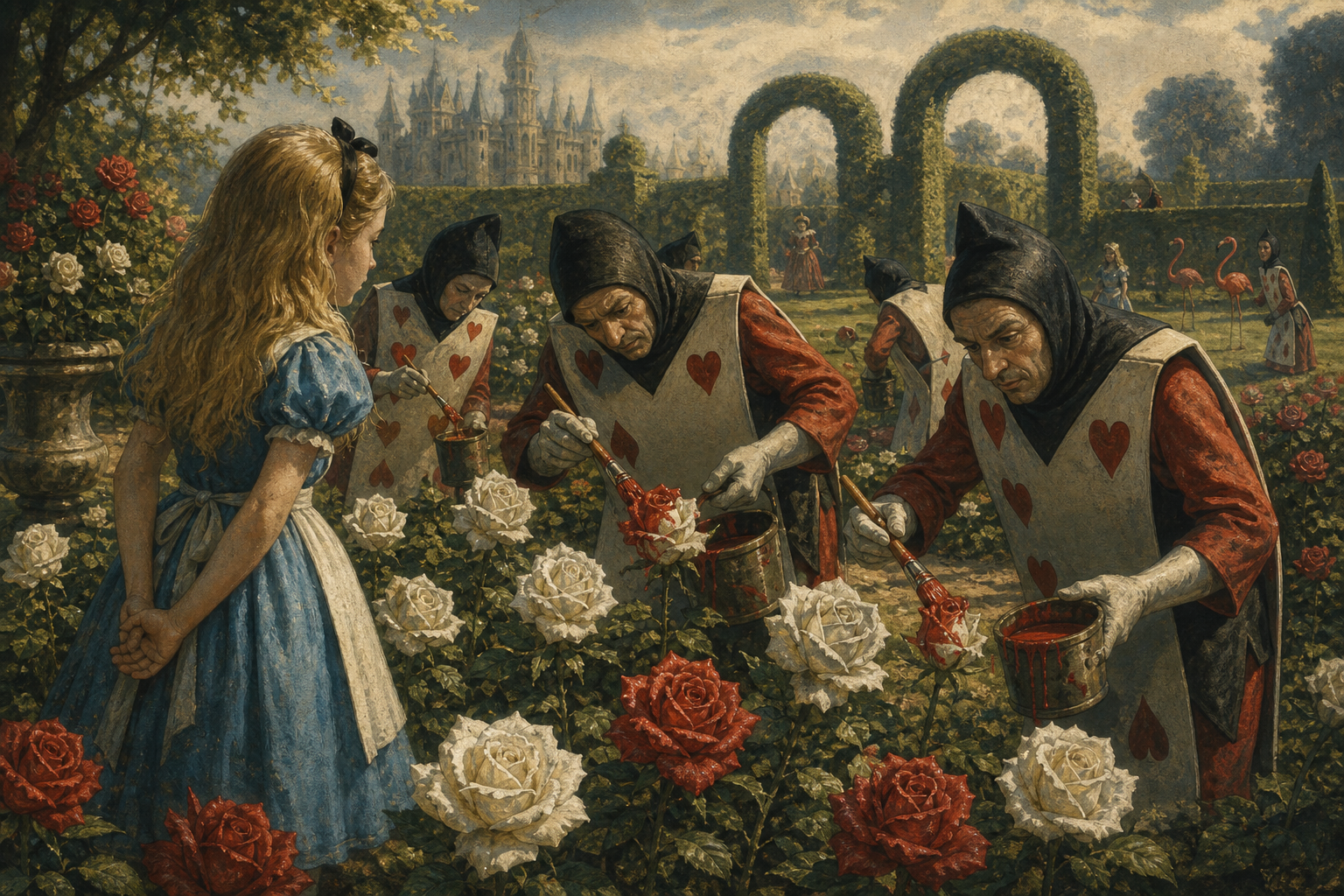
The garden begins with card soldiers painting white roses red because they planted the wrong color. It is a small comic image, but it is politically sharp. Under arbitrary power, truth matters less than the appearance that authority expected. The soldiers do not fix reality; they paint over it.
The Queen of Hearts enters as a figure of pure command. Her repeated demand for executions is frightening because it is violent, but ridiculous because it is so automatic. She does not reason; she declares. Her authority depends on volume, speed, and intimidation.
The croquet game turns institutional order into nonsense. The mallets are flamingos, the balls are hedgehogs, and the arches are living card soldiers. The game has a name and a royal setting, but its materials resist the rules. Carroll makes the institution visible while stripping away its coherence.
Alice is initially nervous, but she begins to see that the Queen's power is partly theatrical. Orders are shouted, but they are not always carried out. Threats are constant, but their force is unstable. The gap between command and reality gives Alice space to think.
The Cheshire Cat's reappearance in the garden complicates the Queen's authority further. A head without a body creates a legal and practical problem: can something be beheaded if it has no body? The joke turns execution into a logical puzzle. Power wants a simple command, but language and form get in its way.
7. The Mock Turtle, schoolroom nonsense, and the road to trial
The Mock Turtle and the Gryphon shift the book toward memories of education. The Mock Turtle describes lessons with punning subject names and melancholy exaggeration. School becomes another system that looks orderly until language begins to slip. The scene works because many readers recognize the shape of schooling even when the details are absurd.
The lobster quadrille, the songs, and the mock lessons may feel like digressions, but they prepare the final movement. The book is moving from private confusion into public institutions. First Alice struggled with her body and memory; now she is approaching law, evidence, testimony, and judgment.
The trial concerns stolen tarts, but the crime matters less than the courtroom. The King acts as judge, the Queen wants punishment, the jury writes down irrelevant details, and the witnesses offer testimony that fails to clarify the case. The form of justice is present, but justice itself is absent.
Alice is growing again as the trial unfolds. On the literal level, her body becomes larger. On the symbolic level, she becomes harder to intimidate. The child who once could not reach a key now sits inside a courtroom and begins to recognize that the court's dignity is hollow.
The trial is the culmination of the book's satire. The caucus-race mocked political procedure, the tea party mocked conversation, and the garden mocked royal authority. The courtroom gathers those problems into one place. Rules, evidence, language, and power all appear, but none of them behaves responsibly.
8. Ending and final meaningThis section contains spoilers.
The trial collapses when the court's nonsense becomes too obvious to frighten Alice. The evidence is absurd, the witnesses do not establish truth, and the King and Queen try to force conclusion before reasoning. When the Queen demands punishment before a verdict, law becomes pure command.
Alice grows until she is no longer afraid of the cards. Her declaration that they are only a pack of cards punctures Wonderland's authority. This is not a physical victory over an enemy. It is a change in perception. Once Alice sees the system as cards, its terror can no longer hold.
She wakes beside her sister, and Wonderland is revealed as a dream. But the dream frame does not make the book meaningless. Dreams allow Carroll to distort ordinary systems so that readers can see them freshly. School, manners, law, monarchy, and language all become strange because Alice has passed through a world where their hidden absurdities are exaggerated.
The ending leaves Alice with no neat moral to memorize. Instead, it leaves her with a sharper instinct for questioning. The final value of Wonderland is not that it teaches one lesson, but that it trains the mind to notice when a lesson, law, or rule is pretending to be wiser than it is.
Major Characters
Alice
questioning child and reader surrogate
Alice is polite, curious, impatient, brave, and often mistaken. She tries to use the lessons, manners, and language she has learned, but Wonderland keeps exposing the limits of those tools. Her intelligence is not that she always understands; it is that she continues to test what she is told.
Her development is subtle. At first, she is overwhelmed by locked doors, changing size, failed memory, and confusing social rules. By the trial, she recognizes that authority can be hollow. Alice's courage comes from perception: she sees when a system is only pretending to make sense.
The White Rabbit
anxious guide into the dream
The White Rabbit introduces time pressure, social urgency, and adult nervousness. He is not a wise guide who explains Wonderland. He is a signal that something official, late, and hidden is already in motion.
His importance lies in rhythm. Alice follows his anxiety before she understands it, and that response begins the adventure. The Rabbit also shows how Wonderland often dresses disorder in the costume of business: watches, gloves, fans, messages, and royal duties.
The Cheshire Cat
playful logic and unstable meaning
The Cheshire Cat does not solve Alice's problems. It exposes the assumptions inside her questions. When she asks for direction, it asks about destination. The answer is not comforting, but it is intellectually honest.
The Cat's vanishing body and remaining grin make it one of the book's central symbols. A sign remains after the structure that should contain it disappears. In a novel obsessed with language, that image matters: meaning can be visible, memorable, and still unstable.
The Queen of Hearts
arbitrary authority
The Queen represents power as noise, threat, and performance. Her repeated demand for executions sounds absolute, but the excess of the command makes it comic. She is frightening because she is violent and ridiculous because she is automatic.
Through the Queen, Alice learns that authority is not the same as reason. The Queen's court, garden, and croquet game all look official, but their rules do not create justice or order. The Queen is powerful until Alice stops believing the performance.
The Hatter and the March Hare
conversation without responsibility
The Hatter and the March Hare turn conversation into a loop of riddles, interruptions, accusations, and evasions. They enforce manners while behaving rudely, which makes the tea party both comic and socially uncomfortable.
Their scene shows how speech can become a form of control. If nobody accepts responsibility for meaning, the person asking for clarity can be made to look impolite. Alice's decision to leave is a refusal to remain inside that broken exchange.
Best Quotes
Curiouser and curiouser!
This line captures Alice's defining habit. Confusion does not shut down her mind; it makes her more alert. The odd grammar also makes the sentence perform what Wonderland is doing: ordinary language bends under the pressure of strange experience.
Who in the world am I?
This is the novel's central identity question. Alice asks it because her body, memory, and knowledge no longer agree. The line turns a child's bewilderment into a serious philosophical problem: selfhood depends on more than a name.
We're all mad here.
The Cheshire Cat's statement destabilizes normality. If everyone in Wonderland is mad, madness is not an exception; it is the local rule. The line also pushes readers to ask who gets to define sanity in the first place.
Sentence first--verdict afterwards.
This is the Queen's sharpest satire of authority. Law should move from evidence to judgment to sentence, but she reverses the order. In a few words, justice becomes command, and procedure becomes performance.
Major Themes
Logic
Nonsense as disciplined logic
Carroll's nonsense is not shapeless chaos. It often works by applying a rule too literally, too mechanically, or in the wrong context. That is why the jokes feel playful and rigorous at the same time.
Identity
Body, memory, and selfhood
Alice's size changes make identity physical. She remains herself, yet her body, memory, and social recognition keep shifting. The novel turns selfhood into a repeated question rather than a settled fact.
Language
Wordplay and failed conversation
Puns, riddles, and circular exchanges show language becoming unstable. Words sound meaningful, but their meaning keeps sliding away from use. In Wonderland, speech is both a tool and a trap.
Power
Authority as performance
The Queen, the trial, the caucus-race, and the schoolroom jokes all expose systems that look official without being rational. Carroll makes authority comic by showing how little sense it sometimes contains.
Lewis Carroll and the Victorian Context
Lewis Carroll was a mathematician and logician, and that background matters. The book's nonsense is not careless disorder. It is rule-bending by someone who understood systems. Many jokes work because a rule is moved from one context into another where it becomes absurd.
The novel also belongs to Victorian culture, a world shaped by schooling, manners, class expectations, moral instruction, monarchy, and legal procedure. Carroll does not attack that world through direct political argument. He miniaturizes and distorts it inside a child's dream. School subjects become puns, etiquette becomes hostility, and court procedure becomes nonsense.
Alice's child perspective gives the book its freedom. She is not outside adult culture; she has learned its poems, manners, and lessons. But she has not yet learned to accept every rule as inevitable. That position lets her ask questions that adults often avoid because they have become used to the rituals around them.
The result is a book that can be read by children as adventure and by older readers as satire. It does not become "serious" by abandoning play. Its seriousness comes through play. Carroll shows that comedy can reveal the weak logic inside systems that usually demand respect.
Why It Still Matters
Today, Alice's Adventures in Wonderland feels surprisingly current because readers still live among rules, platforms, rubrics, institutions, and scripts that often ask for obedience before understanding. Alice's habit of questioning is not childish in the negative sense. It is a form of intellectual hygiene.
The book also treats confusion as productive. Alice does not always win arguments, and she is not always right. But she notices contradiction. She hears when language fails. She senses when authority is louder than it is reasonable. Those are serious reading skills, especially for students learning to move from plot summary to interpretation.
For AP Lit, SAT Reading, IB English, and essay writing, Alice is useful because almost every scene rewards close reading. The size changes connect to identity. The tea party connects to language. The Queen's garden connects to power. The trial connects to justice and institutional form. A short fantasy episode can become a strong paragraph when the reader links image, language, and theme.
The novel also resists a single moral. That is part of its lasting power. It does not tell readers exactly what to think. It teaches them how to keep thinking when a world of confident voices is not making sense.
Frequently Asked Questions
What is Alice's Adventures in Wonderland about?
It is about a girl who follows a White Rabbit into a dream world where ordinary rules stop working. Alice grows and shrinks, meets strange figures, attends an impossible tea party, enters the Queen's garden, and finally faces a nonsensical trial. Beneath the episodic plot, the book studies identity, language, logic, and authority.
Why is Alice considered a classic if it is a children's book?
Because it works on more than one level. Children can enjoy the strange adventure, while older readers can study Carroll's experiments with logic, wordplay, education, law, and social manners. The book is simple enough to enter quickly and complex enough to reward repeated reading.
What does the Cheshire Cat represent?
The Cheshire Cat represents playful but serious logic. It does not guide Alice in the usual way. Instead, it changes the terms of her questions and makes her notice the assumptions behind them. Its disappearing body and remaining grin also make it a symbol of unstable meaning.
Is the ending meaningless because it was a dream?
No. The dream frame does not erase the meaning of the experience. It allows Carroll to make ordinary systems strange. When Alice wakes, the events are not real in a literal sense, but they have changed how authority, language, rules, and selfhood appear to her and to the reader.
Read Next
- Through the Looking-Glass: Carroll's later logic games become more chess-like and mirror-based.
- Peter Pan: another fantasy about childhood, imagination, and adult rules.
- The Wonderful Wizard of Oz: useful for comparing dreamlike travel, social satire, and self-discovery.
Adaptations
- Disney's 1951 animated film: rearranges the episodes around visual rhythm, music, and character comedy.
- Tim Burton's 2010 film: gives the material a stronger coming-of-age and battle structure.
- Stage, ballet, and audio versions: useful for comparing how performers handle the Cat, tea party, Queen, and trial.