The Adventures of Sherlock Holmes Study Guide — AP Lit, SAT Reading, Detective Fiction, and Close Reading
A practical guide for AP English Literature, SAT Reading, IB English, and school essays, with key passages, literary devices, practice questions, and thesis work.
This study guide is built for students who need to discuss The Adventures of Sherlock Holmes with textual evidence. If you want the full story-by-story explanation first, start with the main article.
Who This Guide Is For
This guide is for AP English Literature, SAT Reading, IB English, and school essay readers who need to analyze a short-story collection rather than simply memorize case endings. The goal is to explain how Doyle creates meaning through narration, clues, repeated structure, social setting, disguise, and moral resolution.
By the end, you should be able to:
- identify the collection's most testable passages and methods
- explain Watson's narration as a controlled limit on reader knowledge
- connect clues to social themes such as class, gender, work, and domestic power
- build a defensible AP-style thesis about more than one story
- answer SAT-style questions about inference, function, tone, and word choice
1. Quick Review
- Original title: The Adventures of Sherlock Holmes
- Author: Arthur Conan Doyle
- First collected: 1892
- Form: twelve short stories
- Narrator: Dr. John Watson
- Central method: observation before theory, details before dramatic explanation
- Core themes: observation, data, disguise, domestic danger, class performance, gendered vulnerability, private justice
- Common exam angles: Watson's limited narration, clue structure, the social meaning of objects, incomplete justice
One-sentence summary:
Sherlock Holmes solves twelve cases by turning overlooked details into evidence, but Doyle uses those cases to expose the social pressures hidden inside Victorian respectability.
2. Plot Structure for Exams
Recurring Setup
Most stories begin with Watson's memory, Baker Street routine, or the arrival of a strange client. This places readers near Watson: emotionally engaged, observant enough to notice strangeness, but not yet able to organize the facts as Holmes does.
Investigation
Holmes separates testimony from evidence. He listens to the client's story, but he also reads objects, rooms, routes, clothing, handwriting, advertisements, and physical arrangements. The investigation teaches readers that setting and material detail are never neutral.
Reinterpretation
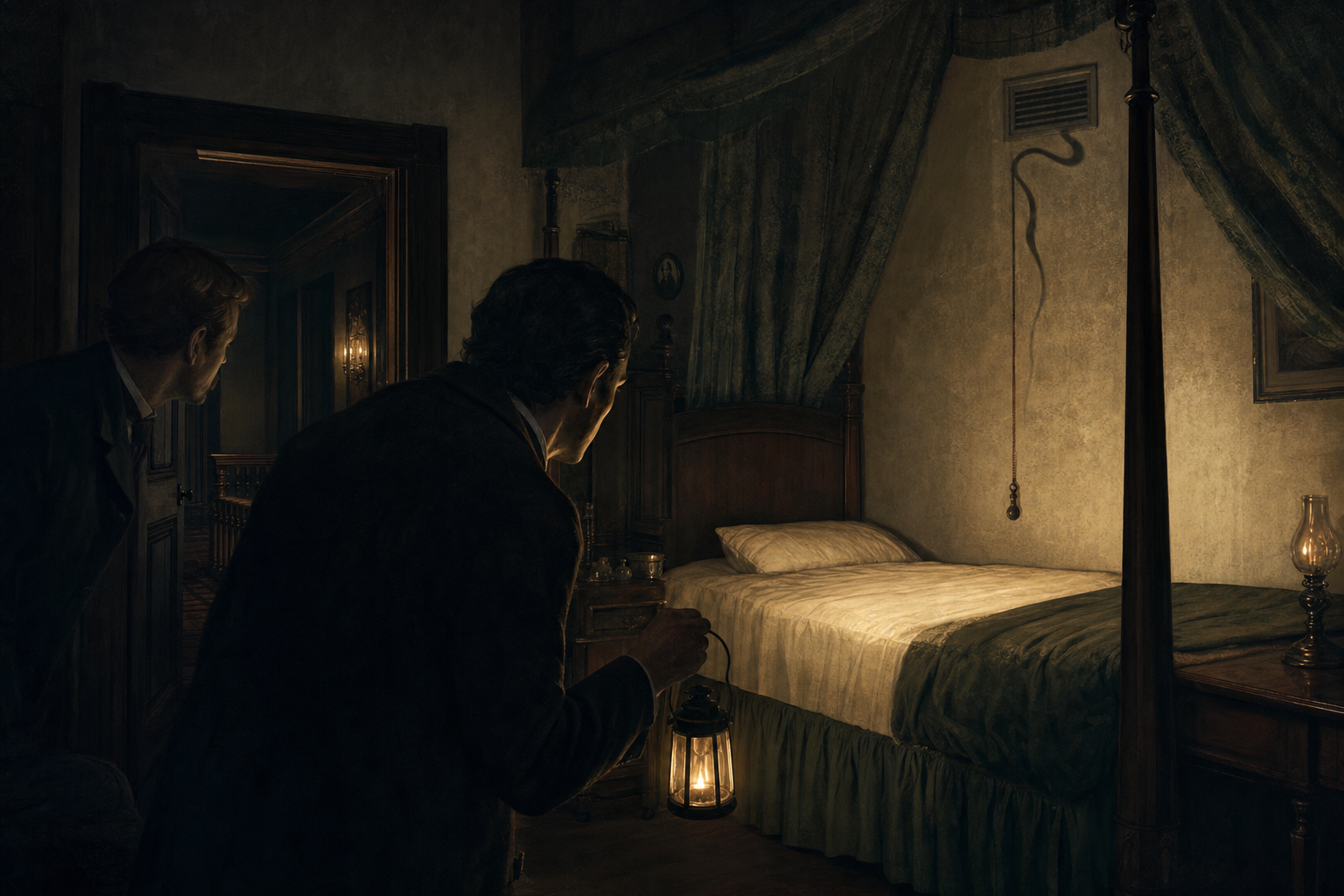
The key reversal usually comes when an odd detail becomes functional. The Red-Headed League is not a joke; it creates absence. The bell-pull in "The Speckled Band" is not decoration; it is part of a murder system. Violet Hunter's hair and dress are not eccentric employer preferences; they make her a visual substitute.
Resolution
Holmes explains the pattern, but justice remains uneven. He saves Helen Stoner and Violet Hunter, fails to save John Openshaw, releases Ryder, and cannot always make legal punishment match moral guilt. That unevenness is essential to sophisticated analysis.
3. Key Original Passages for Close Reading
These passages are not just famous lines. Each one is a compact testing ground for speaker, situation, diction, syntax, tone, and theme. Use them to move from plot summary toward literary argument.
Passage 1: see and observe
You see, but you do not observe. The distinction is clear.
Context: In "A Scandal in Bohemia," Holmes explains the difference between looking at something and registering it as meaningful evidence.
Close reading: The contrast between see and observe defines Holmes's method and Watson's limitation. The sentence turns detection into trained attention.
Essay use: Use it for Watson's narration, reader training, clue structure, and the collection's theory of interpretation.
Passage 2: data before theory
It is a capital mistake to theorise before one has data.
Context: Holmes warns against forming a theory before the case has supplied enough evidence.
Close reading: Capital mistake gives the warning moral and intellectual weight. Data makes Holmes's work sound disciplined, almost scientific.
Essay use: Use it to discuss Holmes's method, the value of delayed interpretation, and the danger of forcing facts into a preferred story.
Passage 3: little things
It has long been an axiom of mine that the little things are infinitely the most important.
Context: In "A Case of Identity," Holmes treats small features of appearance and communication as decisive.
Close reading: Axiom makes the principle sound foundational. The phrase little things turns minor details into the center of detective reading.
Essay use: Use it for objects as evidence: hats, letters, rooms, bell-pulls, footprints, and other details that reorganize the plot.
Passage 4: obvious fact
There is nothing more deceptive than an obvious fact.
Context: In "The Boscombe Valley Mystery," Holmes distrusts the apparently clear case against James McCarthy.
Close reading: The paradox joins obvious and deceptive, warning that easy explanations can become traps.
Essay use: Use it for appearance versus reality, police error, reader misdirection, and the ethics of suspicion.
Passage 5: business to know
My name is Sherlock Holmes. It is my business to know what other people don’t know.
Context: In "The Blue Carbuncle," Holmes names knowledge as his professional identity.
Close reading: Business means occupation, task, and social function. Knowledge is not casual curiosity; it is Holmes's work.
Essay use: Use it for Holmes as a modern professional, the authority of expertise, and the relation between knowledge and power.
Passage 6: violence recoils
Violence does, in truth, recoil upon the violent, and the schemer falls into the pit which he digs for another.
Context: Holmes sums up Roylott's death in "The Speckled Band."
Close reading: Recoil and falls make moral consequence feel physical. The line gives the ending a fable-like symmetry.
Essay use: Use it for moral closure, domestic Gothic, and the satisfaction and limits of poetic justice.
Passage 7: bricks without clay
Data! data! data! I can’t make bricks without clay.
Context: In "The Copper Beeches," Holmes insists that he cannot complete an explanation without more evidence.
Close reading: The repeated Data! dramatizes impatience and method at once. The clay metaphor makes evidence the raw material of interpretation.
Essay use: Use it for the collection's detective method and for arguments about why Holmes delays final explanation.
4. Close Reading Procedure
Step 1: Identify the observer
Ask who sees the clue first: Watson, Holmes, a client, a police officer, or the reader. In these stories, access to the same fact does not mean equal interpretation.
Step 2: Describe the literal detail
Name the object or behavior precisely. Is it a typewritten letter, a fixed bed, a pawnbroker's absence, a goose, a hat, a missing thumb, or a governess's haircut? Vague references to "clues" make weak essays.
Step 3: Ask what the detail does socially
Doyle's objects often reveal social pressure. A letter hides handwriting; a bedroom hides control; a job offer exploits money need; a costume performs class.
Step 4: Track delayed explanation
Holmes often sees the pattern before Watson does, but Doyle delays the explanation to preserve suspense. This delay is a narrative device, not just a plot convenience.
Step 5: Evaluate the ending
Do not stop at "Holmes solves it." Ask whether the victim is saved, the criminal is punished, the social damage is repaired, and whether Holmes's judgment replaces or supports the law.
Worked example: "You see, but you do not observe"
A weak paragraph says the line proves Holmes is smarter than Watson. A stronger paragraph explains how the contrast between seeing and observing trains the reader. Watson and the reader may possess the same visible facts, but Holmes assigns them pattern and weight. Doyle therefore makes detective fiction a lesson in interpretation, not merely a game of guessing.
5. Why Literary Devices Matter
Limited first-person narration
Watson's narration restricts information and creates the gap between fact and interpretation. Readers know enough to feel involved but not enough to solve everything too early.
Clue patterning
Doyle plants details that look incidental until the ending reorganizes them. The pleasure comes from realizing the evidence was present before it was understood.
Disguise and performance
Holmes, Adler, Windibank, St. Clair, and Violet Hunter all show that identity can be staged through voice, clothing, hair, posture, and role.
Red herring
Gypsies, opium dens, strange advertisements, and public scandal often draw attention away from the practical mechanism of the crime.
Domestic Gothic
"The Speckled Band" and "The Copper Beeches" turn homes into threatening spaces where inheritance, gender, and authority produce danger.
Social geography
Baker Street, the City, suburbs, country estates, and railway routes organize the cases. Place is part of evidence.
Dramatic irony
Holmes often understands more than he says. Watson's partial view creates suspense because readers sense withheld meaning.
Moral closure
Some endings offer poetic justice; others expose failure or ambiguity. This variation makes the collection richer than a simple formula.
Cataloguing detail
Holmes's lists of physical traits and objects make detection feel scientific, but they also reveal the assumptions of his culture.
Serial ritual
The repeated pattern of client, puzzle, investigation, and explanation creates the rhythm of magazine detective fiction.
6. Turning Character Analysis into Essay Language
Sherlock Holmes
Method and private judgment
Weak claim: Holmes is smart.
Strong claim: Holmes's intelligence lies in delaying theory until details form a pattern, but his willingness to judge outside the law complicates the collection's idea of justice.
Dr. Watson
Narrative limit and emotional frame
Weak claim: Watson helps Holmes.
Strong claim: Watson's partial understanding lets Doyle turn detection into a reading lesson, because readers share Watson's access to facts without sharing Holmes's disciplined observation.
Irene Adler
Counter-reader
Weak claim: Irene is clever.
Strong claim: Irene Adler matters because she reads Holmes's performance as accurately as he reads others, making the opening story a test of gendered power rather than a simple detective victory.
Helen Stoner
Domestic fear as evidence
Weak claim: Helen is scared.
Strong claim: Helen Stoner's fear becomes credible evidence because Doyle links her testimony to the architecture of the room, exposing domestic authority as a material threat.
7. Thesis Builder for Major Themes
Observation
Attention as Discipline
Weak thesis: Holmes observes well.
Strong thesis: In The Adventures of Sherlock Holmes, observation becomes a moral discipline because the details society overlooks often reveal the people it has failed to protect.
Disguise
Identity as Performance
Weak thesis: Many people wear disguises.
Strong thesis: Doyle uses disguise not merely to surprise readers but to show that Victorian identity depends on readable performances of class, gender, occupation, and respectability.
Home
Domestic Danger
Weak thesis: Some homes are dangerous.
Strong thesis: The collection repeatedly turns domestic interiors into crime scenes, challenging the Victorian ideal of the home as a safe moral refuge.
Justice
Truth Is Not Repair
Weak thesis: Holmes solves crimes.
Strong thesis: Holmes's solutions expose the difference between discovering truth and achieving justice, especially when legal systems cannot punish coercion, prevent harm, or repair trust.
8. SAT Reading Sample
These are SAT-style practice questions, not official College Board questions. Each one is based on a scene, passage, or recurring device in the collection.
Question 1
In the line "You see, but you do not observe," the contrast mainly establishes:
- A. Watson's physical blindness
- B. Holmes's distinction between perception and disciplined attention
- C. the unreliability of all visual evidence
- D. Irene Adler's superiority to the king
Answer: B. Holmes does not mean Watson literally cannot see. He means Watson has not trained himself to select, remember, and interpret visible facts.
Question 2
Holmes's warning against theorising before data most directly criticizes:
- A. scientific vocabulary
- B. newspaper publication
- C. emotional sympathy for clients
- D. conclusions shaped before evidence is gathered
Answer: D. Holmes warns that premature theory twists facts to fit itself. The line does not reject science, newspapers, or sympathy as such.
Question 3
The Red-Headed League's strange copying job functions primarily to:
- A. remove Wilson from his shop while criminals dig below it
- B. test whether Wilson can become a professional writer
- C. help Holmes study encyclopedia style
- D. conceal Irene Adler's photograph
Answer: A. The absurd job creates Wilson's regular absence, giving the criminals time to dig from the pawnbroker's cellar toward the bank.
Question 4
In "A Case of Identity," Hosmer Angel's typewritten letters help reveal:
- A. a publisher's mistake
- B. Mary's lack of imagination
- C. an attempt to hide handwriting and identity
- D. Holmes's dislike of technology
Answer: C. The typewriter conceals handwriting and helps Windibank maintain a false identity.
Question 5
"There is nothing more deceptive than an obvious fact" suggests that obvious facts:
- A. are never true
- B. can stop people from asking better questions
- C. matter only in comic stories
- D. prove the police are always corrupt
Answer: B. An obvious fact can feel so satisfying that investigators stop testing it.
Question 6
The failure to save John Openshaw in "The Five Orange Pips" complicates Holmes by showing that:
- A. he refuses to read letters
- B. Watson invents all the cases
- C. all American references are comic
- D. correct interpretation may arrive too late to prevent harm
Answer: D. Holmes identifies the danger, but timing defeats him. The case limits the fantasy of perfect detection.
Question 7
Neville St. Clair's double life most strongly develops the theme of:
- A. identity as social performance
- B. childhood education
- C. royal marriage
- D. supernatural punishment
Answer: A. St. Clair shifts between respectable husband and professional beggar through costume, setting, and behavior.
Question 8
Holmes's decision to release Ryder in "The Blue Carbuncle" is best read as:
- A. proof that theft is harmless
- B. a rejection of all evidence
- C. an act of private judgment that may be morally debated
- D. a legal requirement in Victorian courts
Answer: C. Holmes's mercy is humane but debatable because Ryder nearly ruined an innocent person.
Question 9
In "The Speckled Band," the fixed bed, false bell-pull, and ventilator are important because they:
- A. decorate an old country house
- B. show Helen dislikes modern furniture
- C. prove Watson designed the room
- D. form a physical system for Roylott's murder plan
Answer: D. The details become meaningful only when read together as a mechanism.
Question 10
The phrase "Violence does, in truth, recoil upon the violent" gives "The Speckled Band" a tone of:
- A. comic misunderstanding
- B. moral consequence
- C. romantic nostalgia
- D. scientific neutrality
Answer: B. The sentence frames Roylott's death as the return of his own violence.
Question 11
Victor Hatherley's injury in "The Engineer's Thumb" emphasizes:
- A. the bodily cost of industrial crime
- B. the safety of secret employment
- C. Holmes's complete control over events
- D. the disappearance of all technology
Answer: A. The case turns machinery and professional labor into physical danger.
Question 12
The missing bride in "The Noble Bachelor" is not primarily a murder victim but:
- A. a detective in disguise
- B. a servant escaping theft charges
- C. a woman returning to a prior emotional bond
- D. a witness to a bank robbery
Answer: C. Hatty leaves because Frank, the man she loved and thought dead, has returned.
Question 13
Arthur Holder's silence in "The Beryl Coronet" mainly shows that silence can indicate:
- A. automatic guilt
- B. protective loyalty and misplaced sacrifice
- C. lack of family feeling
- D. Holmes's narrative absence
Answer: B. Arthur's silence protects Mary, so Holmes must read motive rather than assume guilt.
Question 14
Violet Hunter's role in "The Copper Beeches" is important because she:
- A. ignores every suspicious sign
- B. replaces Watson as permanent narrator
- C. causes the crime for money
- D. observes danger and seeks help before being trapped
Answer: D. Violet's alert reading of her situation begins the investigation before Holmes arrives.
Question 15
Across the collection, Watson's narration usually makes readers:
- A. share limited information before Holmes explains the pattern
- B. know the solution before the client arrives
- C. distrust every event as a dream
- D. ignore the emotional stakes of the cases
Answer: A. Watson gives readers access to facts, but not immediately to Holmes's organizing interpretation.
Question 16
Which detail best supports the idea that domestic spaces can become crime scenes?
- A. Holmes's fondness for concerts
- B. Watson's medical background
- C. the ventilator and fixed bed in Helen Stoner's room
- D. the encyclopedia in the League office
Answer: C. The bedroom's structure becomes part of the murder method, turning home into evidence.
Question 17
The recurring use of disguises suggests that Victorian identity is:
- A. easily read through performance, clothing, voice, and social role
- B. always biologically fixed
- C. unrelated to class
- D. impossible for Holmes to interpret
Answer: A. The stories repeatedly show identity being staged through readable social signs.
Question 18
The collection's magazine-story structure most affects the reading experience by:
- A. eliminating all repetition
- B. creating a recognizable ritual of client, clue, investigation, explanation
- C. preventing Watson from narrating
- D. making every case part of one continuous trial
Answer: B. Repetition becomes ritual, giving readers a familiar path through different social puzzles.
Question 19
When Holmes says he cannot make bricks without clay, the metaphor implies:
- A. deduction requires raw evidentiary material
- B. architecture is the only subject of detection
- C. Watson should become a builder
- D. clients always lie for profit
Answer: A. The clay metaphor presents evidence as the material from which interpretation is built.
Question 20
The best description of Holmes's justice across the collection is that it is:
- A. always identical to court punishment
- B. purely accidental and never reasoned
- C. brilliant at revealing truth but uneven in legal or social repair
- D. unrelated to moral questions
Answer: C. Holmes often reveals truth, but punishment, rescue, and repair remain inconsistent across the stories.
9. AP Lit Essay Questions
Essay Question 1
Analyze how Doyle uses Watson's limited narration to shape suspense and meaning in two or more stories.
Essay Question 2
Discuss how "A Scandal in Bohemia" complicates Holmes's authority through Irene Adler's counter-performance.
Essay Question 3
Choose one object from the collection, such as a hat, bell-pull, photograph, typewritten letter, or goose, and explain how it becomes evidence.
Essay Question 4
Analyze the role of domestic space in "The Speckled Band" and "The Copper Beeches."
Essay Question 5
How does Doyle turn comic absurdity into criminal logic in "The Red-Headed League"?
Essay Question 6
Compare two cases in which disguise reveals anxieties about class or gender.
Essay Question 7
Evaluate Holmes's private judgment in "The Blue Carbuncle." Does the story present mercy as justice, or as an escape from justice?
Essay Question 8
Analyze how delayed interpretation structures reader experience across the collection.
Essay Question 9
Discuss the ethical significance of Holmes's failure in "The Five Orange Pips."
Essay Question 10
How does Doyle use professional expertise, such as medicine, engineering, banking, or detection, to define modern authority?
Essay Question 11
Analyze one female client as an observer rather than a passive victim.
Essay Question 12
Compare the treatment of marriage in "A Case of Identity," "The Noble Bachelor," and "The Copper Beeches."
Essay Question 13
Explain how obviousness functions as a trap in one or more cases.
Essay Question 14
Discuss how the collection uses London and the countryside as different but connected spaces of danger.
Essay Question 15
Analyze the relationship between economic pressure and crime in at least two stories.
Essay Question 16
How does Doyle make Holmes's method appear scientific while keeping the stories dramatic?
Essay Question 17
Choose one story with an incomplete or morally uneasy ending and explain how that ending affects the collection's idea of justice.
Essay Question 18
Analyze how repeated formulas in the collection create pleasure rather than simple predictability.
Essay Question 19
Discuss how material details reveal hidden social relationships.
Essay Question 20
How does The Adventures of Sherlock Holmes help establish conventions later detective fiction inherits or revises?
10. Model Thesis Bank
- Doyle uses Watson's limited narration to make detection feel like a reading lesson: readers possess many of the same facts Watson does, but they must learn why Holmes assigns those facts different weight.
- Irene Adler's success in "A Scandal in Bohemia" matters because it turns the first case into a contest over interpretation, gendered power, and self-protection rather than a simple detective victory.
- In "The Red-Headed League," absurdity is not decoration but camouflage; Doyle makes the ridiculous job logical once readers ask who profits from Wilson's absence.
- "The Speckled Band" transforms a bedroom into a crime mechanism, showing that domestic architecture can encode power, fear, and violence.
- Holmes's mercy in "The Blue Carbuncle" reveals both the appeal and danger of private justice, because his humane reading of Ryder bypasses the innocent man's near-destruction.
- Across the collection, disguise exposes Victorian respectability as a performance maintained through clothes, voice, occupation, and the management of public appearances.
- The failure in "The Five Orange Pips" prevents Holmes from becoming a fantasy of total control and makes timing part of the collection's moral structure.
- Violet Hunter's alertness in "The Copper Beeches" shows that detection often begins before Holmes arrives, when a vulnerable person refuses to dismiss her own observations.
- Doyle's recurring emphasis on data makes Holmes sound scientific, but the stories also show that evidence becomes meaningful only when read inside social context.
- The collection's repeated case structure creates ritual pleasure while allowing each story to test a different anxiety: scandal, money, marriage, domestic danger, professional risk, or failed justice.
- Watson's narrative limitation is not a flaw in the collection but its central teaching device, because his partial perception lets readers experience the difference between seeing a clue and assigning it interpretive value.
- "The Five Orange Pips" disrupts the usual detective-story satisfaction by making Holmes's correct reading arrive too late, thereby separating intellectual success from moral rescue.
- "A Case of Identity" turns romance into coercion by showing how typewritten letters, altered voice, and sentimental promises can become tools for economic confinement.
- In "The Man with the Twisted Lip," St. Clair's double life reveals that class identity depends on public signs that can be manufactured, rented, dirtied, cleaned, and performed.
- "The Beryl Coronet" uses Arthur's silence to challenge the assumption that refusal to speak equals guilt, making interpretation depend on motive rather than surface behavior.
- Doyle's domestic cases show that Victorian homes can hide systems of surveillance and control, so detection requires reading architecture, furniture, and household routines as evidence.
- "The Noble Bachelor" lowers the temperature of mystery in order to expose marriage as a social contract shaped by rank, money, reputation, and prior emotional obligation.
- Holmes's release of Ryder in "The Blue Carbuncle" complicates the collection's ethics because mercy appears generous only if readers overlook the innocent man nearly destroyed by Ryder's theft.
- The collection's repeated movement from bizarre surface to practical motive suggests that eccentric details in detective fiction are rarely ornamental; they are pressure points where social desire becomes visible.
- Across the twelve stories, Doyle makes detection a form of social reading, since clues disclose not only individual guilt but also the class, gender, and economic systems that make deception possible.
11. Academic Vocabulary for Essays
- observation: trained attention that selects and interprets meaningful detail
- inference: a conclusion drawn from evidence rather than stated directly
- red herring: a detail that misdirects readers or investigators
- disguise: a performance that conceals or reshapes identity
- narrative delay: the withholding of explanation to create suspense and interpretation
- domestic Gothic: the use of home and family space as a site of fear or control
- private justice: justice decided by an individual rather than a formal legal system
- social performance: the way class, gender, occupation, and respectability are acted and read
12. Return to the Main Article
Read the full story-by-story guide here: The Adventures of Sherlock Holmes summary and analysis.